I4S 2/2025: The Future of Production with AI, Cobots and Virtual WorldsTechnology needs innovative, value-adding business models
31.03.2025 - von Norbert Gronau
 |

|
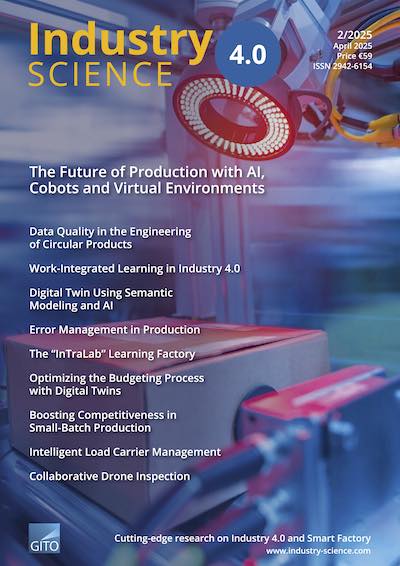
Artificial intelligence, collaborative robotics, and virtual worlds, such as the metaverse, are fueling visions for new forms of industrial value creation. However, innovation alone is not enough—given that these technologies only develop their full potential through intelligent business models. How can companies efficiently integrate AI-supported automation, cobots and digital twins into their processes? What strategies can be used to wrest sustainable competitive advantages from the new technologies? In this issue, we shed light on how smart concepts transform innovations into real added value for companies and make them successful in the long term—whether in the development of recyclable products, the optimization of logistics with AI, or improved small-batch production thanks to collaborative robotics.
All articles at a glance
- Data Quality in the Engineering of Circular Products
Decision support for circular value creation through data ecosystems - Work-Integrated Learning in Industry 4.0
A qualitative analysis of various assistance systems in assembly - Digital Twins Using Semantic Modeling and AI
Self-learning development and simulation of industrial production facilities - Error Management in Production
Current situation and challenges in the industry - The “InTraLab” Learning Factory
Gaining experience and knowledge in digitally transformed work environments - Optimizing the Budgeting Process with Digital Twins
Dashboards and process mining for process-oriented performance measurement - Boosting Competitiveness in Small Batch Production
Scalable and flexible body-in-white production line with collaborative mobile robots - Intelligent Load Carrier Management
AI-supported monitoring and reduction of losses in logistics - Functional Safety and Cyber Security in the Process Industry
A tension between stability and agility - Collaborative Drone Inspection
A new approach to inspection work with AI support - Training in the Industrial Metaverse
Buzzword or opportunity?
Access limited
You are currently not logged in / not yet registered.
In order to download the desired file(s), you must be logged in and have an appropriate inclusive subscription. Alternatively, you can also obtain access by paying a one-off fee.
| Subscription | included | Purchase |
|---|---|---|
| without | − | 59,00 € |
| Digital | − | 56,05 € |
| Expert | − | 53,10 € |
| Professional | ✓ | 0,00 € |
All prices include 7% VAT
After purchasing access rights, you will automatically be redirected back to this page.
You might also be interested in