Branche: Manufacturing

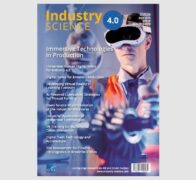
I4S 3/2026: Immersive Technologies in Production

I4S 3/2026: Immersive Technologies in Production

VR, AR, MR, XR: Catalysts for the next industrial revolution?
Immersive technologies are fundamentally transforming manufacturing. VR, AR, MR, and XR merge physical and digital worlds into interactive work environments. In Industry 4.0, they enable more intuitive access to planning, production, maintenance, and training. This issue of Industry 4.0 Science shows how immersive technologies are becoming a central building block of resilient, flexible, and innovative production systems.
AI-Powered Lubrication Strategies for Thread Forming

AI-Powered Lubrication Strategies for Thread Forming

Adaptive spray jet control to increase process reliability and tool life
Reinhard Schmied, Marco Susic, Christian Donhauser ORCID Icon
Thread forming requires precise lubricant application because high contact pressures and process temperatures strongly influence tool loading, friction, and process stability. Although minimum quantity lubrication (MQL) systems are widely used, current spray-based approaches can still suffer from spray losses, insufficient wetting of the thread grooves, and unstable droplet transport. This article presents a concept for adaptive precision lubrication in thread forming based on computational fluid dynamics (CFD)-supported flow analysis, experimental validation, and artificial intelligence (AI)-assisted optimization. The focus is on droplet size, spray jet geometry, nozzle position, ambient flow conditions, and their influence on wetting intensity. Preliminary simulation-based investigations indicate that data-driven optimization can help identify wetting deficiencies and support the development of future control strategies for resource-efficient lubricant application.
Industry 4.0 Science | Volume 42 | 2027 | Edition 3 | Pages 76-83
Optimized Manual Processes in Automotive Production

Optimized Manual Processes in Automotive Production

A module-based approach for the efficient creation of work system simulations
Barbara Brockmann, Tobias Jurk, Beate Stoffels, Jochen Deuse ORCID Icon
In the manufacturing industry, the integration of digital human models into the product development and manufacturing process is becoming increasingly important. Particularly in assembly, which is characterized by a high proportion of manual tasks, motion simulations enable a realistic representation of human work and thus make a significant contribution to the evaluation of motion economy, process validation, and efficiency improvement. However, widespread application in production planning faces various challenges, such as the high initial effort required to create human simulations as well as volatile planning conditions. This article presents a practice-oriented solution from the automotive assembly sector that enables the creation of simulations with reduced effort as well as their early and consistent use in the planning process.
Industry 4.0 Science | Volume 42 | 2026 | Edition 3 | Pages 48-55
Site Assessment for Flexible Intralogistics in Brownfield Sites

Site Assessment for Flexible Intralogistics in Brownfield Sites

Innovative decision support in practice
Jolanda Schierbaum, Carsten Feldmann, Lars Renhof
Due to its dynamic environment, space planning in intralogistics is not a one-time task but a recurring decision-making process subject to numerous constraints imposed by existing infrastructure. Decisions are often based on incomplete data, resulting in a high risk of poor planning decisions and inefficient use of space. This paper presents a practice-oriented process model for space evaluation in brownfield projects. The proposed approach improves the standardization and consistency of space evaluation and promotes best practices among all stakeholders. By supporting systematic decision-making, the process model contributes to optimized planning and resource allocation, thereby reducing risks and avoiding costly implementation errors.The process model is demonstrated through a case study conducted at a commercial vehicle manufacturer.
Industry 4.0 Science | Volume 42 | 2026 | Edition 3 | Pages 124-133
Developing Virtual Reality in Learning Contexts

Developing Virtual Reality in Learning Contexts

Navigating efficiency, content relevance and scalability
Stella Kanatouri ORCID Icon, Oliver Sosna ORCID Icon, Alexander Kulik, Sina C. Truckenbrodt ORCID Icon, Friederike Klan ORCID Icon, Christian Erfurth ORCID Icon
While virtual reality can facilitate hands-on learning, its development faces barriers, including high costs and time demands and scalability challenges. This article presents two case studies that illustrate strategies for overcoming such barriers when training the next generation of skilled workers in environmental technologies. By examining approaches for streamlining development and increasing content relevance and scalability, we highlight lessons learned for future practice. We conclude by envisioning a future in which educational institutions can flexibly and cost-effectively prototype virtual reality in learning contexts, ensuring alignment with curricular goals and learners’ needs.
Industry 4.0 Science | Volume 42 | Edition 3 | Pages 26-34 | DOI 10.30844/I4SE.26.3.3
Industrial Application of Immersive Technologies

Industrial Application of Immersive Technologies

Exploring XR solutions for training, instruction, design review, and assembly planning
Andreas Straube ORCID Icon, Faikar Zakky Haidar ORCID Icon, Matheus Lenzi dos Santos ORCID Icon, Kussai AI Jairoud ORCID Icon, Eduardo Koscianski ORCID Icon
In recent years, the decreasing cost and improved usability of immersive hardware and software have made extended reality (XR) increasingly attractive for industrial applications. Stand-alone systems with inside-out tracking and camera-based pass-through enable accessible mixed reality (MR) solutions. At the same time, emerging no-code software platforms allow engineers to create XR environments without programming expertise, broadening adoption across production settings. This paper explores key industrial application areas of immersive technologies through selected commercially available XR software solutions for product and process training, spatial instructions and guides, collaborative design review, and assembly and production planning.
Industry 4.0 Science | Volume 42 | 2026 | Edition 3 | Pages 38-47 | DOI 10.30844/I4SE.26.3.4
Conducting Experiments in Hybrid Learning Factories

Conducting Experiments in Hybrid Learning Factories

The example of the InTraLab Potsdam
Industrial production is undergoing rapid transformation through digitalization, automation and cyber-physical systems, creating new competence requirements for employees. Learning factories provide experiential environments for developing these competences. This article presents the Industrial Transformation Lab (InTraLab) as a hybrid learning factory combining physical demonstrators and digital simulations.
Learning Factories for the Future of Manufacturing in Brazil

Learning Factories for the Future of Manufacturing in Brazil

Advancing manufacturing through technology and skills development
Manufacturing firms in developing countries face challenges in closing productivity gaps while adopting Industry 4.0 technologies. Learning factories are one helpful approach to countering these challenges. One such example is the learning factory Fábrica do Futuroin São Paulo, Brazil, which has engaged students, supported competence development, and collaborated with industry in applied research, functioning as a hub for advanced manufacturing initiatives.
Industrial Transformation via a Machining Learning Factory

Industrial Transformation via a Machining Learning Factory

A learning module to foster competencies for a sustainability-driven transformation
Oskay Ozen ORCID Icon, Victoria Breidling ORCID Icon, Stefan Seyfried ORCID Icon, Matthias Weigold
Sustainability-enhancing transformation processes are necessary in all sectors if we are to remain within planetary boundaries. This also applies to the industrial sector as a significant emitter of greenhouse gases. Employees need new competencies to master this complex task of industrial transformation. These range from CO2 equivalents accounting to the development and evaluation of transformation scenarios, including technical measures. The learning module developed here addresses these competency requirements and uses the example of the ETA factory to show how a competency-oriented learning module for industrial transformation can be structured. It essentially comprises four phases: data collection and CO2 equivalents accounting, cause analysis, development of measures and evaluation of measures.
Industry 4.0 Science | Volume 42 | Edition 2 | Pages 38-47 | DOI 10.30844/I4SE.26.2.38
Applied AI for Human-Centric Assembly Workplace Design

Applied AI for Human-Centric Assembly Workplace Design

An ethics-informed approach
Tadele Belay Tuli ORCID Icon, Michael Jonek ORCID Icon, Sascha Niethammer, Henning Vogler, Martin Manns ORCID Icon
Artificial intelligence (AI) can enhance smart assembly by predicting human motion and adapting workplace design. Using probabilistic models such as Gaussian Mixture Models (GMMs), AI systems anticipate operator actions to improve coordination with robots. However, these predictive systems raise ethical concerns related to safety, fairness, and privacy under the EU AI Act, which classifies them as high-risk. This paper presents a conceptual method integrating probabilistic motion modeling with ethical evaluation via Z-Inspection®. An industrial case study using the Smart Work Assistant (SWA) demonstrates how multimodal sensing (motion, gaze) and interpretable models enable anticipatory assistance. The approach moves from ethics evaluation to ethics-informed work design, yielding transferable principles and a configurable assessment matrix that supports compliance-by-design in collaborative assembly.
Industry 4.0 Science | Volume 42 | 2026 | Edition 1 | Pages 60-68 | DOI 10.30844/I4SE.26.1.58
1 2 5