The “InTraLab” Learning Factory |
Gaining experience and knowledge in digitally transformed work environments

| Journal | Industry 4.0 Science |
| Issue | Volume 41, Edition 2, Pages 46-51 |
| Bibliography | Share | Cite | Download |
Abstract
Keywords
Article
InTraLab
Learning factories enable simulations of products, processes and resources in an experience-oriented learning environment. These interdisciplinary and multidimensional learning situations support learners in developing the necessary skills through the direct application of learning content. New technologies and associated processes can also be tried out. The possibility of customizing the configuration of practice-oriented learning content to the learners’ experience turns learning factories into a didactic instrument that considers both individual interests and entrepreneurial needs [1, 2].
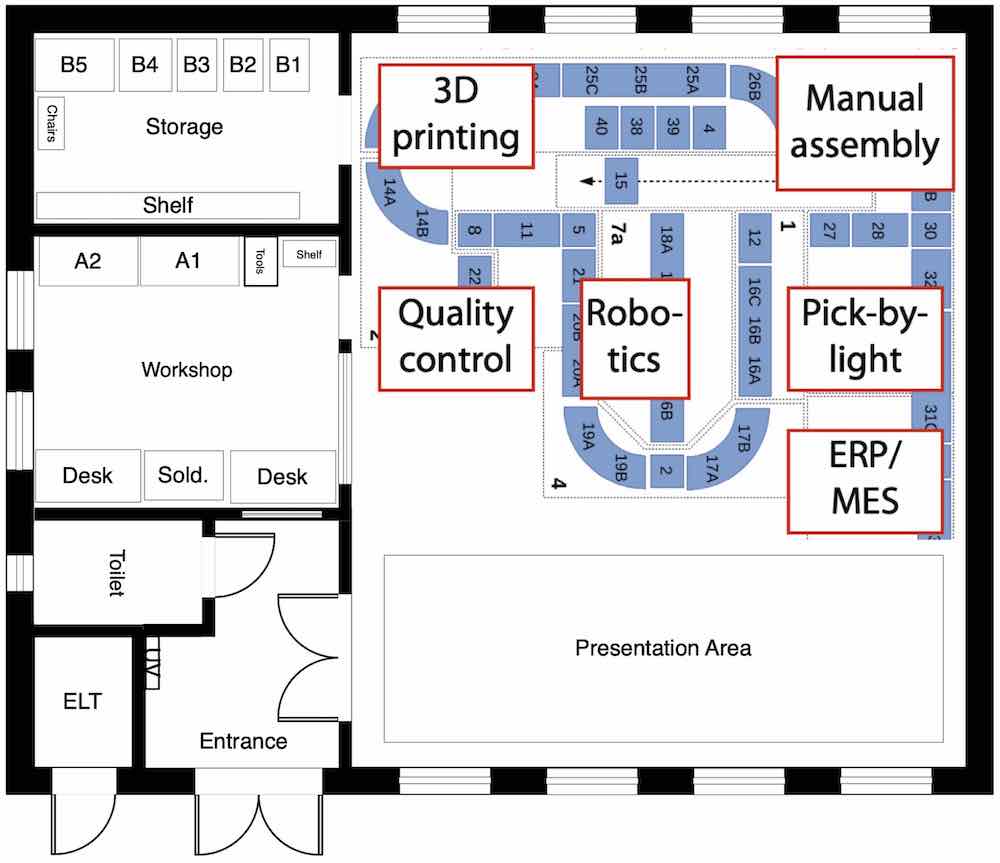
The learning factory in the Industrial Transformation Lab (InTraLab) at the Chair of Business Informatics, esp. Processes and Systems serves as a learning environment where changes in human work can be learned in the midst of digital artifacts (e.g. assistance systems, robots, 3D printing, etc.). Hybrid production processes are modeled and simulated for this purpose. Figure 1 illustrates the floor plan of the InTraLab.
Learning in hybrid simulation environments
The InTraLab simulation environment is based on a hybrid approach to factory modeling, combining a physical model factory with computer-aided simulation. The most suitable form of implementation can be selected for each component of the simulation. This allows the configuration of the necessary production objects (machines, workpiece carriers, etc.) to be flexibly integrated into the desired variant of the production process—regardless of whether they are realized as a physical original, physical model or in virtual form.
This enables the mapping of the required scenario in the model factory. The practical implementation of this hybrid concept is achieved through a combination of physical and virtual models, so-called demonstrators, which represent the central elements of the simulation environment. The interaction of these demonstrators facilitates the representation and simulation of entire production processes [3]. The demonstrators are available in both stationary and mobile versions (Figure 2).
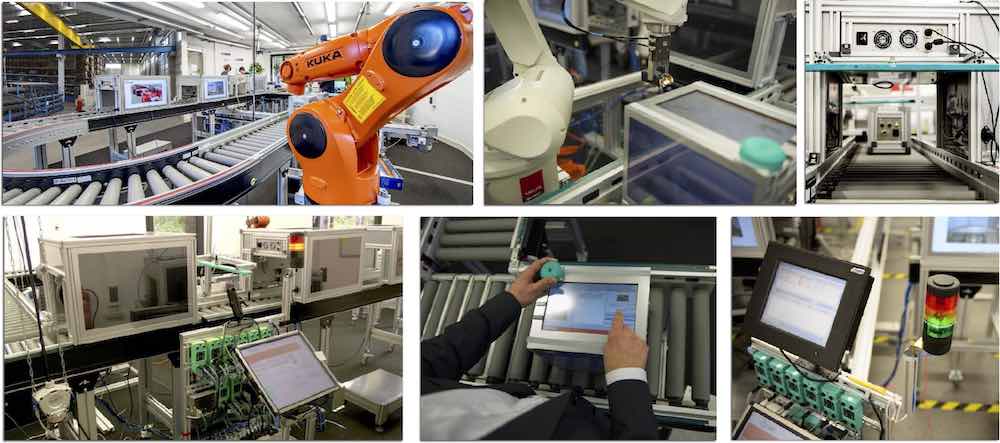
Each demonstrator is a modular unit that configures the parameters of a specific production object in a box. Interface and communication modules allow the demonstrators to interact with other components (e.g. robots) and to be easily expanded, for instance by adding additional sensors (e.g. augmented reality glasses) or actuators (e.g. a fog machine). The machining process is visualized on both the front and back of the demonstrators. The user interface for human-machine interaction is located on top of the demonstrators and provides relevant information about product, process and order [3]. By approximating real production, simulation aids in developing essential skills for digitally transformed work [2, 4].
The didactic concept
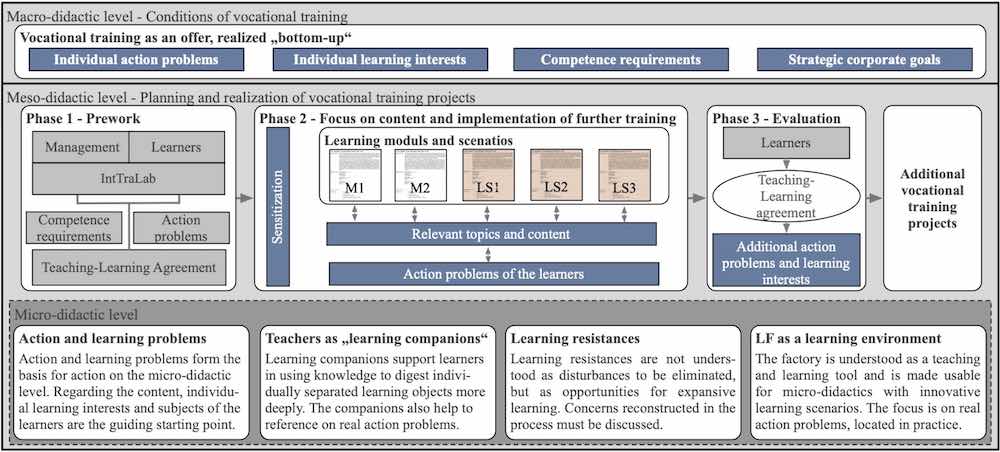
The didactic offer of the InTraLab includes targeted program planning (e.g. the survey of learning interests) at the macrodidactics level. The mesodidactics level describes the conception (e.g. the selection of suitable subject areas that address the identified needs) and implementation of continuous education projects (e.g. the preparation of content in a suitable form). At the microdidactics level, the design of specific teaching and learning situations is described (Figure 3) [4].
A distinctive feature of the InTraLab is its flexibility: Real production processes can be simulated within the system, allowing participants to engage directly with workpieces and machines in real-time. These processes, enriched with learning opportunities, are defined as learning scenarios. Alongside developing individual competence, specific skills (e.g. programming) or soft skills (e.g. communication skills) can be trained.
Skill development within learning scenarios
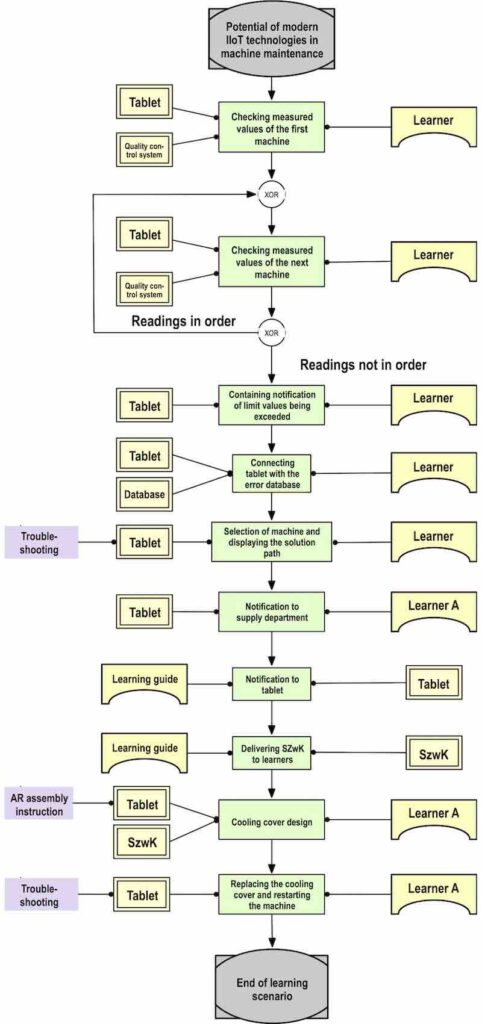
Figure 3 illustrates the didactic structure of the example scenario “Potential of mobile IIoT technologies in machine maintenance”. In this scenario, the participants assume the role of a person responsible for the maintenance of the machines. This role enables the participants to experience the entire quality assurance process from the inspection of a workpiece to the decision on how to proceed. In the learning scenario, learners are confronted with the challenges of digitally transformed work and learn how these can be overcome using IIoT technologies [1].
In addition to learning scenarios, learning modules are also utilized, allowing for targeted use based on the learning interests of the participants.
An overview of learning modules
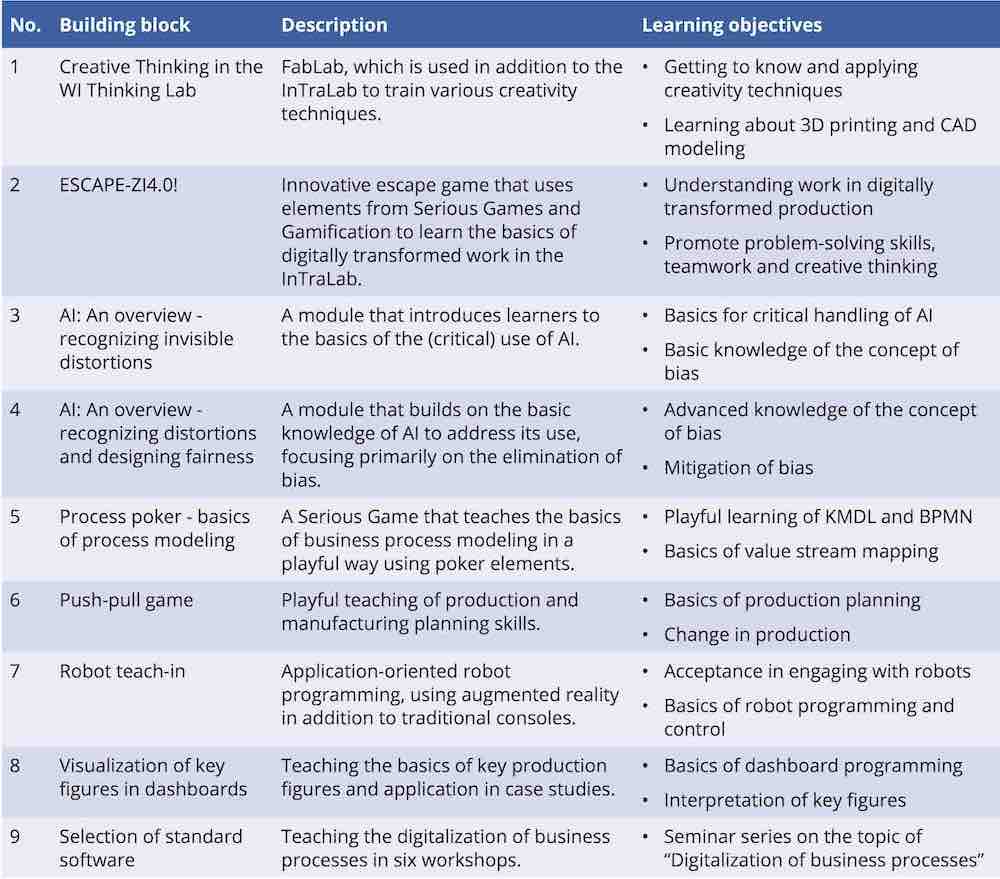
The learning modules are a central element of the didactic concept of the InTraLab. They enable the structured but also sufficiently flexible design of further education projects. The starting point for further education projects is a teaching and learning agreement that addresses both the participants’ learning objectives and the company’s skills requirements. One-day and multi-day training courses are put together on the basis of this catalog of modules according to these identified and formalized needs . The aim is to develop a mixture of theoretical-conceptual modules and practice-oriented modules. The duration of the training courses created in this way varies. Table 1 provides an overview of the various modules.
Maximum immersion for learners in the InTraLab
Insummary, the InTraLab makes it possible to test modern technologies such as augmented and virtual reality, collaborative robots (cobots), networked machines and intelligent assistance systems in a practical way while also obtaining the necessary skills. The combination of real and simulated production entities guarantees a high degree of immersion for learners. The didactic approach makes it possible to address individual learning interests and operational competence requirements with the help of a modular system and learning scenarios.
Bibliography
[1] Gronau, N.; Teichmann, M.; Ullrich, A.: Development of the Industrial IoT Competences in the Areas of Organization, Process, and Interaction Based on the Learning Factory Concept. In: Procedia Manufacturing 2017, p. 8.[2] Teichmann, M.; Lettkemann, V.; Gronau, N.: Digitalization, Demographic Change and Decarbonization: Eight Pivotal Competencies for Learning Factories. Twente 2024.
[3] Lass, S.: Simulationskonzept zur Nutzenvalidierung cyber-physischer Systeme in komplexen Fabrikumgebungen. Potsdam 2017.
[4] Teichmann, M.; Vladova, G.; Gronau, N.: Putting Subject-Oriented Learning into Practice – A meso-didactic design framework for learning scenarios for manufacturing. In: SSRN Electronic Journal (2023).
Potentials: Training
Solutions: Assembly Production Control
You might also be interested in