Digital Twins Using Semantic Modeling and AI |
Self-learning development and simulation of industrial production facilities
 , Ralf Stetter
, Markus Pfeil
, Thomas Bayer
, Bernd Michelberger, Markus Till, Timo Schuchter, Alexander Lohr
, Ralf Stetter
, Markus Pfeil
, Thomas Bayer
, Bernd Michelberger, Markus Till, Timo Schuchter, Alexander Lohr| Journal | Industry 4.0 Science |
| Issue | Volume 41, Edition 2, Pages 30-36 |
| Bibliography | Share | Cite | Download |
Abstract
Keywords
Article
The digital twin approach has been increasingly applied in industrial production for several years [1], enabling the modeling, monitoring, simulation, and prediction of critical system states. AI techniques, particularly machine learning, are used to automatically capture system behavior.
However, AI-derived insights in Industry 4.0 often remain isolated, addressing only specific aspects of a production process. The identification of overarching patterns across the entire production process and product life cycle is typically hindered by the absence of a comprehensive model for the semantic and ontological classification of these insights.
From a statistical perspective, conventional AI and machine learning (ML) methods primarily generate probabilities for the occurrence of specific patterns or correlations, without identifying causal relationships. This inherent uncertainty poses a significant challenge, particularly in complex and critical applications such as industrial production. Approaches from the field of eXplainable AI (XAI), which focus on the automatic description and explanation of ML models [2], can help address this issue. For example, XAI techniques can clarify why a model predicts machine failure and which input parameters contribute to this prediction.
Even explanations and interpretations of AI-derived insights benefit from semantically rich models. Therefore, AI findings can only be fully leveraged in the context of Industrie 4.0 when integrated into comprehensive models that encompass function, behavior, structure, and geometry. This integration enables both the explanation and the transparent prediction of system behavior.
The aim of this project is to develop AI-powered, self-learning, and self-explanatory digital twins that autonomously adjust to real system behavior, ensuring an optimal representation of the production process. Insights derived from AI methods are incorporated into a semantically rich overall model, facilitating the interpretability and explainability of AI models, as well as enabling complex analyses and forecasts through simulation techniques.
Digital twins and AI in production
Digital twins were first introduced by [1] in 2003. Initially, this technology was envisioned as a means for monitoring a product or production plant. However, today, digital twins represent dynamic, virtual entities that serve as digital counterparts of physical systems, enabling complex simulations, analyses, and predictions of the system’s states.
For further processing and analyzing of collected performance and execution data, techniques from machine learning are increasingly being employed, including artificial neural networks, deep neural networks, hidden Markov models, and approaches from physics-informed machine learning. These methods are used to automatically identify typical execution patterns and correlations, as well as to enhance the prediction of future system states [3-7].
Recent research and development efforts in modeling physical systems and representing execution and performance data are increasingly focused on the use of semantic web technologies, such as ontologies and knowledge graphs, to create expressive product and production models [8, 9].
Artificial intelligence applications often face the challenge of uncertainty, particularly when the underlying model only partially represents the observed section of reality. This issue is especially critical in applications such as production, where the explainability of AI models is essential for their reliability and acceptance [2]. The term eXplainable AI (XAI) was introduced by DARPA in 2017 to describe methods for automatically explaining AI models. These approaches either aim to explain the model as a whole or replace it with a more comprehensible surrogate model [10]. XAI techniques are increasingly being applied in the Industry 4.0 domain [11, 12].
Architecture of AI-based digital twins
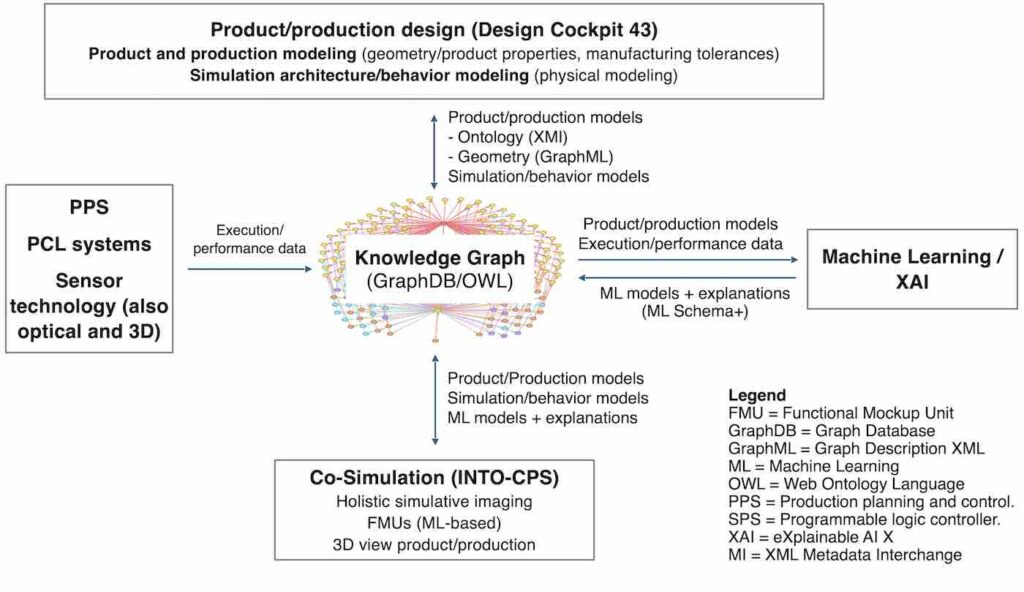
The core element of the AI-based digital twin is a novel, self-learning engineering model. It begins with a product and production model that represents function, behavior, and product geometry. Graph-based design languages, such as the Unified Modeling Language [13, 14] and the Design Cockpit 43 [15] (Figure 1, top), are employed. This approach integrates semantic modeling into the product and production models, enabling the ontological classification of terms and entities within the broader domain context and mapping their relationships and interdependencies.
In contrast to traditional product and production models, the semantically rich model not only acts as an expressive input for artificial intelligence and machine learning processes but also serves as a repository for the knowledge gained through AI regarding cause-and-effect relationships and influencing factors (Figure 1, right). The semantically rich model, as a vital component of the architecture, is technically implemented as a knowledge graph, modeled using the Web Ontology Language (OWL) and stored in the graph-based database GraphDB (Figure 1, middle). This knowledge graph functions as the central knowledge base for all information relevant to or generated for AI-based digital twins.
This framework is well-suited for the integrated, life cycle spanning representation of cross-domain product and process data across areas such as function, behavior, structure, and geometry. By utilizing sensors and actuators (for example, integrated through a production planning and control system), performance and execution data from the production process are collected and semantically annotated, linking them to the product and production model. AI techniques from the field of machine learning are then applied to analyze this data using the semantic model, generating insights into causal relationships and process patterns in the form of AI models.
These insights are then integrated into the overall model as part of a self-learning digital twin and serve as input for simulating production processes. Utilizing techniques from eXplainable AI (XAI), an automatic explanation and description of the AI models is generated, such as characterizing influential features or applying layer wise relevance propagation. The simulation of system behavior, along with the explanation of the underlying AI models, forms the interface of the digital twins for the end user, such as a production manager or employee.
A key concept of the proposed approach is the decomposition of the overall system into Functional Mockup Units (FMUs) [14, 16], each of which has its own dynamics and behavior. The overall system behavior is then derived from the interaction of all FMUs, which are linked through output/input relationships.
This decomposition is already modeled in Design Cockpit 43. A central aspect of the present architecture is the dynamic modeling of the behavior of individual FMUs, not solely through fixed rules or mathematical equations (i.e., classical behavior models), but by automatically learning it from execution and performance data using machine learning (ML) methods. For the FMUs defined in Design Cockpit 43, corresponding ML models can be trained and stored in the knowledge graph for further use.
All relevant aspects of the product and production models, i.e., the FMU definitions and the product and production geometries, as well as the ML models and explanations in addition to the classic simulation and behavioral models, are transferred to the co-simulation based on INTO-CPS (Integrated Tool Chain for Model-based Design of Cyber-Physical Systems) [16]. When simulating system behavior, it is possible to use different ML models to calculate the FMU output or to provide explanations for the output calculated based on the ML model. Figure 1 shows the overall architecture of the digital twin with all components and their interaction.
Validation using a FESTO laboratory system
In this study, a FESTO laboratory system is utilized as a specific application for the exemplary implementation and validation. Figure 2 (top) illustrates the various modules of the FESTO laboratory system. Following the co-simulation concept outlined earlier, the system modules are first decomposed into individual Functional Mockup Units (FMUs), and their output-input interactions are defined (Figure 2).
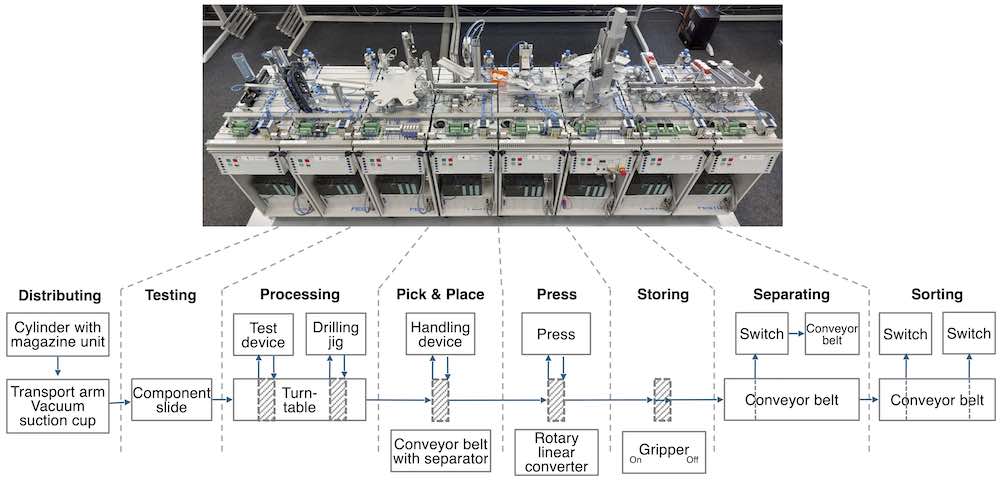
Validation is demonstrated using the Functional Mockup Unit (FMU) component slide in the “testing” module as a case study. To validate the concept of the ML-based, self-learning digital twin, relevant input parameters for the successful sliding process were defined for the FMU component slide, including factors such as air pressure in the slide, component weight, and the curvature of the component’s underside. The output of the FMU is the time required for the sliding process and the success of the process itself.
To validate the approach, all components of the architecture for the component slide application were implemented prototypically. Execution data was generated through test runs, system behavior was learned from this data, and ultimately, the system behavior was simulated in the co-simulation framework as part of the digital twin.
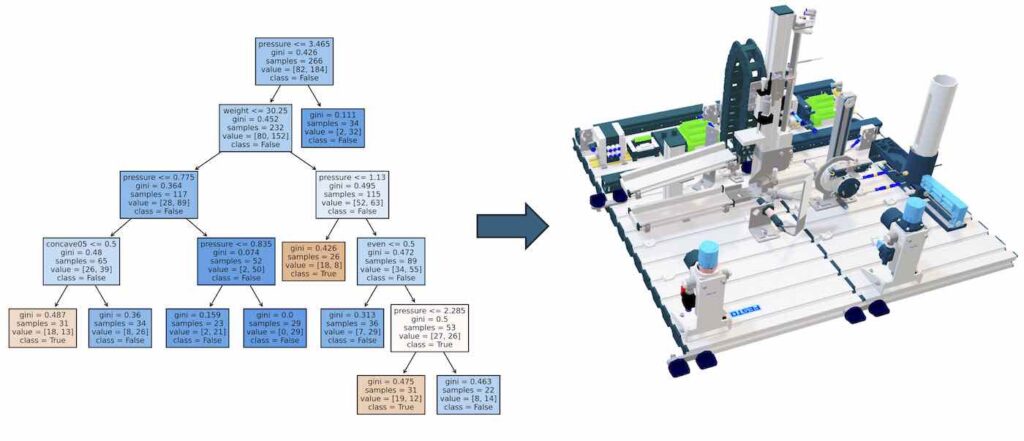
Figure 3 (left) shows a surrogate model (i.e. a substitute model for explaining arbitrary black box models such as artificial neural networks) in the form of a decision tree, which represents the learned system behavior of the component slide based on the execution data created.
Figure 3 (right) illustrates a section of the graphical simulation of the digital twin with the FMU component slide. The decision tree serves as the basis for simulating the system’s behavior, which can thus be predicted and simulated for different input parameters.
The FESTO laboratory system replicates an entire production process, comprising numerous production steps and processing operations. This makes it particularly well-suited for validating the co-simulation concept, where the overall process is decomposed into sub-units known as Functional Mockup Units (FMUs). Additionally, each module of the system is managed and monitored by a programmable logic controller (PLC). The generated execution and performance data are therefore representative of real-world systems.
The proposed co-simulation approach enables not only the detailed modeling of individual FMUs—either through mathematical/physical models or AI-based approaches—but also the representation of complex concurrent processes. However, it should be noted that, in the scope of this validation, FMUs were only linked sequentially. The modeling of complex, concurrent interactions between FMUs using AI was not within the focus of this study.
A novel approach to AI-based, self-learning digital twins
This AI-driven approach replaces traditional physical or mathematical simulations of Functional Mockup Units (FMUs) with machine learning models, eliminating the need for extensive parameter determination. By incorporating techniques from eXplainable AI (XAI), the methodology enhances the interpretability and explainability of ML models. The introduction of a semantically rich model as a core architectural component extends conventional product and production data models, enabling the structured representation of knowledge and relationships.
This model serves both as an input for AI-driven analysis and as a repository for the insights generated through ML and XAI methods. The proposed approach was prototypically implemented and validated using a FESTO laboratory system. Selected system stations were modeled, analyzed, and simulated as Functional Mockup Units (FMUs), enabling the verification of both individual components and the overall architecture. This validation demonstrated the feasibility of AI-based self-learning digital twins and confirmed the functionality of the co-simulation framework.
The next steps in the ongoing research include the integration of additional eXplainable AI (XAI) techniques, with a particular focus on natural language descriptions of machine learning models using large language models (LLMs) and retrieval-augmented generation (RAG) [17]. Furthermore, the overall approach will be tested on a real production plant to assess its scalability and practical applicability. Another promising direction involves leveraging synthetic simulation data generated from process models in Design Cockpit 43 to further enhance model training and validation.
This article was written as part of the project “KIDZ – AI-based digital twin”, funded by the Carl Zeiss Foundation in the funding program “AI breakthroughs”.
Bibliography
[1] Grieves, M.: Digital Twin: Manufacturing Excellence through Virtual Factory Replication. White Paper. 2014. URL: https://scholar.google.com/scholar?hl=en&as_sdt=0,5&cluster=15300272734769108202, accessed 09.01.2025.[2] Burkhart, N.; Huber, M. F.: A Survey on the Explainability of Supervised Machine Learning. In: Journal of Artificial Intelligence Research 70 (2021), pp. 245-317.
[3] Anastasi, S.; Madonna, M.; Monica, L.: Implications of embedded artificial intelligence – machine learning on safety of machinery. In: Procedia Computer Science 180 (2021), pp. 338-343, ISSN 1877-0509. DOI: https://doi.org/10.1016/j.procs.2021.01.171.
[4] Rodrigues, J. F.; Florea, L.; Oliveira, M. C. F.; Diamond, D.; Oliveira, O. N.: Big data and machine learning for materials science. In: Discov Mater 1 (2021) 12, DOI: 10.1007/s43939-021-00012-0.
[5] Toorajipour, R.; Sohrabpour, V.; Nazarpour, A.; Oghazi, P.; Fischl, M.: Artificial intelligence in supply chain management: A systematic literature review. In: Journal of Business Research 122 (2021), pp. 502-517. DOI: https://doi.org/10.1016/j.jbusres.2020.09.009.
[6] Daniyan, I.; Muvunzi, R.; Mpofu, K.: Artificial intelligence system for enhancing product’s performance during its life cycle in a railcar industry. In: Procedia CIRP 98 (2021), pp. 482-487. DOI: https://doi.org/10.1016/j.procir.2021.01.138.
[7] Arff, B.; Haasis, J.; Thomas, J.; Bonenberger, C.; Höpken, W.; Stetter, R.: Analysis and Visualization of Production Bottlenecks as Part of a Digital Twin in Industrial IoT. In: Applied Sciences 13 (2023) 6, p. 3525. DOI: https://doi.org/10.3390/app13063525.
[8] Gräßler, I.; Wiechel, D.; Pottebaum, J.: Role model of model-based systems engineering application. In: IOP Conference Series Material Science and Engineering 1097 (2021) 012003. DOI: https://doi.org/10.1088/1757-899X/1097/1/012003.
[9] Shaked, A.; Reich, Y.: Using Domain-Specific Models to Facilitate Model-Based Systems-Engineering: Development Process Design Modeling with OPM and PROVE. In: Applied Sciences 11 (2021) 1532. DOI: https://doi.org/10.3390/app1104153.
[10] Lécué, F.: On the role of knowledge graphs in explainable AI. In: Semantic Web 11 (2020) 1, pp. 41-51.
[11] Christou, I. T.; Kefalakis, N.; Zalonis, A.; Soldatos, J.: Predictive and Explainable Machine Learning for Industrial Internet of Things Applications. In: 16th International Conference on Distributed Computing in Sensor Systems (DCOSS) 2020, Marina del Rey, CA, USA, pp. 213-218.
[12] Pilania, G.: Machine learning in materials science: From explainable predictions to autonomous design. In: Computational Materials Science 193 (2021), DOI: https://doi.org/10.1016/j.commatsci.2021.110360.
[13] Grüble, T.; Stetter, R.; Schuchter, T.; Till, M.; Rudolph, S.: Combined Geometric and Kinetic Data Model in Model-Based Systems Engineering of Robotic Cells. In: Procedia CIRP 128 (2024), S. 156-161. DOI: https://doi.org/10.1016/j.procir.2024.03.005.
[14] Saft, P.; Pfeil, M.; Stetter, R.; Till, M.; Rudolph, S.: Integration of geometry modelling and behaviour simulation based on graph-based design languages and functional mockup units. In: Procedia CIRP 128 (2024), S. 310-315. DOI: https://doi.org/10.1016/j.procir.2024.06.025.
[15] IILS Ingenieurgesellschaft für Intelligente Lösungen und Systeme mbH. URL: https://www.iils.de, accessed 07.02.2025.
[16] Larsen, P. G.; Fitzgerald, J.; Woodcock, J.; Fritzson, P.; Brauer, J.; Kleijn, Ch.; Lecomte, Th.; Pfeil, M.; Green, O.; Basagiannis, St.; Sadovykh, A.: Integrated tool chain for model-based design of Cyber-Physical Systems: The INTO-CPS project. In: 2nd International Workshop on Modelling, Analysis, and Control of Complex CPS (CPS Data) 2016, S. 1-6. DOI: https://doi.org/10.1109/CPSData.2016.7496424.
[17] Pan, S.; Luo, L.; Wang, Y.; Chen, C.; J. Wang, J.; Wu, X.: Unifying Large Language Models and Knowledge Graphs: A Roadmap. In: IEEE Transactions on Knowledge and Data Engineering 36(7) (2024), S. 3580-3599, DOI: https://doi.org/10.1109/TKDE.2024.3352100.
Your downloads
Solutions: Process Management
You might also be interested in