Collaborative Drone Inspection |
A new approach to inspection work with AI support
| Journal | Industry 4.0 Science |
| Issue | Volume 41, Edition 2, Pages 94-100 |
| Bibliography | Share | Cite | Download |
Abstract
Keywords
Article
Industrial infrastructure is often used for decades or even centuries. In view of the large number of old structures, the introduction and establishment of a more efficient drone inspection methodology can bring economic and infrastructural benefits. The transportation sector is a good example of this, with around 40,000 structures in the federal highway sector [1] that must be regularly inspected and maintained. The condition of structures can deteriorate with increasing age.
The condition grade (CG) of a structure provides a valid indication of this. In the federal highway sector, for example, 23.9% of structures or parts of structures are in good or very good condition. The majority of structures (71.8%) are rated satisfactory or sufficient. 4.3% are rated unsatisfactory or inadequate [1].
The condition of a structure has a significant impact on inspection costs. The influence of condition grade on inspection costs can be clearly illustrated based on a standardized formula from VFIB e.V. [2] (Figure 1). Although the final cost structure of a building inspection can only be determined individually, this standardized approach provides a helpful insight into the cost structure of an inspection. All relevant cost factors are taken into account, including the time required and the hourly rate of the auditors as well as the type of structure and the scope of the inspection [2].
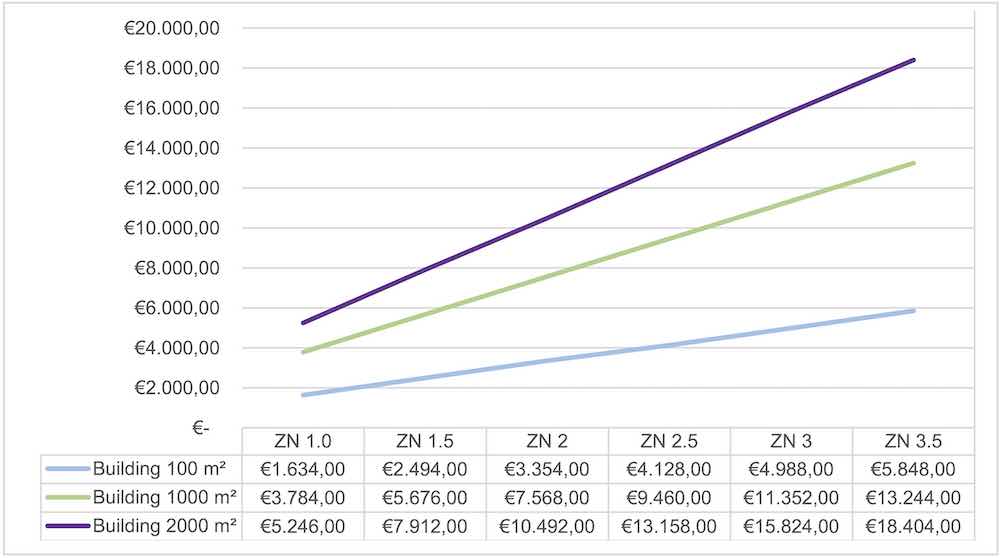
Figure 1 shows a projected calculation example in simplified form to illustrate the influence of condition grades on inspection costs. Result: The worse the condition of a structure, the more complex and expensive an inspection will be. The inspection of a 100 m² bridge with a condition grade of 1.0 costs 1,634 Euros. However, if this bridge is in a poor condition (CG 3.5), the costs increase to approx. 350% and thus to 5,848 Euros. The inspection of a 1000 m² and 2000 m² bridge costs comparatively more. However, Figure 1 shows that the cost trend is similar regardless of the bridge size and that the relative cost difference in the aforementioned constellation is also around 350%.
There is potential here to reduce the effort and therefore the costs of building inspections with innovative drone technology and AI support. There are already initial approaches to how damage can be recorded using drones and automatically detected using AI-based image recognition technology [3].
Recent studies on drone inspection
The idea of drone inspections is not new. Several institutions have already looked into the possibilities of inspection using drones. Krebs and Hagenweiler’s 2019 study deals with the drone inspection of bridges. This study found that drone inspection can be used efficiently for visual inspections. In addition to time and cost savings, better results were also recorded. However, the study only indicated that the drone could be used as a supporting tool, as certain activities in the context of close-up inspections, such as taking material samples, cannot be carried out using a drone [4].
In another study from 2017 by Sperber et al., published by the German Federal Highway Research Institute (BASt), practical flights were carried out with a drone on several bridges to investigate the damage detection of an inspection drone [5]. According to this study, small cracks and chemical effects, among other things, are almost impossible to inspect.
Overall, the suitability here is also limited to the visual inspection of structures [5]. In a study by the German Federal Waterways Engineering and Research Institute (BAW) in 2023, the topic of damage detection was investigated using a hydraulic structure. It was found that the use of a drone only detected around 70% of the cracks. AI-based damage detection software was also tested. The AI only achieved a hit rate of 10% [6].
Another study from 2023, which dealt with visual damage detection, again clearly shows the advantages of autonomous drone inspection. The efficiency of such an inspection variant, as well as good image quality and time savings, are highlighted. In addition, the creation of a digital image makes it easier to track damage that has already been identified, which can lead to an increase in quality through precise monitoring. In addition, the objective and reliable detection of damage also minimizes work risks [3].
Based on the studies, it can be summarized that a drone cannot replace a comprehensive close-up inspection. Rather, drones can be used as a support, as drone technology cannot always detect all damage. In addition, inspections with AI support do not necessarily lead to better results. In this respect, the idea of a collaborative inspection appears to be a realistic solution. A collaborative inspection is based on the idea of collaborative robotics and in this context describes the collaboration between humans and an AI-based drone in the course of a building inspection.
The aim is to utilize the advantages of drone technology and traditional inspection while simultaneously eliminating the disadvantages of both. The use of AI is intended to ensure that inspections are more reliable, faster and more frequent so that downstream maintenance measures can be carried out in the style of predictive maintenance. This prevents unplanned downtime and saves costs.
Research method
Current processes and regulatory requirements must be examined and reviewed so that forward-looking processes can be developed. Existing processes contain all the important components of an inspection and can therefore contain important indicators for a forward-looking inspection methodology. Due to the specialized subject area and the limited availability of documentation, expert interviews were conducted with various stakeholders.
According to the experts, modeling a target process is not about creating new processes but rather about further developing existing processes in line with a collaborative inspection. Inspection work is complex and can be differentiated according to object type and area of responsibility. Similar structures can be recognized with regard to inspection types and inspection intervals. A frequently applied regulation is DIN 1076 (“Engineering structures in connection with roads”). This regulation states that damage must be detected and rectified in good time so that a structure can be used regularly [7].
The option of a drone inspection or the use of a drone as an aid for carrying out an inspection is not explicitly listed in this regulation. There is no regulation comparable to DIN 1076 for the area of drone inspections. Although there are regulations that govern the handling of a drone in flight operations, among other things, no procedures can be derived from them. For this reason, people with expertise in the field of drone flights were also included in the group of experts interviewed.
Target scenarios
The evaluation of the interviews and studies shows that the use of AI-supported drone flights in the course of a drone inspection must be considered in a differentiated manner. This raises the fundamental question of what function AI has in the respective context and how reliably the respective function can be carried out with AI.
Examples of AI use in the drone inspection process can be found in all phases. For example, in the preparation phase, systems trained by machine learning can include particularly vulnerable areas of a structure in the inspection program. During the flight, AI can support the flight control of the drone to fly to certain areas or hover in one position for sensor and image recordings. In the evaluation phase, image and pattern recognition algorithms can help to identify damage.
Accordingly, certain process steps may vary depending on the development status of the AI. The project team assumes that the autonomy of a drone inspection depends on the level of development of the AI. Based on this assumption, Figure 2 shows the main differences between individual project phases depending on the level of AI development.
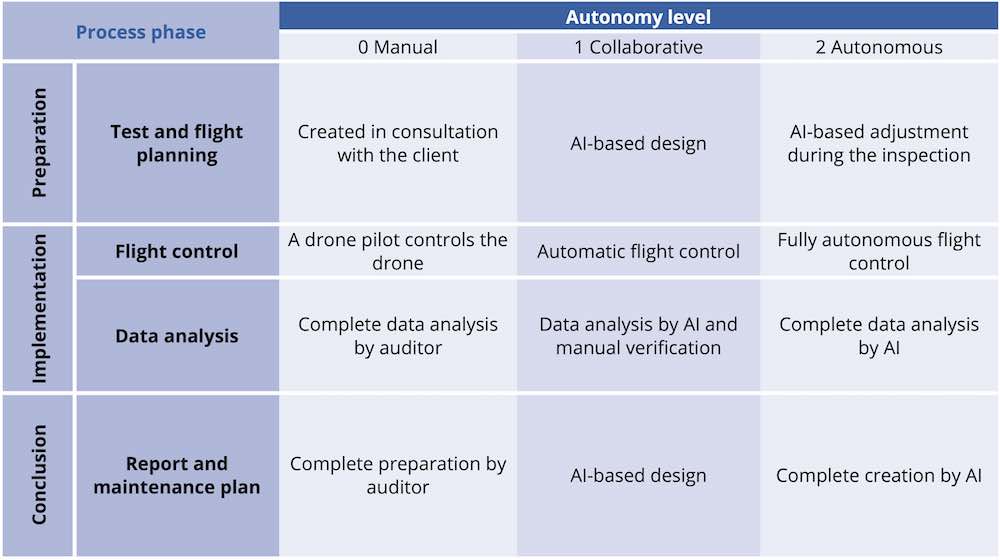
Autonomy level 0 describes a manual drone inspection without an AI component. In this context, the experts surveyed pointed out the manual activities involved in a traditional inspection: reviewing previous documentation, obtaining permits, inspecting the building, cleaning the building and erecting scaffolding. According to the experts, a drone is only used selectively. The main inspection is carried out by the auditor with a notepad and other tools such as a hammer and camera. Only relevant images are used to assess and initiate certain measures. In this scenario, only the auditor evaluates the data and writes the inspection report independently.
Autonomy level 1 can be understood as a form of semi-automated inspection and represents the collaborative process of a drone inspection. This process is already being used today, at least in part. A fully collaborative inspection as a standard procedure is to be expected in the next few years. The collaborative aspect is very pronounced in this scenario. The AI supports the auditor in all important phases. Figure 3 shows the sequence of a collaborative inspection and the interaction between humans and drones.
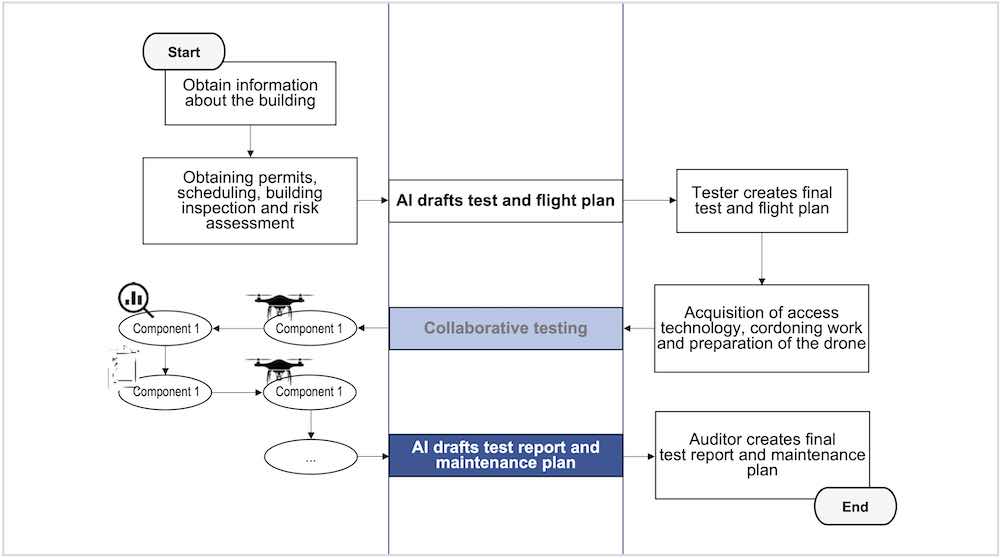
First, all relevant information (reports and construction data) is obtained. This is followed by an on-site inspection of the structure and a risk assessment to check the feasibility of a collaborative inspection. A date is then agreed with the client, taking into account weather conditions. Based on the available information, AI-based software generates an inspection and flight plan. The final planning is carried out by the auditor in collaboration with the client. Based on the preliminary planning, the next step is to procure and set up access technology and to implement cordoning work in a timely manner.
The pre-programming of the flight route for the purpose of a partially automated flight is recommended in stages as part of a collaborative inspection and is still part of the technical preparation. A stage describes a specific area of the building or a specific component. It is therefore possible for a predefined area to be initially inspected by the drone in a semi-automated manner. The data is evaluated in real time using AI-based analysis software. The AI results are validated by the auditor on the basis of the data analysis. This is followed by a selective manual inspection.
During the follow-up inspection, the next area of the structure is inspected by the drone. At this point, the process is repeated until the entire structure has been inspected.
Finally, the inspection results are used and pre-formulated in the form of an inspection report using AI-based analysis software. This is then finalized by the auditor. A maintenance plan is also prepared by the AI and then finalized by the auditor.
Autonomy level 2 describes a fully autonomous drone inspection. In this scenario, it is possible for an AI-based autonomous drone to adapt the flight and inspection plan during the inspection. The flight route is calculated fully autonomously and in real time during the flight. The AI evaluates the data, including damage identification, completely autonomously. Inspection reports and maintenance plans are also generated using AI and without the intervention of an auditor. Manual verification of the output is not required. In the opinion of the project team at the University of Applied Sciences Emden/Leer, this scenario is currently neither technologically nor legally possible, taking into account the data collected.
Further aspects to be investigated in future
The adaptation of current regulations plays an important role in view of the establishment of this new technology. According to the experts surveyed, no additional bureaucratic or regulatory hurdles should be imposed. The legal legitimization of drone inspections should clarify liability issues and specify clearly defined quality standards. In terms of cost-effectiveness, the introduction of an AI-based (semi-automated) inspection drone should be accompanied by an individual cost-benefit analysis and the commissioning of external drone service providers in order to avoid bad investments.
From a scientific perspective, there are further aspects that need to be investigated in the future. These include the evaluation of the reliability of collaborative inspection compared to the classic procedure [8], also including worst-case risks [9], as well as the traceability of AI decisions [10] and the integration of the inspection process into the concept of the “digital twin” of infrastructure and industrial facilities as a component of life-cycle management [11].
This article was created as part of the project “AI-based autonomous drone inspection of inaccessible infrastructures.” The project is funded by the Lower Saxony Ministry of Science and Culture.
Bibliography
[1] Federal Highway Research Institute: Fokus: Brücken. Brückenstatistik. URL: https://www.bast.de/EN/Ingenieurbau/Fachthemen/brueckenstatistik/bruecken_hidden_node.html, accessed 07.02.2025.[2] VFIB e.V.: Empfehlung zur Leistungsbeschreibung, Aufwandsermittlung und Vergabe von Leistungen der Bauwerksprüfung nach DIN 1076. Hinweise zur Vergabe von Bauwerksprüfungen. URL: https://www.vfib-ev.de/service/leistungsbeschreibung.php, accessed 07.02.2025.
[3] Von Thiessen, R.; Scheidegger, F. et al: Automatisierte Infrastrukturwartung. Drohneninspektionen mit Bilderkennung. Zurich 2023. URL: https://www.zh.ch/de/wirtschaft-arbeit/wirtschaftsstandort/innovation-sandbox/ki-in-der-infrastrukturwartung.html, accessed 07.02.2025.
[4] Krebs, H.-A.; Hagenweiler, P.: Inspektion von Brücken und Ingenieurbauwerken mit unbemannten Luftfahrzeugsystemen. Kassel 2019. DOI: http://dx.doi.org/doi:10.17170/kobra-202206286413, accessed 07.02.2025.
[5] Sperber, M.; Gößmann, R. et al: Unterstützung der Bauwerksprüfung durch innovative digitale Bildauswertung – Pilotstudie. Bergisch Gladbach 2017. URL: https://bast.opus.hbz-nrw.de/frontdoor/index/index/docId/1840, accessed 07.02.2025.
[6] Seiffert, A.; Heimig, B.: Innovative Methoden zur Zustandserfassung. FuE-Abschlussbericht B3951.04.04.70009. Karlsruhe 2023. URL: https://hdl.handle.net/20.500.11970/110943, accessed 07.02.2025.
[7] DIN 1076: Ingenieurbauwerke im Zuge von Straßen und Wegen. Überwachung und Prüfung. Berlin 1999.
[8] Rakha, T.; Gorodetsky, A.: Review of Unmanned Aerial System (UAS) applications in the built environment: Towards automated building inspection procedures using drones. In: Automation in Construction 93 (2018). DOI: https://doi.org/10.1016/j.autcon.2018.05.002 .
[9] Alderson, D.; Brown, G.; Carlyle, W. M.; Wood, R. K.: Assessing and Improving the Operational Resilience of a Large Highway Infrastructure System to Worst-Case Losses. In: Transportation Science 52 (2017) 4, 1012-1034. DOI: https://doi.org/10.1287/trsc.2017.0749 .
[10] Ahmed, I.; Jeon, G.; Piccialli, F.: From artificial intelligence to explainable artificial intelligence in industry 4.0: a survey on what, how, and where. In: IEEE Transactions on Industrial Informatics 18 (2022) 8. DOI: https://doi.org/10.1109/TII.2022.3146552.
[11] Kaewunruen, S.; Sresakoolchai, J.; Ma, W.; Phil-Ebosie, O.: Digital Twin Aided Vulnerability Assessment and Risk-Based Maintenance Planning of Bridge Infrastructures Exposed to Extreme Conditions. In: Sustainability (2021) 13, 2051. DOI: https://doi.org/10.3390/ su13042051.
Solutions: Maintenance
You might also be interested in