Innovation

AI-Powered Lubrication Strategies for Thread Forming

AI-Powered Lubrication Strategies for Thread Forming

Adaptive spray jet control to increase process reliability and tool life
Reinhard Schmied, Marco Susic, Christian Donhauser ORCID Icon
Thread forming requires precise lubricant application because high contact pressures and process temperatures strongly influence tool loading, friction, and process stability. Although minimum quantity lubrication (MQL) systems are widely used, current spray-based approaches can still suffer from spray losses, insufficient wetting of the thread grooves, and unstable droplet transport. This article presents a concept for adaptive precision lubrication in thread forming based on computational fluid dynamics (CFD)-supported flow analysis, experimental validation, and artificial intelligence (AI)-assisted optimization. The focus is on droplet size, spray jet geometry, nozzle position, ambient flow conditions, and their influence on wetting intensity. Preliminary simulation-based investigations indicate that data-driven optimization can help identify wetting deficiencies and support the development of future control strategies for resource-efficient lubricant application.
Industry 4.0 Science | Volume 42 | 2027 | Edition 3 | Pages 76-83
Open-Source Implementation of the Industrial Metaverse

Open-Source Implementation of the Industrial Metaverse

Case study and best practices
Henning Strauß ORCID Icon, Tim Johannsen
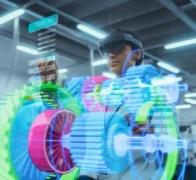
The digital transformation of small and medium-sized enterprises (SMEs) in the manufacturing sector is hampered by vendor lock-in, high cloud costs, and stringent data sovereignty requirements when implementing Industrial Metaverse solutions. Although the Industrial Metaverse is quickly becoming a key concept in Industry 5.0, SMEs are often at a disadvantage when using proprietary solutions. This paper demonstrates how Industrial Metaverse applications can be realized by combining proven communication standards with open web technologies, thereby reducing barriers. This makes immersive applications for training, maintenance, and monitoring feasible even in SMEs. Using an open-source-based prototype as a best-practice implementation, the paper illustrates how the Industrial Metaverse can be made technologically and economically accessible to SMEs.
Industry 4.0 Science | Volume 42 | Edition 3 | Pages 68-73
Immersive Human Digital Twins for Industry 4.0

Immersive Human Digital Twins for Industry 4.0

Supporting adaptive human-centric production by integrating cognitive and physical states
Tajbeed A. Chowdhury ORCID Icon, Martina Lehser ORCID Icon, Eric Wagner ORCID Icon, Paul Motzki ORCID Icon
The rapid advancement of immersive technologies has created new opportunities to transform human-machine collaboration in industry. This paper presents an immersive platform with a digital twin that combines both physical and cognitive characteristics of human dynamics. By integrating multimodal sensing, human biomechanics, and cognitive state into digital twin technology, the proposed system enhances operational safety and ensures better ergonomics. The main argument is that human digital twins are not only desirable but essential for next-generation industrial systems. We discuss the limitations of existing human modeling approaches, outline the conceptual foundations of human digital twins, and demonstrate their industrial relevance across safety, productivity, ergonomics and sustainability.
Industry 4.0 Science | Volume 42 | 2026 | Edition 3 | Pages 6-13 | DOI 10.30844/I4SE.26.3.1
Industrial Application of Immersive Technologies

Industrial Application of Immersive Technologies

Exploring XR solutions for training, instruction, design review, and assembly planning
Andreas Straube ORCID Icon, Faikar Zakky Haidar ORCID Icon, Matheus Lenzi dos Santos ORCID Icon, Kussai AI Jairoud ORCID Icon, Eduardo Koscianski ORCID Icon
In recent years, the decreasing cost and improved usability of immersive hardware and software have made extended reality (XR) increasingly attractive for industrial applications. Stand-alone systems with inside-out tracking and camera-based pass-through enable accessible mixed reality (MR) solutions. At the same time, emerging no-code software platforms allow engineers to create XR environments without programming expertise, broadening adoption across production settings. This paper explores key industrial application areas of immersive technologies through selected commercially available XR software solutions for product and process training, spatial instructions and guides, collaborative design review, and assembly and production planning.
Industry 4.0 Science | Volume 42 | 2026 | Edition 3 | Pages 38-47 | DOI 10.30844/I4SE.26.3.4
Serious Gaming and the Energy Transition

Serious Gaming and the Energy Transition

Collaborative knowledge generation and interactive understanding of complex interrelationships
Janine Gondolf ORCID Icon, Gert Mehlmann, Jörn Hartung, Bernd Schweinshaut, Anne Bauer
Conveying the complexity and multifaceted nature of the energy transition to a broad audience is a challenge. This article demonstrates how interactive serious games on a multitouch table can help make connections tangible and comprehensible. The games and the table were used in various conversational contexts. These are presented here in three case vignettes based on participant observation of the different applications, as well as situated and shared reflection. The vignettes demonstrate how interaction can trigger epistemic processes, enable shifts in perspective, and foster collective thinking, all of which are necessary for shaping the future of society as a whole.
Industry 4.0 Science | Volume 42 | 2026 | Edition 2 | Pages 62-69
Digital Competence Lab (DCL) for Speech Therapy

Digital Competence Lab (DCL) for Speech Therapy

Designing a learning platform to advance digital skills
Anika Thurmann ORCID Icon, Antonia Weirich ORCID Icon, Kerstin Bilda, Fiona Dörr ORCID Icon, Lars Tönges ORCID Icon
The digital transformation of healthcare results in lasting changes in speech therapy. Smart technologies and artificial intelligence (AI) are creating new opportunities to ensure therapy quality, address care bottlenecks, and actively involve patients in exercise processes. At the same time, these developments are expanding the role of speech therapists, who increasingly use digital systems as supportive tools in addition to their core therapeutic tasks. Based on a feasibility study of the AI-supported application ISi-Speech-Sprechen in a real-world setting of complex Parkinson's therapy (PKT), this article outlines the key challenges associated with implementing smart technologies.
Industry 4.0 Science | Volume 42 | 2026 | Edition 1 | Pages 110-118 | DOI 10.30844/I4SE.26.1.102
Co-Determination Dialogues

Co-Determination Dialogues

A tool for human-centered AI implementation
Manfred Wannöffel ORCID Icon, Fabian Hoose ORCID Icon, Alexander Ranft, Claudia Niewerth ORCID Icon, Dirk Stüter
As part of the regional competence center humAIne, funded by the Federal Ministry of Research, Technology, and Space (BMFTR), a process was developed using co-determination dialogues to establish a common understanding of the challenges involved in the introduction of artificial intelligence (AI) between management, employees, and interest groups. Experiences from project partner companies such as Doncasters Precision Castings in Bochum GmbH (DPC) exemplify how co-determination dialogues not only help to develop legally binding regulations for manageable, operationally anchored, sustainable AI use but also initiate continuous qualification processes for all stakeholder groups in accordance with Articles 4 and 5 of the EU AI Act.
Industry 4.0 Science | Volume 42 | Edition 1 | Pages 92-98 | DOI 10.30844/I4SE.26.1.84
Human-Centered AI in Companies with Employee Representation

Human-Centered AI in Companies with Employee Representation

Using the HUMAINE model for a company-specific works agreement
Alexander Ranft, Fabian Hoose ORCID Icon, Claudia Niewerth ORCID Icon, Mathias Preuß, Manfred Wannöffel ORCID Icon
The introduction of artificial intelligence (AI) in companies poses new challenges for regulation and co-determination. Binding requirements have been in force since the 2025 EU AI Act, which must be linked nationally with the Works Constitution Act (BetrVG). The regional competence center humAine has developed a model works agreement on AI (MBV KI) in accordance with Section 77 BetrVG, which strengthens co-determination rights in companies and implements European regulations in a practical way. Flanked by co-determination dialogues, the MBV KI enables company-specific adaptation for responsible and human-centered AI use. Using selected parts of the MBV KI as examples, this article shows how a framework works agreement on AI can be designed and discusses its transferability to companies without a works council. The MBV KI presented here contributes to the sustainable, socially secure design of the digital transformation.
Industry 4.0 Science | Volume 42 | Edition 1 | Pages 14-21 | DOI 10.30844/I4SE.26.1.14
Multi-Stakeholder AI Ethics in Radiology

Multi-Stakeholder AI Ethics in Radiology

Implications for integrated technology and workplace design
Valentin Langholf ORCID Icon, Alexander Ranft, Lena Will, Robin Denz ORCID Icon, Johannes Schwarz ORCID Icon, Majd Syoufi, Pavlos Rath-Manakidis, Marc Kämmerer, Marcus Kremers, Axel Mosig ORCID Icon, Uta Wilkens ORCID Icon, Jörg Wellmer ORCID Icon
AI assistance can be seen as a welcome aid in radiology, a highly complex environment characterized by round-the-clock time pressure and quality expectations. However, it must meet high ethical standards from the perspective of both users and patients. It is a challenge to incorporate this human-centered approach into the development and introduction of AI applications.
Industry 4.0 Science | Volume 42 | Edition 1 | Pages 136-143 | DOI 10.30844/I4SE.26.1.128
Production Control in Space

Production Control in Space

An AI-supported approach for industry in orbit
Dominik Augenstein, Lara Jovic
Production in space, of semiconductors for example, offers many advantages for companies. At the same time, high transport costs mean that careful consideration must be given to the production materials being transported. The use of Kalman filters enables (real-time) control from Earth, making space production a cost-efficient option. Machine learning could make it a viable approach even for highly complex production systems.
Industry 4.0 Science | Volume 41 | 2025 | Edition 6 | Pages 22-29
1 2 9