Work-Integrated Learning in Industry 4.0 |
A qualitative analysis of various assistance systems in assembly

| Journal | Industry 4.0 Science |
| Issue | Volume 41, Edition 2, Pages 20-29 |
| Open Access | https://doi.org/10.30844/I4SE.25.2.20 |
| Bibliography | Share | Cite | Download |
Abstract
Keywords
Article
With the advancing development of assistance systems (AS), companies are increasingly recognizing new potential for rationalization. Real-time information can be used to optimize existing production processes, simplify personnel deployment planning and shorten training times [1, 2, 3]. At the same time, assistance systems should open up potential for the humanization of work on a physiological and cognitive level because they maintain and expand skills or compensate for missing skills [1-7].
In the debate on the social consequences of Industry 4.0, two opposing scenarios are emerging with regard to cognitive requirements in work processes: With the introduction of new technologies in the workplace, either increasing demands on employees, especially in high-skilled work, or decreasing demands on employees, especially in low-skilled work, are to be expected [4-7]. Against this backdrop, this study takes an analytical look at cognitive assistance systems and asks the following question: To what extent do cognitive AS contribute to work-integrated learning from the employee’s perspective? The collected perspectives on the implementation of AS provide insights into its opportunities and risks.
Conceptual approach
The study aims to empirically describe and critically reflect on work-integrated learning via cognitive assistance systems. A fundamental sociological understanding of work forms the starting point: Work as the “basis for the central development of individual human abilities” [15] is based on actions that are theoretically differentiated into 1) an objectifying action that is instrumental and rationalized, and 2) a subjectifying action that is experience-guided [15, 16]. This distinction is illustrated in the model below.
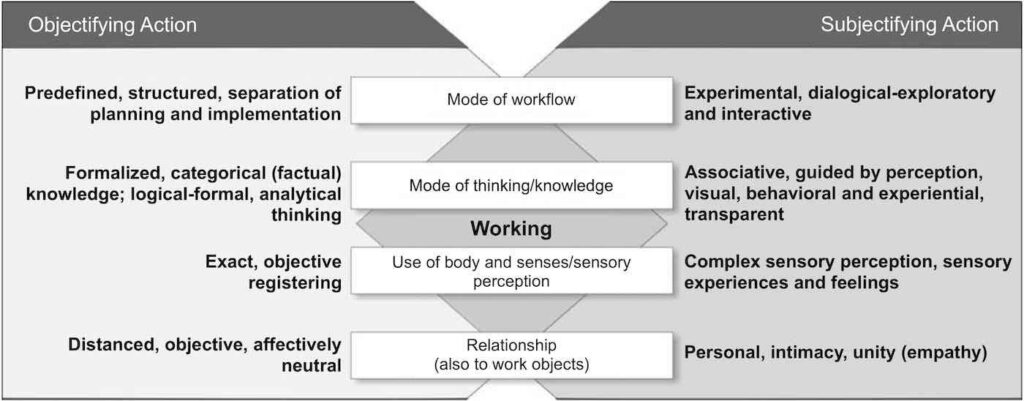
This model is based on numerous empirical studies that have shown since the 1950s that work processes are not completely controllable, especially in industry, and that implicit experiential knowledge is required alongside rational action. The acquisition of both explicit and implicit knowledge thus becomes an integral part of work with terms such as “experience-led learning” [15, 16] or “work-integrated learning” [20].
Work-integrated learning, which can be structured by formal and informal mechanisms in companies and takes place at workplaces and in interaction with equipment e.g. materials or tools and machines. Therefore, in industrial companies the object of learning can be technical artifacts such as cognitive assistance systems, which play a key role in production but are diverse in practice. They are categorized into (a) pre-structured, (b) adaptive and (c) tutorial AS [2].
The requirements of each AS depend on its classification. Whether assistance systems contribute to the development of human work capacity [16, 17, 28] or to self-determined work activities [20] depends strongly on the guiding principles used in the genesis of the technology [13, 14, 29a, b].
Case studies in assembly indicate that hardly any significant changes are discernible in low-skilled work, while the opposite tendencies are evident in high-skilled work. Particularly in cases of more flexible work organization with frequently changing processes, AS relieve effects on mental health. However, greater process stability in the control system jeopardizes the development of experiential knowledge due to a decreasing human engagement with technology.
The integration of AS does reveal new control potential in production, which is important for meeting the increasing requirements in process design. Nevertheless, the research emphasizes that vocational skills from dual training and professionally structured experience remain relevant for the assessment of possible malfunctions in the production process and the initiation of suitable measures to eliminate malfunctions [8-10, 19].
Since the introduction of Industry 4.0, there have been indications that a ‘progressive polarisation of work’ [6] and the specific design of technology could be causing this.
In social interactions, predominant guiding principles such as materialized interests in work equipment can have a structuring effect on the concrete work actions of workers [13, 14] and decide ‘who has the burden of work, […] who has the opportunity to intervene […] or who gets access to what information’ [27 a, b]. Following on from existing research, the aim is therefore to trace subjective perspectives in technology development and technology use.
Methodology
Methodologically, the study is based on a qualitative research design that combines subject-oriented and process-oriented aspects [21, 22, 23]. Case studies are used, in particular eight established production companies in the metal and electrical industry (M+E industry) that belong to globally operating companies and are based in Germany.
The companies differ in that they are four large companies with established co-determination structures and over 1000 employees each and four small and medium-sized enterprises (SMEs), each with around 300 employees and some without co-determination structures. All eight companies have successively implemented new assistance systems in the context of Industry 4.0, which makes them suitable for evaluating work-integrated learning for employees.
Data is collected in the form of a qualitative longitudinal survey to take into account changes in subjective interpretations. The first major phase relates to the period from 2017 to 2021 in the four large companies and the second phase covers the period from 2022 to 2024 with the four SMEs. Instruments such as participant observation and guided interviews were used to collect data.
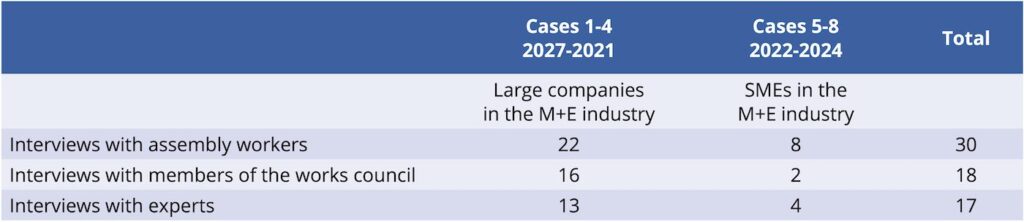
The data was evaluated reconstructively using qualitative content analysis [24]. The analysis includes interviews with three groups of employees in the respective companies: (1) assembly workers who were asked about their work-integrated learning processes before, during and after the implementation of AS; (2) members of the works council and (3) experts involved in the development, planning and implementation of company digitalization projects. Internal company documents were integrated to contextualize the results.
Perspectives on assistance
In line with Industry 4.0, cognitive assistance systems are embedded in extensive digitalization projects in companies. Different forms with varying degrees of dissemination can be identified. In the eight companies surveyed, pre-structured forms can be found primarily in manual assembly and adaptive forms primarily in automated assembly. Only a few pilot projects with tutorial AS were found.
Pre-structured assistance
A typical assistance system that is used in all the companies studied is pre-structured assistance. It is specially designed for repetitive work processes and is implemented in manual assembly. Known as digital worker guidance, it closely guides work actions in the assembly process. The central feature is the mapping of linear action sequences in the form of digital manual formats, with defined step-by-step instructions including images or film sequences and usually pick-by-light or pick-by-voice systems.
The user group primarily includes semi-skilled workers who perform manual tasks for which they do not require formal vocational training. The tasks mainly consist of assembling very small parts on circuit boards, which requires a great deal of dexterity, among other things, but is usually associated with short training periods. The employees in the companies surveyed have mostly worked in manual assembly for over 20 years and have been able to develop their experience over many years through regular rotations at assembly stations.
Perspectives in development
From the point of view of the management representatives interviewed, work in manual assembly should be structured as closely as possible in order to speed up task execution and achieve production stability. Meticulous instructions help to avoid possible errors in the selection of components and shorten training times during production peaks in order to integrate untrained personnel, such as temporary workers, more quickly. Some of the managers surveyed emphasized that the use of pre-structured assistance systems enables greater variety in tasks.
These perspectives are taken up in technology development. The technical concept behind pre-structured AS revolves primarily around standardization. All the developers interviewed reported that digital worker guidance is of interest to many companies due to the low barriers to entry and that employees largely perceive the use of assistance systems in pilot phases positively.
Perspectives in practice
From the perspective of the manual assembly workers surveyed, the use of pre-structured assistance systems is easy to learn. Especially in pilot projects and during the initial phases of the technology’s introduction, they are in favor of the AS and emphasize their willingness to acquire initial IT operating skills.
After implementation, the employees have an assembly station with permanently installed assistance systems that must be activated by the employees at the start of the shift. A visual work instruction opens on a monitor, which displays detailed step-by-step instructions for the relevant job. During execution, several programs run in the background, giving light and sound signals at the appropriate time to indicate which components are required for the next production step.
In addition, sensors record which product is being processed by whom and at what time, while the employees can see the outstanding orders on another monitor. At the end, they confirm that their order has been processed and receive automated feedback using smileys, among other things, which should help with motivation. Only selected user knowledge is available for the respective task.
The willingness for a regular use changes when the workers surveyed in manual assembly realize that their experience-based knowledge becomes largely obsolete due to the systems and that hardly any thinking is required. Due to the obligatory use and the strong pre-structure, employees expressed the subjective feeling that they no longer feel responsible for the tasks they carry out during assembly:
“We are only there as hands and not as heads. You see everything on the screen here […] every step. I know it all inside out. The light flashes now and shows what material you need and where it will go. Here you have the numbers and the computer shows you where to find the material. […] The other screen automatically calls up the instructions, you don’t have to think anymore, just follow them […] there’s no more content.”
Experienced employees, in particular, perceive the AS as producing mental underload and even disrupting their self-established work routines due to the permanent need to confirm any steps performed. This often slows down work, contrary to assumptions by management that the AS will lead to greater efficiency. Respondents repeatedly point out that they were previously more trusted to perform the correct assembly steps correctly without permanent guidance.
Before implementation, manual assembly tasks were highly pre-structured and integrated into tightly synchronized production processes. Employees usually received a paper-based manual with assembly instructions and paper-based lists for selecting the right components. In retrospect, the interviewees see this as an additional tool that they only used when necessary. They would like to see adaptive AS.
Adaptive assistance
Another typical assistance system used for assembly in many of the companies studied is adaptive AS. It is designed specifically for automated assembly, enabling the recording and mapping of relevant machine data from automated assembly lines. Known as a so-called decision support system, it is used for problem-based learning in unpredictable work situations. This enables uninterrupted and error-free automated assembly processes, because dynamic production processes cannot simply be interrupted for situational solutions in the event of faults.
The user group includes high-skilled workers with sufficient seniority and formal vocational training, e.g. as machine and plant operators. Their task consists of controlling and converting automated assembly lines, whereby smaller programming steps have to be carried out several times a day in order to adjust certain parameters. Maintenance tasks are also included. In addition to technical expertise and programming knowledge, these tasks require procedural experience, for example to assess the extent of malfunctions. These activities are considered “knowledge-and technology-intensive” and “demanding” and require a longer training period.
Perspectives in development
From the point of view of the management representatives interviewed, automated assembly is about greater process stability and more flexible adaptation of highly standardized processes to the respective order situation. Adaptive AS should therefore simplify employees’ decision-making with visualized, near-real-time data on machine status, so that they can identify problem areas early on and develop suitable solutions without stopping the systems.
These perspectives are also taken up in technology development, where the concepts for adaptive AS in automated assembly revolve around making highly standardized processes more flexible. From a development perspective, real-time-based information in adaptive systems serves to reduce decision complexity.
Perspectives in practice
From the perspective of automated assembly employees, the use of adaptive assistance systems is perceived as time-consuming, whilst providing little relief, especially at the beginning. Regular use led to the interviewees feeling more confident in using the AS. Particularly in complex and time-pressured day-to-day production, they perceive a reduction in situational stress moments, for example during changeovers and malfunctions, and feel more confident in taking appropriate measures. The employees perceived adaptive AS as a particularly useful relief during production peaks due to the networking of automated assembly lines via mobile devices.
“We now don’t have to travel long distances on the line to solve the problem and communication within the team is also much easier than before, when it was cumbersome and time-consuming.”
Before implementation of the adaptive AS, employees used Excel spreadsheets as a decision-making aid. After implementation, relevant machine and process data can be retrieved almost in real time, preventing unpredictable situations in the production process. In the event of malfunctions, the assistance system provides detailed descriptions of solutions as step-by-step instructions, which employees consider “very helpful.”
Experienced employees emphasize that the introduction of adaptive AS increases flexibility in production because, for example, changeovers take place more frequently than before. Meanwhile, algorithmic programs run in the background to analyze production, which third parties can access at any time.
Tutorial assistance
Tutorial AS, which are comparatively new, are occasionally used. They are similar to adaptive AS in that they can be permanently adapted. However, they differ in that they are not designed for the direct management of work activities but purely as learning support. In designated rooms, selected employees enter simulated work situations and test new applications safely in order to learn from mistakes. Individual work and learning activities and the frequency with which they are carried out are recorded and documented by sensors, which are algorithmically linked to stored experience portfolios.
The user group for tutorial AS mainly includes younger employees who do not only work in assembly and to whom managers attribute an increased affinity for technology and willingness to learn. Employees who have been with the company for a long time and have extensive experience often do not (yet) have access to this assistance system. The general degree of dissemination still appears to be very low. Of the eight companies surveyed, only three had a tutorial AS.
Perspectives in development
The management representatives emphasize that tutorial AS are designed specifically for training and further education. They promote the targeted development of new process knowledge among industrial employees, independently of ongoing production. In addition, they support the operational organization of new learning opportunities. The developers point out that tutorial AS are based on AI and support the practice of new workflows and the acquisition of new skills on an ad hoc basis.
The interviewees point to increased learning effects in the form of situational adaptation to available knowledge and self-determined individualization of learning. For the operational organization of learning, the individual learning needs of employees are visualized via networked systems such as learning analytics. Data sourced through the networking of various artifacts such as mobile devices is recorded using sensory camera systems and platforms.
Perspectives in practice
From the perspective of assembly employees, tutorial AS enable both simple assembly processes and complex controls in automated assembly to be learned as required. In pilot projects, selected employees got to know tutorial AS in specially demarcated areas on the store floor or in separate rooms. For example, they tried out new ways of operating machines and systems.
At the same time, the possible impact of changing various parameters was simulated, to assess, for example, the consequences of a (partial) system failure. Automated assembly employees describe this as a new and practice-oriented learning experience. They emphasize that this AS is important for gaining new experience in dealing with other new technologies:
“The system is useful for finding new and unknown solutions to problems. By interacting and experimenting, we can train the operation of new machines and systems in automation outside of ongoing production, and that makes sense. […] The real-time feedback displayed by the AS is important for exchange between colleagues.”
In manual assembly, on the other hand, tutorial AS are used to help structure the workflow. The system provides information, for example, if certain settings at the workplace are not conducive to employee health or if breaks should be taken.
Some of the employees surveyed appreciate the increased adaptability of the systems and perceive the feedback upon achieving goals positively. After repeated use, the motivating effect fades and creates resistance. On reflection, they criticize that individual learning recommendations and visual feedback on learning have arisen from the recording of their action data.
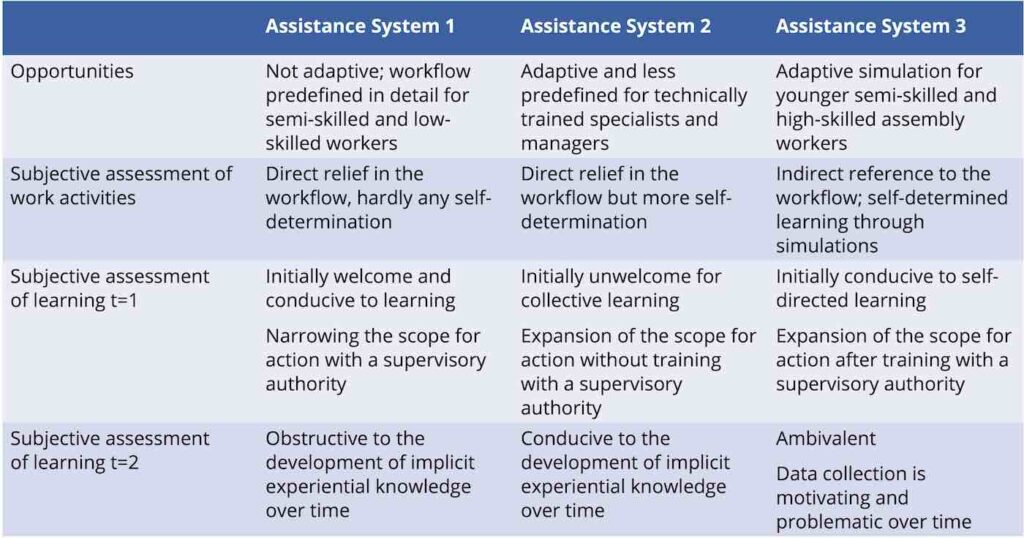
A comparison of the assistance systems is shown in Figure 3.
Unresolved areas of tension
Cognitive assistance systems help to identify opportunities for upskilling in assembly, for example the learning of new tasks that arise either through other new technologies or through changed workflows, as well as in coping with complex work requirements. Adaptive and tutorial AS are more needs-oriented than strongly pre-structured AS, as they take into account the individual prior knowledge of employees and promote the further development of experiential knowledge.
Despite the relieving effects, however, an overly optimistic view of assistance systems falls short of the mark. Works councils point out challenges:
“Technical support can perhaps prevent deskilling and enable employees to learn from mistakes, but personalized learning that takes place outside daily work and in specially designated rooms costs the company and requires time off. We still have to negotiate that.”
The development of AS predominantly conforms to a management ideal geared towards increasing efficiency and a zero-defect policy. This results in standardized processes and the networking of algorithmic systems, which usually happens beneath the surface but can, in the long term, lead to the “measuring of work” [26]. From the point of view of the works councils interviewed, adaptive AS in particular present an area of tension between the promotion of learning and control mechanisms:
“There are also problematic control potentials, as assistance systems use sensors to record the speed of the actions performed and the data in turn flows into production planning as available information to increase efficiency in production. We also need to sensitize the workforce to this.”
Assistance systems that are used for low-skilled work—as a “complementary technology for process rationalization” [29b]—do not promote upskilling. On the contrary, permanently following specific instructions creates subjective experiences of devaluation and a loss of the significance of experiential knowledge. This results in a decreasing acceptance of technology and a decreasing willingness to learn. In the long term, the risk of deskilling cannot be ruled out due to cognitive underload, while technical potential for independent adaptation to existing knowledge remains untapped.
AS with additional integrated learning content that is not only oriented towards the functionalist learning objectives of the current workplace would be important, as would company-based learning opportunities that enable participation despite tight production schedules. [10]
When it comes to learning with assistance systems, works councils point to a need for regulation and emphasize the far-reaching consequences of AS that are too tightly structured. According to them, the prospect of a potential reduction in training time with AS creates unfavorable incentives for companies to rely even more on temporary work in the future from an efficiency perspective, with the accompanying risk of falling wage standards:
“Standardizing assembly with constant instructions can promote the loss of cognitive skills and lower wage levels in the long term. This is often not considered.”
In contrast, other works councils point to stable wage levels in the industry and emphasize that although they can prevent possible pay cuts for existing staff, but cuts in future wages cannot be ruled out:
“As you can see, the complexity remains the same, as does the salary bracket. […]. We want our colleagues to keep their money […]. But who knows: when new people are hired, the world often looks very different.”
The risk of deskilling not only results from prevailing models in technology development or the pre-structured nature of previous assistance systems. Rather, individual learning and the organization of learning also depend on functioning co-determination. For example, semi-skilled workers in SMEs as well as in large companies addressed the issue of insufficient demand, but this was hardly taken up in social interactions, as the exchange was mainly determined by employees with an affinity for technology and, as expected, hardly any works councils were involved.
The works councils surveyed are divided on the topic of their involvement and co-determination. Many report their increasing involvement in pilot projects and are in favor of special exchange formats for needs-based technology design. At the same time, the form of the technology often makes it difficult to develop suitable regulations with regard to the avoidance of technology-supported performance monitoring.
They also criticize the lack of insight on the part of management regarding how to deal with the emptying of work content for semi-skilled workers, a topic which hardly ever finds its way into technology development. They are critical of involving employees at an early stage, as there is a risk that employees would contribute to a devaluation of their own skills.
The empirical results contribute to the ongoing debate on the transformation of work with Industry 4.0. The analysis of cognitive assistance systems takes a critical approach to the consequences of previous standards in technology development, even if the case-specific data does not allow to generalize the developments.
In summary, the future will depend on responsible technology development that takes into account the experiences of all employees in work-integrated learning with human-centered guiding principles, but without unnecessary control mechanisms. Furthermore, management must also provide additional learning opportunities especially for employees assigned to low-skilled work. In this way, the financial devaluation of labour can be prevented.
Bibliography
[1] Apt, W.; Schubert, M.; Wischmann, S.: Digitale Assistenzsysteme. Prospects and challenges for use in industry and services. iit – Institute for Innovation and Technology. Berlin 2018.[2] Apt, W.; Bovenschulte, M.; Priesack, K.; Hartmann, E. A.; Weiß, C.: Einsatz von digitalen Assistenzsystemen im Betrieb. iit – Institute for Innovation and Technology. Berlin 2018.
[3] Stich, V.; Gudergan, G.; Senderek, R.: Arbeiten und Lernen in der digitalisierten Welt. In: Hirsch-Kreinsen, H.; Ittermann, P. (ed): Digitalization of industrial work. Baden-Baden 2015, pp. 109-130.
[4] Spath, D.; Ganschar, O.; Gerlach, S.; Hämmerle, M.; Krause, T.; Schlund, S.: Produktionsarbeit der Zukunft – Industrie 4.0. Fraunhofer IAO. 2013.
[5] Ittermann, P.; J. Niehaus, 2018: Industrie 4.0 und Wandel von Industriearbeit – revisited. Forschungsstand und Trendbestimmungen. In: H. Hirsch-Kreinsen, P. Ittermann, J. Niehaus (ed) Digitalisierung industrieller Arbeit. Die Vision Industrie 4.0 und ihre sozialen Herausforderungen, Baden-Baden: Nomos, pp. 33-60.
[6] Hirsch-Kreinsen, H.: Einleitung: Digitalisierung industrieller Arbeit. In: Hirsch-Kreinsen, H.; Ittermann, P.; Niehaus, J. (ed): Digitalisierung industrieller Arbeit. Die Vision Industrie 4.0 und ihre sozialen Herausforderungen. Baden-Baden 2018, pp. 13-32.
[7] Hirsch-Kreinsen, H.: Digitalisierung industrieller Einfacharbeit. Entwicklungspfade und arbeitspolitische Konsequenzen. In: Work 26 (2017) 1, pp. 7-32.
[7a] Hirsch-Kreinsen, H.; Ittermann, P.; Falkenberg, J.: Szenarien digitalisierter Einfacharbeit: Konzeptionelle Überlegungen und empirische Befunde aus Produktion und Logistik. Baden-Baden 2019.
[7b] Ittermann, P.; Ortmann, U.; Virgillito, A.; Walker, E.: Hat die Digitalisierung disruptive Folgen für Einfacharbeit? Kritische Reflexion und empirische Befunde aus Produktion und Logistik. In: Industrielle Beziehungen. Zeitschrift für Arbeit, Organisation und Management 26 (2019) 2, pp. 150-168.
[8] Kuhlmann, M.; Splett, B.; Wiegrefe, S.: Montagearbeit 4.0? A Eine Fallstudie zu Arbeitswirkungen und Gestaltungsperspektiven digitaler Werkerführung. In: WSI Mitteilungen (2018), pp. 182-188.
[9] Baethge-Kinsky, V.; Kuhlmann, M.; Tullius, K.: Technik und Arbeit in der Arbeitssoziologie – Konzepte für die Analyse des Zusammenhangs von Digitalisierung und Arbeit. In: AIS-Studien 11 (2018) 2, pp. 91-106.
[10] Warnhoff, K.; De Paiva Lareiro, P.: Skill Development on the Shop Floor – Heading to a Digital Divide? In: Proceedings of the Weizenbaum Conference 2019 “Challenges of Digital Inequality – Digital Education, Digital Work, Digital Life”, pp. 1-10.
[11] Vladova, G.; Wotschack, P.; EN Paiva Lareiro, P.; Gronau, N.; Thim, C.: Lernen mit Assistenzsystemen. Vor lauter Aufgaben den Prozess nicht sehen? In: Industrie 4.0 Management 36 (2020) 3, pp. 16-20.
[12a] Schröder, C.: Herausforderungen von Industrie 4.0 für den Mittelstand. Bonn 2016.
[13] MacKenzie, D.; Wajcman, J.: The Social Shaping of Technology. In: MacKenzie, D.; Wajcman, J. (ed): The Social Shaping of Technology (1985), pp. 2-25.
[14] Rammert, W.: Die technische Konstruktion als Teil der gesellschaftlichen Konstruktion der Wirklichkeit. In: Technik – Handeln – Wissen. Wiesbaden 2016.
[15] Böhle, F.; Bolte, A.; Neumer, J.; Pfeiffer, S.; Porschen, S.; Ritter, T.; Sauer, S.; Wühr, D.: Subjektivierendes Arbeitshandeln – „Nice to have“ oder ein gesellschaftskritischer Blick auf „das Andere“ der Verwertung? In: Arbeit als Subjektivierendes Handeln 4 (2011) 2, pp. 16-26.
[16] Böhle, F.: Arbeit als Handeln. In: Böhle, F.; Voß, G. G.; Wachtler, G. (ed): Handbuch Arbeitssoziologie. Wiesbaden 2018.
[17] Niehaus, J.: Mobile Assistenzsysteme für Industrie 4.0: Gestaltungsoptionen zwischen Autonomie und Kontrolle. (FGW-Studie Digitalisierung von Arbeit, 4). Forschungsinstitut für gesellschaftliche Weiterentwicklung e.V. (FGW). Dusseldorf 2017.
[18] Falkenberg, J.: Mobile Kontrolleure. A Eine arbeitssoziologische Analyse digitaler Assistenzsysteme in der Logistik 4.0. In: Hirsch-Kreinsen, H.; Karacic, A. (ed): Logistikarbeit in der digitalen Wertschöpfung. Perspektiven und Herausforderungen für Arbeit durch technologische Entwicklungen. Dusseldorf 2018, pp. 37-56.
[19] Backhaus, N.: Kontextsensitive Assistenzsysteme und Überwachung am Arbeitsplatz: Ein meta-analytisches Review zur Auswirkung elektronischer Überwachung auf Beschäftigte. In: Zeitschrift für Arbeitswissenschaft 73 (2019) 1, pp. 2-22.
[20] Dehnbostel, P.: Betriebliche Lernorte, Lernräume und Selbstlernarchitekturen. In der digitalisierten Arbeitswelt. In: Magazin Erwachsenenbildung (2019), pp. 35-36.
[21] Kelle, U.; Kluge, S.: Vom Einzelfall zum Typus: Fallvergleich und Fallkontrastierung in der qualitativen Sozialforschung. Wiesbaden 2010.
[22] Pflüger, J.; Pongratz, H.; Trinczek, R.: Fallstudien in der deutschen Arbeits- und Industriesoziologie. Eine Bestandsaufnahme. In: Industriesoziologische Fallstudien: Entwicklungspotenziale einer Forschungsstrategie. Berlin 2010, pp. 22-71.
[23] Yin, R. K.: Case study research and applications. Design and methods. Los Angeles 2018.
[24] Gläser, J.; Laudel, G.: Experteninterviews und qualitative Inhaltsanalyse als Instrumente rekonstruierender Untersuchungen. Wiesbaden 2010.
[25] Huchler, N.: Grenzen der Digitalisierung von Arbeit – Die Nicht-Digitalisierbarkeit und Notwendigkeit impliziten Erfahrungswissens und informellen Handelns. In: Zeitschrift für Arbeitswissenschaft 71 (2017) 4, pp. 215-223.
[26] Krzywdzinski, M.; Pfeiffer, S.; Evers, M.; Gerber, C.: Measuring Work and Workers. Wearables and Digital Assistance Systems in Manufacturing and Logistics. In: WZB Discussion Paper SP III 2022-301. Berlin 2022.
[27a] Rammert, W.: Prozesse der Technikgenese und der Stellenwert von Leitbildern der Technikentwicklung. In: E. Fricke (ed.): Zur Zukunftsorientierung von Ingenieuren und Naturwissenschaftlern. Friedrich-Ebert-Stiftung. Bonn 1994, p. 15.
[27b] Rammert, W.: Die technische Konstruktion als Teil der gesellschaftlichen Konstruktion der Wirklichkeit. In: Technik – Handeln – Wissen. Wiesbaden 2016.
[28] Pfeiffer, S.; Suphan, A.: Industrie 4.0 und Erfahrung – das Gestaltungspotenzial der Beschäftigten anerkennen und nutzen. In: Hirsch-Kreinsen, H.; Ittermann, P.; Niehaus, J. (ed): Digitalisierung industrieller Arbeit. Die Vision Industrie 4.0 und ihre sozialen Herausforderungen. Baden-Baden 2018, pp. 205-230.
[29a] Huchler, N.: Die ‘Rolle des Menschen’ in der Industrie 4.0: Technikzentrierter vs. humanzentrierter Ansatz. In: Arbeits- und Industriesoziologische Studien 9 (2016), pp. 57-79.
[29b] Huchler, N.: Komplementäre Arbeitsgestaltung. Grundrisse eines Konzepts zur Humanisierung der Arbeit mit KI. In: Zeitschrift für Arbeitswissenschaft 76 (2022) 2, pp. 158-175.
[30] Kuhlenkötter, B. et al.: Mitbestimmung und Partizipation im Transformationsprozess zur Industrie 4.0. In: Arbeit 28 (2019), pp. 401-422.
Your downloads
Potentials: Training
Solutions: Assembly Production Planning
You might also be interested in