I4S 5/2025: Artificial Intelligence and Digital AssistanceHow we can better support work
|

|

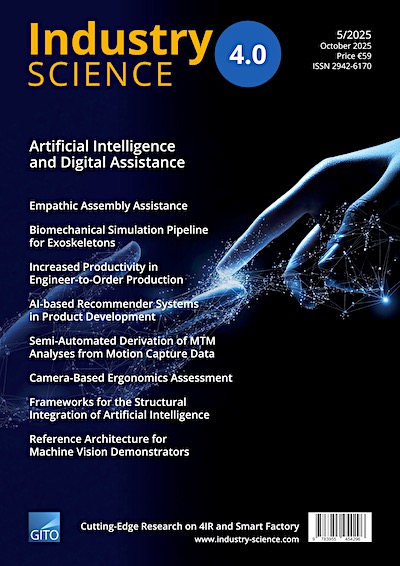
German industry faces enormous challenges: demographic change, ecological transformation, geopolitical risks, and a high need for investment in infrastructure are compounded by stagnating productivity and a growing shortage of skilled workers. At the same time, technological advances are opening up new opportunities: artificial intelligence and digital assistance systems can make work more efficient and productive. While they have long been part of our everyday lives, their use in industry has so far fallen short of their potential. The Scientific Society for Work and Business Organization (WGAB) shows how innovative concepts can effectively support human work and open up new ways to strengthen competitiveness.
All articles at a glance
- Empathic Assembly Assistance
Combining AI-based data analysis and empathic human digital twins - AI-Supported Personnel Planning in Industrial Maintenance
User-centered development and implementation in a pilot project - Applied Knowledge and Augmented Reality
Bridging the gap between learning and application - Biomechanical Simulation Pipeline for Exoskeletons
A digital tool for the targeted development of support systems - Human-Centered AI-Paired Work Systems
Integrating GenAI and the human factor in work system theory - Bridging Knowledge Gaps with GenAI in Industrial Maintenance
Specific needs and contextualized solutions - Mechanisms of GenAI Governance
A case study on the responsible use of GenAI in organizations - Assistance for Simulation in Production and Logistics
A literature-based classification - Increased Productivity in Engineer-to-Order Production
Digital assistance between design and production in shipbuilding - Automation of Production Planning and Control
A deep dive into production control with intelligent agents - AI-Based Recommender Systems in Product Development
A framework for knowledge discovery from multimodal data in industrial applications - The Bias of “Instructional Systems for the Disabled”
Ethnographic insights from deploying augmented reality in a sheltered workshop - Derivation of MTM Analyses from Motion Capture Data
Evaluation of the procedure and comparison with a manual MTM analysis - Camera-Based Ergonomics Assessment
Developing a method for use in manual assembly - AI Smart Workstation for Industrial Quality Control
Enhancing productivity through vision systems, real-time assistance, and Axiomatic Design - Data-Driven Assistance Systems in the Working Environment
Efficient development of target group-specific BI dashboards in companies - Frameworks for the Structural Integration of Artificial Intelligence
Comparing organizational approaches - Towards Human-Centered Industrial AI Adoption
A reference architecture for machine vision demonstrators
Access limited
You are currently not logged in / not yet registered.
In order to download the desired file(s), you must be logged in and have an appropriate inclusive subscription. Alternatively, you can also obtain access by paying a one-off fee.
| Subscription | included | Purchase |
|---|---|---|
| without | − | 59,00 € |
| Digital | − | 56,05 € |
| Expert | − | 53,10 € |
| Professional | ✓ | 0,00 € |
All prices include 7% VAT
After purchasing access rights, you will automatically be redirected back to this page.
You might also be interested in