Optimizing the Budgeting Process with Digital Twins |
Dashboards and process mining for process-oriented performance measurement
| Journal | Industry 4.0 Science |
| Issue | Volume 41, Edition 2, Pages 52-58 |
| Bibliography | Share | Cite | Download |
Abstract
Article
Enhanced predictability in the budgeting process
Integrated IT systems and processes automated by workflows improve the predictability of planning data in the company. The traditional planning and budgeting process often ties up a lot of capacity in the controlling department. Digital twins in combination with dashboards and process mining can support companies in visualizing the actual state of the budgeting process as well as identifying and evaluating possible target states, using process simulations.
The planning and budgeting process
A budget is a formal, value-based plan set for a decision-making unit, outlining targets for a specific period with a defined level of commitment. The resulting budget for the next financial year includes the definition, setting and monitoring of formal targets. It describes the financial impact of actions and serves to achieve value-based results [1].
Traditional budgeting
According to Horváth, the traditional planning and budgeting process consists of 5 components (see Figure 1).
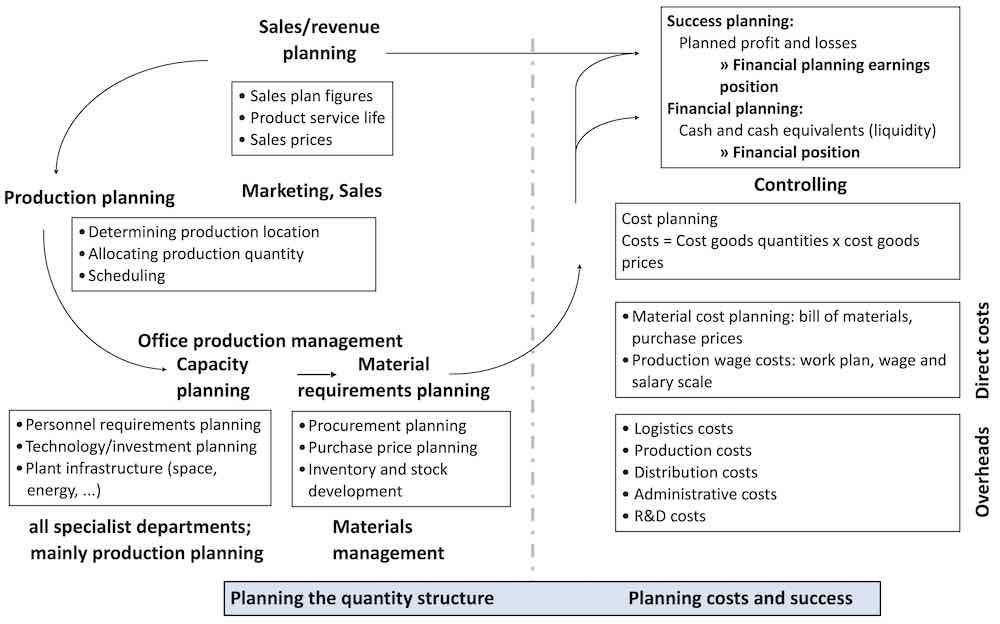
Budgeting typically starts in the sales area. Forecasting sales per product group at an early stage poses a significant challenge, as the current financial year and its sales figures are often not yet mapped in Controlling. The inventory, including the safety stock, is determined in the logistics and production sector. In addition, it is essential to establish the number of active production sites and identify which systems are available and which investments in new machines are needed.
Personnel planning is a key parameter next financial year’s budget. This involves determining the headcounts and capacities (full-time equivalents) within the company’s individual departments.
The procurement area determines the materials of individual material groups A, B and C, as well as the raw materials and supplies (RHB) required in the production business. Thus, individual suppliers can be contacted and informed which items are likely to be ordered in the new financial year, at what quantity and at what time. Material purchasing is linked to stockpiling in commission and central warehouses. This facilitates the planning of stock levels, which are reflected in the balance sheet under the inventories item, encompassing all raw, auxiliary, and operating materials, as well as finished goods.
The first stage of action and quantity planning has thus been completed by planning various quantities such as the number of items to be produced, the number of staff employed and the number of existing and new machines.
The budgeting process is finalized in the second stage of Controlling and brought together with the management oncer the budget has been agreed upon. All completed planning templates from the specialist departments are imported into the system, ensuring that the core components of the income statement, cash flow statement and balance sheet are finalized. Many companies conduct their annual budgeting process based on historical data, often using tools such as Excel, due to the large volume of different data required. Very few companies use digital twins to map the budgeting process and describe it in more detail.
Innovative technologies to optimize the budgeting process
New technologies help speeding up the budgeting process and improve the predictability of planning data.
Digital twins can be described as a virtual representation of a real product or process. In contrast to digital models and digital shadows, this innovative technology is based on a fully automated, two-way data exchange between the real and digital object (see Figure 2).
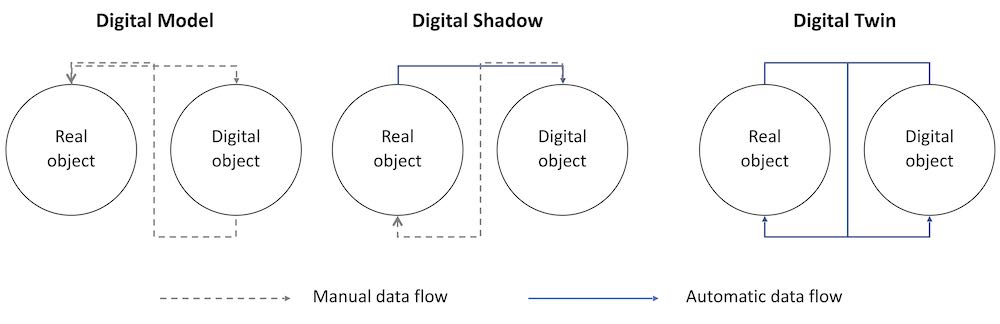
There are considerable differences in the definitions found in relevant literature [4]. However, the consensus is that the focus is on simulation and the development of infrastructural requirements, with the goal of establishing standards.
If the traditional budgeting process is viewed as a model approach, digital twins can be used to enhance it: For example, digital budgeting can combine data as a “single source of truth” and use it throughout the entire life cycle. Actual, planned and target data can be supplemented with synthetic data for simulations. The artificially generated data sets can be used for scenarios to evaluate risks. This facilitates the design of what-if studies. They can also be used to generate forecast and prediction values [5]. Digital twins can be understood as a comprehensive framework for integrating g innovative technologies aimed at enabling process optimization and data-driven corporate management.
Modern BI tools with associated dashboards offer integrated and collaborative solutions for planning, simulation and forecasting. They can also be used to incorporate workflow, security and versioning mechanisms. Associated platforms combine data from different sources and eliminate the separation between reporting and planning.
Dashboards are suitable tools for understanding and using data and its correlations through visualization [6]. They are used in various areas, such as business intelligence, and incorporate various visual elements such as graphics, diagrams and charts to present information in an easily comprehensible manner. Effective dashboard design is crucial for communicating information clearly and efficiently, enabling users to make informed decisions and gain valuable insights from data. They can be generated based on design principles such as the International Business Communication Standards [7]. In combination with key figures, they enable decision support throughout the process.
In recent years, process mining has established itself as a successful tool for process analyses [8]. While budgeting focuses on the content of financial planning and control, process mining can be used to analyze process flows in general. This approach is suitable for automatically analyzing existing business processes for variants and their efficiency (see Figure 3). Process mining therefore proves to be suitable for utilizing automation potential for planning and budgeting processes and for ensuring improved transparency in decision-making.
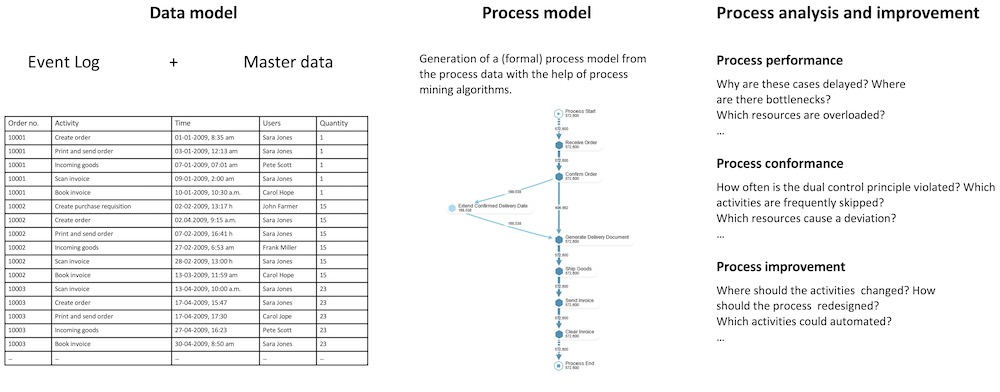
Process mining is based on event logs, which record information about process activities, time stamps and the actors involved in combination with master data from upstream IT systems. Event logs with relevant attributes can be generated using suitable KPIs. Automatically generated actual process models enable the identification of discrepancies, bottlenecks and deviations from the intended process as part of process discovery. Conformance checking with a target process or permitted activities can be used to support internal controls.
Process mining dashboards and links with other digital technologies (e.g. machine learning) can help to identify the causes of process inefficiencies or deviations. Budget process analyses can be conducted in real time to monitor process efficiency and identify areas for improvement. Overall, the automation capabilities of process mining can be used to increase process transparency, identify opportunities for improvement and optimize resource allocation. Advanced process mining tools also offer simulation capabilities to measure the potential impact of changes.
Digital budgeting
The tools that can be used within the traditional budgeting process may be integrated into a comprehensive concept combining a digital twin with a BI and process mining dashboard:
Reporting sales figures for the following financial year poses problems for the sales department every year. Not all trade fairs have taken place yet, reports on sales figures for new products from the sales force are subjective and sales forecasts for the individual sales regions vary greatly. A basic digital interface of the sales system featuring the articles sold in the last 5 years creates clarity and can be used as a basis for the budgeting process in the next year.
The time-consuming manual retrieval of planning data from individual sales areas is no longer necessary. This way, sales managers gain more time to increase sales in the last six months. The sales plan data for the upcoming year is automatically extracted and integrated into the digital twin concept using process mining software.
The automated visualization of actual process structures through process mining is particularly beneficial in logistics and production.
Process visualization can serve as the basis for holistic business process management: Target activities, sub-processes and main processes can be modeled and used for process performance measurement as an innovative controlling tool [10]. Corresponding results can be used for budgeting.
With personnel planning across the entire company, the process structures of the individual departments are linked to the planned capacities. As a result of an analysis, expensive personnel costs provide indications for optimization potential, which can ideally be integrated as a challenge in the budgeting process for the next financial year. Mapping the personnel planning process using digital twins is an effective approach.
In a process-based digital twin strategy, target/actual comparisons of material quantity and price against previous years can be effectively conducted during material procurement. Simulations reveal critical process deviations [11], such as when a supplier is unable to deliver due to a crisis and a switch to another supplier at a higher purchase price results in increased planned costs in the budgeting process.
Improvements through process mining can be achieved at the end of budgeting processes, when the controlling department is required to make the planning data transparent.
Challenges for digital budgeting
Digital twins can be characterized as images of real products or processes and form the conceptual starting point of business intelligence and process mining solutions. In this model case, the budgeting process is to be completely transferred into the event log of a process mining tool. The so-called “Extraction-Transformation-Loading (ETL)” approach is a suitable solution for this: the ETL process enables companies to consolidate and standardize data from diverse sources, making it suitable for analyses and reporting. To accomplish this, it is essential to identify relevant data sources and establish the necessary IT interfaces, such as Application Programming Interfaces (APIs).
The process mining approach requires all steps to be logged with a time stamp and is based on so-called “Process-Aware Information Systems” (PAIS). These are software systems that manage and execute operational business processes based on process models [12].
The selection of suitable key figures is essential for the design of a business intelligence dashboard. Standardized design, functional requirements and usability also play an important role. This includes so-called “responsive design”, i.e. the ability to automatically adapt to different devices and screen sizes.
From a business management perspective, planning data must be generated for budgeting to facilitate conducting target/actual comparisons. Scenario-based simulation data is required to enhance the evaluation of future-oriented perspectives such as risk aspects.
Measuring success in digital budgeting processes
The definition of qualitative and quantitative key performance indicators (KPIs) is particularly relevant for dashboards, where these key figures can be integrated as values or graphics. In addition to the order processing and production time, the receivables processing time or budget entry time can be measured and optimized in the system.
In terms of costs, key figures, such as personnel costs, costs of individual processes (purchasing costs or production and sales costs), are interesting and can ideally be compared with the previous year or the overall trend. Qualitative key figures, such as the complaint rate and the training rate play a significant role in simulating the budget for the upcoming financial year. Measures aimed at reducing the complaint rate and increasing the training rate must be cost-approved and incorporated into the budgeting process.
Digital twins, dashboards and process mining require an understanding of processes
Mapping and controlling company and order processing processes generally enhance transparency within the organization. In addition, integrating digital twins, dashboards and process mining in the budgeting process creates considerable potential for improvement [13]. Considerable preparatory work is required in the controlling area, including the creation of process visualization using appropriate tools and the development of relevant key performance indicators within dashboards. Fundamentally, gaining comprehensive insight into the actual processes is essential. This requires controllers to have a solid understanding of both key figures and processes.
Bibliography
[1] Hauer, G.; Ultsch, M.: Unternehmensführung kompakt. Munich2010.[2] Horvath, P.; Gleich, R.; Seiter, M.: Controlling, 15th edition. Munich 2024.
[3] Singh, M.; Fuenmayor, E.; Hinchy, E. P.; Qiao, Y.; Murray, N.; Devine, D. M.: Digital Twin: Origin to Future. In: Applied System Innovation (2021) 4, DOI: https://doi.org/10.3390/asi4020036.
[4] Klostermeier, R.; Haag, S.; Benlian, A.: Digitale Zwillinge. In: Meinhardt S.; Pflaum A.: Digitale Geschäftsmodelle – Edition 1. Wiesbaden 2019, pp. 255–270.
[5] Morelli, F.; Schnabel, K.: Controlling: Predictive Analytics und Forecasting. In: WISU – Das Wirtschaftsstudium 51 (2022) 1, pp. 77-83, 111.
[6] Baars, H.; Kemper, H.-G.: Business Intelligence & Analytics, 4. Edition. Wiesbaden 2021.
[7] International Business Communication Standards. URL: https://www.ibcs.com/ibcs-standards-1-2/, accessed 08.01.2025.
[8] Morelli, F.; Noé, F.: Process Mining. In: WISU – Das Wirtschaftsstudium 10/2024, pp. 921–926, 942–943.
[9] Celonis SE: Einführung zu Process Mining (EMS). In: Präsentationsunterlagen „8c) Einführung zu Process Mining (EMS) “,Celonis Academic Alliance, 41 pages, Munich 2023.
[10] Binder, B. C. K.; Morelli, F.: Innovative Controlling-Instrumente – agil und stimmig eingesetzt. In: Controller-Magazin 1 (2024), pp. 70–76.
[11] Nasca, D.; Munck, J. C.: Controlling-Hauptprozesse: Einfluss der digitalen Transformation, Zukunft vs. Vergangenheit: Planung, Budgetierung und Forecast in Zeiten der digitalen Transformation. URL: https://www.haufe.de/finance/haufe-finance-office-premium/controlling-hauptprozesse-einfluss-der-digitalen-transformation_idesk_PI20354_HI12076805.html, accessed 08.01.25.
[12] Van der Aalst, W. M. P.: Process-Aware Information Systems: Lessons to Be Learned from Process Mining. In: Jensen, K.; van der Aalst, W. M. P. (Ed.): Transactions on Petri Nets and Other Models of Concurrency II. Lecture Notes in Computer Science, edition. 5460. Berlin Heidelberg 2009.
[13] Ehrich, J.: 4 Schritte: Erstellen Sie Ihren digitalen Zwilling mit Process Mining. 2010. URL: https://der-prozessmanager.de/aktuell/news/process-mining-4-schritte-zum-digital-twin, accessed 27.12.2024.
You might also be interested in