KI

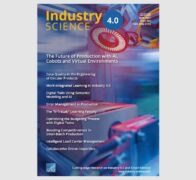
I4S 5/2025: Artificial Intelligence and Digital Assistance

I4S 5/2025: Artificial Intelligence and Digital Assistance

How we can better support work
Demographic change, skills shortages, and stagnating productivity are threatening the competitiveness of German industry. At the same time, AI and digital assistance systems are opening up new opportunities: they make work more efficient and support skilled workers. But while they have long been part of everyday life, their potential in industry remains largely untapped—this is where this issue comes in with innovative concepts.
AI Smart Workstation for Industrial Quality Control

AI Smart Workstation for Industrial Quality Control

Enhancing productivity through vision systems, real-time assistance, and Axiomatic Design
Leonardo Venturoso ORCID Icon, Simone Garbin ORCID Icon, Dieter Steiner, Dominik T. Matt
Traditional quality control often falls short in high-mix, low-volume production environments due to variability and complexity. This project introduces an advanced workstation to boost industrial productivity and quality, developed with Axiomatic Design to ensure a clear link between customer needs, functional requirements, and design solutions. Combining polarization cameras, high-resolution imaging, adaptive lighting, and deep learning-based computer vision, the system performs high-accuracy inspection on quantity, quality, and compliance. A digital assistance system offers real-time feedback via an intuitive interface. Validation in a controlled environment confirmed both the system’s practical benefits and its scalability.
Industry 4.0 Science | Volume 41 | 2025 | Edition 5 | Pages 128-134 | DOI 10.30844/I4SE.25.5.124
Data-Driven Assistance Systems in the Working Environment

Data-Driven Assistance Systems in the Working Environment

Efficient development of target group-specific BI dashboards in companies
Martin Schmauder ORCID Icon, Gritt Ott ORCID Icon, Martin Hahmann
Dashboards play a key role in informed business decisions. Based on findings from an action research process, this article shows how company-specific solutions can be systematically developed and bad investments avoided. The provision of IT capacities, securing data access, formulating requirements, and developing the data model prove to be particularly critical.
Industry 4.0 Science | Volume 41 | 2025 | Edition 5 | Pages 136-143 | DOI 10.30844/I4SE.25.5.130
Automation of Production Planning and Control

Automation of Production Planning and Control

A deep dive into production control with intelligent agents
Jonas Schneider, Peter Nyhuis ORCID Icon, Matthias Schmidt
How can artificial intelligence (AI) automate production planning and control? This study examines its potential to enhance efficiency in modern production environments. The focus is on establishing a robust data infrastructure that integrates real-time, historical, and contextual data to create a solid basis for AI models. Reinforcement learning (RL) is applied to aid automation. A roadmap for implementation, focusing on practical application, is presented. This roadmap incorporates simulation-based training methods and outlines strategies for continuous improvement and adaptation of production processes.
Industry 4.0 Science | Volume 41 | 2025 | Edition 5 | Pages 86-93 | DOI 10.30844/I4SE.25.5.84
Field Meets Code

Field Meets Code

Artificial intelligence for better collaboration in software development
Andreas Groche, Dominik Augenstein
Software development is fundamental to digital transformation. A good foundation of data is required for developers to tailor software to the needs of the commissioning department. Unfortunately, the data models required for this are incomplete, often created unilaterally by the development department and not embedded in the business context. This makes it difficult for both developers and AI to find the right algorithms. The present approach increases understanding and exchange between the specialist and development departments and offers digital assistance with data modeling as a basis for software development. Furthermore, AI approaches can help to increase the quality and completeness of the data.
Industry 4.0 Science | Volume 41 | Edition 4 | Pages 104-110
I4S 2/2025: The Future of Production with AI, Cobots and Virtual Worlds

I4S 2/2025: The Future of Production with AI, Cobots and Virtual Worlds

Technology needs innovative, value-adding business models
Artificial intelligence, collaborative robotics, and virtual worlds, such as the metaverse, are fueling visions for new forms of industrial value creation. However, innovation alone is not enough—given that these technologies only develop their full potential through intelligent business models. How can companies efficiently integrate AI-supported automation, cobots and digital twins into their processes?
I4S 1/2025: 40 Years of Digital Transformation in Manufacturing

I4S 1/2025: 40 Years of Digital Transformation in Manufacturing

Key research questions for tomorrow's production and logistics
Digital transformation has been a central focus of scientific discussions for years. Questions relating to data-driven decisions, artificial intelligence and resilient supply chains are at the heart of current research. The articles in this issue explain key trends and present scientific findings and practical solutions - from automation and the circular economy to cloud computing.
Introduction of Machine Learning in Production

Introduction of Machine Learning in Production

An SME-specific, holistic guide
Manuel Savadogo, Malte Stonis ORCID Icon, Peter Nyhuis ORCID Icon
Machine learning offers a wide range of potential, especially in production, and is therefore becoming increasingly important. However, small and medium-sized businesses are lacking guidelines that are specifically tailored to their individual challenges to guide them step-by-step through the process. In conjunction with a potential analysis, the determination of relevant prerequisites and a maturity assessment, this article can serve as a guide for SMEs.
Industry 4.0 Science | Volume 40 | 2024 | Edition 6 | Pages 88-95
Can Artificial Intelligence (AI) Act as an Enabler for Industry 4.0 (4IR)?

Can Artificial Intelligence (AI) Act as an Enabler for Industry 4.0 (4IR)?

Impacts on the maturity level of Industry 4.0 technologies
Dennis Richter, Mildred Doe, Steffen Kinkel ORCID Icon
Artificial intelligence is often mentioned often mentioned in the same context as Industry 4.0, but the exact role of AI is unclear. Is AI just another 4IR technology or an essential "enabler" for other 4IR technologies? Six experts assess the impact of AI on 41 4IR technologies. AI could indeed be a decisive factor in unleashing the full potential of Industry 4.0.
Industry 4.0 Science | Volume 40 | 2024 | Edition 6 | Pages 80-87 | DOI 10.30844/I4SE.24.6.80
Intelligent Shopfloor Assistants

Intelligent Shopfloor Assistants

Increasing productivity through the use of generative AI
Eckart Uhlmann ORCID Icon, Julian Polte ORCID Icon, Christopher Mühlich ORCID Icon, Yassin Elsir
In modern production companies, a heterogeneous IT landscape often complicates day-to-day work. A promising antidote is the use of intelligent agents, which use generative AI for routine tasks and can therefore increase efficiency. Whether these intelligent systems can be successfully integrated into existing networks determines whether the flow of information can be improved and manual effort reduced.
Industry 4.0 Science | Volume 40 | 2024 | Edition 6 | Pages 64-71
1 2