I4S 6/2025: Manufacturing in SpaceInfinite possibilities for industrial production?
09.12.2025
|

|
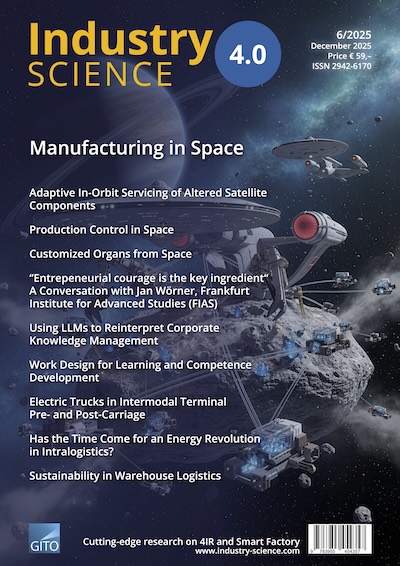
Manufacturing leaves Earth: What long sounded like science fiction is rapidly developing into a strategic field of the future for industry. Falling launch costs and new players in the space industry are making production possible for the first time under completely new conditions—with properties that are impossible on Earth. Whether it’s in-orbit maintenance of satellites, production control in space, or the manufacture of human organs in microgravity, approaches are emerging in space that could transform entire industries. This issue of Industry 4.0 Science highlights opportunities, business models, technological barriers, and the path to scalable value chains beyond Earth’s surface.
All articles at a glance
- Adaptive In-Orbit Servicing of Altered Satellite Components
Adaptive gripper placement on altered components for servicing in-orbit satellites - Production Control in Space
An AI-supported approach for industry in orbit - “Entrepreneurial courage is the key ingredient”
Interview with Prof. Jan Wörner, Director of the Frankfurt Institute for Advanced Studies (FIAS) - Customized Organs from Space
How weightlessness could change human lives - Potentials, Premises, Perspectives
Using LLMs to reinterpret corporate knowledge management - Electric Trucks in Intermodal Terminal Pre- and Post-Carriage
Impact on terminal processes in combined road-rail freight transport - Loam Construction and Wooden Shelving
A contribution to sustainability in warehouse logistics - Has the Time Come for an Energy Revolution in Intralogistics?
The current status of hydrogen fuel cell-powered MHE - Work Design for Learning and Competence Development
Emerging ways of organizing and supporting learning in digitally transformed workplaces - Explainable AI – XAI
Making AI work in business and not just clever sounding
Access limited
You are currently not logged in / not yet registered.
In order to download the desired file(s), you must be logged in and have an appropriate inclusive subscription. Alternatively, you can also obtain access by paying a one-off fee.
| Subscription | included | Purchase |
|---|---|---|
| without | − | 59,00 € |
| Digital | − | 56,05 € |
| Expert | − | 53,10 € |
| Professional | ✓ | 0,00 € |
All prices include 7% VAT
After purchasing access rights, you will automatically be redirected back to this page.
You might also be interested in