Data Quality in the Engineering of Circular Products |
Decision support for circular value creation through data ecosystems

| Journal | Industry 4.0 Science |
| Issue | Volume 41, 2025, Edition 2, Pages 12-19 |
| Open Access | https://doi.org/10.30844/I4SE.25.2.12 |
| Bibliography | Share | Cite | Download |
Abstract
Keywords
Article
Product characteristics and their associated environmental impact are determined in the early stages of the product life. Decisions affecting product sustainability are made during the engineering process. Product engineering methods, models and tools serve as the foundation for these decisions [1, 2]. These aspects are integrated into company-specific processes to efficiently implement sector-related features and dependencies on customer processes. Examples of such implementations are documented in the product engineering processes of automotive manufacturers [3] or suppliers such as Bosch [4].
In particular, interactions within the value creation networks, as well as changing regulatory and political framework conditions, must be considered. CircuLaw, for example, provides an impressive overview of the regulations within the framework of the EU Green Deal [5]. It is essential that the entire product life is considered when planning and engineering a product. One challenge arises while engineering circular products: Circularity strategies must be anchored in the business model for an effective circular economy [6].
Apart from the production and operation of a product, additional data requirements need to be considered: Such a business model can only prevail if the benefits generated during the decommissioning and return processes can be proven. Therefore, the generic product life cycle model emphasizes a strong need for information circularity [6]. Circularity extends dependencies on suppliers and energy providers to encompass aspects such as, the logistics of collecting, inspecting, and processing used materials [7]. This process makes cross-company data exchange very important and depends on data spaces such as Gaia-X, Catena-X and Manufacturing-X [8].
Enabling sustainability assessment through data ecosystems
Data from the entire product life, including internal engineering data and information from value creation partners, is merged using various sustainability metrics. This process incorporates data of varying quality levels. During early stages, catalog data from commercial suppliers allows for initial estimates to be made. However, these estimates are often affected by vague assumptions and gaps in the databases. The data quality is correspondingly low at the beginning of the product life and uncertainty remains high (Figure 1, see [9]).
During engineering, initial assumptions can be refined using data from the production of existing products and later supplemented with operational data. This way, the actual data quality is effectively increased [10] (Figure 1). When assessing sustainability, the quality of the collected data should be explicitly and transparently considered. This ensures that sustainability metrics, corresponding indicators, and other relevant measures provide sufficient validity for approval processes. A comprehensive assessment of data quality requires identifying relevant data quality criteria and indicators. The aim is to maintain the required data quality within the product and process model at each engineering iteration or life cycle stage.
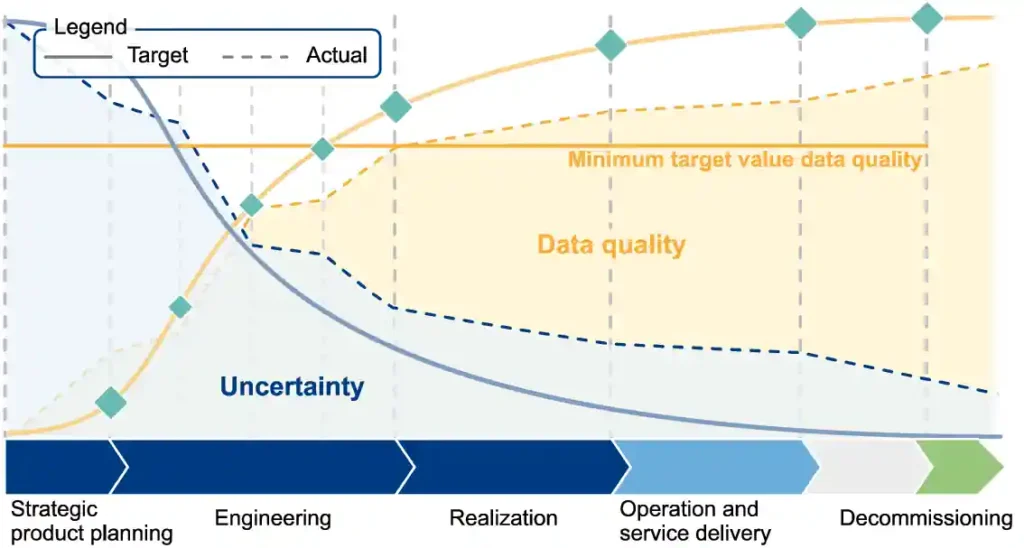
Data quality increases throughout the product life cycle
The reliability of the sustainability assessment depends on the quality of the data used. Data quality criteria are used to assess the quality of both the processes and all associated data sets [13]. Dynamic life cycle assessments are essential for evaluating the environmental impact of products during engineering. These balances offer the possibility to track temporal and process-related changes throughout the product life [14]. For an effective assessment, specific data quality criteria with corresponding characteristics must be defined throughout the entire product life. The necessary characteristics of data quality criteria for sustainability assessment are the subject of various reviews.
The ISO 14000 series of standards serves as the basis for the definition and application of these criteria. This series of standards contains different versions and levels of detail [15]. Due to the industrial relevance of ISO 14040/14044, the criteria of temporal coverage, geographical coverage, technological coverage, accuracy, completeness, representativeness, consistency, comparative accuracy, uncertainty and data source mentioned are commonly applied [16, 17].
Although these criteria are described in the standard, there is no concrete structure for their practical application. However, by evaluating these criteria in specific ways, it is possible to make transferable statements about data quality, identify potential for improvement and analyze uncertainties [18].
The Pedigree matrix is an established tool for evaluating data quality. This matrix defines a selection of data quality criteria and associated semi-quantitative evaluation approaches. A subset of the data quality criteria outlined in ISO 14044 is applied. However, the criteria characterized in the matrix do not allow a qualitative assessment of all areas of data quality, but only the selection of semi-quantitative criteria [19]. Various approaches extend this by integrating flows and processes [19], including qualitative statements [20] and considering the documentation and procedures of the survey [10]. These extensions serve to increase the informative value of the matrix and enable a more flexible application throughout the entire product life.
Based on the established standards and the different approaches, a set of data quality criteria has been developed for sustainability assessment across the entire product life (Fig. 2). These criteria can be divided into inherent and system-related criteria [21]. The inherent criteria assess the data quality based on its domain, the relationship between the values and the metadata. System-related criteria refer to the entire data set and allow for comprehensive analysis. This distinction results in a more comprehensive assessment of data quality and offers a basis for identifying potential for improvement and uncertainties.

Conscious management of data quality in product engineering
Environmental impacts must be assessable throughout the entire engineering process, at every stage of the product life. This approach allows for engineering the product to meet the required standards at key decision points in the engineering process. Data quality should be explicitly and comprehensibly considered in order to implement sustainability metrics and indicators with sufficient significance for the respective approval processes. Semi-quantitative characteristics of the data quality criteria (Fig. 2) provide a practicable basis for the manageability of these criteria. The characteristics enable a characterization of the data quality at a specific point in time and thus facilitate a review of the data quality.
Based on the features of the Pedigree matrix, a selection of semi-quantitative characteristics is presented as an example in Figure 3 [18]. The highest possible value of a criterion corresponds to a value of “4”, which equals optimal data quality. In this adaptation of the model, lower values, down to “0”, indicate a decrease in quality, contrasting with the original Pedigree matrix.
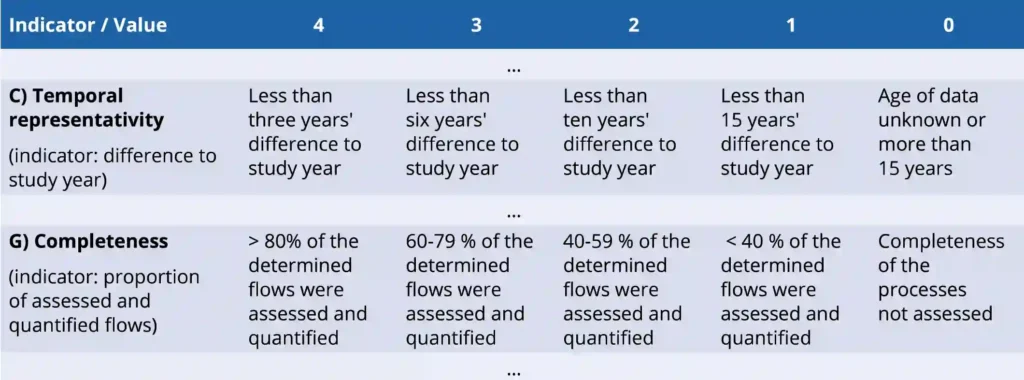
Indicators with relative evaluation – such as completeness – require a definition of the corresponding reference system. For the entire product engineering process, this must correlate with the minimum target value for data quality (Fig. 1). At the early stages of engineering, catalog data from providers such as Sphera can offer initial estimates of higher-level processes. These are refined during engineering using data from the production of current products.
Feasibility establishes the boundary conditions for managing data quality: it involves both the collection of data and the definition of progressively increasing target values throughout the product life and across iterations in product engineering. The conceptual implementation of the model is illustrated using the example of the minimum target values for the data quality criteria in product engineering.
Figure 4 visualizes the minimum target values of the criteria in a radar chart. The specification of target values is recommended on a company-specific but cross-product basis: Once a product creation system or a product engineering process is established within the company, a data quality target value can be defined for each engineering iterations involved. This way, the wide range of regulations and standards within the company become manageable while also ensuring that internal standards from strategic product planning are systematically integrated into engineering projects. By gradually increasing the target values, a continuous improvement in data quality is achieved throughout the product life.
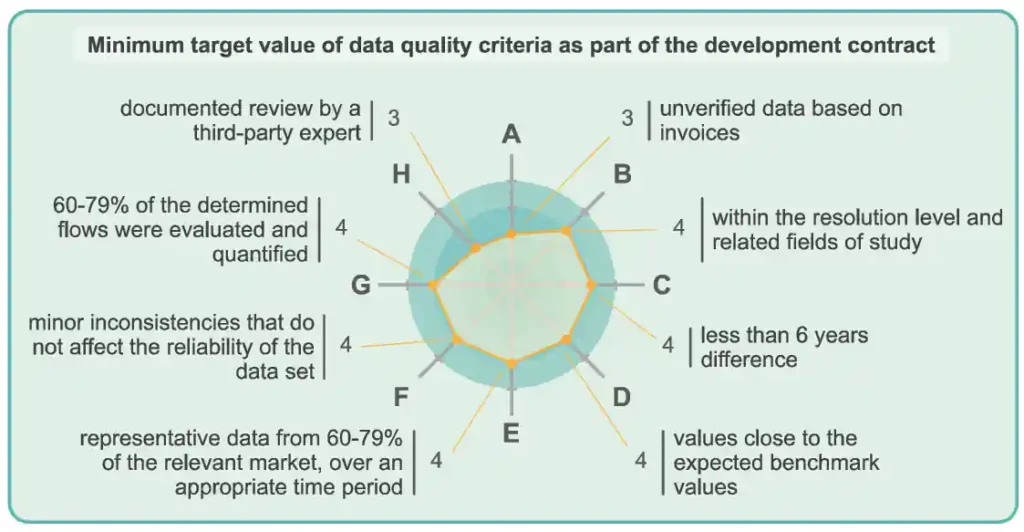
The target values, as part of the engineering assignment, ensure that the analyses are accurate, consistent and representative. The focus is on creating a solid foundation for sustainability assessments as early as the engineering phase, even if the data is still incomplete, unverified or approximate. In product life cycle management, data quality should be further improved during the product’s use phases and production. For representativeness, technology-related statements must be documented and supported by calculations (criterion A à value 3).
Due to the dependence on previously collected data, geographical representation must remain within a resolution level and refer to a related study area (B à 4). The timeliness of the data should differ by no more than six years (C à 4). The accuracy of the data should be consistent with previously established benchmarks (D à 4). Additionally, the data collection method must ensure that at least 60-79% of the relevant market is assessed and represented within a reasonable timeframe (E à 4).
The data set must be robust, meaning that only minor inconsistencies are allowed, as long as they do not impact the reliability of the identified data (F à 4). At least 60-79% of the relevant flows should be fully assessed and quantified (G à 4). By releasing the process to other departments and phases, a review by at least one third-party reviewer is required (H à 3). The relative assumptions, such as those in the data collection methods, are determined by the specification of the objective and scope of the life cycle assessment. By defining data quality criteria along with recommendations for indicators and target values, developers are supported in making a comprehensible and comparable assessment of data quality.
Application of the model using the example of a robotic gripper
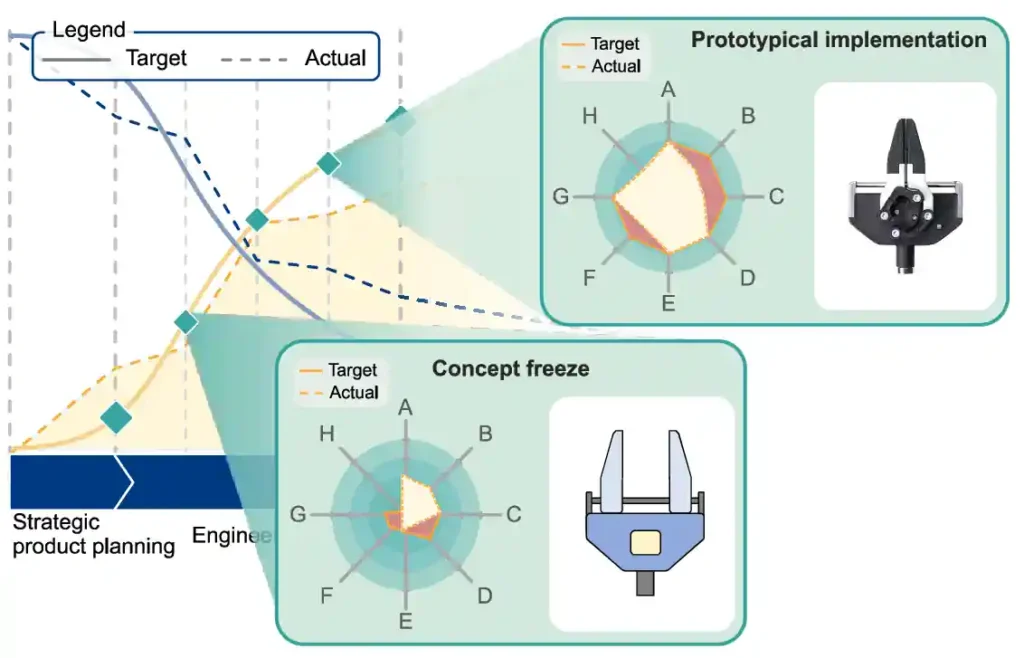
One application of the developed model is illustrated through the case study of a robotic gripper. In this case study, the production system is provided by the “Smart Automation Laboratory”, a research environment for Cyber-Physical Production Systems (CPPS) [22]. Figure 5 visualizes two specific decision points in the engineering process as well as the characteristics of the data quality criteria. For this purpose, data quality is carefully considered during the phases of conceptual definition of product characteristics, the concept freeze, and prototype implementation, prior to final engineering iteration.
Up until the concept freeze, only concept sketches and a small amount of data for a life cycle assessment are available. However, the definition of the desired operating principle significantly influences the subsequent environmental impact and enables an initial, useful assessment. In this case study, individual aspects can be represented using existing documentation. At the same time, process models created for previous products can be partially transferred to the new gripper.
However, the inconsistencies and varying levels of detail in the data reduce the quality of the overall data set. These aspects particularly affect the criteria of completeness and consistency (Fig. 3). Figure 5 visualizes how the defined criteria are applied to the decision points. For the “prototypical implementation”, the target values for all criteria are adjusted closer to the minimum target value for the entire engineering (Fig. 4) compared to the concept freeze. The laboratory environment offers the advantage of providing extensive data from the production infrastructure.
Enabling systematic decisions through data quality
The model offers a systematic approach for the evaluation and targeted improvement of data quality in sustainability-oriented product engineering. By specifying data quality criteria – including completeness, consistency, accuracy and timeliness – with recommended indicators and target values, engineering is supported in producing a comprehensible and comparable assessment.
The quality of the collected data is explicitly and transparently considered to ensure the effective implementation of sustainability metrics at the respective decision points in the product engineering process, providing sufficient informative value. The specification of concrete decision points can be enhanced by incorporating specific sustainability metrics, methods, algorithms and milestones within company-specific engineering processes.
This article was created as part of the “Decide4ECO” project, which is funded by the Federal Ministry for Economic Affairs and Climate Protection (BMWK) under the grant number 13MX002G.
Bibliography
[1] Gräßler, I.; Oleff, C.: Systems Engineering. Verstehen und industriell umsetzen. Berlin Heidelberg 2022.[2] VDI/VDE 2206:2021. Development of mechatronic and cyber-physical systems.
[3] Gräßler, I.; Thiele, H.; Grewe, B.; Hieb, M.: Responsibility Assignment in Systems Engineering. In: Proceedings of the Design Society 2 (2022), pp. 1875-1884.
[4] Gräßler, I.: Kundenindividuelle Massenproduktion. Entwicklung, Vorbereitung der Herstellung, Veränderungsmanagement. Berlin Heidelberg 2004.
[5] EU Regulations for a circular economy, CircuLaw, 2024.
[6] Gräßler, I.; Pottebaum, J.: Generic Product Lifecycle Model: A Holistic and Adaptable Approach for Multi-Disciplinary Product-Service Systems. In: Applied Sciences 11 (2021) 10, p. 4516.
[7] Gräßler, I.; Hesse, P.: Approach to Sustainability-Based Assessment of Solution Alternatives in Early Stages of Product Engineering. Proceedings of the Design Society. 17th International Design Conference. Design Conference, vol. 17. Cambridge, UK 2022, pp. 1001-1010.
[8] Graessler, I.; Pottebaum, J.; Holland, M.; Wiechel, D.; Dickopf, T.; Stjepandić, J.: Leveraging Data Ecosystems in Model-Based Systems Engineering for Ecological, Circular Added Value. In: Cooper, A.; Trigos, F.; Stjepandić, J.; Curran, R.; Lazar, I. (Eds.): Engineering For Social Change. Advances in Transdisciplinary Engineering. IOS Press 2024, pp. 175-184.
[9] Pottebaum, J.; Gräßler, I.: Informationsqualität in der Produktentwicklung: Modellbasiertes Systems Engineering mit expliziter Berücksichtigung von Unsicherheit. In: Konstruktion 2020 (2020) 11-20, pp. 76-83.
[10] Wolf, M.; Chomkhamsri, K.; Brandao, M.; Pant, R.; Ardente, F.; Pennington, D.; Manfredi, S.; De Camillis, C.; Goralczyk, M.: International Reference Life Cycle Data System (ILCD) Handbook – General guide for Life Cycle Assessment – Detailed guidance. EUR 24708 EN (2010).
[11] Villares, M.; Işıldar, A.; van der Giesen, C.; Guinée, J.: Does ex ante application enhance the usefulness of LCA? A case study on an emerging technology for metal recovery from e-waste. In: The International Journal of Life Cycle Assessment 22 (2017) 10, pp. 1618-1633.
[12] Fernandes, G.; Eduardo Teixeira Brandão, L.: Managing uncertainty in product innovation using marketing strategies. Journal of Information Systems and Technology Management 13 (2016) 2, pp. 219-240.
[13] Weidema, B. P.: Multi-user test of the data quality matrix for product life cycle inventory data (1998).
[14] Miller, S. A.; Keoleian, G. A.: Framework for analyzing transformative technologies in life cycle assessment. In: Environmental science & technology 49 (2015) 5, pp. 3067-3075.
[15] Pålsson, AC.; Flemström, F.: Gap analysis of the documents in the ISO 14000-series with regard to quality management of environmental data and information. Chalmers University of Technology. 2004.
[16] ISO 14040. Environmental management — Life cycle assessment — Principles and framework.
[17] ISO 14044. Environmental management — Life cycle assessment — Requirements and guidelines.
[18] Weideman, B. P.; Wesnaes, M. S.: Data quality management for life cycle inventories – an exmaple of using data quality indicators (1996).
[19] Edelen, A.: Guidance on Data Quality Assessment for Life Cycle Inventory Data.
[20] Ciroth, A.; Foster, C.; Hildenbrand, J.; Zamagni, A.: Life cycle inventory dataset review criteria-a new proposal. In: International Journal of Life Cycle Assessment 25 (2020) 3, pp. 483-494.
[21] ISO-IEC 25024-2015. Measurement of data quality.
[22] Grässler, I.; Pottebaum, J.; Grewe, B.: Forschen für die Zukunft der Produktentstehung. Innovation erleben und validieren. In: Konstruktion (2024) 76, pp. 60-61.
Your downloads
Potentials: Resource Efficiency
Solutions: Process Management Product Development Quality Management
You might also be interested in