I4S 3/2026: Immersive Technologies in ProductionVR, AR, MR, XR: Catalysts for the next industrial revolution?
10.06.2026 - von Norbert Gronau
 |

|
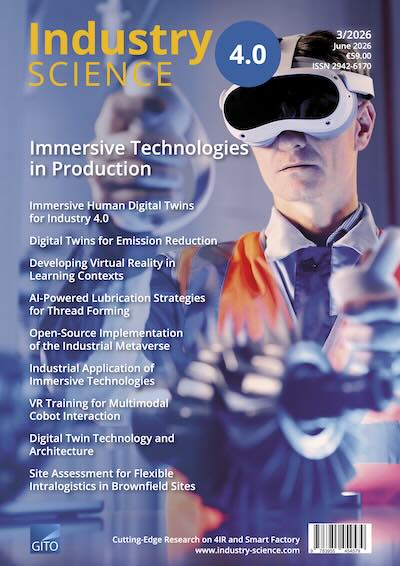
Immersive technologies are fundamentally transforming industrial value creation. Virtual Reality (VR), Augmented Reality (AR), Mixed Reality (MR), and Extended Reality (XR) combine physical and digital worlds into interactive work environments. In Industry 4.0, they have long since ceased to serve merely as a means of visualizing data; instead, they enable its intuitive use in planning, production, maintenance, and training. This creates new opportunities for faster decision-making, more efficient processes, and closer collaboration between humans and technology. This issue of Industry 4.0 Science demonstrates how immersive technologies are becoming a central building block of resilient, flexible production systems.
All articles at a glance
- Immersive Human Digital Twins for Industry 4.0
Supporting adaptive human-centric production by integrating cognitive and physical states - Digital Twins for Emission Reduction
Ex-ante case study on a pump test bench in industrial production - Developing Virtual Reality in Learning Contexts
Navigating efficiency, content relevance and scalability - Industrial Application of Immersive Technologies
Exploring XR solutions for training, instruction, design review, and assembly planning - Optimized Manual Processes in Automotive Production
A module-based approach for the efficient creation of work system simulations - Industry 4.0—Progress and Digitalization in Limbo
Status of sustainable transformation and digitalization in production engineering - Open-Source Implementation of the Industrial Metaverse
Case study and best practices - Digital Factory Planning for Startups
A simulation-based production structure design - AI-Powered Lubrication Strategies for Thread Forming
Adaptive spray jet control to increase process reliability and tool life - Application Potentials of Chinese Knowledge Platforms
Digital platforms for knowledge transfer in research and education - Decentralized Coordination of AMRs
Regulations for Autonomous Mobile Robots - VR Training for Multimodal Cobot Interaction
Virtual learning environments for collaborative robots - Digital Twin Technology and Architecture
A synthesis of concept and practice - Site Assessment for Flexible Intralogistics in Brownfield Sites
Innovative decision support in practice - SmartBending—Inline Measurement for Process Correction
Inline process optimization for error compensation in swivel bending
Access limited
You are currently not logged in / not yet registered.
In order to download the desired file(s), you must be logged in and have an appropriate inclusive subscription. Alternatively, you can also obtain access by paying a one-off fee.
| Subscription | included | Purchase |
|---|---|---|
| without | − | 59,00 € |
| Digital | − | 56,05 € |
| Expert | − | 53,10 € |
| Professional | ✓ | 0,00 € |
All prices include 7% VAT
After purchasing access rights, you will automatically be redirected back to this page.
You might also be interested in