VR

I4S 3/2026: Immersive Technologies in Production

I4S 3/2026: Immersive Technologies in Production

VR, AR, MR, XR: Catalysts for the next industrial revolution?
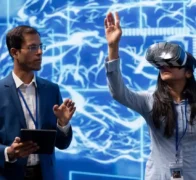
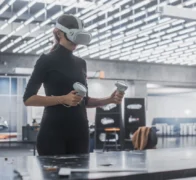
Immersive technologies are fundamentally transforming manufacturing. VR, AR, MR, and XR merge physical and digital worlds into interactive work environments. In Industry 4.0, they enable more intuitive access to planning, production, maintenance, and training. This issue of Industry 4.0 Science shows how immersive technologies are becoming a central building block of resilient, flexible, and innovative production systems.
Developing Virtual Reality in Learning Contexts

Developing Virtual Reality in Learning Contexts

Navigating efficiency, content relevance and scalability
Stella Kanatouri ORCID Icon, Oliver Sosna ORCID Icon, Alexander Kulik, Sina C. Truckenbrodt ORCID Icon, Friederike Klan ORCID Icon, Christian Erfurth ORCID Icon
While virtual reality can facilitate hands-on learning, its development faces barriers, including high costs and time demands and scalability challenges. This article presents two case studies that illustrate strategies for overcoming such barriers when training the next generation of skilled workers in environmental technologies. By examining approaches for streamlining development and increasing content relevance and scalability, we highlight lessons learned for future practice. We conclude by envisioning a future in which educational institutions can flexibly and cost-effectively prototype virtual reality in learning contexts, ensuring alignment with curricular goals and learners’ needs.
Industry 4.0 Science | Volume 42 | Edition 3 | Pages 26-34 | DOI 10.30844/I4SE.26.3.3
Industrial Application of Immersive Technologies

Industrial Application of Immersive Technologies

Exploring XR solutions for training, instruction, design review, and assembly planning
Andreas Straube ORCID Icon, Faikar Zakky Haidar ORCID Icon, Matheus Lenzi dos Santos ORCID Icon, Kussai AI Jairoud ORCID Icon, Eduardo Koscianski ORCID Icon
In recent years, the decreasing cost and improved usability of immersive hardware and software have made extended reality (XR) increasingly attractive for industrial applications. Stand-alone systems with inside-out tracking and camera-based pass-through enable accessible mixed reality (MR) solutions. At the same time, emerging no-code software platforms allow engineers to create XR environments without programming expertise, broadening adoption across production settings. This paper explores key industrial application areas of immersive technologies through selected commercially available XR software solutions for product and process training, spatial instructions and guides, collaborative design review, and assembly and production planning.
Industry 4.0 Science | Volume 42 | 2026 | Edition 3 | Pages 38-47 | DOI 10.30844/I4SE.26.3.4
Trends and Challenges in Factory Software

Trends and Challenges in Factory Software

Norbert Gronau ORCID Icon
Any networked information system that is used in the context of manufacturing and logistics in a factory can be referred to as factory software. This article describes six trends that will significantly influence the way software is used in factories in the near future. The trends are described in ascending order in terms of significance of impact.
Industry 4.0 Science | Volume 39 | 2023 | Edition 1 | Pages 114-119 | DOI 10.30844/I4SE.23.1.114