Industrial Metaverse

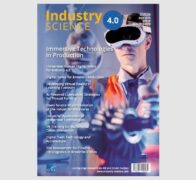
I4S 3/2026: Immersive Technologies in Production

I4S 3/2026: Immersive Technologies in Production

VR, AR, MR, XR: Catalysts for the next industrial revolution?
Immersive technologies are fundamentally transforming manufacturing. VR, AR, MR, and XR merge physical and digital worlds into interactive work environments. In Industry 4.0, they enable more intuitive access to planning, production, maintenance, and training. This issue of Industry 4.0 Science shows how immersive technologies are becoming a central building block of resilient, flexible, and innovative production systems.
Open-Source Implementation of the Industrial Metaverse

Open-Source Implementation of the Industrial Metaverse

Case study and best practices
Henning Strauß ORCID Icon, Tim Johannsen
The digital transformation of small and medium-sized enterprises (SMEs) in the manufacturing sector is hampered by vendor lock-in, high cloud costs, and stringent data sovereignty requirements when implementing Industrial Metaverse solutions. Although the Industrial Metaverse is quickly becoming a key concept in Industry 5.0, SMEs are often at a disadvantage when using proprietary solutions. This paper demonstrates how Industrial Metaverse applications can be realized by combining proven communication standards with open web technologies, thereby reducing barriers. This makes immersive applications for training, maintenance, and monitoring feasible even in SMEs. Using an open-source-based prototype as a best-practice implementation, the paper illustrates how the Industrial Metaverse can be made technologically and economically accessible to SMEs.
Industry 4.0 Science | Volume 42 | Edition 3 | Pages 68-73
Digital Supply Chain Twin: The Pathway to Success

Digital Supply Chain Twin: The Pathway to Success

A catalyst for increasing competitiveness
Gökhan Cenk ORCID Icon, Jonas Andersson, Tobias Engel ORCID Icon
Companies face a variety of challenges when optimizing global supply chains. Economic interests must be balanced with legal requirements, such as the German Supply Chain Due Diligence Act (SCDDA) and the European Sustainability Reporting Standards (ESRS). A digital supply chain twin (DSCT) enables the visualization of value creation networks and supports key business functions, such as purchasing, supply chain management, distribution, service, and sales. By leveraging immersive technologies, the DSCT helps generate sustainable competitive advantages across the entire supply network.
Industry 4.0 Science | Volume 41 | 2025 | Edition 3 | Pages 52-60 | DOI 10.30844/I4SE.25.3.52
Potentials and Application of the Industrial Metaverse

Potentials and Application of the Industrial Metaverse

Convergence from simulation to reality
Oliver Petrovic, Yannick Dassen, Christian Brecher
This paper deals with the concept of the Industrial Metaverse and its potential impact on the manufacturing industry. First, the possibilities of the Industrial Metaverse are explained in general and then possible resulting functionalities for production technology along the life cycle are presented. For the two topics "Synthetic Data Generation" and "Virtual Qualification" the implications of the Industrial Metaverse are considered more concretely.
Industrie 4.0 Management | Volume 39 | 2023 | Edition 5 | Pages 27-32 | DOI 10.30844/IM_23-5_27-32