smart manufacturing

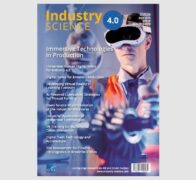
I4S 3/2026: Immersive Technologies in Production

I4S 3/2026: Immersive Technologies in Production

VR, AR, MR, XR: Catalysts for the next industrial revolution?
Immersive technologies are fundamentally transforming manufacturing. VR, AR, MR, and XR merge physical and digital worlds into interactive work environments. In Industry 4.0, they enable more intuitive access to planning, production, maintenance, and training. This issue of Industry 4.0 Science shows how immersive technologies are becoming a central building block of resilient, flexible, and innovative production systems.
SmartBending—Inline Measurement for Process Correction

SmartBending—Inline Measurement for Process Correction

Inline process optimization for error compensation in swivel bending
Christian Donhauser ORCID Icon, Reinhard Schmied, Marco Susic
Swivel bending is an established forming process that minimizes material loss and enables efficient use of resources. However, the process requires complex optimizations that have traditionally relied heavily on the expertise of machine operators. This results in significant time and material costs, as optimization steps are performed iteratively. Given the shortage of skilled workers, a technological upgrade of the machines in line with Industry 4.0 is necessary. As part of a research project, intelligent sensor technology was used to record critical influencing factors that reveal correlations between product defects and machine deformations. Based on this, a methodology was developed that forms the foundation for inline compensation, enabling the equipment to autonomously adjust process parameters to correct product defects and, in the long term, enable defect-free production from the very first component.
Industry 4.0 Science | Volume 42 | 2026 | Edition 3 | Pages 134-141
Digital Twins for Emission Reduction

Digital Twins for Emission Reduction

Ex-ante case study on a pump test bench in industrial production
Felix Bischoff, Ingela Tietze ORCID Icon, Peter Hertweck, Nina van Hasz
Digital twins are frequently referred to as a promising approach for reducing greenhouse gas (GHG) emissions in industrial production; however, robust empirical evidence of their benefits under real-world conditions is largely lacking. In this case study, the emission reduction potential of a digital twin—as a conceptually described target system—is quantified ex-ante via the example of a test bench for hydraulic pumps. To this end, the GHG emissions of the original test plan for the year 2025 are determined based on actual measured energy consumption of the tested pumps and time-resolved grid electricity emission intensities. This is followed by a rule-based rescheduling, in which energy-intensive test processes are shifted to time intervals with lower emissions. The rescheduling takes operational constraints into account so that processes and equipment remain unchanged. The savings potential is determined by comparing the GHG emissions of the reference and the optimized case.
Industry 4.0 Science | Volume 42 | 2026 | Edition 3 | Pages 16-24 | DOI 10.30844/I4SE.26.3.2
Technologies for Assisting Manual Order Picking

Technologies for Assisting Manual Order Picking

From conventional pick-by systems to AI-driven manual picking assistance
Md Khalid Siddiqui ORCID Icon, Jonathan Kressel ORCID Icon, Jürgen Grinninger
Manual picking remains common due to the high initial cost of support systems. This paper reviews existing technologies, presents an exploratory vision-based prototype, and examines existing literature that explores how combining object detection with language systems could enhance manual workflows. The findings suggest a promising, low-cost direction for worker support in logistics.
Industry 4.0 Science | Volume 41 | Edition 4 | Pages 6-19 | DOI 10.30844/I4SE.25.4.6
Digital Twins for Production

Digital Twins for Production

RAPIDZ — Resource analysis and process integration through digital twins
Christian Salzig ORCID Icon, Julia Burr ORCID Icon, Sophie Hertzog
In today’s manufacturing industry, digital twins are a key enabler for optimizing production processes and efficient resource use. However, creating digital twins is often associated with high or difficult-to-estimate costs and typically requires unknown characteristic values, such as material parameters, making practical implementation challenging. With RAPIDZ, we present a tool for creating and using digital twins that overcomes these barriers through its modular structure. The virtual modeling of physical systems enables comprehensive analysis and real-time forecasting of material flows, energy consumption and machine performance. The use of RAPIDZ increases production line efficiency, enhances flexibility and response time, and enables proactive maintenance to minimize downtime.
Industry 4.0 Science | Volume 41 | Edition 3 | Pages 6-12 | DOI 10.30844/I4SE.25.3.6
ReThink! Smart Manufacturing 2024
Start 23.06.2024 - End 25.06.2024

ReThink! Smart Manufacturing 2024

Rethink! Smart Manufacturing helps leaders in the manufacturing industry to optimize, strengthen and redesign their businesses. At ReThink! Smart Manufacturing 2024, which will take place from June 23-25 in Berlin, visitors can discuss with up to 150 executives how the latest trends and technologies in smart manufacturing, such as factory automation, AI and robotics, are impacting every aspect of business. Take part in the event and secure your ticket today!
Advanced analytics applications in smart manufacturing – A systematic literature review on their perspectives, effects, and sustainability

Advanced analytics applications in smart manufacturing – A systematic literature review on their perspectives, effects, and sustainability

André Ullrich ORCID Icon
Advanced analytics applications in smart manufacturing provide beneficiary effects such as predictive maintenance, energy optimized factories, and automized quality management of products. While the benefits and thus the sustainability effects are well investigated, the research field is characterized by many single applications with little conceptual synthesis. Therefore, this research aims to systematize the field and to identify specific sustainability themes in context of advance analytics applications. This chapter provides an overview of existing advanced analytics applications in smart manufacturing and clusters the addressed sustainability themes. Applying a systematic literature review, following the PRISMA statement, 65 different applications within four research perspective could be identified. Furthermore, ten different sustainability-related effects of the applications in smart manufacturing unfold. The content analysis resulted in 27 sustainability themes, which ...
Industry 4.0 Science | 2022 | | DOI 10.30844/WGAB_2022_7