Developing Virtual Reality in Learning Contexts |
Navigating efficiency, content relevance and scalability
 , Oliver Sosna
, Alexander Kulik, Sina C. Truckenbrodt
, Friederike Klan
, Christian Erfurth
, Oliver Sosna
, Alexander Kulik, Sina C. Truckenbrodt
, Friederike Klan
, Christian Erfurth
| Journal | Industry 4.0 Science |
| Issue | Volume 42, Edition 3, Pages 26-34 |
| Open Access | https://doi.org/10.30844/I4SE.26.3.3 |
| Bibliography | Share | Cite | Download |
Abstract
Keywords
Article
Virtual reality has gained recognition over time as an educational and training tool [1]. The special affordances of virtual reality, such as spatial presence and embodied interaction, allow learners to engage with complex concepts in ways that conventional teaching methods cannot replicate. Moreover, virtual reality allows access to learning contexts that are inaccessible either physically or as a result of high costs.
Research results highlight virtual reality’s capacity to enhance learners’ engagement and motivation [2-3], foster active and hands-on learning experiences [3], improve training outcomes [4] and knowledge retention [3, 5], and support the comprehension of abstract concepts [6]. Despite these benefits, the development of virtual reality learning applications to prepare future labor forces for Industry 4.0 working environments presents challenges relating to time and cost, accessibility, didactic relevance and scalability:
- Virtual reality development can be time- and cost-intensive [3], although time and cost both vary with the type and quality of the content. 360° videos and static 3D reconstructions can be captured with decreasing effort, whilst interactive 3D environments require structured and detailed geometrical models and behavior [8]. The quality of the user experience also depends on technical factors—reduced latency [9], visual and temporal resolution, high-quality media—all of which require further investments [8].
- Technical accessibility presents a challenge. 3D machine and industrial facility models are often very complex. They require special computing hardware for interactive use, while retaining their detail. To ensure broad accessibility, interactive learning experiences should run on untethered mobile devices without expensive rendering servers. Doing so enables users to switch between presentation screens, tablets, mobile phones, and mixed-reality headsets.
- Virtual reality development in learning contexts poses didactic relevance and curricular suitability challenges. Ready-made virtual reality learning resources are scarce compared to e-learning and may not match curricular needs [3]. Bespoke virtual reality development can tackle the issue of didactic relevance but is associated with high cost and time investment [3]. Furthermore, as the effectiveness of virtual reality educational resources depends on how well they are designed [1, 10], integrating multiple forms of expertise—subject matter knowledge, virtual reality development skills, and instructional design expertise—is advantageous. The integration of diverse stakeholders via co-creation can play a key role in supporting the development of relevant and well-designed virtual reality learning experiences.
- Bespoke virtual reality learning content may lack scalability, as it is unlikely to be used by multiple educational institutions with different curricula. In addition, organizations must balance case‑specific learning scenarios with the need for reusable software components.
In this article, we present two case studies that focus on bespoke virtual reality learning scenario development in the field of water resource management. With these case studies, we investigate strategies for optimizing the virtual reality creation process in terms of the aforementioned challenges.
Several related virtual reality learning resources are available in Germany, such as the EDS® WWTP VR-Simulator [11], the VR seawater desalination plant [12], a 360° model of a water treatment plant [13], and a virtual reality simulation of a pump station [14]. However, none of the existing applications fully fit with the curriculum and learner needs of the two institutions involved in our study: The vocational school Bildungsverein der Ver- und Entsorgungsunternehmen Thüringen e.V. (BVE) and the Rheinisch-Westfälische Technische Hochschule Aachen University (RWTH Aachen).
Three key research questions (RQ) guided our research:
- RQ1. How can co-creation participants with limited virtual reality expertise contribute meaningfully to the design of a virtual reality learning experience?
- RQ2. How can a co-creation approach support a streamlined virtual reality creation process?
- RQ3. How can scalability challenges relating to virtual reality learning experiences be addressed in academic and vocational training contexts?
The BVE case study: Using virtual reality for large-scale water infrastructures
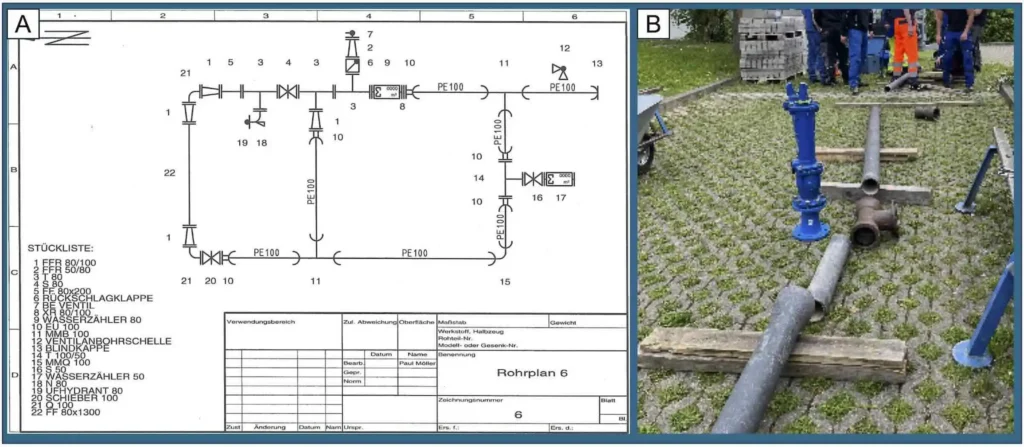
In collaboration with BVE—a vocational school for environmental technology professions—we investigated the potential of social virtual reality to complement practical instruction. To identify all requirements, we held an initial workshop with vocational teachers, in which two core constraints emerged. First, practical classes can only accommodate small-scale pipework assemblies due to space and cost limitations (Fig. 1B), leaving apprentices without exposure to the large-scale configurations that they will encounter professionally (Fig. 1A). Secondly, physical properties such as fluid dynamics are not directly observable in real pipework, requiring measurement instruments and remaining otherwise opaque to learners.
To ground our understanding further, we attended a teaching session on pipe system construction. The session followed a recurring structure: a teacher presented a construction schematic, followed by a brief review phase with input from only a small number of active apprentices, after which the class moved to the workshop to locate physical components and assemble them mechanically. This procedure required the entire day.
Informal conversations with apprentices during the session revealed that conceptual understanding of pipework configurations frequently suffered under the physical demands of assembly—the manual effort left little cognitive space for strategic thinking or the development of mental models of the whole system. Participation was also structurally uneven, with most apprentices observing rather than actively engaging.
These observations directly informed the pedagogical rationale for our virtual reality approach. Virtual assembly in a collaborative virtual reality environment shifts the activity from manual labor toward conceptual reasoning: components can be rapidly assembled, reconfigured and discussed without physical handling, and fluid dynamics can be visualized directly within the pipe geometry. This allows more students at a time to participate actively and enables rapid iteration across multiple construction schematics—something that is not feasible within a single practical session using physical components. We anticipate that this will strengthen conceptual knowledge and broaden active engagement across the group of apprentices.
Following the teaching observation, we presented an initial prototype of the Pipeworks Editor, built on the VR4more software development kit [15], and aligned the development roadmap with BVE teachers. Teachers subsequently provided four sample schematics, which defined the initial set of pipe components requiring digitization and semantic annotation, including snap targets, connection logic, and flow behavior metadata to support interactive assembly and simulation.
The component architecture was designed to be open and extensible by principle, mirroring the real world in which available components evolve with construction norms and field demands. This modularity also supports reuse across domains and, as a planned extension, will allow saved sub-assemblies to function as reusable modules, making the construction of large and complex systems more efficient. BVE teachers exhibited particular interest in discussing large-scale facility architectures in lectures; such systems are difficult to explore in situ, as much of their structure is concealed behind walls or underground. The virtual reality environment addresses this by making otherwise hidden infrastructure spatially accessible and navigable.
Apprentices at BVE are aged roughly between 16 and 25 years. All apprentices observed had prior experience with computer gaming. While some reported prior virtual reality experience, others showed initial hesitation toward full immersion. The multi-device support offered by VR4more—spanning desktop, tablet, and virtual reality headsets—proved important here, as apprentices who began on familiar screen-based interfaces transitioned to more immersive modes once initial reservations subsided. Active exploration was observed across device types.
One open question we will carry into future evaluation is whether the interactivity of the environment poses attention risks in a teaching context. We anticipate that structured guidance and regular teacher intervention will be necessary to maintain focus.
The work with BVE is ongoing. A formalized comparative teaching session is planned, in which an virtual reality-assisted lesson will be contrasted with a traditional session to validate and extend these early observations.
The RWTH Aachen case study: Enhancing decision-making skills for seawater desalination plant design
The RWTH Aachen case study focuses on developing didactically relevant virtual reality learning content in a time- and cost-effective way. A co-creation process was carried out to develop a learning scenario. The scenario was created first with analogue 3D prototypes before transferring the analogue prototypes into virtual reality using an artificial intelligence-assisted authoring workflow.
More specifically, a two-day co-creation workshop was held at RWTH Aachen, Institute of Engineering Hydrology, with eight students pursuing an MSc degree in Sustainable Management–Water and Energy, two faculty members and three virtual reality developers of the RWTH Aachen. The goal was to design a virtual reality learning scenario that fits into the curriculum and addresses students’ learning needs. During the workshop, participants expressed the need to apply their theoretical knowledge into practice and requested to simulate the decisions involved in designing efficient and sustainable desalination plants in virtual reality, experiencing the trade-offs of their actions.
Participants collaborated to create a 3D storyboard of their scenario idea, using the LEGO® Serious Play® method [16]. Figure 2 illustrates the 3D storyboard, summarizing the steps of participants’ learning scenario, where learners design a seawater desalination plant in virtual reality, making appropriate decisions to balance cost, efficiency and sustainability.
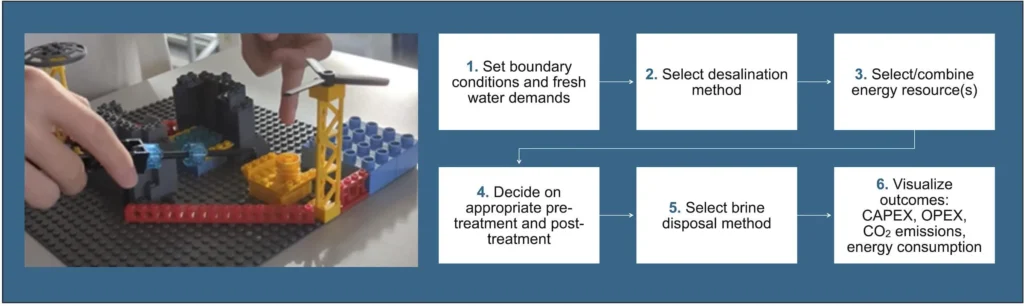
A key challenge posed by co-creation is the transfer of the LEGO®prototypesinto virtual reality. It was anticipated that separating the co-creation of learning content from the virtual reality prototyping process could result in multiple iteration cycles. Hence, the RWTH Aachen virtual reality team attempted a rapid virtual reality prototype of one of the learning scenarios created during the workshop (Fig. 3) usingShapes XR [17], a virtual reality tool designed for simple prototyping and real-time co-creation.
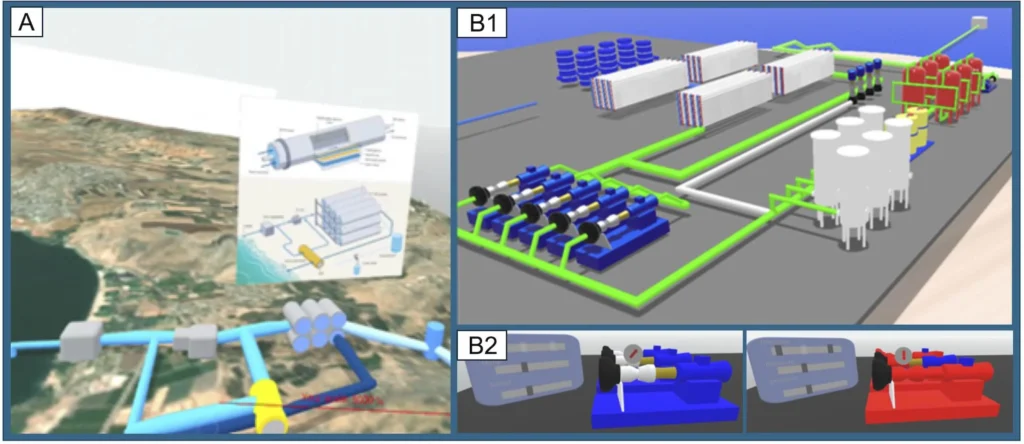
The selected learning scenario centered on visualizing the effects of adjusting pressure on water production and energy efficiency in seawater desalination. The Shapes XR approach enabled primary testing of the prototype during the workshop. Its development was continued after the workshop by one of the authors of this article (Fig. 3B1, B2) and will be tested with students in future.
As a novice in virtual reality and with no coding expertise, the author used artificial intelligence to guide the virtual reality prototype design, by providing step-by-step instruction on sketching components of the desalination plant and suggesting how to represent animations, like the one in Figure 3B. The artificial intelligence-assistant, CoPilot [18], was given prompts to guide the prototyping in Shapes XR, such as, “take me step-by-step through modeling a high-pressure pump of a seawater desalination plant using Shapes XR”. CoPilot provided detailed instructions regarding the right geometrical shapes, their alignment, size and color. The same process was followed for modeling other parts of the plant and for creating animated scenes.
Rethinking virtual reality development for Industry 4.0 learning scenarios
In this section, we discuss the research insights in light of the research questions.
RQ1. How can co-creation participants with limited virtual reality expertise contribute meaningfully to the design of a virtual reality learning experience?
Both case studies demonstrate that meaningful contribution from non-virtual reality experts is achievable via different modes of engagement. In the RWTH Aachen case study, the co-creation process allowed students and professors to develop a didactically relevant virtual reality learning experience that meets learners’ needs and aligns with the university’s curriculum.
This was achieved despite participants’ limited virtual reality expertise in two steps: first, they used LEGO® as a simple, intuitive analogue medium to develop learning content. Second, rapid virtual reality prototypes were created using Shapes XR, allowing an immediate transfer of their storyboards into the virtual reality medium. Participants were the main actors in the design process. The rapid virtual reality prototypes following their analogue concepts offered the chance to directly influence 3D design aspects.
In the BVE case study, teachers contributed through an iterative consultative process. Direct observation of a teaching session about pipe system construction—alongside informal conversations with apprentices—generated insights into learner needs that shaped both the pedagogical rationale and the component digitization scope. Teachers subsequently provided pipe constellation tasks (as in Fig. 1A) that immediately defined the initial set of components requiring development. This form of systematic firsthand engagement with the learning context feeds directly into design decisions.
RQ2. How can a co-creation approach support a streamlined virtual reality creation process?
In both case studies, investing in understanding learning needs ahead of software development reduced the risk of increased development time and cost due to misaligned iterations. In the RWTH Aachen case study, we focused on collaboratively shaping learning ideas and aligning learning objectives rather than committing to software development prematurely. Although balancing learning needs with technical feasibility and managing expectations early in the process can be beneficial, doing so before defining learning objectives may limit creativity, undermining the value of co-creation. In addition, it could lead to the creation of a virtual reality experience in which the content is not fully aligned, requiring multiple iterations.
Furthermore, as even well-aligned analogue prototypes (such as our LEGO® storyboard) might deviate from the final virtual reality product, analogue prototypes were translated into virtual reality prototypes with Shapes XR. This allowed for the review of the virtual reality prototypes in a collaborative and immersive mode across devices. As it does not require coding expertise and includes easy-to-learn sketching tools, Shapes XR offers a pre-production workflow that enables rapid virtual reality prototyping and thereby harbors potential for streamlining virtual reality production.
In the BVE case study, attending a live teaching session before prototyping served a similar front-loading function. Observations of apprentices’ participation patterns and cognitive load informed design priorities such as the emphasis on rapid assembly, fluid dynamics visualization, and multi-device accessibility before significant resources were committed.
RQ3. How can scalability challenges relating to virtual reality learning experiences be addressed in academic and vocational training contexts?
The two case studies illustrate different context-specific scalability strategies. Scalability of virtual reality in academia remains a challenge, as each institution follows its own curriculum and requires bespoke learning resources. Although a one-size-fits-all solution is unlikely to solve the scalability issue, accessible no-code virtual reality tools such as Shapes XR offer a potential workaround, as they allow the flexible prototyping of virtual reality content based on educational needs.
In vocational training contexts, scalability can be approached architecturally. The BVE case study demonstrates this through a reusable component library with configurable functionality. Using the library, semantically enriched pipe components—annotated with snap targets, connection logic, and flow behavior—can be assembled in a variety of learning scenarios. This architecture mirrors real-world extensibility, where available components evolve with construction norms. Planned extensions such as sub-assemblies that are storable and reusable as modules further extend this scalability to large and complex system configurations. As digital twin technologies mature through initiatives such as OpenUSD, such semantically enriched educational components may increasingly integrate with broader Industry 4.0 data ecosystems.
Potential implications for virtual reality in learning
In conclusion, our research approach has the following potential implications for the development of virtual reality learning experiences in academic and vocational training contexts:
- Integrating no-code, virtual reality rapid prototyping tools into the design process could empower educational institutions to prototype their own virtual reality learning experiences in the future. Shapes XR allows real-time, collaborative virtual reality prototyping even at a distance and artificial intelligence can be used to guide the entire prototyping process, lowering barriers for non-virtual reality experts even further. A shift toward no-code immersive design tools combined with artificial intelligence could democratize immersive education.
- Reusable content libraries with configurable, semantically enriched components offer a scalable alternative to bespoke virtual reality development in vocational training contexts. Such libraries enable teachers to assemble and reconfigure learning scenarios without recurring investment.
- In both case studies, early involvement of stakeholders enables a needs-based design—whether through structured co-creation or direct observation of teaching practice. This reduces misalignment risk and streamlines subsequent production. Highly accessible, no-code virtual reality design tools and artificial intelligence can allow educators and learners to build and refine immersive prototypes before investing in costly development.
This contribution was made possible thanks to the Institute of Hydrology at RWTH Aachen (led by Professor Heribert Nacken) and BVE (led by Gerrit Matthäi). We acknowledge the anonymous reviewers for their constructive comments on an earlier version of the manuscript. Funding by the German Federal Ministry of Research, Technology and Space via the research project “ThWIC: Experimentelle Lernumgebung für Wasserwirtschaft in sozial gemischter Realität (WaterLab)” (grant: 03ZU1214J-A/-B/-C) is gratefully acknowledged.
This is an original article. The German translation can be accessed via DOI: 10.30844/I4SD.26.3.3
Bibliography
[1] Samala, A. D.; Rawas, S.; Rahmadika, S.; Criollo-C, S.; Fikri, R.; Sandra, R. P.: Virtual reality in education: global trends, challenges, and impacts—game changer or passing trend? In: Discover Education 4 (2025) 229, p. 45. DOI: https://doi.org/10.1007/s44217-025-00650-z[2] Pellas, N.; Dengel, A.; Christopoulos, A.: A scoping review of immersive Virtual Reality in STEM education. In: IEEE Transactions on Learning Technologies 13 (2020) 4, pp. 748-761. DOI: https://doi.org/10.1109/TLT.2020.3019405
[3] Vats, S.; Joshi, R.: The impact of Virtual Reality in education: A comprehensive research study. In: Sharma, S. K.; Dwivedi, Y. K.; Metri, B.; Lal, B.; Elbanna, A. (eds.): Transfer, diffusion and adoption of next-generation digital technologies. Cham 2024. DOI: https://doi.org/10.1007/978-3-031-50204-0_11
[4] Singhaphandu, R.; Pannakkong, W.: A review on enabling technologies of industrial virtual training systems. In: International Journal of Knowledge and Systems Science 15 (2024) 1, pp. 1-33. DOI: https://doi.org/10.4018/IJKSS.352515
[5] Olmos-Raya, E.; Ferreira-Cavalcanti, J.; Contero, M.; Castellanos, M. C.; Chicchi Ciglioli, I. A.; Alcañiz, M.: Mobile virtual reality as an educational platform: A pilot study on the impact of immersion and positive emotion induction in the learning process. In: Eurasia Journal of Mathematics, Science and Technology Education 14 (2018) 6, pp. 2045-2057. DOI: https://doi.org/10.29333/ejmste/85874
[6] Su, Y.-S.; Cheng, H.-W.; Lai, C.-F.: Study of virtual reality immersive technology enhanced mathematics geometry learning. In: Frontiers in Psychology 13 (2022) 760418, pp. 1-8. DOI: https://doi.org/10.3389/fpsyg.2022.760418
[7] Ritter, K. A.; Chambers, T. L.: Three-dimensional modeled environments versus 360 degree panoramas for mobile virtual reality training. In: Virtual Reality (2022) 26, pp. 571-581. DOI: https://doi.org/10.1007/s10055-021-00502-9
[8] Boukhris, M.; Paljic, A.; Lafon-Pham, D.: 360° versus 3D environments in VR headsets for an exploration task. In: Lindeman, R.; Bruder, G.; Iwai, D. (eds.): Virtual Environments 2017. Proceedings of the 27th International Conference on Artificial Reality and Telexistence and 22nd Eurographics Symposium on Virtual Environments (ICAT-EGVE ’17). Gosslar 2017.
[9] Lie, A. A.; Buntoro, O. T.; Purwanto, E. S.; Ario, M. K.: The future of virtual reality: Prospect and problems. In: Procedia Computer Science 245 (2024), pp. 355-364. DOI: https://doi.org/10.1016/j.procs.2024.10.261
[10] Lin, Y.; Wang, G.; Suh, H.: Exploring the effects of immersive virtual reality on learning outcomes: a two-path model. In: Schmorrow, D.; Fidopiastis, C. M. (eds.): Augmented Cognition. Human Cognition and Behavior (HCII 2020). Cham 2020. DOI: https://doi.org/10.1007/978-3-030-50439-7_6
[11] Festo Didactic SE; Adiro.com: Water technology. Virtual Reality für wiederholbaren Know-how Transfer. Betreiberpartnerschaften 4.0 (Wasser), Berlin 18./19.9.2019. URL: https://www.betreiberpartnerschaften.de/assets/files/VR_Presentation%20DE_Festo_Adiro_KRO_minimal.pdf, accessed 07.04.2026.
[12] Nacken, H.: MyScore: Avatar-basiertes Lehren und Lernen. URL: https://ak-xrl.gi.de/initiativen-und-projekte/projektvorstellungen/detail/myscore-avatar-basiertes-lehren-und-lernen, accessed 06.01.2026.
[13] Wolf, M.; Wehking, F.; Montag, M.; Söbke, H.: 360°-based virtual field trips to waterworks in higher education. In: Computers 10 (2021) 118, p. 15. DOI: https://doi.org/10.3390/computers10090118
[14] Naghed, D.: Immersive Multi-User Simulation für das Störfall-Handling eines Pumpwerks. Bachelor Thesis, Erfurt University of Applied Sciences, 2023.
[15] Consensive. Large Model Social XR: efficient, accessible, and mobile. URL: https://consensive.com/products/, accessed 12.04.2026.
[16] Hillmer, D.: PLAY! Der unverzichtbare LEGO® SERIOUS PLAY® Praxis-Guide für Workshops, Coachings & Moderation. Munich 2023.
[17] Shapes XR. Shapes XR. Bring ideas to life in 3D. URL: https://www.shapesxr.com/, accessed 07.01.2026.
[18] Microsoft CoPilot: Your AI companion. URL: https://copilot.microsoft.com/, accessed 18.03.2026.
Your downloads
Potentials: Training
You might also be interested in