Mixed Reality

Training in the Industrial Metaverse

Training in the Industrial Metaverse

Buzzword or opportunity?
Leon Schellhammer ORCID Icon, Lucas Waag, Mert Cumert, Dieter Uckelmann ORCID Icon
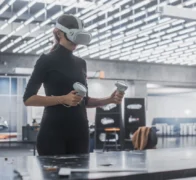
Metaverse-based training programs offer a realistic and risk-free learning environment that is particularly valuable in industrial contexts, e.g. in immersive training and the simulation of workflows. Challenges remain in the areas of data protection, technological acceptance and integration into existing systems. Using a carefully crafted questionnaire, four expert interviews were conducted to investigate whether the metaverse can innovate training programs effectively and lastingly. Its standardized format yields comparable, reliable data while allowing for an accurate evaluation of the results.
Industry 4.0 Science | Volume 41 | 2025 | Edition 2 | Pages 102-108
Industrial Maintenance via Remote Technologies

Industrial Maintenance via Remote Technologies

An Overview of the Current Use of Technologies in Practice
Katrin Wieczorek, Javad Ghofrani, Laura Seiffert, Robert Pampuch, Dirk Reichelt
The level of networking and complexity in intelligent manufacturing is constantly increasing. As a result, the demands on employees are growing, especially due to changing work tasks. In addition, the existing lack of skilled workers leads to bottlenecks. The use of remote technologies opens up new opportunities for collaboration, especially in maintenance. Considering the challenges of industrial maintenance, to what extent can remote technologies be used to efficiently meet these demands? This article provides an overview of the remote technologies currently used and discussed in practice and research. In addition, it shows which prerequisites must be created for an effective application of the technologies.
Industrie 4.0 Management | Volume 36 | 2020 | Edition 6 | Pages 59-64
Smart Interfaces for Simple Things

Smart Interfaces for Simple Things

Deep Insights through Semantic Technologies and Mixed Reality
Simon Mayer, Kay Römer
Industrial devices have virtual and physical components that interact with each other in a plethora of ways. We report on a system that enables operators to pose queries about physical, regulatory and functional relationships between components and visualizes responses as a holographic overlay, thereby enabling in-situ querying and rendering of information for “on-the-spot” decisions. Importantly, our approach is not only applicable to digitally integrated components but applies equally well to “simple” objects such as surfaces and workpieces, and the materials they are made of.
Industrie 4.0 Management | Volume 34 | 2018 | Edition 4 | Pages 33-37
Efficient Creation of Truck Assembly Processes with Virtual and Mixed Reality

Efficient Creation of Truck Assembly Processes with Virtual and Mixed Reality

Franz Obermair, Valeska Nassiri, Johann Reitzenberger
Flexible and quick adaption to changes in design and technical requirements or order quantity is a key factor in the commercial vehicles sector. Due to higher wage costs, European production sites need also efficient and well organized assembly processes. This paper details the implementation of a Virtual Reality System. Using Virtual and Mixed Reality Systems assembly processes can be optimized for production at a very early stage in the design process.
Industrie Management | Volume 28 | 2012 | Edition 2 | Pages 38-41