Autor: Hermann Lödding

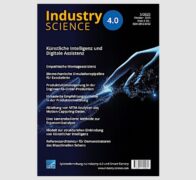
I4S 5/2025: Artificial Intelligence and Digital Assistance

I4S 5/2025: Artificial Intelligence and Digital Assistance

How we can better support work
Demographic change, skills shortages, and stagnating productivity are threatening the competitiveness of German industry. At the same time, AI and digital assistance systems are opening up new opportunities: they make work more efficient and support skilled workers. But while they have long been part of everyday life, their potential in industry remains largely untapped—this is where this issue comes in with innovative concepts.
Derivation of MTM Analyses from Motion Capture Data

Derivation of MTM Analyses from Motion Capture Data

Evaluation of the procedure and comparison with a manual MTM analysis
Silas Pöttker ORCID Icon, Maria Neumann ORCID Icon, Martin Benter, Constantin Eckart ORCID Icon, Ulrike Wolf ORCID Icon, Peter Kuhlang, Hermann Lödding ORCID Icon
For around 15 years, German labor productivity per working hour has been increasing at significantly less than 1% per year. At the same time, more detailed productivity analyses reveal high potential in companies. The issue is that the required MTM analyses are complex and not yet employed as broadly and frequently as would be necessary. One solution is the use of digital technologies such as motion capture. These make it possible to carry out productivity analyses with little effort, as they provide data that accelerates the analysis. The MTMmotion® tool from the MTM ASSOCIATION e. V. was developed with the aim of carrying out valid and compliant MTM analyses using data provided by other technologies. This article compares the method developed for a motion capture system and MTMmotion® with a conventional MTM-1® analysis. The main result is that digital technologies can be used to create valid MTM analyses in early planning phases with little effort in order to make early ...
Industry 4.0 Science | Volume 41 | 2025 | Edition 5 | Pages 112-119 | DOI 10.30844/I4SE.25.5.108
Analyzing Work Processes with Motion Capture Systems

Analyzing Work Processes with Motion Capture Systems

Solution and implementation principles
Hermann Lödding ORCID Icon, Silas Pöttker ORCID Icon, Tim Jansen ORCID Icon
The double transformation describes the necessary change in the economy in the dimensions of ecology and digitalization. Motion capture systems offer new possibilities for recording and analyzing work processes in industrial assembly. They visualize motion sequences with high frequency, precision and resolution. The question therefore arises as to how the technology can be used in the context of digital transformation to further develop the analysis of work processes and the design of workplaces. Our article discusses this on the basis of solution principles and describes implementation principles for the development of upcoming digital assistance systems.
Industry 4.0 Science | Volume 40 | 2024 | Edition 5 | Pages 43-49 | DOI 10.30844/I4SE.24.5.42
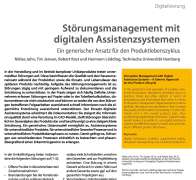
Disruption Management with Digital Assistance Systems

Disruption Management with Digital Assistance Systems

A generic approach for the product lifecycle
Niklas Jahn, Tim Jansen ORCID Icon, Robert Rost, Hermann Lödding ORCID Icon
In the production and operation of complex, one- of-a-kind products, disruptions inevitably occur. In practice, there are often deficits in terms of transparency and information flow when it comes to disruption management. Digital assistance systems facilitate disruption documentation: they increase the quality of information by locating it in the CAD model and in the overall product plan, thus accelerating targeted fault elimination. A generic data model makes it possible to use digital assistance systems for different products, trades and processes and in different product life phases. (Only in German)
Industrie 4.0 Management | Volume 39 | 2023 | Edition 2 | Pages 15-19
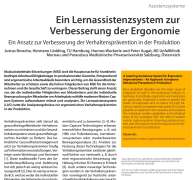
A Learning Assistance System for Ergonomic Improvements

A Learning Assistance System for Ergonomic Improvements

An Approach to Improve Behavioral Prevention in Production
Justus Brosche, Hermann Lödding ORCID Icon, Hannes Wackerle, Peter Augat
Musculoskeletal disorders are the major cause of incapacity to work in the production industry in Germany. Accordingly, ergonomic work processes are particularly important in order to protect the health of employees and to reduce the high follow-up costs for companies and society. This article presents an approach that assesses and analyzes the individual worker capabilities and individual strain at the workplace with the help of modern motion capture systems. A learning assistance system uses the analysis results for ergonomic behavioral prevention in production.
Industrie 4.0 Management | Volume 38 | 2022 | Edition 2 | Pages 23-27
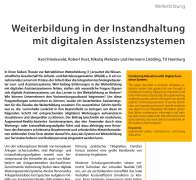
Continuing Education with Digital Assistance Systems

Continuing Education with Digital Assistance Systems

Axel Friedewald, Robert Rost, Nikolaj Meluzov, Hermann Lödding ORCID Icon
The paper describes a modular, AR-based assistance system that guides the user through a maintenance task by displaying components and meta-information step by step. By supplementing a learning success control, the system can also be used for continuing education of service technicians and operating personnel. Special emphasis was placed on an integrated information system that allows maintenance information and training tasks to be created with little effort and at the same learning and work tasks to be teached on the systems used in practice.
Industrie 4.0 Management | Volume 36 | 2020 | Edition 3 | Pages 7-10
Web-based Productivity Analysis

Web-based Productivity Analysis

A Data-Driven Approach for the Design of Production Systems
Constantin Grabner, Robert Glöckner, Hermann Lödding ORCID Icon, Nils Barck
Opportunities arising from new technologies like smart mobile devices and augmented reality have a huge impact on the manufacturing industry but are not taken advantage of when it comes to productivity analysis. As a consequence productivity analyses are rarely used and companies cannot benefit from a systematic approach to tackle improvement processes. This paper presents a productivity analysis method that uses a web-based application for data acquisition and is designed in a way that enables production staff to perform analyses on their own.
Industrie 4.0 Management | Volume 35 | 2019 | Edition 3 | Pages 30-34
An All-Purpose Tool for Production Analysis

An All-Purpose Tool for Production Analysis

Development of a Multi-Method Web Application
Constantin Grabner, Thomas Schoop, Hermann Lödding ORCID Icon
There are numerous analysis methods available to support engineers working on continuous improvement projects. Digital transformation facilitates to reduce the effort for data acquisition and processing. The Institute of Production Management and Technology and the medical company Dräger have jointly developed a web application for multi-method analysis. This article describes its data structure and technology.
Industrie 4.0 Management | Volume 33 | 2017 | Edition 6 | Pages 7-10
Collaborative Augmented Reality

Collaborative Augmented Reality

Discussions of Individual Customer Change Requests at a Great Distance
Henrik Schröder, Axel Friedewald, Lev Perschin, Hermann Lödding ORCID Icon
Due to the high competition on the world market, companies look for unique characteristics for their products. One opportunity is to establish a closer relationship to the customer by giving him the possibility to make last-minute change requests. This approach provides a possibility to discuss such a request at a great distance via Augmented Reality. The objective is to evaluate its feasibility and its costs on short notice and in cooperation with the customer.
Industrie 4.0 Management | Volume 33 | 2017 | Edition 5 | Pages 49-52
Augmented Reality in a One-of-a-kind Production

Augmented Reality in a One-of-a-kind Production

Potenziale der Informationsversorgung in der Unikatfertigung
Axel Friedewald, Philipp Halata, Nikolaj Meluzov, Hermann Lödding ORCID Icon
The one-of-a-kind production often is characterized by a high share in manual work. Information gathering requires an essential percentage of the workers time. The article shows as Augmented Reality can help to reduce the efforts of information gathering and to increase productivity.
Industrie 4.0 Management | Volume 33 | 2017 | Edition 3 | Pages 7.10
1 2