The Bias of “Instructional Systems for the Disabled” |
Ethnographic insights from deploying augmented reality in a sheltered workshop

| Journal | Industry 4.0 Science |
| Issue | Volume 41, 2025, Edition 5, Pages 102-110 |
| Open Access | https://doi.org/10.30844/I4SE.25.5.102 |
| Bibliography | Share | Cite | Download |
Abstract
Article
The manufacturing and industrial sector have been undergoing a large change, driven by interconnectivity and the advancement of digital technologies. Industry 4.0, the term coined to describe this transformation, has often been connected to the change in the skill profile of workers that such a transformation goes hand in hand with.
The lack of skilled workers and reflections on the changing role of humans in industrial systems have led to a shift toward a more socio-centric perspective that considers the interests of various stakeholders rather than focusing solely on technological development and productivity gains [1]. Ultimately, the follow-up term Industry 5.0 reflects on the human’s role in industrial systems saturated with digitization and calls for the deployment of technologies with the principles of sustainability in mind [2].
A key message of Industry 5.0 calls for the use of “digitalization with a purpose” [2]. One important example of this human-centered approach to manufacturing is the use of digital instruction systems to support workers with disabilities [3]. These technologies not only aim to provide productivity gains but also aim to make industrial workplaces more inclusive. Digital instructions tools, such as screens or augmented reality systems, help by breaking down complex information into smaller steps, making tasks more manageable for a wider range of workers [4].
For people with disabilities, work presents not only economic participation and provision of pay but also a possibility for social integration and independence. However, despite policies aimed at improving employment of people with disabilities, they continue to face lower employment rates and lower pay [5]. Their marginalized position is exacerbated by the perception of them as deviating from the concept of an ideal worker due to being less productive and less able to work [6].
Industrial engineering research rarely questions the link between disability, limited work ability, and lower productivity. Against this backdrop, we started the research project A2I in 2023, which focuses on using augmented reality (AR) as a learning assistance tool in a sheltered workshop. Over the past two years, we have applied a user-centered approach, collaborating closely with workers with disabilities. Our experiences challenge the narrative of industrial research, in particular the idea that instructional technologies serve as an “enabler tool” for work. Through autoethnographic insights, we reflect critically on the role of research in developing and promoting digital assistance technologies in future studies.
Spatial Augmented Reality as an Assistance Tool in Manufacturing
Digital assistance systems promise to improve the position of workers with disabilities by supporting them during work [3]. Especially for persons with learning, cognitive, or attentional disabilities, paper-based instructions can lead to split-attention effect, i.e. when the instructions are spatially disconnected from the work task [7]. Reducing extraneous load, i.e. the load necessary to process the work instructions, could free cognitive resources that in turn could be dedicated to learning and performing complex work.
The spatial contiguity effect is grounded in the cognitive load theory of learning and has been supported by multiple empirical works and meta-analyses [8]. In manufacturing and assembly, spatial contiguity can be achieved by overlaying augmented reality instructions or holograms into the field of view [7].
Spatial augmented reality (SAR) is a form of AR that enables spatial projection of holograms through a projection system installed in the workspace [9]. SAR has been used in multiple studies with disabled workers in a manufacturing and assembly context [4, 10, 11]. Compared to paper-based instructions, these studies found SAR to lead to higher usability and productivity.
Prior research often presents assistance technologies, such as SAR, as compensatory tools that enable workers with disabilities “to be successful in their performance of industrial tasks that were formerly difficult to accomplish” [11]. This conception of assistance technologies serving as an enabler tool to achieve productivity and improve work capabilities are mostly based on short-term studies, often conducted in laboratory settings. However, a gap exists regarding long-term perspectives on assistance systems for workers with disabilities. We aim to address this gap through long-term considerations and reflections from deploying SAR in a sheltered workshop.
Method
Manufacturing research rarely employs long-term methodologies that incorporate first-person perspectives, particularly in the context of deploying assistance systems for persons with disabilities. In addressing this gap, our discussion draws on autoethnography, an ethnographic method from the social sciences that merges personal experience with research analysis. Autoethnography positions the researcher both as subject and investigator, enabling a systematic exploration of cultural and social phenomena through lived experience. This approach has recently gained in popularity in HCI research due to its potential to provide insights into individual experiences that are often disregarded in conventional research. Beyond evaluating quantitative aspects like functionality and usability, autoethnographic methods allow for a deeper dive into the social implications of technology [12].
Use of spatial augmented reality in the project A2I
Our project uses spatial augmented reality as an instruction provision system in the context of manufacturing and assembly, in particular woodworking and furniture manufacturing. The work was performed at Wien Work, a sheltered workshop that employs over 360 persons, 70% of which have disabilities. In the woodworking department, the majority of workers have a hearing impairment. In addition, the woodworking department offers inclusive vocational training for apprentices with hearing, cognitive, or learning impairments.
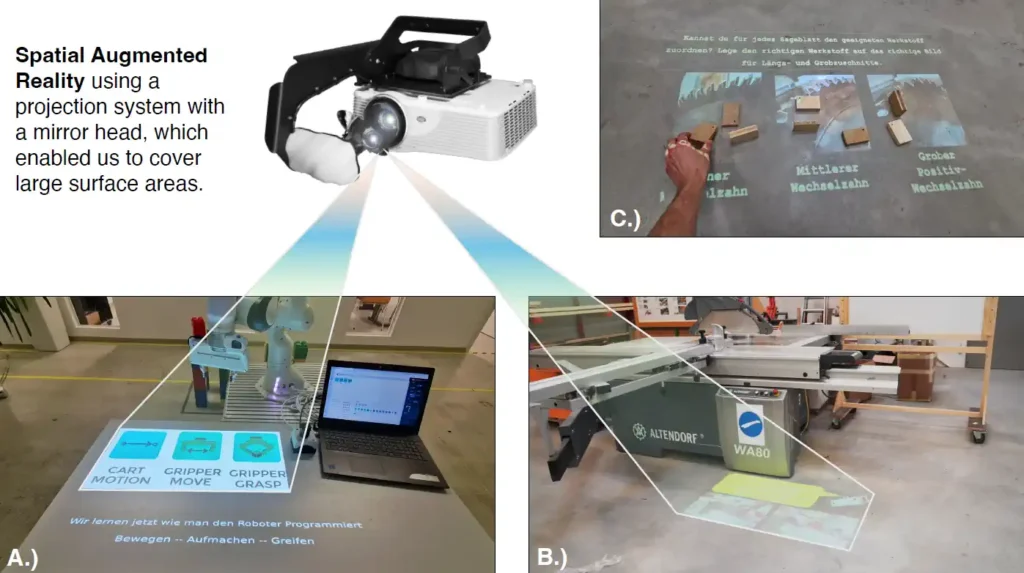
After preliminary interviews with workers, mock-up use cases with SAR were deployed in our laboratory to enable the workers and apprentices to experience the technology outside work settings. This included use cases like SAR-supported cabling assembly or learning how to program a collaborative robot with the help of SAR instructions. Over 30 sessions were carried out in the lab settings before the deployment was transferred to the production environment. This included an SAR-supported tutorial on using an industrial buzz saw, which was implemented participatively via regular feedback from experienced apprentices and finally evaluated with five apprentices that had not operated the machine before. Figure 2 illustrates examples of the use cases.
Data and Analysis
The autoethnography was based on a mixed approach via the authors’ notes and protocols from observations and user studies with workers and lived experiences. This data was subsequently coded as reconstructions of the experiences. The analysis of the data was performed using thematic analysis [13].
In this section, we present our findings, structured around the themes resulting from the thematic analysis: (1) productivity and work ability as goals, (2) usefulness of instructional systems in the context of the target group, and (3) challenges when working with persons with disabilities. Aligned with the autoethnographic approach, the presentation of findings aims to offer a rich and evocative narrative of the researcher’s personal experiences.
On the “Productivity vs. Disability” gap
Research often states that assistance systems must cover for a “productivity gap” between workers with disabilities and non-disabled employees, exacerbated by assumptions of reduced work ability present in industrial research. For example, studies presented in [14] or [15] assume that workers with disabilities work two to five times slower than non-disabled peers. These views partially formed my perceptions of productivity and usefulness of augmented reality systems for workers with disabilities prior to the project.
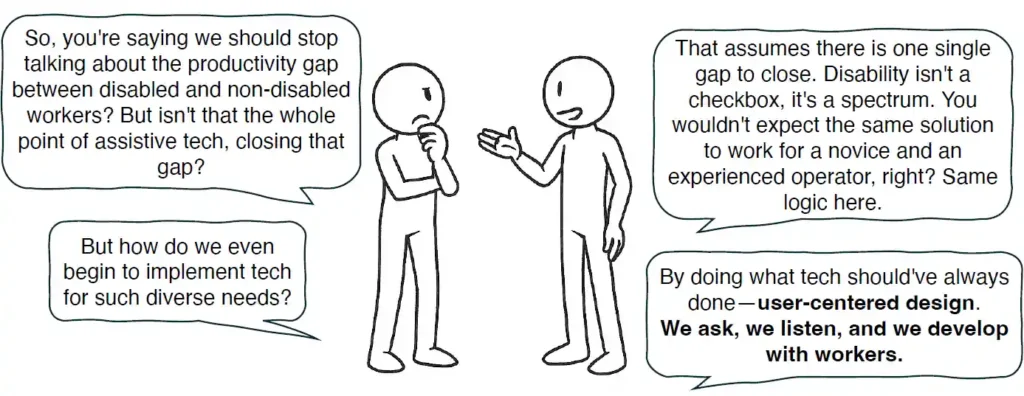
After two years of deploying SAR in a sheltered workshop and regular interactions with workers with disabilities, I have found no uniform productivity deficit that technology must compensate. The workers I collaborate with represent a variety of skills and experiences. Many hold three- to four-year vocational qualifications, use CAD software and operate computerized machinery proficiently. Some individuals do encounter difficulties with certain industrial tasks, but so do some non-disabled colleagues. Disability, in practice, is not a binary “checkbox” that deterministically predicts lower industrial performance. Rather, it is one dimension among many that shape an individual’s capabilities. Do we assume all workers to have the same skill set? The same logic applies here as well.
Will assistance systems like augmented reality ultimately improve the productivity of workers with disabilities? My field observations suggest a nuanced answer. For some employees, whose work capacity is already high, it will not change much about how they approach work tasks. For others, digital assistance systems will not result in them being more productive at all. For instance, optimized instruction provision could improve the work of a worker with attention deficit/hyperactivity disorder (ADHD), but this improvement might not be significant enough in terms of productivity. These autoethnographic insights therefore caution against treating assistive technologies solely as remedies for a supposed deficit. We should adapt them to a wide range of skills found in the manufacturing workforce.
What, then, is the contribution that HCI and industrial engineering research can make, if not “closing a productivity gap”? Our research goal should be to create conditions in which every employee can perform at their best. Overly focusing on quantitative outcomes like productivity in terms of cycle time, throughput, or error rates overshadows the benefits such systems can provide, such as their ability to create more engaging work conditions. In the end, work should also be an enjoyable experience.
Useful instruction provision—where requirements of disabled and non-disabled workers align
What goals and requirements should we follow when developing instructional assistance systems for workers with disabilities? In accordance with the principles of human-centered research, we must listen more and assume less. And when we listen, it is interesting how the requirements of workers with disability and non-disabled workers align.
At the start of our project, I believed that augmented reality instructions should be simplified for workers with disabilities as much as possible. Experience quickly proved otherwise. Difficulties rarely lie in the simple steps; they appear when the tasks get complex. Thus, overly reducing the complexity of instructions would hinder the learning effect, because it lacks the context of real-life work.
A prime example of this is technical terminology. My initial instinct was to substitute complex terminology with simpler wording, fearing that such instructions might not be well understood by workers with hearing impairments due to these terms not being present in sign language. However, my fellow collaborators disagreed, saying that “learning the terminology is an integral part”, for instance, in preparing for the vocation certification. Interviews confirmed that apprentices with hearing deficiencies have already encountered and understood these terms in school. In this regard, it would be unwise to overly simplify instructions in these systems beyond the complexity that reflects real-world settings. Yet, research typically talks about step-by-step guidance to break down complex work into simple steps.
The problem of step-by-step guidance is that it can limit worker autonomy. If you project an instruction saying, “now put this part here”, which is common in use cases of AR for workers with disabilities [4, 10], such micro-guidance limits decision-making and the contextual “before” and “after” needed for deep understanding. My field experience showed me that most workers do not want guidance, they want a concise representation of complex information to understand better. Sure, deaf employees might prefer visual instructions via images and pictograms.
But have you ever tried assembling a piece of Ikea furniture using only text instructions, with no visuals? Good luck with that!
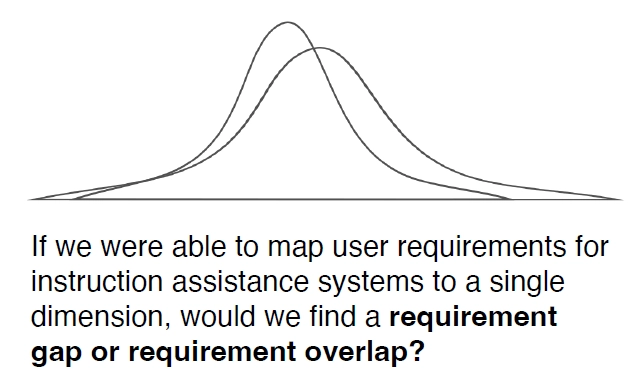
When developing work assistance systems, the real question is whether requirements of workers with disabilities differ from those of their non-disabled peers. In the context of instruction provision, I see a large overlap between the groups (Fig. 3). If a system has been shown to increase productivity for disabled workers, I hold it for likely that it will have a similar effect for non-disabled workers, and vice versa.
It is not all happy talk
Despite the positive experiences from the last two years, it is important to reflect on the challenges of deploying digital assistance systems for workers with disabilities. A key challenge lies in communication and the lack of feedback. This goes beyond a natural language barrier in the case of workers with sign language as their native language, even when sign language interpreters are present.
At the beginning of the project, workers were hesitant to discuss ideas for use cases, stating “I don’t know how to contribute.” This lack of feedback makes it hard to gain meaningful insights into how best to support them. A potential reason for the sparse feedback could be their arguably low acceptance of technology. Common questions included “will I be replaced?” or “am I going to be observed?” Deploying new technology can trigger one’s status quo bias [16]—the preference for maintaining the current status quo—as having to get accustomed to new technology might simply mean additional effort.
The concept of an ideal worker includes two factors—productivity and social interaction [6]. Concerning the deployment of assistance systems, the user-centered design approach hinges on open interactions and feedback from the envisioned user group. Sparse feedback leads to guesswork and designing systems in the dark, and it prolongs the development timeline.
To overcome this challenge requires effort from both the researchers and the workers and enough time for both groups to get accustomed to each other. Based on my experience, I argue for a slow and transparent approach to deploying digital assistance systems to avoid a sense of failure if the system is not working as intended. It should be an iterative process with gradually increasing rich experiences for both groups.
Digital assistance grounded in reality
The goal of digital assistance systems, such as augmented reality, is to improve the work of employees with disabilities and help them to better integrate in industrial processes [11]. Ultimately, one could argue that this aims to cover for the industrial perceptions of ideal productivity and work ability [6]. We present ethnographic insights from deploying spatial augmented reality as an assistance tool in a sheltered workshop, with a focus on woodworking. Our findings caution against the narrative of digital instructional systems serving as an “enabler technology” to help people work “better”. Empirical field work on productivity points towards workers with disabilities exhibiting similar job performance as non-disabled workers [17].
In designing digital assistance systems, it is of utmost importance to reflect this and focus on designing systems that create more engaging work conditions rather than seeing assistive technologies as a remedy for a supposed “productivity gap”. We should base our research on active participation and listen to ideas about how to best create such engaging systems.
In doing so, we might find that the requirements of workers with disabilities for creating engaging systems overlap with those of non-disabled employees, as in the case of instruction provision. These perspectives invite researchers to reframe digital assistance systems not as compensatory tools but as opportunities to rethink industrial work in ways that are more inclusive, engaging, and grounded in the realities of all workers.
This work was supported by the Vienna Chamber of Labour as part of the A2I project (AK Wien Digitalisierungsfonds Arbeit 4.0).
This is an original article. The German translation can be accessed via DOI: 10.30844/I4SD.25.5.102
Bibliography
[1] Matt, D. T.; Orzes, G.; Rauch, E.; Dallasega, P.: Urban production–A socially sustainable fac-tory concept to overcome shortcomings of qualified workers in smart SMEs. In: Computers & Industrial Engineering 139 (2020), p. 105384.[2] Barata, J.; Kayser, I.: Industry 5.0–past, present, and near future. In: Procedia Computer Science 219 (2023), pp. 778-788.
[3] Heinz, M.; Büttner, S.; Jenderny, S.; Röcker, C.: Dynamic task allocation based on individual abilities-experiences from developing and operating an inclusive assembly line for workers with and without disabilities. Proceedings of the ACM on Human-Computer Interaction 5 (2021) (EICS), pp. 1-19.
[4] Mark, B. G.; Rauch, E.; Matt, D. T.: The application of digital worker assistance systems to support workers with disabilities in assembly processes. In: Procedia CIRP 103 (2021), pp. 243-249.
[5] Kruse, D.; Schur, L.; Johnson-Marcus, H. A.; Gilbert, L.; Di Lallo, A.; et al.: Assistive technology’s potential to improve employment of people with disabilities. In: Journal of occupational rehabilitation 34 (2024) 2, pp. 299-315.
[6] Østerud, K. L.: Disability discrimination: Employer considerations of disabled jobseekers in light of the ideal worker. In: Work, employment and society 37 (2023) 3, pp. 740-756.
[7] Dixon, D.; Terton, U.; Greenaway, R.: Reducing the Split-Attention Effect in Assembly based Instruction by Merging Physical Parts with Holograms in Mixed Reality. In: CSEDU (2018) 1, pp. 235-244.
[8] Schroeder, N. L.; Cenkci, A. T.: Spatial contiguity and spatial split-attention effects in mul-timedia learning environments: A meta-analysis. In: Educational Psychology Review 30 (2018), pp. 679-701.
[9] Funk, M.; Kosch, T.; Schmidt, A.: Interactive worker assistance: comparing the effects of in-situ projection, head-mounted displays, tablet, and paper instructions. In: Proceedings of the 2016 ACM international joint conference on pervasive and ubiquitous compu-ting (2016), pp. 934-939.
[10] Funk, M.; Mayer, S.; Schmidt, A.: Using in-situ projection to support cognitively impaired workers at the workplace. In: Proceedings of the 17th international ACM SIGACCESS con-ference on Computers & accessibility (2015), pp. 185-192.
[11] Aksu, V.; Jenderny, S.; Martinetz, S.; Röcker, C.: Providing context-sensitive mobile assis-tance for people with disabilities in the workplace. In: Advances in Design for Inclusion: Proceedings of the AHFE 2018 International Conference on Design for Inclusion, July 21-25, 2018, Loews Sapphire Falls Resort at Universal Studios, Orlando, Florida, USA 9, pp. 3-14. Springer International Publishing.
[12] Kaltenhauser, A.; Stefanidi, E.; Schöning, J.: Playing with Perspectives and Unveiling the Au-toethnographic Kaleidoscope in HCI–A Literature Review of Autoethnographies. In Proceedings of the 2024 CHI Conference on Human Factors in Computing Systems (pp. 1-20).
[13] Clarke, V.; Braun, V. (2017). Thematic analysis. The journal of positive psychology, 12(3), 297-298.
[14] Finco, S.; Neumann, W. P.; Setayesh, A. (2024). Investigating the productivity in different assembly system configurations for a better inclusion of disabled workers. In: IFAC-PapersOnLine 58 (2024) 19, pp. 199-204.
[15] Litwin, P.; Antonelli, D.; Stadnicka, D.: Disabled employees on the manufacturing line: Sim-ulations of impact on performance and benefits for companies. In: IFAC-PapersOnLine 55 (2022) 10, pp. 848-853.
[16] Samuelson, W.; Zeckhauser, R.: Status quo bias in decision making. In: Journal of risk and uncertainty 1 (1988), pp. 7-59.
[17] Hernandez, B.; McDonald, K.: Exploring the costs and benefits of workers with disabilities. In: Journal of Rehabilitation 76 (2010) 3.
Your downloads
Potentials: Leadership
Solutions: Production Control
You might also be interested in