AI Smart Workstation for Industrial Quality Control |
Enhancing productivity through vision systems, real-time assistance, and Axiomatic Design

| Journal | Industry 4.0 Science |
| Issue | Volume 41, 2025, Edition 5, Pages 128-134 |
| Open Access | https://doi.org/10.30844/I4SE.25.5.124 |
| Bibliography | Share | Cite | Download |
Abstract
Keywords
Article
Rising demands for customization, shorter product life cycles, and stricter quality standards are reshaping modern manufacturing [1]. Traditional quality control, based on manual checks or rigid automation, struggles in high-mix, low-volume settings, especially with reflective or complex materials like glass or aluminum [2]. This is particularly relevant in sectors such as premium packaging and automotive component inspection, where production batches are diverse, and manual inspection introduces inconsistencies.
Although Industry 4.0 offers tools like cyber-physical systems, AI, and smart workstations, integrated use of high-resolution RGB and polarization-sensitive imaging remains rare. RGB captures color and texture, while polarization highlights surface defects like stress lines and micro-scratches, especially on glass. Currently, no system integrates both in a unified, real-time vision pipeline for industrial use. Existing solutions treat them separately, reducing accuracy in visually challenging scenarios [3]. This is likely due to difficulties in synchronization and real-time processing of high-resolution data.
This study proposes a modular, cost-efficient system that fills this gap. The core research question is whether a smart inspection system can merge RGB and PolarSens imaging to provide a more reliable view of material surfaces. A further challenge is combining these inputs in an AI-driven vision pipeline that works in real time in variable settings.
Additionally, the role of Axiomatic Design (AD) must be examined for ensuring modularity, scalability, and SME applicability. AD is a structured method that links user needs to technical solutions by mapping functional requirements to design parameters [4]. Its principles, functional independence of functions and minimal complexity help create scalable and traceable system architectures, especially useful in dynamic industrial contexts.
This paper presents a smart workstation based on AD that integrates high-resolution and polarization-sensitive imaging with GPU-accelerated AI. Tested in a pre-packaging use case, the system costs around €20,000, making it accessible for SMEs. Results show better defect detection, lower operator effort, and a scalable design suitable for wider industrial use.
Design and vision in Industry 4.0: From theory to use
Axiomatic Design (AD) maps problems across four domains—Customer, Functional (FRs), Physical (DPs), and Process—and uses iterative “zigzagging” between FRs and DPs to develop robust, decoupled solutions. AD suits complex manufacturing systems, aiding early detection of interdependencies and supporting structured design, especially in smart, reconfigurable environments.
Unlike more exploratory approaches like Design Thinking or Agile, which are useful for early ideation and prototyping, AD provides a formal structure ideal for technical system decomposition and traceability, particularly where modularity, cost-efficiency, and industrial integration are priorities [5]. AD helps SMEs develop modular, scalable intelligent systems aligned with operational needs and Industry 4.0 goals.
AI enhances AD by supporting decomposition, optimization, and validation, translating needs into functional requirements, and suggesting design parameters using data and simulations. In particular, computer vision (CV) is central to automating quality inspection, offering fast, contactless, and consistent evaluation that often outperforms manual checks, especially in high-volume or variable contexts [6]. Typical tasks include defect detection, dimensional control, and part verification [7], often relying on methods like edge detection or template matching.
Recent developments integrate CV with AI, particularly deep learning and Convolutional Neural Networks (CNNs), for detecting subtle or complex flaws [8]. Polarization imaging further improves performance on reflective or transparent materials like glass and metal [3], while GPU acceleration supports real-time in-line inspection. When combined with digital assistance, CV also aids operators through feedback and guided decisions [9]. The smart workstation in this study merges these technologies to deliver scalable, adaptable, and accurate quality control.
Designing the smart workstation: From needs to functions
The AI smart workstation is a cyber-physical production system (CPPS) that combines physical and digital components through networked communication to perform tasks intelligently. It improves quality and reduces errors by integrating specialized hardware, AI software, and human-machine interaction. Equipped with polarization cameras, high-resolution cameras and adaptive lighting, it enables accurate surface inspection. Real-time analysis is powered by AI and GPU processing, while a user-friendly interface supports operator decisions.
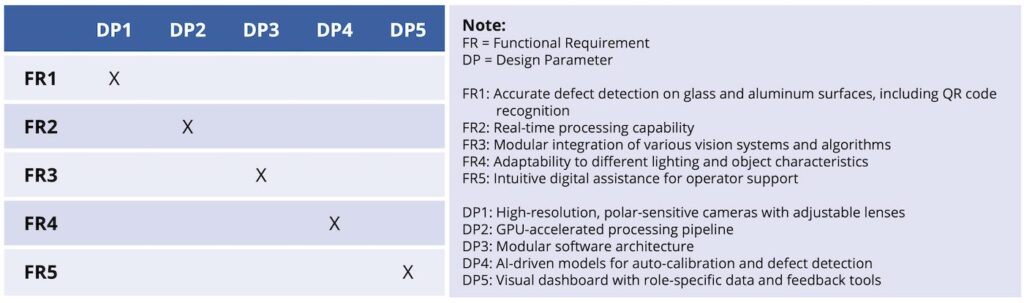
The AD framework structures the system, specifically functional requirements and design parameters, supporting the workstation’s modular and scalable architecture. The Functional Requirements (FRs) were derived from key Customer Needs (CNs) identified through stakeholder input in the previously manual pre-packaging quality control process. These needs include accurate detection of missing or incorrect parts, fast and reliable inspection, adaptability to different products, and clear operator guidance to reduce training time and errors.
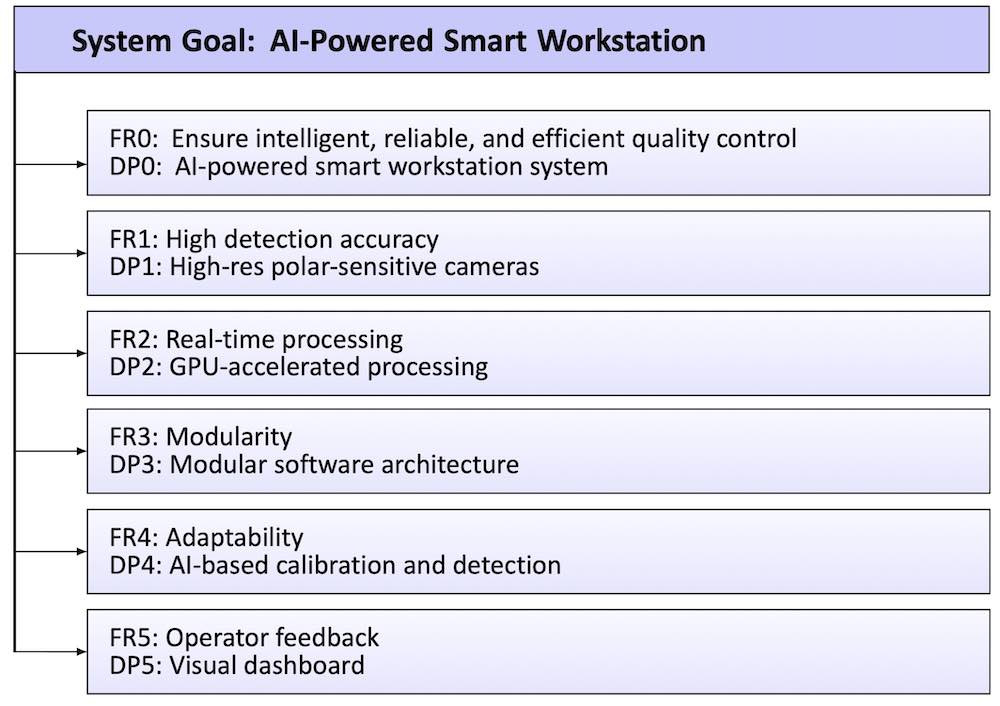
These CNs were translated into Functional Requirements that capture the system’s essential capabilities: detecting defects on glass and aluminum, reading QR codes reliably, ensuring real-time performance, supporting modular vision components, adapting to variable lighting, and assisting operators through an intuitive interface. Corresponding Design Parameters (DPs) include high-resolution polar-sensitive cameras, GPU-based processing, modular software, AI-driven calibration and detection, and a feedback-oriented visual dashboard.
Each design parameter was implemented through specific process variables, such as checkerboard camera calibration, GPU-based deep learning, a plugin-ready Python architecture, histogram-based lighting control, and a Flask interface with real-time feedback. A design matrix links parameters to their functional requirements, while a hierarchical tree visualizes their system relationships.
Prototype implementation and performance insights
A preliminary implementation of the smart workstation was developed and tested in a controlled environment simulating a pre-packaging station for shower cabin components. The goal was to validate the design assumptions made through Axiomatic Design (AD) and to assess the system’s performance in detecting defects and supporting operators.
The smart workstation prototype integrates several interconnected components that work together to enable automated inspection and operator support. The system includes an RGB camera (Baumer VLT-X-650 C.I), which is positioned 2.5 meters above the pre-packaging table and is used for QR code detection and material recognition. In parallel, a PolarSens camera (Baumer VCXG.2-51MP) detects defects in reflective or transparent materials.
For material classification and defect detection, the YOLOv11 (You Only Look Once) model was used. This state-of-the-art algorithm performs object localization and classification in a single pass, outputting class labels and bounding boxes simultaneously. Unlike region proposal methods, YOLO delivers faster processing with competitive accuracy, making it ideal for real-time inspection tasks.
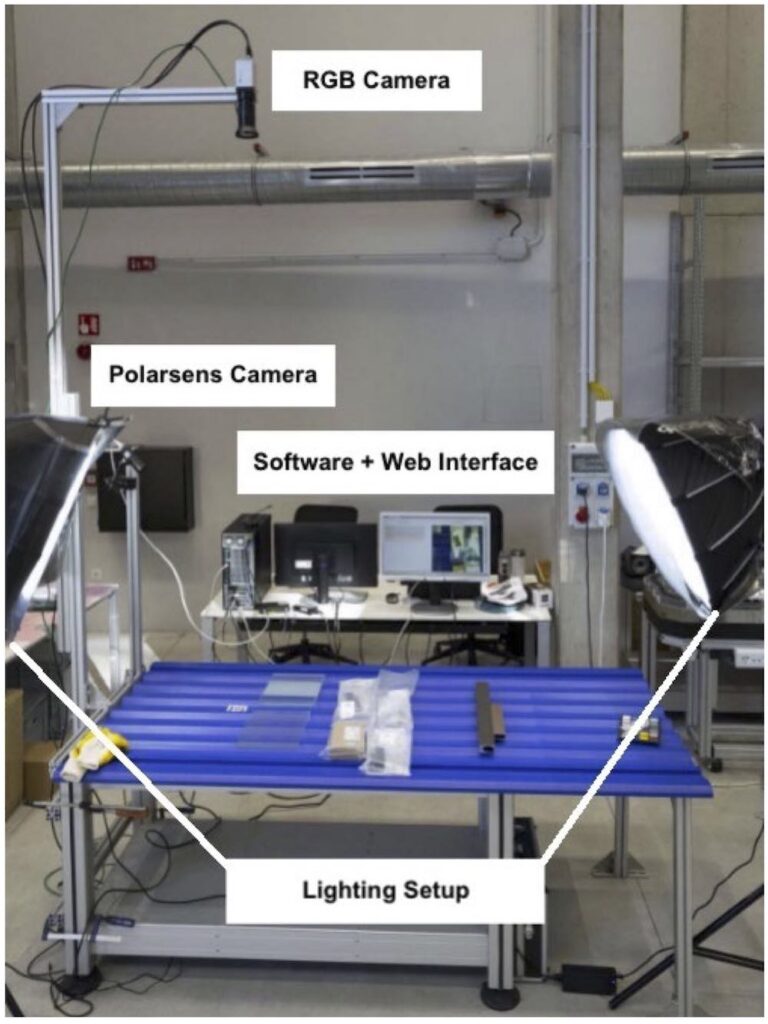
The workstation ensures stable visual conditions with softboxes and tunable LEDs for uniform, glare-free lighting. Materials are inspected on a central pre-packaging table, with data processed through a modular Python pipeline supporting plug-in models. An NVIDIA GTX 5070 GPU enables real-time AI predictions, while a Flask and JavaScript web interface offers live feedback and operator support. This setup ensures seamless hardware–software integration for efficient, automated quality control.
The prototype was evaluated in a realistic pre-packaging context using glass, aluminum, and QR-tagged items. Key metrics such as detection accuracy, QR decoding, processing time, modularity, and lighting robustness were tested under different conditions and benchmarked against manual inspection or literature values to validate effectiveness.
- Detection Accuracy: Over 80% for QR codes, profile and glass features and surface defects, comparable or superior to manual inspection (typically 70-85% depending on conditions) [10]. Though automated optical inspection systems can reach 95-99% in ideal cases, this result is notable given the general-purpose setup and material complexity.
- QR Decoding Accuracy: Averaged above 80% across lighting and test conditions, outperforming manual methods prone to high error rates [11]. The system’s real-time decoding reduced operator workload and minimized transcription errors in repetitive packaging tasks.
- Material Recognition and Defects Detection: Model performance was evaluated using Mean Average Precision at intersection over union thresholds of 0.50 (mAP50) and 0.50:0.95 (mAP5095). For material recognition, the system achieved over 90% mAP50 and 70% mAP5095. For defect detection, it reached 50% mAP50 and 20% mAP5095.
- Processing Time per Frame: 0.19 seconds (≈ 5 fps) with GPU acceleration, enabling real-time operation. This is a 7.5× speedup over a CPU-only version previously tested in internal benchmarks, and confirms the feasibility of in-line deployment, consistent with reported GPU advantages in multi-task inspection systems [12].
- System Modularity: Developed using modular components (for example classes/functions), enabling easy updates. This reflects best practices for flexible systems in high-mix, low-volume production [1].
- Lighting Robustness: The lighting setup ensured stable image quality despite ambient variation, reducing glare-related noise, a key advantage when inspecting reflective or transparent materials [13].
Although no baseline data existed for manual inspection times or errors, operator feedback indicated reduced cognitive load and more consistent processes. The AI models adapted thresholds and confidence scores in real time based on lighting and surface reflectivity, improving defect detection. This adaptability, driven by calibration and feedback loops, optimized DP4 with minimal human input. Results confirm that the AD met all functional requirements with low coupling and high adaptability [14].
A practical solution for Industry 4.0
The modular AI-powered workstation demonstrates how Axiomatic Design (AD) translates operational needs into engineering solutions. Based on “Plug and Produce,” it ensures flexibility, standardization, and easy reconfiguration [15, 16]. Combining cyber-physical production systems (CPPS), digital interfaces, and modular components, the system supports SMEs in adopting Industry 4.0. It automates inspection, reduces errors and training time, and improves productivity in high-mix settings. Some manual steps remain (for example repositioning under difficult lighting), but future upgrades like adaptive lighting may increase autonomy.
Though tested on shower-cabin components, the workstation addresses generic pre-packaging tasks, such as verifying and boxing items, that are common across industries like furniture, electronics, and mechanical parts. Its modular design enables easy adaptation to similar contexts, confirming its scalability beyond the initial use case.
Initial pilot feedback suggests the system is intuitive and easy to integrate, and its architecture offers a promising foundation for cross-domain scalability. Moving forward, efforts will focus on long-term reliability, self-learning capabilities, and deeper integration with CPPS frameworks. Altogether, this work positions the smart workstation as a scalable and future-ready solution that bridges technical, human, and organizational dimensions of modern manufacturing.
This is an original article. The German translation can be accessed via DOI: 10.30844/I4SD.25.5.128
Bibliography
[1] Tsarouhas, P.; Papaevangelou, N.: Critical steps and conditions to be included in a business model in logistics, seeking competitive advantage from the perspective of the modern digital age and industry 4.0. In: Applied Sciences 14 (2024) 7, p. 2701.[2] Aust, J.; Pons, D.: Comparative analysis of human operators and advanced technologies in the visual inspection of aero engine blades. In: Applied Sciences, 12 (2022) 4, p. 2250.
[3] Li, D.; Peng, X.; Cao, H.; Xie, Y.; Li, S.; et al.: Real-time polarimetric imaging and enhanced deep learning model for automated defect detection of specular additive manufacturing surfaces. In: Photonics 12 (2025) 3, p. 243.
[4] Suh, N. P.: Designing-in of quality through axiomatic design. In: IEEE Transactions on reliability, 44 (1995) 2, pp. 256-264.
[5] Matt, D. T.; Rauch, E.: Application of axiomatic design for the design of flexible and agile manufacturing systems. In: Design Engineering and Science (2021), pp. 483-519.
[6] Zhou, L.; Zhang, L.; Konz, N.: Computer vision techniques in manufacturing. In: IEEE Transactions on Systems, Man, and Cybernetics: Systems, 53 (2022) 1, pp. 105-117.
[7] Silva, C. A. d. S.; Paladini, E. P.: Smart machine vision system to improve decision-making on the assembly line. In: Machines 13 (2025) 2, p. 98.
[8] Ren, Z.; Fang, F.; Yan, N.; Wu, Y.: State of the art in defect detection based on machine vision. In: International Journal of Precision Engineering and Manufacturing- Green Technology, 9 (2022) 2, pp. 661-691.
[9] Havlíková, K.; Hořejší, P.; Kopeček, P.: Effect of augmented reality support on quality inspection of welded structures. In: Applied Sciences 13 (2023) 21, p. 11655.
[10] Caballero-Ramirez, D.; Baez-Lopez, Y.; Limon-Romero, J.; Tortorella, G.; Tlapa, D.: An assessment of human inspection and deep learning for defect identification in floral wreaths. In: Horticulturae 9 (2023) 11, p. 1213.
[11] Kubáňová, J.; Kubasáková, I.; Čulík, K.; Štítik, L.: Implementation of barcode technology to logistics processes of a company. In: Sustainability 14 (2022) 2, p. 790.
[12] Weiss, E.; Caplan, S.; Horn, K.; Sharabi, M.: Real-time defect detection in electronic components during assembly through deep learning. In: Electronics 13 (2024) 8, p. 1551.
[13] Nascimento, R.; Rocha, C. D. ; Garcia Gonzalez, D.; Silva, T.; Moreira, R.; et al.: Automated optical system for quality inspection on reflective parts. In: The International Journal of Advanced Manufacturing Technology (2025), pp. 1-16.
[14] Seeliger, A.; Cheng, L.; Netland, T.: Augmented reality for industrial quality inspection: An experiment assessing task performance and human factors. In: Computers in Industry 151 (2023), p. 103985.
[15] Rauch, E.; Spena, P. R.; Matt, D. T.: Axiomatic design guidelines for the design of flexible and agile manufacturing and assembly systems for smes. In: International Journal on Interactive Design and Manufacturing (IJIDeM), 13 (2019) 1, pp. 1-22.
[16] Francalanza, E.; Mercieca, M.; Fenech, A.: Modular system design approach for cyber physical production systems. In: Procedia Cirp 72 (2018), pp. 486-491.
Your downloads
Potentials: Innovation
Solutions: Quality Management
You might also be interested in