
Mechanisms of GenAI Governance |
A case study on the responsible use of GenAI in organizations

| Journal | Industry 4.0 Science |
| Issue | Volume 41, 2025, Edition 5, Pages 58-64 |
| Open Access | https://doi.org/10.30844/I4SE.25.5.58 |
| Bibliography | Share | Cite | Download |
Abstract
Article
The rapid spread of generative artificial intelligence (GenAI) is transforming industrial value creation significantly [1]. Since GenAI can generate non-predefined results such as text, images, audio, or code based on individual inputs [2], this technology is becoming increasingly prevalent in a wide range of applications in manufacturing companies [3]. This brings complex challenges in terms of accountability, transparency, and regulatory compliance, making it a pressing governance issue [4, 5, 6].
Governance of AI systems aims to align the use of AI with an organization’s strategies, goals, values, legal requirements, and ethical principles [7]. To this end, governance mechanisms such as guidelines, processes, or training tools are designed to ensure an ethical and compliant use of AI in organizations [8]. Previous approaches to AI governance have primarily focused on aspects such as technological control of AI systems, regulatory compliance, and organizational control [4, 5].
Social factors such as employee attitudes, awareness, and skills have not been sufficiently considered [8]. Meanwhile, regulatory frameworks impose external obligations that further reinforce the importance of employee-related aspects in AI and GenAI governance. For example, Article 4 of the EU AI Act requires organizations to ensure an appropriate level of AI literacy among their employees [9]. Despite initial conceptual models, there is still a lack of empirical evidence on how AI governance mechanisms can be designed, implemented, and made effective in practice to address these aspects [8].
Therefore, the aim of this qualitative case study is to examine how governance mechanisms can be designed to promote knowledge, acceptance, and responsible use of GenAI among employees. To this end, we accompanied a manufacturing company during the implementation of GenAI over a period of six months, with a specific focus on the governance mechanisms used. We analyze the identified mechanisms using the framework of structural, procedural and relational governance mechanisms developed by [8].
Our findings indicate that organizations should adopt a holistic approach, combining structural, procedural, and relational mechanisms to address employee-related aspects of GenAI governance. By connecting theoretical models with practical insights, we contribute to the growing field of GenAI governance and provide practical recommendations for a competent and responsible use of GenAI in organizations.
Mechanisms of GenAI governance
While the basic assumptions of AI governance also apply to GenAI, it becomes apparent that the technical peculiarities of the technology require a rethinking in the organizational context. Hence, GenAI expands the scope of AI governance by extending technology-related aspects and adding a new employee-related dimension [8]. While technology-related aspects are widely discussed, employee-related aspects have received little attention in the literature to date [8, 10, 11]. This is particularly problematic since GenAI systems, given their openness, unpredictability, and interactivity, place high demands on employee judgment and personal responsibility to avoid organizational risks.
In this context, it is argued that organizations should succeed in three key areas: (1) promoting a critical yet positive attitude toward GenAI systems among their employees, which encourages them to critically reflect on AI-generated outputs while also engaging them to experiment with these systems; (2) making employees aware of the possibilities and limitations of GenAI systems in order to inform them about the organizational risks of GenAI use, for example in relation to security concerns or IP leakage, and (3) empowering employees to use GenAI systems competently so that they have the skills to generate correct and relevant outputs and are able to evaluate them in terms of their alignment with the organization’s strategy and values [6, 12, 8].
To address these employee-related aspects, three distinct GenAI governance mechanisms, which differ in their design and objectives, can be distinguished (see Fig. 1) [8]. First, structural mechanisms of GenAI governance refer to the definition of relevant roles within the organization and the location of decision-making authority. Some organizations, for example, appoint AI ethics officers or form specific committees to guide the responsible use of AI in the organization and to act as points of contact for employees [11]. Regulatory frameworks such as the EU AI Act may also impose requirements on the location of decision-making authority [6, 9].
Second, procedural mechanisms of GenAI governance aim to align decision-making and use of GenAI to the organization’s strategic and value-based objectives [6, 8]. In addition to higher-level guidelines [13], these include aspects such as risk management, contractual and legal aspects as well as compliance monitoring and issue management [8].
Third, relational mechanisms of GenAI governance contribute to a competent and responsible use of GenAI through needs-based training and by adequately structuring the implementation process. This also includes fostering collaboration between stakeholders by communicating the organization’s intention for GenAI use through appropriate channels [8].
![Figure 1: Mechanisms of GenAI governance in an organization (according to [8]).](https://industry-science.com/wp-content/uploads/2025/09/Obermann_I4S-25-5_Figure-1-1024x235.jpeg)
However, while conceptual considerations are more advanced, empirical findings on how governance mechanisms can be designed to promote a responsible use of GenAI are missing. Therefore, building on the existing framework for distinguishing corporate GenAI governance mechanisms [8], we then provide practical insights from a case study analysis.
GenAI governance in corporate practice
To gain practical insights into the design of governance mechanisms addressing attitude, awareness and skills of employees, we conduct a case study analysis by accompanying a medium-sized manufacturing company during the six-month GenAI implementation process. The company develops and produces specialized industrial products for the B2B sector and aims to empower its employees in their daily work with a GenAI tool. This could assist in creating texts and designing presentations, or support formula generation in Excel or the analysis of bugs in code snippets.
As part of this process, the company is committed to using GenAI responsibly. To this end, the company has implemented a series of governance mechanisms to promote the competent use of GenAI. Part of the data collection process involved gaining insight into the mechanisms used and how they are implemented.
Our data is based on insights gained from workshops, access to internal documents, and interviews with employees from various departments. Using the conceptualization of governance mechanisms [8], we focus on employee-related aspects in our data analysis and examine the mechanisms implemented with regard to their intended governance objective (structural, procedural, or relational). As a result, we identify twelve distinct mechanisms, serving as practical insights on how organizations can design their corporate GenAI governance (see Fig. 2).
Analyzing the governance endeavors of the case study, it becomes obvious that some mechanisms aim to designate a clear location of responsibility and decision-making authority in the manufacturing company (structural mechanisms), while others are designed to define policies for the responsible use of the tool and to ensure compliance with them (procedural mechanisms). In addition, we explore endeavors to integrate employees and train them appropriately (relational mechanisms).
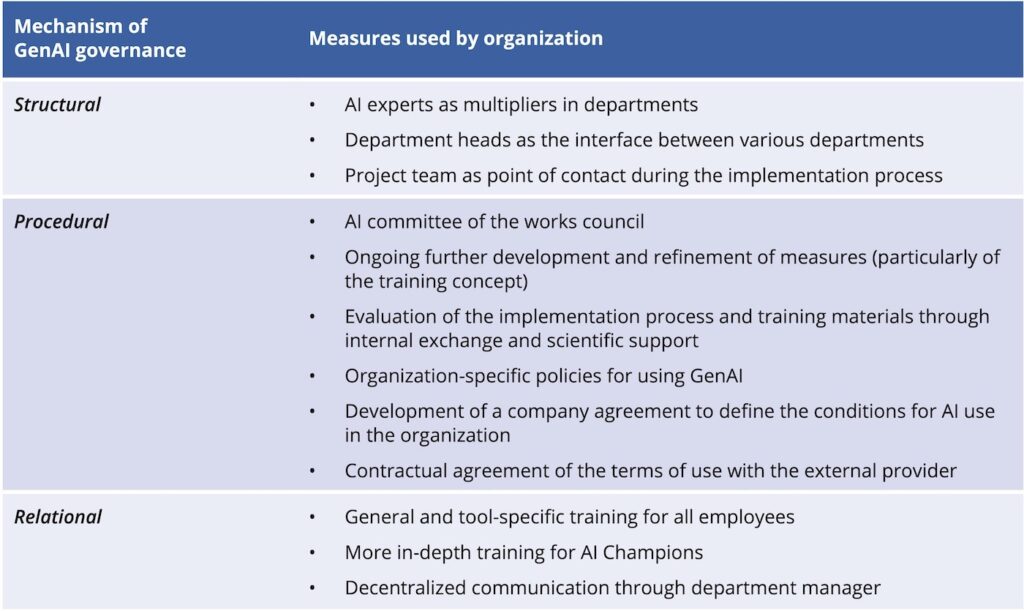
Since structural conditions are already in place before the implementation process, responsibilities can be divided into four areas: First, a small project team is responsible for the operational implementation, communication and the development of training materials. This team has a high level of technical expertise and is therefore also responsible for the development of training for other employees. Second, a separate AI committee is formed by the works council, which explicitly deals with AI-related issues and interacts with the project team.
Third, while the main responsibilities are anchored in specific areas of the organization, department heads take on a mediating role in which they communicate organizational plans and information. They thus form an interface between departments, the project team, and the guidelines at the organizational level. Fourth, from the individual departments, some employees are selected and extensively trained to become experts in the GenAI tool. This enables them to assume a multiplier role within the organization, serving as knowledgeable contacts for everyday inquiries related to GenAI and actively promoting the tool’s adoption across various departments. With this, the organization clearly distributes responsibility and decision-making authority among individual actors and groups of actors.
To create a unified understanding within the manufacturing company of which aspects need to be considered for the responsible use of the GenAI tool, and to install mechanisms that ensure this form of use aligns with the organization’s strategic and value-based objectives, the organization used procedural mechanisms. These include, among other things, the development of a company agreement that regulates the conditions for the use of AI in the organization and thus avoids AI-related effects, for example in relation to job cuts and discrimination in selection processes.
The organization developed policies that relate, for example, to the handling of sensitive data and must be followed when using the GenAI tool. As a result, they decided to use GenAI on a contractual basis with an external provider, so that terms of use (for example regarding security risks) are specified in the license agreement. Through continuous monitoring, feedback loops, and evaluations, the company developed processes to identify and deal with emerging problems early on.
At various points in the implementation process, these policies are communicated to the departments and trainings are developed (relational mechanisms). The company opted for decentralized communication via the heads of department, who are responsible for passing on details about the implementation process and possible uses to the departments. Complementary training courses were created that address general aspects of GenAI, providing tool-specific support. To build up deeper expertise and train some employees in the departments as experts in the GenAI tool, additional and more specialized training courses are being developed. In these trainings, aspects such as prompt engineering, AI ethics and fields of application for the GenAI tool in the company will be further explored.
GenAI governance mechanisms as the key to responsible use
GenAI implies specific governance risks and therefore requires targeted mechanisms by the organization, particularly with regard to employee-related aspects. The manufacturing company case study reveals a combination of structural, procedural, and relational mechanisms. This holistic approach allows for the clear assignment of responsibilities within the organization and helps when defining guidelines for responsible use and empowering employees to use GenAI competently.
First, the organization is committed to promoting a positive yet critical attitude toward GenAI by making the tool available across departments, encouraging employees to try it out, and raising awareness about the importance of critically evaluating AI-generated content.
Second, it aims to strengthen awareness of the possibilities and limitations of the technology, for example by assigning responsibilities to various individuals and groups, and by developing policies for responsible use.
Third, the organization focuses on developing skills for competent GenAI use through general and specialized training programs. Regarding the regulatory requirements posed by the EU AI Act, our insights provide practical recommendations on how organizations can promote responsible GenAI use through targeted governance mechanisms.
In addition, it became evident that the conceptual model [8] provides a valuable transferability to practice. We therefore encourage researchers to build on our findings and conduct a more in-depth comparative analysis between companies using different GenAI tools to gain more insight into individual GenAI governance mechanisms.
This article was written as part of the project “HUMAINE (human-centered AI network) – Transfer-Hub of the Ruhr Metropolis for human-centered work with AI”, which is funded by the German Federal Ministry of Research, Technology and Space in the program “Future of Value Creation – Research on Production, Services and Work” and supervised by the Project Management Agency Karlsruhe (PTKA) (funding code: 02L19C200).
This is an original article. The German translation can be accessed via DOI: 10.30844/I4SD.25.5.58
Bibliography
[1] Rane, N.: ChatGPT and similar generative artificial intelligence (AI) for smart industry: role, challenges and opportunities for industry 4.0, industry 5.0 and society 5.0. In: INNOVATIONS IN BUSINESS AND STRATEGIC MANAGEMENT (2024) 2, pp. 10-17.[2] Brynjolfsson, D.; Li, D; et al.: Generative AI at Work. In: The Quarterly Journal of Economics (2025), qjae044.
[3] Aromaa, S.; Heikkilä, P; et al.: Company perspectives of generative artificial intelligence in industrial work. In: Procedia Computer Science (2025) 253, pp. 217-226.
[4] Hickman, E.; Petrin, M.: Trustworthy AI and corporate governance: the EU’s ethics guidelines for trustworthy artificial intelligence from a company law perspective. In: European Business Organization Law Review (2021) 22, pp. 593-625.
[5] Birkstedt, T.; Minkkinen, M.: AI governance: themes, knowledge gaps and future agendas. In: Internet Research 33 (2023) 7, pp. 133-167.
[6] Mäntymäki, M.; Minkkinen, M.; et al.: Putting AI ethics into practice: The hourglass model of organizational AI governance. arXiv preprint (2022) arXiv:2206.00335.
[7] Mäntymäki, M.; Minkkinen, M.; et al.: Defining organizational AI governance. In: AI and Ethics 2 (2022) 4, pp. 603-609.
[8] Schneider, J.; Kuss, P.; et al.: Governance of generative artificial intelligence for companies. arXiv preprint (2024) arXiv:2403.08802.
[9] EU AI Act, Article 4: AI literacy. URL: https://artificialintelligenceact.eu/de/article/4/, accessed 02.04.2025.
[10] Schneider, J.; Abraham, R.; et al.: Artificial Intelligence governance for businesses. In: Information Systems Management40 (2023) 3, pp. 229–249.
[11] Lupp, D.; Obermann, N.; et al.: AI governance in DAX40: A typology of organizational guidelines for self-regulation. Paper presented at EURAM 2025 Conference. Track T09_08 – Responsible and Human-centered Artificial Intelligence in Business Ethics – Standards, Processes and Behaviours.
[12] Annapureddy, R.; Fornaroli, A.; et al.: Generative AI literacy: Twelve defining competencies. Digit. Gov.: Res. Pract. Just Accepted (August 2024).
[13] Jobin, A.; Ienca, M.; et al.: The global landscape of AI ethics guidelines. In: Nature Machine Intelligence 1 (2019) 9, pp. 389–399.
Your downloads
Potentials: Leadership
You might also be interested in