Autor: Wolfgang Kersten

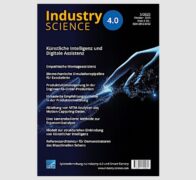
I4S 5/2025: Artificial Intelligence and Digital Assistance

I4S 5/2025: Artificial Intelligence and Digital Assistance

How we can better support work
Demographic change, skills shortages, and stagnating productivity are threatening the competitiveness of German industry. At the same time, AI and digital assistance systems are opening up new opportunities: they make work more efficient and support skilled workers. But while they have long been part of everyday life, their potential in industry remains largely untapped—this is where this issue comes in with innovative concepts.
Resilience and Sustainability in the Supply Chain

Resilience and Sustainability in the Supply Chain

How SMEs can prepare for the changes to come
Jonas Fuchs, Lasse Bo Ladewig, Wolfgang Kersten ORCID Icon
More than 99% of German companies are small and medium-sized enterprises (SMEs), which therefore represent an important part of industrial supply chains. New regulations are increasing the pressure on companies to create transparency along the supply chain so that the role of SMEs is also coming into focus. However, they are often confronted with limited financial and human resources. Based on a quantitative survey and a literature review, this article deals with the question of what SME-friendly approaches could look like.
Industry 4.0 Science | Volume 40 | 2024 | Edition 1 | Pages 57-62
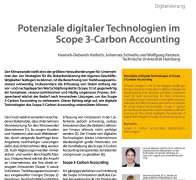
Potentials of Digital Technologies in Scope 3-Carbon Accounting

Potentials of Digital Technologies in Scope 3-Carbon Accounting

Hannah-Deborah Harbich, Johannes Schnelle ORCID Icon, Wolfgang Kersten ORCID Icon
Climate change is one of the biggest challenges facing companies. To be able to define strategies for decarbonizing their business activities, companies need to start accounting for their emissions. Calculating Scope 3 emissions is a complex, resource- intensive, and often imprecise process for companies. By using digital technologies, Scope 3 carbon accounting can become more transparent, efficient, and secure. This article highlights the potential of digital technologies in Scope 3 carbon accounting.
Industrie 4.0 Management | Volume 39 | 2023 | Edition 2 | Pages 29-32 | DOI 10.30844/IM_23-2_29-32
COVID-19: A Catalyst for Digitalization and Transparency?

COVID-19: A Catalyst for Digitalization and Transparency?

A study on the effects of the pandemic
Johannes Schnelle ORCID Icon, Henning Schöpper ORCID Icon, Wolfgang Kersten ORCID Icon
The COVID-19 crisis had an unmistakable impact on the procurement situation in global supply chains, to which companies had to adapt quickly. The effects make it clear that to reduce risks, companies must address the structure and transparency of supply chains. The following article examines what knowledge the actors have and how digitalization can lead to further improvement. The results show that companies currently have little supply chain knowledge beyond their direct suppliers, but are increasingly able to obtain the supply chain data they require. At the same time, the results indicate that there is still potential to increase transparency and the use of data.
Industrie 4.0 Management | Volume 37 | 2023 | Edition 1 | Pages 27-31 | DOI 10.30844/I4SE.23.1.72
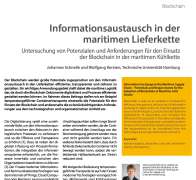
Information Exchange in the Maritime Supply Chain

Information Exchange in the Maritime Supply Chain

Johannes Schnelle ORCID Icon, Wolfgang Kersten ORCID Icon
Blockchain is seen as an enabler to increase the efficiency, transparency, and security of information exchange in supply chains. An important application area is maritime logistics, as blockchain facilitates the digitalization of documents and increases the efficiency of the processes. In this article, we elaborate on the example of temperature-controlled container transports the potential for adopting blockchain and the requirements to be considered from the technological and organizational environment.
Industrie 4.0 Management | Volume 38 | 2022 | Edition 6 | Pages 29-32 | DOI 10.30844/IM_22-6_29-32
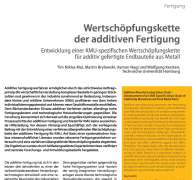
Additive Manufacturing Value Chain

Additive Manufacturing Value Chain

Development of an SME-specific value chain of additively manufactured final metal parts
Tim Niklas Mai, Martin Brylowski, Ayman Nagi, Wolfgang Kersten ORCID Icon
Additive manufacturing processes are becoming increasingly important in industry and enable the cost-e ective production of complex components in small quantities. Small and medium-sized enterprises (SMEs) in particular can bene t from the high customization potential enabling the development of new business models. However, the widespread use of additive processes faces high production costs and technological challenges. Meanwhile, scienti c research focuses on the optimization of individual process steps of additive manufacturing and does not o er su cient support for SMEs. Therefore, this paper deals with the development of a cross-process value chain of additive manufacturing for SMEs. Based on a systematic analysis of scienti c literature, relevant additive manufacturing processes were investigated, and a cross-process value chain was derived. The results were veri ed by expert interviews and central research and development requirements were extracted.
Industrie 4.0 Management | Volume 38 | 2022 | Edition 3 | Pages 25-30 | DOI 10.30844/I40M_22-3_25-30
Measuring Digitalization

Measuring Digitalization

A sociotechnical KPI model for the digital transformation
Felix Krol, Birgit von See, Wolfgang Kersten ORCID Icon
A successful digital transformation for attaining Industry 4.0, is a crucial success criterion for many companies today. The ongoing global COVID-19 pandemic has shown the need for digitalization in companies and has further accelerated this development. However, these times, companies are confronted with an uncertain order and profit situation. Thus, they need to allocate their investments purposefully. Evaluating the digital maturity by using a profound indicator system is therefore a sound basis for decision making. This paper develops such a sociotechnical KPI model along the dimensions “Strategy and Organizational Leadership”, “Digital Skills/Human Capital” as well as “Smart Process/Operations”. In the future, this model can be used for determining the digital maturity and thus, it can be applied for allocating digitalization investments.
Industrie 4.0 Management | Volume 37 | 2021 | Edition 3 | Pages 30-34 | DOI 10.30844/I40M_21-3_S30-34
Evolving Change Management

Evolving Change Management

Current challenges, success factors and adjustments for digital transformation
Florian Dörries, Marco Wichering, Wolfgang Kersten ORCID Icon
In view of the digital transformation, companies are facing radical changes which could have a big impact on their business success. Change management could help companies to deal with this transformation and to avoid the risk of losing market share to more innovative companies. The more important question at this stage is if traditional Change management models handle this topic well or if they must be adjusted. This article identifies challenges and success factors by using a literature analysis and a survey, by means of which an adapted model for successful Change management is generated.
Industrie 4.0 Management | Volume 37 | 2021 | Edition 1 | Pages 50-54 | DOI 10.30844/I40M_21-1_S50-54
Beautiful New Transparency with Blockchain

Beautiful New Transparency with Blockchain

Why Transparency Creates Unexpected Obstacles for Logistics Business
Sven Reimers, Wolfgang Kersten ORCID Icon
Blockchain technology is expected to have great potential for success, especially in logistics and supply chain management. In the following, the Blockchain project “Release Order based on Blockchain (ROboB)” in the Port of Hamburg will be discussed in particular. The analysis showed that in addition to positive aspects, the core characteristics of the Blockchain could also represent obstacles for logistics business. Therefore, this paper examines whether transparency is an important design consideration when using blockchain in logistics and the supply chain.
Industrie 4.0 Management | Volume 36 | 2020 | Edition 1 | Pages 11-14 | DOI 10.30844/I40M_20-1_S11-14
Internet of Things Calls for a New Way of Working

Internet of Things Calls for a New Way of Working

Ways to Digitally Transform Qualification, Organization, and Leadership
Birgit von See, Wolfgang Kersten ORCID Icon
When aiming for an Industry 4.0 vision, companies are well-advised to not only focus on technology and data. With any digital transformation, the careful consideration of all elements of the company’s “socio-technical triangle” (man, technology, and organization) is a central success factor. Based on a qualitative survey, we identified qualification, organization, and leadership as central dimensions of the work system. Integrative measures include identification of competence requirements, training in data-thinking as well as agile working methods and structures. Finally, leadership plays a central role in orchestrating the digital transformation.
Industrie 4.0 Management | Volume 34 | 2018 | Edition 3 | Pages 8-12 | DOI 10.30844/I40M_18-3_S8-12
1 2 3