Assistance for Simulation in Production and Logistics |
A literature-based classification

| Journal | Industry 4.0 Science |
| Issue | Volume 41, 2025, Edition 5, Pages 66-76 |
| Open Access | https://doi.org/10.30844/I4SE.25.5.64 |
| Bibliography | Share | Cite | Download |
Abstract
Keywords
Article
Although discrete-event simulation has been useful for planning and operating production and logistics systems in industry for many years, there are still obstacles to its application today. These are primarily due to the high modeling effort, the lack of data or the insufficient data quality, the inadequate model validity for the intended purpose, and high experimental effort. In addition, the shortage of skilled workers means that there is a lack of qualified personnel to ensure consistent application. This is particularly important for the implementation of digital twins. For this reason, research has focused for years on reducing the effort involved in using simulation and making simulation studies more efficient.
This article analyzes, based on the literature, how the different phases of a simulation study can be supported, highlighting possible phase-specific assistance. The field of simulation-based assistance systems is not considered. The article concludes with a discussion of open research topics.
Brief definition of assistance and assistance systems
The term “assistance system” in the context of decision support is not new. As early as 2008, this term was the subject of an interdisciplinary discourse between computer science, logistics, and sociology as part of the Collaborative Research Centre SFB 559 “Modeling Large Logistics Networks”. Subsequently, in [1, p. 242], assistance systems were defined as “computer-based systems that support humans in decision-making and implementation”.
Furthermore, [1, p. 242] specifies that assistance systems for decision support are “characterized by the identification of a set of solutions, the selection and evaluation of alternatives, and autonomous action.” The authors add that the performance potential of assistance systems lies in their “ability to perform intelligent procedures that humans systematically fail to execute due to their limited cognitive abilities when faced with high levels of difficulty and (system) complexity” [1, p. 242].
Assistance systems are human-machine systems that have different levels of automation, depending on the extent of digital support. This results in different distributions of tasks and decisions between humans and computers. Assistance tools that support tasks involved in the conducting simulation studies in production and logistics are discussed in [2], among others. However, the focus here is on providing knowledge and assistance functions to reduce routine activities; decision support is only a secondary focus.
With the advancing use of artificial intelligence (AI) methods, decision-making processes are also increasingly being shifted to computers. However, in this article, the term “assistance” is deliberately defined more broadly than “assistance system” with regard to the supporting simulation studies. For the literature review, it encompasses both computer-based tools and research on effort reduction, such as procedure models and methodologies. This broadening of the term was chosen because computer-based implementations can be realized from initially non-computer-based assistance if the application is sufficiently accepted.
Assistance for discrete-event simulation
In order to investigate the range of assistance available for discrete-event simulation, a search is conducted in the relevant scientific simulation literature. For this purpose, the conference proceedings of the ASIM symposium “Simulation in Production and Logistics” and the “ASIM Symposium Simulation Technology SST” since 2010 are analyzed. Additionally, the production and logistics-related tracks of the Winter Simulation Conference since 2010, as well as all issues of the Journal of Simulation and Simulation Notes Europe since 2020 are included.
Based on the titles and abstracts, publications are identified whose results are classified in the above-defined areas of assistance or assistance systems. Further literature related to the current basic research projects “LOCsGEN – Generation of operating curves for order-picking systems under uncertainty” (DFG 544959882) and “KL4SiM – Automated generation of structural variants for simulation models of production and logistics using combinatorial logic” (DFG 511349842), which focus on improving the use of simulation, is also considered.
This approach initially identifies 69 scientific articles. Based on the aforementioned definition of assistance and the preliminary results of the initial research, the following search string is formulated for a systematic search in the Web of Science database:
(TI=(“discrete-event simulation”) OR TI=(“discrete event simulation”) OR AB=(“discrete-event simulation”) OR AB=(“discrete event simulation”)) AND (ALL=(“production”) OR ALL=(“manufacturing”) OR ALL=(“logistic“)) AND (ALL=(“standardization”) OR ALL=(“standardisation”) OR ALL=(“procedure model“) OR ALL=(“checklist“) OR ALL=(“guide“) OR ALL=(“knowledge base”) OR ALL=(“template“) OR ALL=(“automat“) OR ALL=(“ontolog“) OR ALL=(“machine learning”) OR ALL=(“LLM“) OR ALL=(“Large Language Model“) OR ALL=(“Large-Language Model“)).
The search period is limited to the years from 2010 onwards. This query initially returns 545 results, which are evaluated based on their titles and abstracts. Subsequently, 81 sources are selected from the database for full-text review.
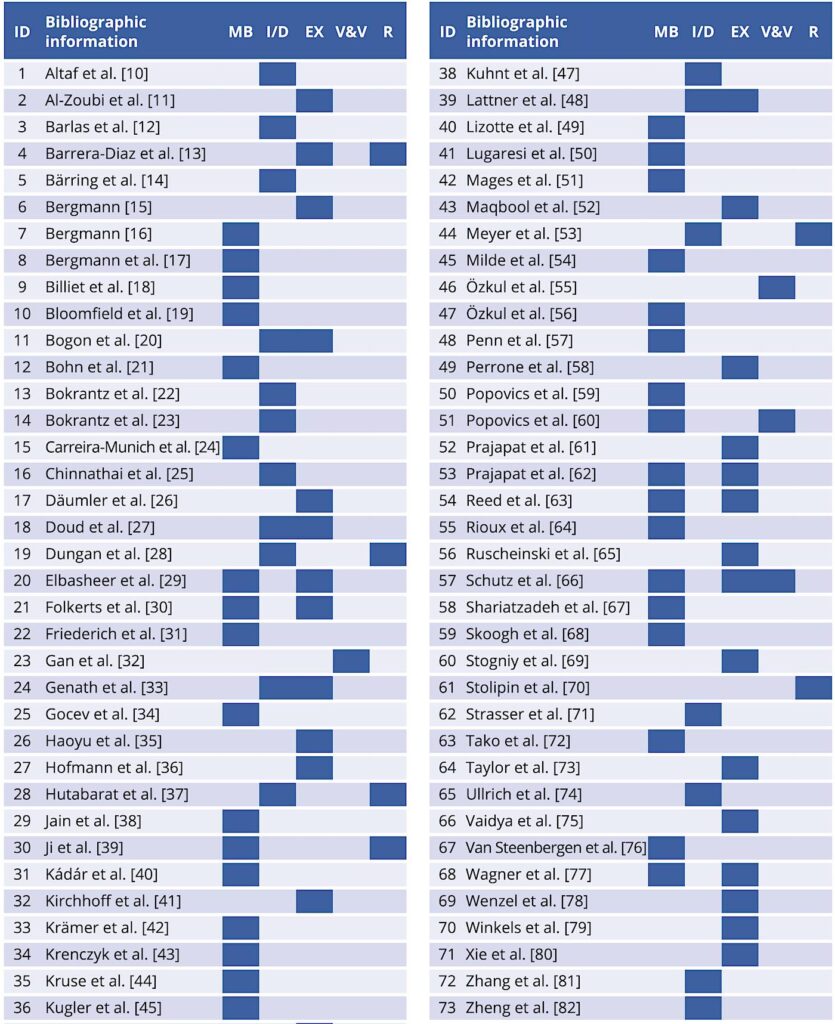
In addition, there are 69 sources that were already identified in the initial search, so that a total of 150 scientific articles are evaluated on the basis of their full text. After reviewing the content, 73 sources dealing with assistance during the conduction of simulation studies remain. Where sources represent the same subject by the same team of authors, only the most recent source is included. These sources are listed in the concept matrix in Figure 1 and assigned to their corresponding simulation study phases. These phases are based on those of the procedure model for conducting simulation studies according to [3, p. 6], with the exception of the offer phase.
Additionally, system analysis, model formalization, and implementation fall under the umbrella of model building (MB). The two phases of data collection and data preparation are assigned to information and data acquisition (I/D). Verification and validation (V&V) of data and models does not constitute a separate phase, but runs in parallel with all other phases and is therefore also considered. The sources listed in Figure 1 are indexed in the following text with [ID 1]-[ID 73].
Assistance for model building
The number of publications on assistance in model generation (Fig. 1) indicates that efficiency gains in this particularly complex phase are constantly being researched, with a focus on reducing the effort involved in manual model building by using (semi-)automatic model generation (AMG).
The authors in [ID 8] define AMG as a group of approaches in which models are not generated entirely manually but rather in a data-driven manner using (simulation) external data sources. Computer-aided design (CAD) models are one example of such data source, on the basis of which simulation model layouts can be automatically generated or checked.
This article elaborates on the concept of externalized knowledge as the basis for AMG. For instance, [ID 25] presents an ontology-based software module for the automatic configuration and verification of model layouts. Meanwhile, [ID 30] presents an ontology-based approach to model versioning that enables the detection and recording of changes between different model versions, including a check for inconsistencies.
[ID 73] uses a semantic modeling approach for model generation and result visualization, while [ID 31] applies ontologies to promote interoperability between simulation models and other digital factory tools. [ID 16] and [ID 21] query ontologies to identify suitable resources for representation in a simulation model. This research demonstrates the maturity of semantic models in simulation as models of symbolic artificial intelligence (SAI).
Other approaches to assistance in the form of SAI use software synthesis based on combinatorial logic for AMG. An example of this can be found in [ID 42], where the authors use software synthesis to generate different machine configurations in model variants. They then use these simulation model variants to define joint system solutions for sales purposes. Other publications focus on automating the transformation of phase results during model generation. One example of this is [ID 55], in which the authors present an assistance system for AMG that derives an executable model from an existing (semi-formal) concept model (from the system analysis phase).
Building on this, recent research uses large language models (LLMs) to automatically generate model specifications and executable models based on natural language descriptions [ID 15, ID 33]. In particular, [ID 15] applies LLMs to create a “copilot” for model building. LLMs are machine learning (ML) models trained on data. Other data-driven approaches are taken to model building. For instance, [ID 22], [ID 41] and [ID 47] use process-mining algorithms to extract executable models or model parameters (semi-)automatically based on event data. [ID 50] extract model structures, including model topology, based on data from programmable logic controllers.
Another example of assistance during model building is the use of standardized interfaces, such as CMSD (Core Manufacturing Simulation Data), which were particularly popular during the 2010s. For example, [ID 7], [ID 8] and [ID 29] use CMSD-formatted data to reduce the effort involved in modeling elements such as resources, shift models, or orders. [ID 51] present standardized data structures, enabling users with limited knowledge of a specific simulation tool to build models.
The research presented suggests that assistance in the context of model generation already encompasses a range of artificial intelligence methods. Nevertheless, these do not yet constitute fully fledged assistance systems.
Assistance for information and data acquisition
In order to perform simulations successfully, relevant information and data must be obtained and processed. However, this often poses a considerable challenge due to missing data, limited access to data sources, and poor data quality [ID 38]. Approaches that support information and data acquisition (Fig. 1) therefore aim to reduce the effort associated with information and data acquisition, improve the quality of the input data, and consequently, enhance the quality of the simulation results.
Procedural models [ID 13, ID 18, ID 38] and software tools [ID 39] are already available to support information and data acquisition. [ID 38] expands the procedure model for conducting a simulation study [3] to include phases for information and data acquisition as well as consistent verification and validation. The individual steps range from defining objectives to identifying, collecting, and recording information to structuring and analyzing data and testing data usability.
Additionally, specialized software tools support data collection, preparation, and analysis across the various phases of the simulation study. For example, EDASim [ID 11] and AssistSim [ID 39] include auxiliary functions for selecting, validating, and preparing input data, and for analyzing output data, as well as for designing and executing experiments (see more below). These tools are now available on the market as a joint assistance system [4].
Another approach is to use an expert system that encompasses relevant simulation knowledge [ID 44]. The structured collection and management of expert knowledge according to a defined set of rules improves data collection and preparation and reduces the learning and training effort required for simulation. The expert system can be implemented in the form of a wiki, for example [ID 19]. Visual wikis, in particular, enable the collaborative development and maintenance of system descriptions and facilitate communication between the modeling and specialist departments [ID 19].
Furthermore, data repositories are used for data acquisition [ID 65], while value stream analysis is employed as an additional method of data capturing [ID 5]. The latter visualizes material and information flows, thus facilitating the identification of the required data and the categorization of existing information. This streamlines the data collection process and provides valuable insight into the system to be modeled.
In addition to assisting acquisition of information and data, other approaches focus on improving access to data and information. The authors of [ID 1] demonstrate how time parameters for simulation can be extracted from refined RFID data, thereby avoiding the effort associated with manual data collection. [ID 3] and [ID 8] present a tool for extracting simulation-relevant data from various operational information systems (e.g. ERP or ME systems), using statistical methods to extrapolate and thus prepare missing data.
The tool in [ID 59] offers similar functionality but it also formalizes data in CMSD format. This means that it can describe data independently of the simulation tool. [ID 34] presents a similar but less functional approach using a connector to transfer operational data to a simulation model.
[ID 62] and [ID 65] also present an approach to preprocessing data by applying statistical methods to investigate systems with a particularly wide range of product variants. Rather than changing the properties of a data point directly, their framework uses clustering to automatically select representative product families for simulation. Conclusions can then be drawn about the overall system based on these families. This reduces the effort involved in information and data acquisition, model building, and experiment execution.
Assistance for the “Experiments and analysis” phase
The “experiments and analysis” phase can be time-consuming, as it involves design and execution a large number of simulation experiments, followed by analysis. Assistance systems offer a variety of options to reduce the effort involved (Fig. 1). Tools such as the aforementioned AssistSim [ID 39] or commercially available tools like SimAssist [4] or SAFE [ID 49] aim to automate experiment design and execution to save time and reduce errors. The support covers everything from the design of the experiment plan with parameter configurations to the evaluation and visualization of results, which is particularly beneficial for inexperienced users. Further approaches to automating the design and execution of simulation experiments can be found, for example, in [ID 18] and [ID 68].
In addition, there are several approaches that support specific aspects of experiment design and execution. These include, for example, template-based simulation experiment specification [ID 56] and the automatic variation of model structures using combinatorial logic [ID 69, ID 70]. Unlike the approaches for model generation [ID 42], model structure variants are automatically generated based on a valid executable model, enabling automated structure variation. This enables a large number of model structure variants to be simulated and compared in terms of their quality of result.
Another important approach is statistical metamodeling [ID 32, ID 37, ID 71, ID 72]. Rather than carrying out a large number of complex simulation experiments, a simplified, approximate model – the metamodel – is built based on a few simulation runs and replications. This metamodel can then be used to investigate the behavior of the underlying simulation model in a broader parameter space.
Furthermore, distributed simulation [ID 43, ID 64] enables the modeling of large and complex production and logistics systems despite the associated computational load. Standards [ID 6, ID 64] are often used to promote the interoperability of distributed simulation models. In addition to web-based approaches for distributing simulation experiments, mobile devices can also be used [ID 43], enabling more flexible and accessible execution of simulation studies for inexperienced users.
In addition, the visualization of simulation experiments [ID 17] can facilitate analysis and communication of results, providing intuitive access for everyone involved. In this context, cloud-based assistance systems [ID 2, ID 66] also allow simulation experiments to be executed and accessed flexibly via mobile devices.
Assistance for verification and validation
V&V software functionalities are already offered in commercially available discrete-event simulation tools for checking the executable model (consistency checks) or the input and output data (functions for regression and correlation analysis or for calculating confidence intervals) [5]. Additionally, the tools directly support individual V&V techniques such as animation (for V&V techniques, see [6], among others).
However, V&V assistance is often application-specific and cannot be used consistently for all phases of the simulation process. For instance, [ID 23] presents a V&V assistance system for simulation models running in parallel with system operation in the semiconductor industry. [ID 47] offers a V&V framework based on operational data using process mining, but this can only be used during model building.
Assistance for re-use
Provided that the information and knowledge gained are documented accordingly, simulation studies provide valuable experience for the application of simulation in follow-up studies. For this purpose, [ID 61] presents an ontology-based methodology that supports the re-use of simulation knowledge and is based on a continuously expanding knowledge base.
Evaluation of the analysis and open research topics
The research presented here illustrates the diversity of assistance available for simulation studies, as well as the significant variation in the maturity levels and the lack of continuity. Tools are available to automate experiment design and execution, and to aggregate and prepare data in the information and data acquisition phase. In the modeling phases, various assistance approaches have emerged over the last 15 years, including the standardization of interfaces, the use of simulation tool-independent model formalisms, or statistical metamodeling. However, these approaches have not yet been consolidated.
Research on assistance for V&V and re-use is still in its infancy. Although procedure models and methodologies have been identified, the scope of the research is limited compared to the aforementioned phases. This offers an opportunity for further research, as consistent V&V is essential for carrying out reliable investigations and accelerating the systematic re-use of results.
Analysis of the scientific literature reveals that there are a variety of forms of assistance available for various tasks in the phases of a simulation study. These forms scan be implemented as checklists, procedure models, software functions, or even standalone tools. However, assistance systems for actual decision support (as defined at the beginning of this article) are still largely unavailable, despite the evident need for them and the associated research gaps in both science and application. There is a complete lack of continuity, cross-phase assistance systems. In order to close these gaps, the following fields should be prioritized for future assistance systems in the context of simulation:
- Improving automated model generation
- Ensuring that information gathered for simulation models is both quality-compliant and time-synchronous, based on real system data
- Ensuring the validity of models and data through continuous, guided V&V assistance
- Self-learning and error-detecting simulation models (see [7])
- Natural language design, execution, and evaluation of experiments, as well as reducing experimental effort while improving the accuracy of results
- Creating sustainable, reusable simulation knowledge, even after the project has ended
- Rule-based enablement of interoperability between models and tools
Current research in the fields of statistical metamodeling, artificial intelligence, and theoretical models of computer science could be useful here (see [8] and [ID 15, ID 32, ID 70]). For instance, the use of LLMs offers potential for fields 1 and 3, while statistical metamodeling methods could be used in field 5.
As an additional starting point for field 5, theoretical models of computer science, such as those in [ID 70], offer expanded possibilities for automatically varying non-numerical parameters, such as structures or control strategies, in experiments. Methods of statistical data analysis and AI can be used for field 2, while machine learning methods can be used for field 4, and ontologies can be used for field 6.
The prevalence of combining simulation with other methods such as optimization, machine learning, or process mining, makes the interoperability of models and tools (field 7) increasingly important (for the implementation of digital twins, for example) and requires appropriate assistance, for example in the form of ontology-based “copilot” applications. When using AI methods, particularly machine learning methods such as LLMs, explainability (“Explainable Artificial Intelligence” or “XAI”) and, more broadly, trustworthiness (“Trustworthy Artificial Intelligence” [9]) are essential prerequisites for successful implementation.
Summary and outlook
Based on a literature analysis, this article identified various possibilities for assistance along the procedure model for discrete-event simulation in production and logistics in order to derive research gaps. The research shows that a variety of assistance options are already available to support simulation use. However, it also becomes clear that assistance systems for decision support in simulation have not yet been sufficiently researched in terms of their methodological foundations. Methods from the fields of AI and statistics that complement discrete-event simulation could open new avenues of decision support, thereby reducing the time and effort needed for simulation studies.
The original German version of this article can be accessed via DOI: 10.30844/I4SD.25.5.66
Bibliography
[1] Blutner, D.; Cramer, S. et al.: Assistenzsysteme für die Entscheidungsunterstützung. In: Buchholz, P.; Clausen, U. (eds.): Große Netze der Logistik. Berlin Heidelberg 2009.[2] Mayer, G.; Spieckermann, S.; Wenzel, S.: Steigerung der Produktivität in
Simulationsstudien mit Assistenzwerkzeugen. In: Zeitschrift für wirtschaftlichen Fabrikbetrieb 107 (2012), pp. 174-177.
[3] Wenzel, S.; Weiß, M. et al.: Qualitätskriterien für die Simulation in Produktion und Logistik – Planung und Durchführung von Simulationsstudien. Berlin Heidelberg 2008.
[4] SimPlan AG: SimAssist. URL: https://www.simassist.de/, accessed 23.04.2025.
[5] VDI: VDI-3633 Sheet 13 Simulation von Logistik-, Materialfluss- und Produktionssystemen – Verifizierung und Validierung (V&V). Berlin 2023.
[6] Rabe, M.; Spieckermann, S.; Wenzel, S.: Verifikation und Validierung für die Simulation in Produktion und Logistik – Vorgehensmodelle und Techniken. Berlin Heidelberg 2008.
[7] Furmans, K.; Hanschke, T. et al.: Simulation für Produktion und Logistik. Düsseldorf 2021.
[8] Schweitzer, F.; Habel, L. et al.: Metamodel-based Simulation Optimization Using Machine Learning for Solving Production Planning Problems in the Automotive Industry. In: Bui, T. X. (ed.): Proceedings of the 58th Hawaii International Conference on System Sciences. Honolulu (USA) 2024.
[9] Longo, L.; Brcic, M. et al.: Explainable Artificial Intelligence (XAI) 2.0: A Manifesto of Open Challenges and Interdisciplinary Research Directions. In: Information Fusion 106 (2024), pp. 1-22.
[10] Altaf, M. S.; Bouferguene, A. et al.: Integrated Production Planning and Control System for a Panelized Home Prefabrication Facility Using Simulation and RFID. In: Automation in Construction 85 (2018), pp. 369-383.
[11] Al-Zoubi, K.; Wainer, G.: Mobile Experimentation Using Modeling and Simulation in the Fog/Cloud. In: Journal of Simulation 16 (2022) 6, pp. 550-571.
[12] Barlas, P.; Heavey, C.: KE tool: An Open Source Tool for Automated Input Data in Simulation. In: Roeder, P.; Frazier, P. I. et al. (Eds.): Proceedings of the 2016 Winter Simulation Conference. Washington (USA) 2016.
[13] Barrera-Diaz, C. A.; Oscarsso, J. et al.: Discrete Event Simulation Output Data-Handling System in an Automotive Manufacturing Plant. In: Procedia Manufacturing 25 (2018), pp. 23-30.
[14] Bärring, M. V. L.; Nafors, D. et al.: A VSM Approach to Support Data Collection for a Simulation Model. In: Chan, W. K. V.; D’Ambrogio, A. et al. (eds.): Proceedings of the 2017 Winter Simulation Conference. Las Vegas (USA) 2017.
[15] Bergmann, S.: A New Web Based Method for Distribution of Simulation Experiments Based on the CMSD Standard. In: Laroque, C.; Himmelspach, J. et al. (eds.): Proceedings of the 2012 Winter Simulation Conference. Berlin 2012.
[16] Bergmann, S.: Automatische Generierung adaptiver Modelle zur Simulation von Produktionssystemen. Ilmenau 2014.
[17] Bergmann, S.; Straßburger, S.: Automatische Modellgenerierung – Stand, Klassifizierung und ein Anwendungsbeispiel. In: Mayer, G.; Pöge, C. et al. (eds.): Ablaufsimulation in der Automobilindustrie. Berlin, Heidelberg 2020.
[18] Billiet, H.; Stark, R.: Automatic Generation of a Simulation Model to Support the Rescheduling of a Fixed-Layout Assembly System. In: Bergmann, S.; Feldkamp, N. et al. (Eds.): 20th ASIM Symposium on Simulation in Production and Logistics 2023. Ilmenau 2023.
[19] Bloomfield, R.; Mazhari, E. et al.: Interoperability of Manufacturing Applications Using the Core Manufacturing Simulation Data (CMSD) Standard Information Model. In: Computers & Industrial Engineering 62 (2012) 4, pp. 1065-1079.
[20] Bogon, T.; Timm, I. J. et al.: Towards Assisted Input and Output Data Analysis in Manufacturing Simulation: The EDASim Approach. In: Laroque, C.; Himmelspach, J. et al. (eds.): Proceedings of the 2012 Winter Simulation Conference. Berlin 2012.
[21] Bohn, D.; Angelidis, E. et al.: Grafisches Werkzeug zur Erstellung von Optimierungsalgorithmen für komplexe Montagesysteme. In: Dangelmaier, W.; Laroque, C.; Klaas, A. (eds.): Simulation in Produktion und Logistik 2013. Paderborn 2013.
[22] Bokrantz, J.; Skoogh, A. et al.: A Methodology for Continuous Quality Assurance of Production Data. In: Yilmaz, L.; Chan, W. K. V. et al. (eds): Proceedings of the 2015 Winter Simulation Conference. Huntington Beach (USA) 2015.
[23] Bokrantz, J.; Skoogh, A. et al.: Data Quality Problems in Discrete Event Simulation of Manufacturing Operations. In: SIMULATION 94 (2018) 11, pp. 1009-1025.
[24] Carreira-Munich, T.; Paz-Marcolla, V.; Castro, R.: DEVS COPILOT: Towards Generative AI-Assisted Formal Simulation Modeling based on Large Language Models. In: Lam, H.; Azar, D. et al. (eds.): Proceedings of the 2024 Winter Simulation Conference. Orlando (USA) 2024.
[25] Chinnathai, M. K.; Al-Mowafy, Z. et al.: A Framework for Pilot Line Scale-up Using Digital Manufacturing. In: Procedia CIRP 81 (2019), pp. 962-967.
[26] Däumler, M.; Reith, K. B. et al.: Approach on Evaluating Material Handling Simulation Runs under Consideration of Different Target Groups. In: 24th Symposium on Simulation Technology. Hamburg 2018.
[27] Doud, K.; Yilmaz, L.: Framework for Formal Automated Analysis of Simulation Experiments Using Probabilistic Model Checking. In: Chan, W. K. V.; D’Ambrogio, A. et al. (eds.): Proceedings of the 2017 Winter Simulation Conference. Las Vegas (USA) 2017.
[28] Dungan, P.; Heavey, C.: Proposed Visual Wiki System for Gathering Knowledge about Discrete Event Systems: In: Johansson, B.; Jain, S. et al. (eds.): Proceedings of the 2010 Winter Simulation Conference. Baltimore (USA) 2010.
[29] Elbasheer, M.; D’Augusta, V. et al.: Leveraging Auto-generative Simulation for Decision Support in Engineer-to-Order Manufacturing. In: Procedia Computer Science 232 (2024), pp. 1319-1328.
[30] Folkerts, H.; Pawletta, T.; Deatcu, C.: Model Generation for Multiple Simulators Using SES/MB and FMI 13. In: Deatcu C.; Lückerath, D. et al. (eds.): 25th Symposium on Simulation Technology. Online 2020.
[31] Friederich, J.; Wetong, C. et al.: Equipment-centric Data-driven Reliability Assessment of Complex Manufacturing Systems. In: Loper, M.; Jin, D. (eds.): SIGSIM-PADS ’23. Orlando (USA) 2023.
[32] Gan, B. P.; Lendermann, G. P. et al. (2013): Automatic Model Verification for Semiconductor Manufacturing Simulation. In: Pasupathy, R.; Kim, S.-H. et al. (eds.): Proceedings of the 2013 Winter Simulation Conference. Washington (USA) 2013.
[33] Genath, J.; Bergmann, S. et al.: Development of an Integrated Solution for Data Farming and Knowledge Discovery in Simulation Data. In: Simulation Notes Europe 32 (2022) 3, pp. 121-126.
[34] Gocev, P.; Rabe, M.: Graphical Layout Planning Module within a Semantic Web Framework for Modeling and Simulation. In: Zülch, G.; Stock, P. (eds.): 14th ASIM Conference on Simulation in Production and Logistics. Karlsruhe 2010.
[35] Haoyu, L.; Tang, Y. et al.: Large Language Model Assisted Experiment Design with Generative Human-Behavior Agents. In: Lam, H.; Azar, D. et al. (eds.): Proceedings of the 2024 Winter Simulation Conference. Orlando (USA) 2024.
[36] Hofmann, W.; Lang, S. et al.: A Brief Introduction to Deploy Amazon Web Services for Online Discrete-Event Simulation. In: Procedia Computer Science 200 (2022), pp. 386-393.
[37] Hutabarat, W.; Oyekan, J.: Combining Virtual Reality Enabled Simulation with 3D Scanning Technologies Towards Smart Manufacturing. In: Roeder, P.; Frazier, P. I. et al. (eds.): Proceedings of the 2016 Winter Simulation Conference. Washington (USA) 2016.
[38] Jain, S.; Lechevalier, D.: Standards Based Generation of a Virtual Factory Model. In: Roeder, P.; Frazier, P. I. et al. (eds.): Proceedings of the 2016 Winter Simulation Conference. Washington (USA) 2016.
[39] Ji, F.; Vogel-Heuser, B. et al.: Ontology Versioning for Managing Inconsistencies in Engineering Models Arising from Model Changes in the Design of Intralogistics Systems. In: IEEE Transactions on Automation Science and Engineering 22 (2024), pp. 1249-1261.
[40] Kádár, B.; Terkaj, W.; Sacco, M.: Semantic Virtual Factory Supporting Interoperable Modeling and Evaluation of Production Systems. In: CRIP Annals 62 (2013) 1, pp. 443-446.
[41] Kirchhoff, D.; Kirberg, M. et al.: Metamodel-based Optimization of Shift Planning in Highbay Warehouse Operations. In: Quality and Reliability Engineering International 39 (2022) 2, pp. 590-608.
[42] Krämer, R.; Heger, J.: Beschleunigte Erstellung von Simulationsmodellen für Produktions- und Logistikprozesse mithilfe von GPT-basierten Large Language Models. In: Rose, O.; Uhlig, T. (eds.): ASIM SST 2024 Conference Proceedings Short Papers. Munich 2024.
[43] Krenczyk, D.; Kempa, W. M. et al.: Integration of Manufacturing Operations Management Tools and Discrete Event Simulation. In: IOP Conference Series: Materials Science and Engineering 400 (2018) 2.
[44] Kruse, T.; Schmidtmann, A.: Generierung eines Simulationsmodells auf Basis einer CMDB. In: Dangelmaier, W.; Laroque, C.; Klaas, A. (eds.): Simulation in Produktion und Logistik 2013. Paderborn 2013.
[45] Kugler, M.; Franz, V.: CiSmo – CAD-integrierte Simulationsmodellierung für die Bauablaufsimulation im Hochbau. In: Zülch, G.; Stock, P. (eds.): 14th ASIM Symposium Simulation in Production and Logistics. Karlsruhe 2010.
[46] Kuhnt, S.; Kirchhoff, D. et al.: Generating Logistic Characteristic Curves using Discrete Event Simulation and Response Surface Models. In: Simulation Notes Europe 30 (2020) 3, pp. 95-104.
[47] Kuhnt, S.; Wenzel, S.: Information Acquisition for Modelling and Simulation of Logistics Networks. In: Journal of Simulation 4 (2010) 2, pp. 109-115.
[48] Lattner, D. A.; Pisch, H.: AssistSim – Towards Automation of Simulation Studies in Logistics. In: Simulation Notes Europe 21 (2011) 3-4, pp. 119-128.
[49] Lizotte, M.; Rioux, F.: IMAGE-Scenarization: A Computer-Aided Approach for Agent-based Analysis and Design. In: Johansson, B.; Jain, S. et al. (eds.): Proceedings of the 2010 Winter Simulation Conference. Baltimore (USA) 2010.
[50] Lugaresi, G.; Matta, A.: Automated Digital Twins Generation for Manufacturing Systems: A Case Study. In: IFAC-PapersOnLine 54 (2021) 1, pp. 749-754.
[51] Mages, A.; Mieth, C. et al.: Automatic Component-based Synthesis of User-Configured Manufacturing Simulation Models. In: Feng, B.; Pedrielli, G. et al. (eds.): Proceedings of the 2022 Winter Simulation Conference. Singapore 2022.
[52] Maqbool, F.; Malik, A. W. et al.: SEECSSim: A Toolkit for Parallel and Distributed Simulations for Mobile Devices. In: Journal of Simulation 15 (2021) 3, pp. 235-260.
[53] Meyer, T.; Müller-Sommer, H.; Straßburger, S.: Erhöhung der Wiederverwendbarkeit von Eingangsdaten für Belieferungssimulationen durch Expertensysteme. In: Zülch, G.; Stock, P. (eds.): 14th ASIM Conference on Simulation in Production and Logistics. Karlsruhe 2010.
[54] Milde, M.; Reinhart, G.: Automated Model Development and Parametrization of Material Flow Simulations. In: Mustafee, N.; Bae, K.-H. G. et al. (eds.): Proceedings of the 2019 Winter Simulation Conference. National Harbor (USA) 2019.
[55] Özkul, F.; Sutherland, R. et al.: Einsatz von Process-Mining zur Verifikation und Validierung von Simulationsmodellen in Produktion und Logistik. In: Bergmann, S.; Feldkamp, N. et al. (eds.): Simulation in Produktion und Logistik 2023. Ilmenau 2023.
[56] Özkul, F.; Sutherland, R. et al.: Verknüpfung von ereignisdiskreter Simulation und Process-Mining in Produktion und Logistik. In: Breitenecker, F.; Deatcu, C. et al. (eds.): ASIM SST 2022 Proceedings Long Papers. Vienna (Austria) 2022.
[57] Penn, M. L.; Monks, T.: Towards Generic Modeling of Hospital Wards: Reuse and Redevelopment of Simple Models. In: Journal of Simulation 14 (2020) 2, pp. 107-118.
[58] Perrone, L. F.; Main, C. S.; Ward, B. C.: SAFE: Simulation Automation Framework for Experiments. In: Laroque, C.; Himmelspach, J. et al. (eds.): Proceedings of the 2012 Winter Simulation Conference. Berlin 2012.
[59] Popovics, G.; Monostori, L.: ISA Standard Simulation Model Generation Supported by Data Stored in Low Level Controllers. In: Procedia CIRP 12 (2013), pp. 432-437.
[60] Popovics, G.; Pfeiffer, A.; Monostori, L.: Generic Data Structure and Validation Methodology for Simulation of Manufacturing Systems. In: International Journal of Computer Integrated Manufacturing 29 (2016) 12, pp. 1272-1286.
[61] Prajapat, N.; Tiwari, A. et al.: A Framework for Next Generation Interactive and Immersive DES Models. In: Vyatkin, V.; Martinez, J. L. et al. (eds.): IEEE 17th International Conference on Industrial Informatics. Helsinki (Finland) 2019.
[62] Prajapat, N.; Turner, C. et al.: Real-Time Discrete Event Simulation: A Framework for an Intelligent Expert System Approach Utilizing Decision Trees. In: The International Journal of Advanced Manufacturing Technology 110 (2020), pp. 2893-2911.
[63] Reed, S.; Löfstrand, M.; Andrews, J.: Modelling Cycle for Simulation Digital Twins. In: Manufacturing Letters 28 (2021), pp. 54-58.
[64] Rioux, F.; Lizotte, M.: IMAGE-Scenarization: From Conceptual Models to Executable Simulation. In: Jain, S.; Himmelspach, J. et al. (eds.): Proceedings of the 2011 Winter Simulation Conference. Phoenix (USA) 2011.
[65] Ruscheinski, A.; Budde, K. et al.: Generating Simulation Experiments based on Model Documentations and Templates. In: Rabe, M.; Juan, A. A. et al. (eds.): Proceedings of the 2018 Winter Simulation Conference. Gothenburg (Sweden) 2018.
[66] Schutz, J.; Sauvey, C. et al.: A Practical and Sustainable Approach to Industrial Engineering Discrete-Event Simulation with Free Mathematical and Programming Software. In: Sustainability 17 (2025) 9, p. 3973.
[67] Shariatzadeh, N.; Sivard, S.; Lindberg, L.: An Approach for Manufacturing Process Representation in Product Lifecycle Management. In: Engineering Materials 572 (2013), pp. 239-244.
[68] Skoogh, A.; Johansson, B.; Stahre, J.: Automated Input Data Management: Evaluation of a Concept for Reduced Time Consumption in Discrete Event Simulation. In: Simulation 88 (2012) 11, pp. 1279-1293.
[69] Stogniy, I.; Scholl, W.: Using Accuracy Measurements to Evaluate Simulation Model Simplification. In: Bae, K.-H.; Feng, B. et al. (eds.): Proceedings of the 2020 Winter Simulation Conference. Orlando (USA) 2020.
[70] Stolipin, J.; Wenzel, S.: Ontologie-basierte Methodik zur Unterstützung der Nachnutzung von Simulationswissen. In: Putz, M.; Schlegel, A. (eds.): Simulation in Produktion und Logistik 2019. Chemnitz 2019.
[71] Strasser, S.; Peirleitner, A.: Reducing Variant Diversity by Clustering Data Pre-Processing for Discrete Event Simulation Models. In: Bernardino, J.; Quix, C.; Filipe, J. (eds.): Proceedings of the 6th International Conference on Data Science, Technology and Applications. Madrid (Spain) 2017.
[72] Tako, A. A.; Vasilakis, C.; Kotiadis, K.: A Participative Modeling Framework for Developing Conceptual Models in Healthcare Simulation Studies. In: Johansson, B.; Jain, S. et al. (eds.): Proceedings of the 2010 Winter Simulation Conference. Baltimore (USA) 2010.
[73] Taylor, S. J. E.; Turner, S. J.: Bridging the Gap: A Standards-Based Approach to OR/MS Distributed Simulation. In: Transactions on Modeling and Computer Simulation 22 (2012) 4, pp. 1-23.
[74] Ullrich, O.; Potapenko, V.; Rishe, N.: Examining Repositories for Simulation Data. In: Simulation Notes Europe 30 (2020) 2, pp. 61-66.
[75] Vaidya, R.; Mittal, A.; Nanaware, G.: Cloud-based Simulation Platform (CSP): A Novel Way to Democratize Simulation-based Experimentation. In: Lam, H.; Azar, D. et al. (eds.): Proceedings of the 2024 Winter Simulation Conference. Orlando (USA) 2024.
[76] Van Steenbergen, R.; Brunetti, M.; Mes, M.: Network Generation for Simulation of Multimodal Logistics Systems. In: Kim, S.; Feng, B. et al. (eds.): Proceedings of the 2021 Winter Simulation Conference. Phoenix (USA) 2021.
[77] Wagner, T.; Schwenke, C.: Automated Planning, Execution and Evaluation of Simulation Experiments of Semiconductor AMHS. In: Pasupathy, R.; Kim, S.-H. et al. (eds.): Proceedings of the 2013 Winter Simulation Conference. Washington (USA) 2013.
[78] Wenzel, S.; Stolipin, J. et al.: Trends in Automatic Composition of Structures for Simulation Models in Production and Logistics. In: Mustafee, N.; Bae, K.-H. G. et al. (eds.): Proceedings of the 2019 Winter Simulation Conference. National Harbor (USA) 2019.
[79] Winkels, J.; Özkul, F. et al.: Component-Based Synthesis of Structural Variants of Simulation Models for Changeable Material Flow Systems. In: Lam, H.; Azar, D. et al. (eds.): Proceedings of the 2024 Winter Simulation Conference. Orlando (USA) (2024).
[80] Xie, W.; Wang, B.; Zhang, P.: Metamodel-Assisted Sensitivity Analysis for Controlling the Impact of Input Uncertainty. In: Mustafee, N.; Bae, K.-H. G. et al. (eds.): Proceedings of the 2019 Winter Simulation Conference. National Harbor (USA) 2019.
[81] Zhang, H.; He, J.: Neural Network-Assisted Simulation Optimization with Covariates. In: Kim, S.; Feng, B. et al. (eds.): Proceedings of the 2021 Winter Simulation Conference. Phoenix (USA) 2021.
[82] Zheng, X. C.; Hu, X. et al.: An Aircraft Assembly Process Formalism and Verification Method Based on Semantic Modeling and MBSE. In: Advanced Engineering Informatics 60 (2024), p. 102412.
Your downloads
You might also be interested in