Autor: Peter Kuhlang

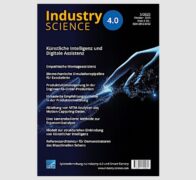
I4S 5/2025: Artificial Intelligence and Digital Assistance

I4S 5/2025: Artificial Intelligence and Digital Assistance

How we can better support work
Demographic change, skills shortages, and stagnating productivity are threatening the competitiveness of German industry. At the same time, AI and digital assistance systems are opening up new opportunities: they make work more efficient and support skilled workers. But while they have long been part of everyday life, their potential in industry remains largely untapped—this is where this issue comes in with innovative concepts.
Derivation of MTM Analyses from Motion Capture Data

Derivation of MTM Analyses from Motion Capture Data

Evaluation of the procedure and comparison with a manual MTM analysis
Silas Pöttker ORCID Icon, Maria Neumann ORCID Icon, Martin Benter, Constantin Eckart ORCID Icon, Ulrike Wolf ORCID Icon, Peter Kuhlang, Hermann Lödding ORCID Icon
For around 15 years, German labor productivity per working hour has been increasing at significantly less than 1% per year. At the same time, more detailed productivity analyses reveal high potential in companies. The issue is that the required MTM analyses are complex and not yet employed as broadly and frequently as would be necessary. One solution is the use of digital technologies such as motion capture. These make it possible to carry out productivity analyses with little effort, as they provide data that accelerates the analysis. The MTMmotion® tool from the MTM ASSOCIATION e. V. was developed with the aim of carrying out valid and compliant MTM analyses using data provided by other technologies. This article compares the method developed for a motion capture system and MTMmotion® with a conventional MTM-1® analysis. The main result is that digital technologies can be used to create valid MTM analyses in early planning phases with little effort in order to make early ...
Industry 4.0 Science | Volume 41 | 2025 | Edition 5 | Pages 112-119 | DOI 10.30844/I4SE.25.5.108
Productive and Ergonomic Work in Industry 4.0

Productive and Ergonomic Work in Industry 4.0

Ganzheitliche Planung und Gestaltung menschlicher Arbeit
Peter Kuhlang, Thomas Finsterbusch, Thomas Mühlbradt, Sören Liebig
It is against the background of Industrie 4.0 that profound knowledge of the principles and basics of manual work or efficient work design, respectively, gains particular importance. It will continue to be a fair and neutral reference basis for the design of productive and ergonomic work in the Smart Factory. By collecting both time-relevant and ergonomically relevant data, MTM-HWD® (Human Work Design) a new MTM (Methods-Time Measurement) building block system offers an unprecedented quality in describing and evaluating human work. It, thus, combines work method-oriented with ergonomic work design.
Industrie Management | Volume 31 | 2015 | Edition 3 | Pages 11-15
Enhancement of Personal and Organizational System and Method Competencies by Further Developing Value Stream Mapping

Enhancement of Personal and Organizational System and Method Competencies by Further Developing Value Stream Mapping

Steigerung der personalen und organisationalen System- und Methodenkompetenz
Peter Kuhlang, Thomas Edtmayr, Alexander Sunk, Michael Hrach, Wilfried Sihn
The main goal of a company is to conduct target oriented rationalization efforts. Thus, the challenges are, among others, to transparence, to bundle, to adapt, to re-interpret and to develop personal and organizational competencies for a systematic and methodic planning, designing and implementing resp. a sustainable improvement of processes and value streams. This article describes the further developments of “Value Stream Mapping” (Value Stream oriented Process Management, Value Stream Mapping and MTM, evaluation of alternative value streams, cost development of value streams by changing input parameters). Existing, implicit knowledge will be explicated and systematically bundled along the value stream from different departments of a company. The personal and organizational system and method competencies are therefore available to evaluate improvement measures and to perform their implementation target oriented.
Industrie Management | Volume 30 | 2014 | Edition 3 | Pages 25-29