Human-Centered AI-Paired Work Systems |
Integrating GenAI and the human factor in work system theory

| Journal | Industry 4.0 Science |
| Issue | Volume 41, 2025, Edition 5, Pages 38-48 |
| Open Access | https://doi.org/10.30844/I4SE.25.5.38 |
| Bibliography | Share | Cite | Download |
Abstract
Keywords
Article
The focus of the human factors/ergonomics (HFE) scientific discipline is on understanding the interaction between technology, the human, and the organization. It aims to optimize human well-being as well as the overall performance of the system [1]. The discipline adopts a human-, user-, or worker-centric perspective [1, 2, 3] when analyzing, optimizing, or designing work processes.
HFE’s basic unit of analysis is the work system [4], defined as a set of elements consisting of one or several humans interacting with tools, technologies and processes within a work environment [1]. This definition builds upon the concept of sociotechnical systems, the limits of which, for example for incorporating work across organizational, geographical, cultural, and temporal boundaries, have been increasingly highlighted. In reaction, when designing work systems, HFE extended their range of elements and dimensions [3]. Also in other domains, for example in production planning, work systems are viewed as key elements for transforming input into output [5] and identified as the central place for value creation within organizations [6].
Widely available for almost three years now, generative artificial intelligence (GenAI) has meanwhile become an integral part of the workplace [7]. The deployment of GenAI in practice is parallelled with strong interest research, including in HFE [8], the findings of which have been applied in AI development [9]. Thereby, a need has become evident for adaptation and further development of underlying HFE concepts, particularly of the work system itself.
This article therefore proposes a re-evaluation and an update of the concept of the work system. It aims at adequately representing the different characteristics of GenAI and the variety of roles it can take on within a work system. It also strives to more appropriately capture GenAI’s collaboration with the human(s) in the system, which can be different from the use of and interaction with AI-enabled technology previously considered in work system models.
Modeling humans performing work
The inherent assumption of the different conceptualizations of a work system is that humans are performing work, i.e. transforming a given input into a desired output using specific resources and under specific circumstances. Accordingly, models of work systems so far have only differed in their emphasis of specific work system elements or in some interplay between them.
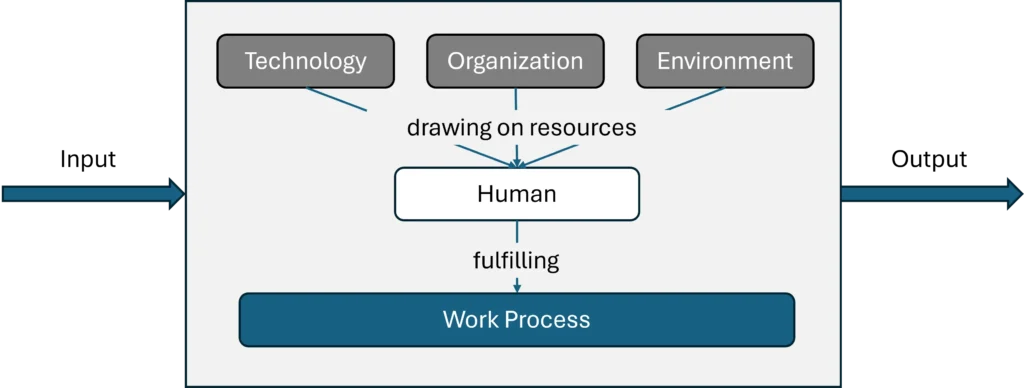
Early models of work systems, as well as generic ones, have focused on a single person performing a task with technological support (for example machines), embedded within an organization and within a particular work environment [see 10, 11]. This has led to a more general understanding that the central level of analysis of work systems is a single-occupied workstation [12, 13]. Such microergonomic work system models have their focus on the person’s well-being, for example the so-called balance model [10, 14], on the work process, for example the REFA model [4, 5], or on the performance-based outcome [11]. Figure 1 depicts such a basic work system.
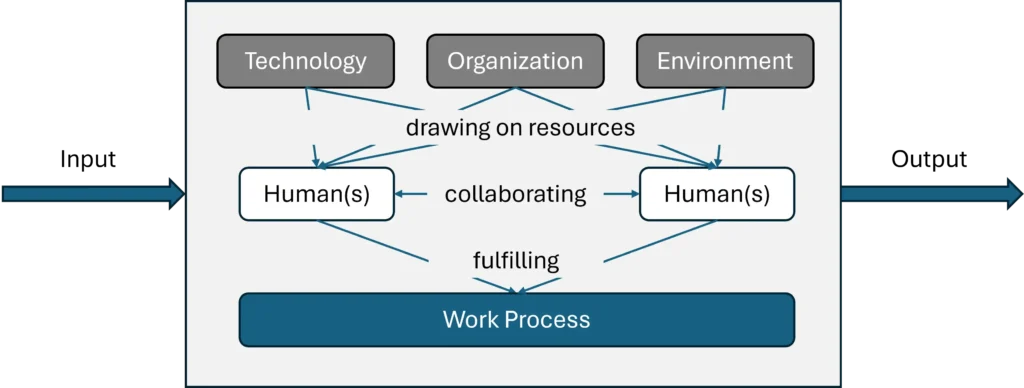
Macroergonomic work system models [16, 17, 18] consider more than one human working in a work system and focus on their collaboration. These models depict more complex work systems by visualizing interdependencies and distinguishing responsibilities, for example by modeling two subsystems—a management and planning system and an execution system [12], conceptually shown in Figure 2. Additionally, this expansion of perspective enables capturing and analyzing self-directed and self-responsible work processes that are characteristic of more recent organizational principles. It also provides the opportunity for a more dynamic representation of work processes within work systems [ibid].
A commonality of prior microergonomic and macroergonomic work system models is that they have not explicitly formulated that actors within work systems could be non-human, as for example suggested in organizational theory in the 1960s [19]. The assumption of exclusively human actors has remained largely uncontested (until the availability of GenAI). It has meant that all other elements within the system are viewed as passive in nature or acting in a largely predetermined or deterministic manner, as (non-AI-powered) robots and collaborative robots (cobots) do. Accordingly, pre-programmed automated machines that were cooperatively producing with humans were conceptualized within the technology/resource domain of work systems.
Other potential non-human actors, like animals, have not been specifically considered either, despite the fact that animals, with their abilities and (limited) autonomy, are intelligent actors that are intensively collaborating with humans in distinct work systems to perform specific tasks and achieve certain results. Examples of such work systems (see Fig. 3) relate often to working dogs and their human leaders (for example shepherds with herding dogs, gamekeepers with anti-poaching dogs, police with drug-sniffing dogs) but also to demining units with explosive-sniffing rodents [20].

Therefore, this article suggests considering non-human, intelligent actors in work system conceptualizations, by default. In the following, the focus will, however, be solely on AI (or GenAI respectively) as an additional intelligent actor in AI-paired work systems, for example “AI engineers” [21] and “AI scientists” [22].
Modeling multiple intelligent actors in work systems
As elaborated above, macroergonomic work system models assume a minimum of two intelligent actors in collaboration. Building on these assumptions, we assume two types of intelligent actors, human(s) and artificial intelligence, who interact within a work system under the condition that both types of actors must be simultaneously present (and active).
Artificial intelligence does not equal artificial intelligence. To give an abbreviated definition, AI refers to systems that, given a complex goal, act by perceiving their environment, interpreting the collected data, reasoning on the knowledge derived from this data and deciding the best actions to take to achieve the given goal [23].
This definition stresses the active role of AI as well as the inherent diversity in implementation. The latter is further emphasized by the statement that “GPTs are GPTs”, meaning that generative pre-trained transformers are general-purpose technologies [24] offering a wide range of applications. Consequently, in a work system, AI can be conceptualized as a tool/technology in use (Fig. 4a) or as an independent and active player [25], as shown in Figure 4b.
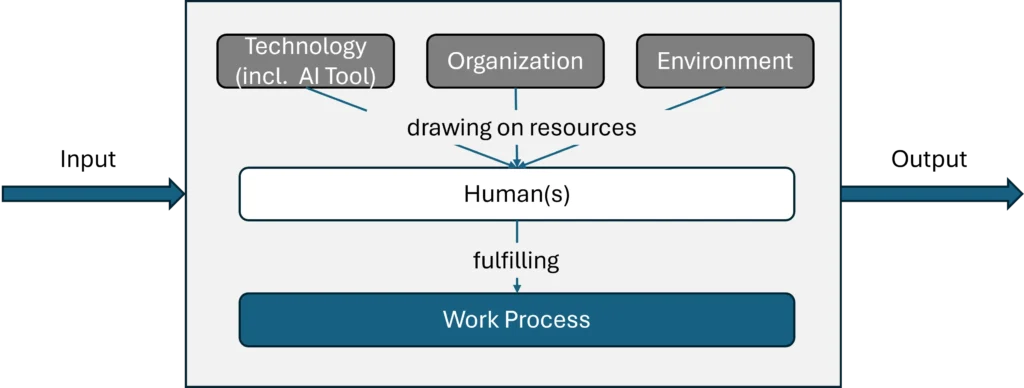
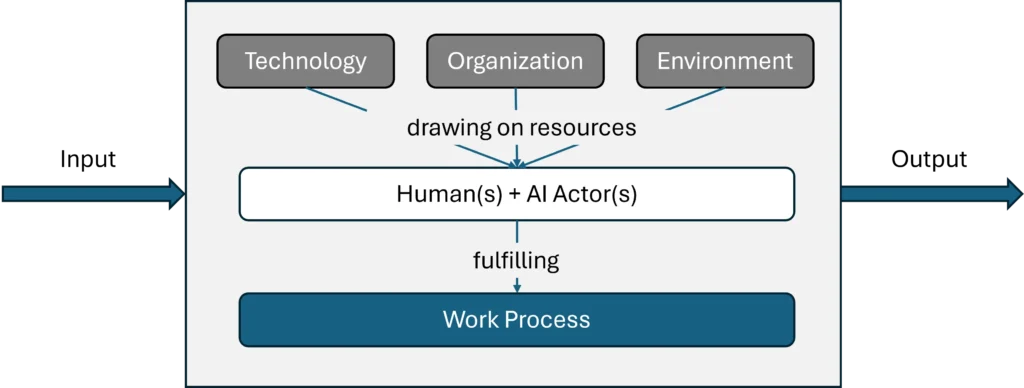
So far, AI is mainly deployed as a tool to support humans executing specific tasks, for example text writing or intelligent search. With both the increasing abilities of AI and the increasing confidence of human actors in it, it can be assumed that AI will be increasingly used and perceived as a collaborator with humans, supporting workers in specific work processes, for example as chatbots in customer service [26].
This perception is amplified in the case of collaborative social robots (cosbots) with their distinct social abilities [27]. Soon, it can be expected that AI agents will be fulfilling entire tasks autonomously [28], thereby replacing human work and changing sociotechnical systems to (intelligent) technical systems. Alternatively, at a higher level of analysis, these AI agents could be viewed as “AI employees” [29], supervised by humans, thereby establishing a new form of work system (Fig. 5), wherein humans take on the role of team leaders.

Humans supervising AI actors is, however, only one option in the collaboration of human and AI actors within a work system. To analyze the work relationship between humans and AI actors, the dimensions of hierarchy relevance and emotional involvement must be considered [25]: Human emotional involvement is low when AI actors in work systems act as copilots, i.e. when humans supervise AI actors, or as colleagues, i.e. when AI and humans work alongside each other with different, potentially successive, tasks (for example in the case of an AI-powered enterprise resource planning system that stipulates the human action to follow).
Human emotional involvement is (rather) high when humans perceive the AI actor to be a companion that offers sparring (or coaching) or when, alternatively, the AI acts as a controller, supervising the humans in the work system. Both research and practice are only just beginning to understand these interactions within work systems and their dynamics.
The roles of humans and AI vary and evolve during any specific work process. The division of their roles might change depending on the task at hand, the required qualifications, or the abilities of the actors present. Any work process consists of different stages and actions, for example problem perception, task description, situation analysis, procedure definition, task execution, and quality assurance. In each of them, one actor might be better qualified, equipped, or experienced to perform the task than the other. For example, humans might be better at perceiving problems, while AI might be better at analyzing data and status quo.
Also, in an iterative process of execution and verification, humans and AI might be dependent on each other for delivering the best outcome, with no actor prevailing in its abilities. Consequently, when analyzing work systems with multiple actors, particularly with a combination of human and AI actors, the division of roles between human and AI actors as well as its evolution during the work process must be considered (Fig. 6).
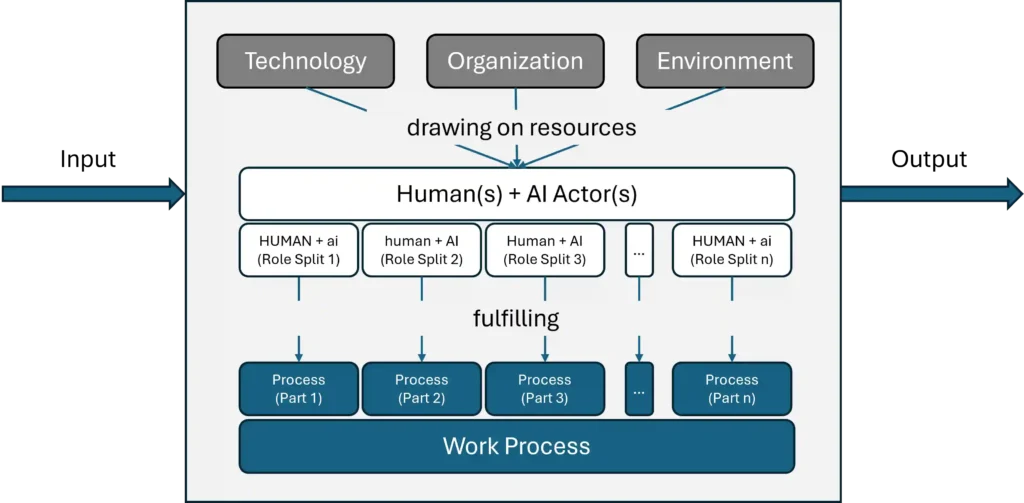
The collaboration of human and AI actors in work systems is subject to further dynamic forces. Besides displaying and using existing capabilities, both human and AI actors are capable of learning, potentially leading to a shift in role allocation within the work process. Therefore, a persisting challenge in work process design relates to the dynamic staffing of the process with human and AI actors based on their qualifications, in an attempt to establish a symbiotic work relationship between them [30].
Matching humans and AI agents in AI-paired work systems
Thus far, this article has distinguished between two types of intelligent actors in work systems—human actors and AI actors—and treated them as rather homogenous groups. However, further differentiation is needed, since both types of actors display individual characteristics, traits, and capabilities. Research indicates that the result of a collaboration depends on the individual characteristics of both the human actors and the AI actors, as well as on matching them appropriately [31].
A very early study of the effects of using GenAI tools showed that different groups of workers benefit to different extents from using ChatGPT [32]: low-skilled workers benefitted more than highly skilled workers from using the same AI tool, thereby decreasing the disparity between their work results. Also, people with better prompting skills achieved better outcomes using GenAI [33]. Similarly, AI tools and AI actors differ in their capabilities: some are better than others in generating text, reasoning or in controlling robots and interacting with other physical actors. Consequently, appropriate capability-based matching of human actors and AI actors becomes necessary (Fig. 7).
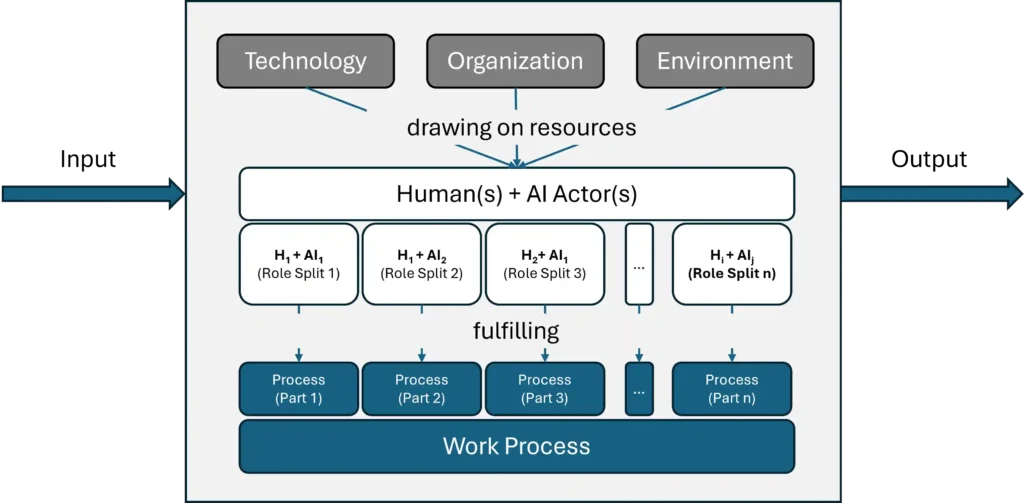
Recent research suggests that success in matching human actors and AI actors is not only dependent on the individual capabilities of the actors but also on their respective personality traits [31]. This holds true for both human and AI actors, as AI models can be prompted to simulate personality traits. Consequently, the induced AI traits can complement human personalities to enhance collaboration [ibid]. The results of the experiment show that pairing conscientious humans with open AI agents led to better results, while pairing extroverted humans with conscientious AI agents reduced output quality [ibid].
Lastly, matching human and AI actors for collaborative work also requires matching multiple different AI actors to jointly support and collaborate with the human actors. Particularly the rise of personal AI agents, which can support a person in a multitude of ways, prompt a need for increased consideration in work system design. Job-related personal assistants can organize agendas and plan forthcoming activities, but they might also support the individual worker by providing learning and training support related to the job activities. In this respect, they might influence or interfere with task-related AI agents that engage in the work process itself.
A link between the two AI agents is required as well as a coordination procedure for their collaboration, especially if the human actor is not expected to mediate between them and choose between potentially different or conflicting recommendations. Therefore, we suggest that the minimum basic unit of analysis in human-centered AI-paired work systems consists of one person with a personal AI agent (pAI) and a task-related AI actor (tAI), which can be expanded by another set of three such actors as to reflect larger work systems (Fig. 8).
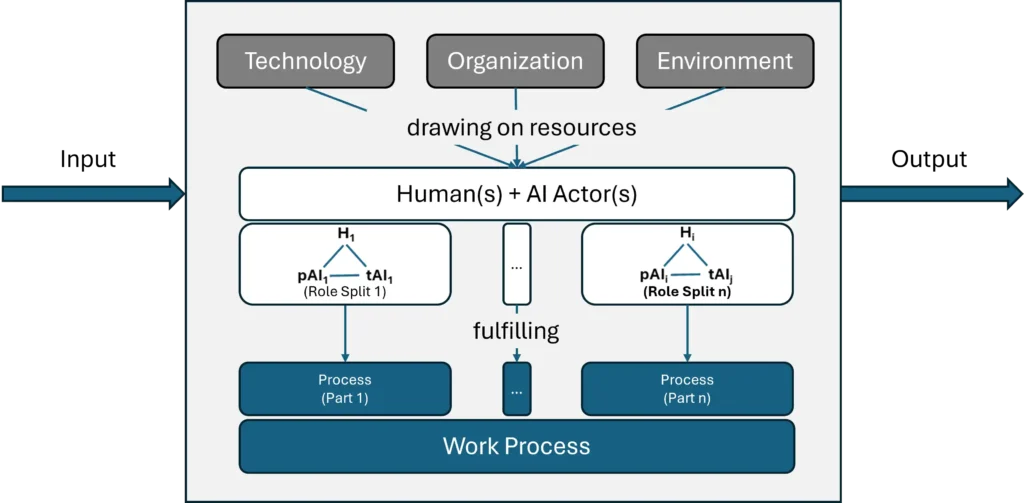
Contributions and implications
With artificial intelligence entering work practice, the theoretical and methodological basic unit of analysis in HFE must be re-evaluated and further developed in order to adequately depict the (soon to be) more complex reality of work systems. This is particularly relevant for organizational performance, since work systems are the central place for value creation in organizational practice [6].
This article proposed a new model for human-centered AI-paired work systems that considers the existence of AI within these systems, its different roles therein, and the need for purposeful and adequate matching of human and AI actors. Furthermore, it was elaborated that at least two types of AI actors in work systems—personal AI agents and task-related AI actors—must be conceptualized to reflect (expected) reality in many professions and jobs. This article thus contributes to advancing the field of HFE by elaborating the intricate work relationship between humans and AI actors that is gaining in complexity as the symbiotic relationship between them grows.
This new model contributes to organizational practice, too, as it prepares for arising requirements in organizational development and the design of value-creating processes in the age of omnipresent artificial intelligence, considering individual characteristics, traits, and capabilities of both human and AI actors [31]. Furthermore, issues related to hierarchy and emotional involvement [25] as well as to leadership in the collaboration of humans and AI were recognized: issues that, earlier, with (non-AI-powered) cobots, were of no—or at least lesser—importance in theory and practice.
This is an original article. The German translation can be accessed via DOI: 10.30844/I4SD.25.5.38
Bibliography
[1] International Ergonomics & Human Factors Association IEA: What is Ergonomics (HFE)? URL: https://iea.cc/about/what-is-ergonomics, accessed 22.04.2025.[2] Kadir, B. A.; Broberg, O.: Human-centered design of work systems in the transition to industry 4.0. Applied Ergonomics 92 (2021) 103334, DOI: 10.1016/j.apergo.2020.103334.
[3] Carayon, P.: Human factors of complex sociotechnical systems. In: Applied ergonomics 37 (2006) 4, pp. 525–535, DOI: 10.1016/j.apergo.2006.04.011.
[4] Schmauder, M.; Spanner-Ulmer, B.: Ergonomie – Grundlagen zur Interaktion von Mensch, Technik und Organisation. Munich 2022.
[5] REFA-Institut: REFA-Grundausbildung 4.0 – Begriffe und Formeln (REFA-Kompendium Arbeitsorganisation, Band 3). Munich 2021.
[6] Nyhuis, P.; Schmidt, M.: Das Arbeitssystem – Ort der Wertschöpfung, Teil 1: Beschreibungsmodelle. In: Nyhuis, O.; Schmidt, M.: Logistische Modelle der innerbetrieblichen Lieferkette. Berlin 2025. DOI: 10.1007/978-3-662-70758-6_4.
[7] Mayer, H.; Yee, L.; Chull, M.; Roberts, R.: Superagency in the Workplace – Empowering people to unlock AI’s full potential (2025). URL: https://www.mckinsey.com/capabilities/mckinsey-digital/our-insights/superagency-in-the-workplace-empowering-people-to-unlock-ais-full-potential-at-work#/, accessed 22.04.2025.
[8] Haner, U.-E.; Braun, M.; Hölzle, K.: Die „fehlende Mitte“ der Arbeitsforschung (The “missing middle“ in work research). In: wt Werkstattstechnik online 114 (2024) Nr. 6, pp. 334-343. DOI: 10.37544/1436-4980-2024-06-86.
[9] Petrat, D.: Artificial intelligence in human factors and ergonomics: an overview of the current state of research. In: Discover Artificial Intelligence 1 (2021) 3, DOI: 10.1007/s44163-021-00001-5.
[10] Smith, M. J.; Carayon Saintfort, P.: A Balance Theory of Job Design for Stress Reduction. In: International Journal of Industrial Ergonomics 4 (1989) 1, pp. 67-79.
[11] Helander, M. G.: Forty years of IEA: some reflections on the evolution of ergonomics. In: Ergonomics 40 (1997) 10, pp. 952-961. DOI: 10.1080/001401397187531.
[12] Schlick, C.; Bruder, R.; Luczak, H.: Arbeitswissenschaft. 4. Auflage. Berlin, Heidelberg 2018.
[13] Helbing, K. W.: Handbuch Fabrikprojektierung. 3. Auflage. Berlin 2024. DOI:
10.1007/978-3-662-64583-3.
[14] Carayon, P.: The Balance Theory and the Work System Model … Twenty Years Later. In: International Journal of Human-Computer Interaction 25 (2009) 5, pp. 313-327. DOI: 10.1080/10447310902864928.
[15] Haner, U.-E.: Entwicklung eines Modells zur Beschreibung innovativer Arbeitswelten. 2025. Dissertation at the University of Stuttgart (in publication).
[16] Hendrick, H. W.: An Overview of Macroergonomics. In: Hendrick, H. W.; Kleiner, B. M. (eds): Macroergonomics. Theory, methods, and applications. Mahwah, NJ, USA, 2002, pp. 1-23.
[17] Hendrick, H. W.; Carayon, P.; Robertson, M.; Kleiner, B. M.: The State, Trends and Future of Macroergonomics. In: Proceedings of the Human Factors and Ergonomics Society Annual Meeting 49 (2005) 16, p. 1498. DOI: 10.1177/154193120504901608.
[18] Kleiner, B. M.: Macroegonomics: work system analysis and design. In: Human factors 50 (2008) 3, pp. 461-467. DOI: 10.1518/001872008×288501.
[19] Leavitt, H. J.: Applied Organizational Change in Industry: Structural, Technological and Humanistic Approaches. In: March, J. G. (ed.): Handbook of organizations. London, New York, 1965, pp. 1144-1170.
[20] Edwards, T. L.; Cox, C.; Weetjens, B.; Tewelde, T., Poling, A.: Giant African pouched rats (Cricetomys gambianus) that work on tilled soil accurately detect land mines. Journal of Applied Behavior Analysis 48 (2015) 3, pp. 696-700. DOI: 10.1002/jaba.214.
[21] University of Stuttgart: Der erste „KI-Ingenieur“ der Welt kommt aus Stuttgart. 2025. URL: https://www.uni-stuttgart.de/universitaet/aktuelles/meldungen/Der-erste-KI-Ingenieur-der-Welt-kommt-aus-Stuttgart/, accessed 20.06.2025.
[22] Feng, J.; Qi, Y.; Xu, R.; Pandey, S.; Chu, X.: turbulence.ai: an end-to-end AI Scientist for fluid mechanics, towards infinite discovery. 2025. DOI: 10.13140/RG.2.2.15044.95369.
[23] The European Commission’s High-Level Expert Group on Artificial Intelligence: A Definition of AI: Main Capabilities and Scientific Disciplines (2018). URL: https://ec.europa.eu/futurium/en/system/files/ged/ai_hleg_definition_of_ai_18_december_1.pdf, accessed 22.04.2025.
[24] Eloundou, T.; Manning, S.; Mishkin, P.; Rock, D.: GPTs are GPTs: Labor market impact potential of LLMs. In: Science 384 (2024) 6702, pp. 1306-1309.
[25] Haner, U.; Bauer, W.: Colleague, Copilot, Companion, Controller – Roles of AI in Work Systems. In: Tareq Ahram and Waldemar Karwowski (eds): Human Factors in Design, Engineering, and Computing. AHFE (2024) International Conference. AHFE Open Access, vol. 159. AHFE International, USA. DOI: 10.54941/ahfe1005746.
[26] Brynjolfsson, E.; Li, D.; Raymond, L. R.: Generative AI at work (2023). National Bureau of Economic Research (Working Paper 31161). DOI: 10.3386/w31161.
[27] Cusano, N.: Cobot and Sobot: For a new Ontology of Collaborative and Social
Robots. In: Found Sci 28 (2023), pp. 1143-1155. DOI: 10.1007/s10699-022-09860-2.
[28] Loucks, J.; Crossan, G.; Sarer, B.; Widener, C.: Autonomous generative AI agents: Under development (2024). URL: https://www2.deloitte.com/us/en/insights/industry/technology/technology-media-and-telecom-predictions/2025/autonomous-generative-ai-agents-still-under-development.html, accessed 22.04.2025.
[29] The Guardian: Microsoft says everyone will be a boss in the future – of AI employees. URL: https://www.theguardian.com/technology/2025/apr/25/microsoft-says-everyone-will-be-a-boss-in-the-future-of-ai-employees, accessed 25.04.2025.
[30] Hölzle, K.; Braun, M.; Dangelmaier, M.; Haner, U.-E.; Ohlhausen, P.: „Arbeitswissenschaft-in-the-loop“ – Mensch-Technik-Integration und ihre Auswirkung auf Mensch, Arbeit und Arbeitsgestaltung. In: 70. Kongress der Gesellschaft für Arbeitswissenschaft e.V., 06.-08.03.2024, Stuttgart.
[31] Ju, H.; Aral, S.: Collaborating with AI Agents: Field Experiments on Teamwork, Productivity, and Performance (2025). URL: https://arxiv.org/pdf/2503.18238.
[32] Noy, S., Zhang, W.: Experimental evidence on the productivity effects of generative artificial intelligence. In: Science 381 (2023) 6654, pp. 187-192. DOI: 10.1126/science.adh2586.
[33] Dell’Acqua, F.; McFowland III, E.; Mollick, E.; Lifshitz-Assaf, H.; Kellogg, K. C.; et al.: Navigating the Jagged Technological Frontier: Field Experimental Evidence of the Effects of AI on Knowledge Worker Productivity and Quality. Harvard Business School Working Paper, No. 24-013, September 2023.
Your downloads
Potentials: Business Models
Solutions: Production Planning
You might also be interested in