Adaptability

Digital and Ecological Transformation in Companies

Digital and Ecological Transformation in Companies

Challenges and potential in interaction
Manfred Wannöfel, Bernd Kuhlenkötter ORCID Icon, Christopher Prinz ORCID Icon, Fabian Hoose ORCID Icon, Manfred Wannöffel ORCID Icon
Although the concept of double transformation is being intensely discussed in companies, the practical implementation in operational structures often remains unclear. This article sheds light on how digital technologies and environmental sustainability strategies can be developed either synergistically, antagonistically or independently of each other. In addition, it discusses the different experiences of employees in different industries and the varying progress in the introduction of digital and ecological measures. To this end, it will discuss existing research findings and practical examples that pave the way for the successful integration of both transformation processes in companies.
Industry 4.0 Science | Volume 40 | 2024 | Edition 5 | Pages 34-42 | DOI 10.30844/I4SE.24.5.34
Digital Transformation Coaching

Digital Transformation Coaching

Employee development as a supplement to change management in transformation processes
Michael Bauer, Eric Grosse ORCID Icon
Digital transformation processes have a high tendency for delay, exceeding costs, and failure. This poses a significant risk in competitive global markets and shifting business models of entire industries. Successful companies have a different approach to new technologies than more traditional incumbents. Including the workforce in the transformation via change leadership in a digital transformation coaching process can reduce fear and resistance and can lead to a paradigm shift of approaching the digital transformation itself: as an agility driven, infinite game with high potential gain.
Industry 4.0 Science | Volume 40 | 2024 | Edition 3 | Pages 33-40
Robustness-enabling Properties in Business Processes

Robustness-enabling Properties in Business Processes

Identification and evaluation of characteristics related to robustness
Annika Lange ORCID Icon, Jens Mathis Rieckmann ORCID Icon, Jan Lukas Schmidt ORCID Icon, Thomas Knothe ORCID Icon
The crises of recent years have highlighted the importance of robust business processes. Even if the concept of robustness is often not clearly defined in the context of entrepreneurial activity, it can certainly be defined on the basis of various factors such as agility, adaptability and resilience. A systematic analysis of robustness and its prerequisites in the corporate context is therefore highly relevant, especially in times characterized by uncertainty.
Industry 4.0 Science | Volume 40 | 2024 | Edition 3 | Pages 27-32
Resilience and Sustainability in the Supply Chain

Resilience and Sustainability in the Supply Chain

How SMEs can prepare for the changes to come
Jonas Fuchs, Lasse Bo Ladewig, Wolfgang Kersten ORCID Icon
More than 99% of German companies are small and medium-sized enterprises (SMEs), which therefore represent an important part of industrial supply chains. New regulations are increasing the pressure on companies to create transparency along the supply chain so that the role of SMEs is also coming into focus. However, they are often confronted with limited financial and human resources. Based on a quantitative survey and a literature review, this article deals with the question of what SME-friendly approaches could look like.
Industry 4.0 Science | Volume 40 | 2024 | Edition 1 | Pages 57-62
Corporate Purpose as Guideline for the UN Sustainable Development Goals

Corporate Purpose as Guideline for the UN Sustainable Development Goals

Aligning business strategy with the UN Sustainable Development Goals
Jürgen Hamann ORCID Icon, Jennifer Ettner ORCID Icon, Sandra Heymann ORCID Icon
This article describes how companies can accelerate the implementation of the United Nations Sustainable Development Goals (SDGs). As a guideline, we propose the concept of corporate purpose. By focusing on the added value generated for stakeholders, a corporate purpose has a meaningful effect and provides orientation. As part of our research, a self-assessment was developed, which makes the status quo of corporate purpose in companies measurable.
Industry 4.0 Science | Volume 40 | 2024 | Edition 1 | Pages 37-43
Sustainable Food Supply Chains through Artificial Intelligence

Sustainable Food Supply Chains through Artificial Intelligence

A conceptual visualization to promote animal welfare and food quality
Corinna Köters ORCID Icon, Maik Schürmeyer, Alexander Prange ORCID Icon
For the transition to a sustainable economy to succeed in its entirety, logistics must be considered in addition to raw materials and manufactu­ring. Artificial intelligence will play a central role in improving the exchan­ge of data between the individual links in the supply chain and in regula­ting processes and costs at the various stages of production. The meat industry, with its hygienic and increasing ethical requirements for animal welfare, is set to greatly benefit from the digital revolution.
Industry 4.0 Science | Volume 40 | 2024 | Edition 1 | Pages 70-75 | DOI 10.30844/I4SE.24.1.70
Sustainable Materials as a Strategy for the Future

Sustainable Materials as a Strategy for the Future

Key elements for corporate materials management
Dirk Scheer ORCID Icon, Janine Gondolf ORCID Icon, Olaf Toedter ORCID Icon
The flow of materials along regional and global value chains has far-reaching environmental, economic and social effects. The sustainability profile of materials should therefore play a central role in management. Adapting material flows to adhere to sustainable principles requires an integrated approach that includes all areas of the company. The decisive factor is that sustainable materials management ultimately requires the entire life cycle of a product to be taken into account – from design and produc- tion through to sales and aftercare measures.
Industry 4.0 Science | Volume 40 | 2024 | Edition 1 | Pages 44-49
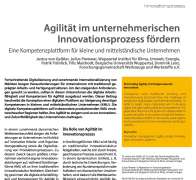
Promoting Agility in Entrepreneurial Innovation

Promoting Agility in Entrepreneurial Innovation

A competence platform for small and medium-sized enterprises
Justus von Geibler ORCID Icon, Julius Piwowar ORCID Icon, Patrik Fröhlich ORCID Icon, Filiz Meidrodt ORCID Icon, Dominik Lenz ORCID Icon
Companies with traditional working and manufacturing structures face the challenge of progressive digitalization and internationalization. In order to adapt, many companies aim to develop digital and agile working skills and competences. This paper describes the conception of a digital platform to promote agility in innovation of small and mediumsized enterprises (SMEs) in structurally weak regions and to contribute to their innovativeness and future viability.
Industrie 4.0 Management | Volume 39 | 2023 | Edition 6 | Pages 27-31 | DOI 10.30844/IM_23-6_27-31
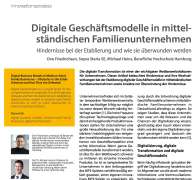
Digital Business Models in Medium­Sized Family Businesses

Digital Business Models in Medium­Sized Family Businesses

Obstacles to the Estab­lishment and How They Are Defeated
Ove Friedrichsen, Michael Heins
Digital transformation is a crucial factor for the competitiveness of companies. This article explores obstacles and their interrelationships in establishing digital business models in medium-sized family businesses as well as initial approaches to overcoming these obstacles.
Industrie 4.0 Management | Volume 39 | 2023 | Edition 6 | Pages 12-16 | DOI 10.30844/IM_23-6_12-16
Dimensions of Industrial Openness

Dimensions of Industrial Openness

Understanding Openness and Its Implications for Sustainable Transformation
Nils Weiher ORCID Icon, Theresa Riedelsheimer ORCID Icon, Kai Lindow ORCID Icon
The topic of Openness is of growing importance for industry, especially in Europe. However, the term Openness is used very differently. Openness includes several concepts, including Open Source Hardware, Open Source Software, Open Data, Open Standards, Open Innovation, Open Science and Open Education. The concepts address different dimensions of Openness, all based on some kind of participation and with the goal to create more transparency and accessibility. This article defines the concepts and provides a basic understanding of their importance for industry and for greater sustainability.
Industrie 4.0 Management | Volume 39 | 2023 | Edition 6 | Pages 42-45 | DOI 10.30844/IM_23-6_42-45
1 2 3 4 21