Sustainable Food Supply Chains through Artificial Intelligence |
A conceptual visualization to promote animal welfare and food quality

| Journal | Industry 4.0 Science |
| Issue | Volume 40, 2024, Edition 1, Pages 70-75 |
| Open Access | https://doi.org/10.30844/I4SE.24.1.70 |
| Bibliography | Share | Cite | Download |
Abstract
Keywords
Article
Drivers for sustainable food supply chains
On the one hand, developments through artificial intelligence (AI) can be understood as a “technology push”. In the supply chain, AI is currently used primarily for optimization in the areas of design, planning, scheduling and for predicting production volumes [1, 2]. In recent years, time series or big data analyses have primarily been used to detect anomalies in production data. The applications therefore primarily cover strategic areas rather than operational ones. It can also be seen that AI applications have thus far been implemented selectively and not comprehensively along the entire supply chain. In order to change this, data, trust and a cultural change are required [1]. The use of explainable AI (XAI) can present results of AI to users in a comprehensible manner and promote trust [3].
On the other hand, development potential based on “market pull” is evident. Stakeholders such as political decision-makers, suppliers, producers and consumers are increasingly interested in sustainable food supply chains. Possible measures to achieve this include environmentally friendly decisions, optimization of distribution channels and restructuring [4]. Consumer trends show that transparency is the strongest trend. It has a significant impact on logistics, as this trend influences the entire value chain. In addition, food waste awareness, which includes discarded food and losses caused by inefficient processes and processing steps within the logistics chain, is also becoming significant due to strong growth in consumer trends [5].
Holistic data networking in supply chains
In the automotive industry, the proprietary data ecosystem, Catena-X, which is based on GAIA-X, enables collaboration within an industry sector [6, 7]. This promotes a data-driven value chain that meets the challenges of the industry. Another existing solution is the Manufacturing-X initiative, which strengthens sustainability, resilience and competitiveness of the industry with an intelligently networked data network across industrial sectors [8].

Supply chain from turkey as livestock to turkey meat as a food product
Based on the initial situation described above, this concept focuses on the parameters of production processes and resource use along the value chain from turkey as livestock to turkey meat as a processed food product, in order to visualize a sustainable food supply chain through the use of AI. According to Karwowska, there is little data on food waste in the meat industry. At the same time, the meat industry is characterized by a negative impact on the environment [9]. The Meat Atlas of 2021 shows that avoidable losses within the food supply chain from livestock to food are mainly present in the process steps leading up to slaughter [10].
Visualization of sustainable food supply chains
Figure 1 visualizes a classic food supply chain, which consists of actors from different stages of the value chain working together. In the supply chain, there is a flow of materials and information [11] (characterized by the transport processes). The visualization covers the food supply chain and includes producers, the processing and production stages through to distribution via retailers to the end consumer.
A potential challenge within the first processes of the food supply chain that is not recognized predictively can result in it being passed on along the material flow. A non-centralized exchange of information can hinder the recognition of such an eventuality. Measures may not be initiated promptly enough, meaning that the problem is no longer resolved and the consumer consumes a food item which may be unsafe. This is visualized in Figure 2.

The conceptually developed sustainable supply chain is based on the networking of all players across the supply chain. In this network, it is possible to centrally store and intelligently link the production data of those involved in the process and to exchange information between the players along the food supply chain.
In addition, an exchange between all players about process flows can promote understanding of the needs, requirements and processes of others. On the one hand, the use of AI (both in the supply chain as a whole and in its individual sectors) creates opportunities to predictively identify and resolve challenges. On the other hand, the networking and exchange of data can also promote a centralized flow of information so that food which may be unsafe can be removed from the process at an early stage and the possibility of it reaching the consumer can be eliminated. Figure 3 visualizes the approach.
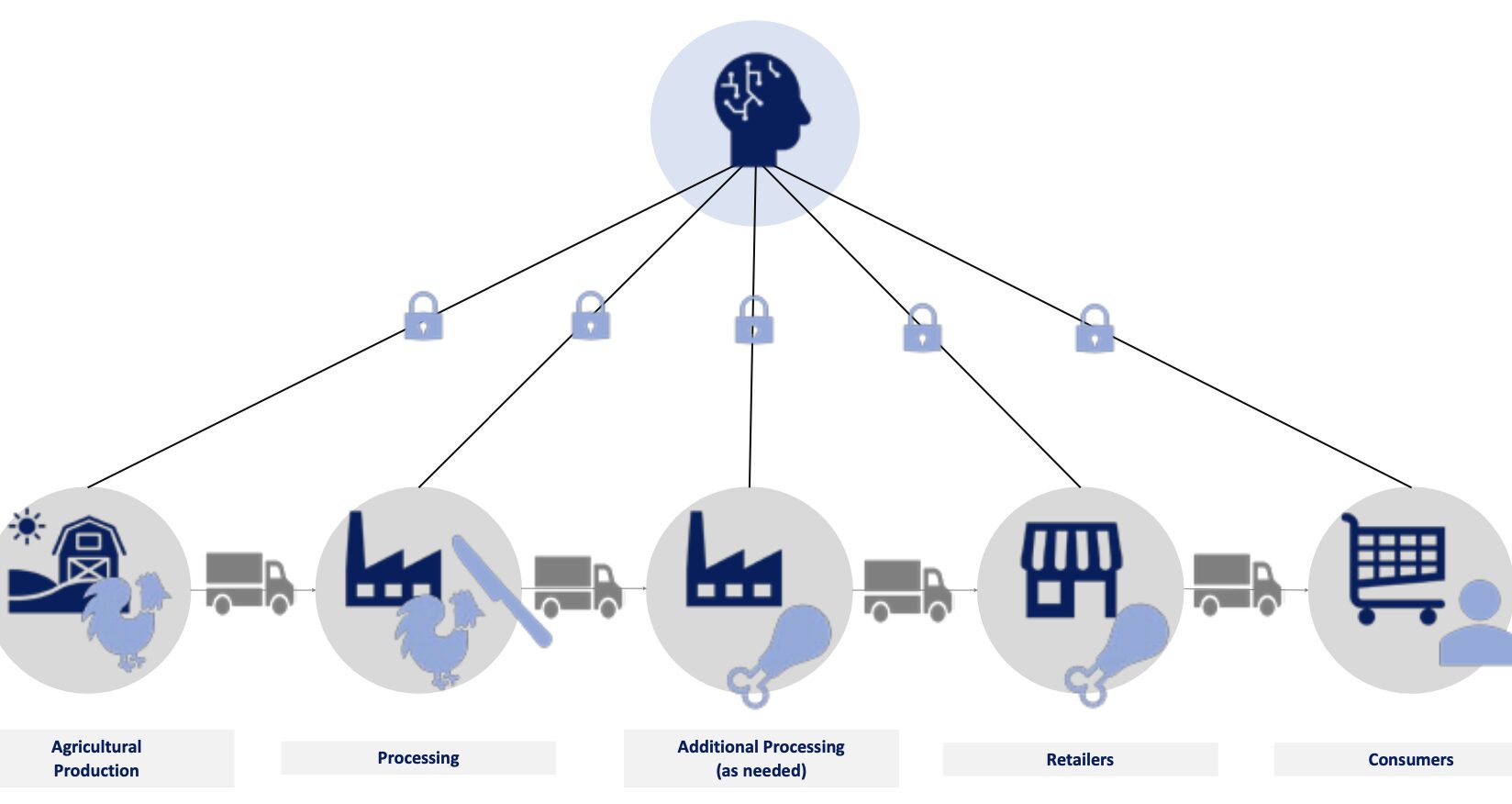
It is also possible to store data centrally along the food supply chain without other actors having access to it, thereby preserving the data sovereignty of the individual actors in the supply chain. This means that each link in the value chain can decide on the receipt and use of data [12]. However, standardization, compatibility and interoperability of systems and processes promote effectiveness within the supply chain [13]. The resulting benefits are illustrated in Figure 4.

The visualization demonstrates how e.g. a diseased animal that would lead to an unacceptable food quality after further processing is detected through the use of AI in agricultural production. A direct exchange of processing information ensures that this animal is not processed and is removed from the supply chain. The AI can be guided by visual characteristics by working with image classification, image segmentation and object recognition. In this way, non-compliant incidents can be detected efficiently and at an early stage. Production and consumption parameters are also relevant in order for the AI to recognize processes that are outside the ideal range in good time. This can be achieved through regression, time series analyses or the detection of anomalies.
Effects of a sustainable food supply chain
By implementing sustainable food supply chains using the example of turkey as livestock to turkey meat as a processed food product, four possible effects are derived. These effects can be summarized as the promotion of transparency, process optimization, food quality and safety as well as animal health and welfare. Figure 5 visualizes these and shows that the compatibility and interoperability of the systems and processes along the supply chain should be fulfilled in order to ensure the highest possible effectiveness [13].

Possible effects of promoting transparency can be the implementation of a central exchange of information or the reduction of workload due to the availability of continuous information. Increased data transparency allows process steps along the food supply chain to be planned and executed in an optimized manner.
An example of this is the distribution of turkeys from the finishing phase to the slaughterhouse. The transparency of the animals’ weight data enables efficient route planning within the supply chain. As a result, turkeys can be slaughtered at the ideal slaughter weight, which not only reduces costs, but also makes the finishing period more sustainable and is therefore also beneficial to animal welfare.
The predictive identification of potential challenges and the reduction of rejects along the supply chain can be used as arguments for promoting food quality. Improving animal health and increasing animal welfare primarily boosts agricultural production and downstream processes. The early detection of possible diseases, for example, serves as a measurable parameter for this effect.
This article was created as part of the KINLI project, which is funded by the German Federal Ministry of Food and Agriculture (BMEL) under the reference number 28DK124C20.
Bibliography
[1] Pournader, M. u. a.: Artificial Intelligence Applications in Supply Chain Management. In: International Journal of Production Economics 241 (2021). URL: www.sciencedirect.com/science/article/pii/S0925527321002267, Abrufdatum 06.11.2023.[2] Toorajipour, R. u. a.: Artificial Intelligence in Supply Chain Management: A Systematic Literature Review. In: Journal of Business Research 122 (2021), S. 502-517. URL: www.sciencedirect.com/science/article/pii/S014829632030583X, Abrufdatum 06.11.2023.
[3] Sofianidis, G. u. a.: A Review of Explainable Artificial Intelligence in Manufacturing. URL: arxiv.org/abs/2107.02295, Abrufdatum 06.11.2023.
[4] Paciarotti, C.; Torregiani, F.: The Logistics of the Short Food Supply Chain: A Literature Review. In: Sustainable Production and Consumption 26 (2021). S. 428-442. URL: www.sciencedirect.com/science/article/abs/pii/S2352550920302876, Abrufdatum 06.11.2023.
[5] Nitsche, B.; Figiel, A.: Zukunftstrends in der Lebensmittellogistik – Herausforderungen und Lösungsimpulse. Berlin 2016.
[6] Gaia-X. European Association for Data and Cloud AISBL: Gaia-X Architecture Document – 22.10 Release. URL: docs.gaia-x.eu/technical-committee/architecture-document/22.10/, Abrufdatum 06.11.2023.
[7] Catena-X. The First Open and Collaborative Data Ecosystem: Catena-X Operating Model Whitepaper Release V2 – 21.11.2022. URL: catena-x.net/fileadmin/user_upload/Publikationen_und_WhitePaper_des_Vereins/CX_Operating_Model_Whitepaper_02_12_22.pdf, Abrufdatum 06.11.2023.
[8] Bundesministerium für Wirtschaft und Klimaschutz (BMWK): „Manufacturing-X“ Eckpunkte für die Umsetzung von „Manufacturing-X“ im produzierenden Gewerbe zur Sicherung des Wettbewerbsstandortes Deutschland (2022). Whitepaper. URL: www.plattform-i40.de/IP/Navigation/DE/Manufacturing-X/Initiative/initiative-manufacturing-x.html, Abrufdatum 06.11.2023.
[9] Karwowska, M. u. a.: Food Loss and Waste in Meat Sector – Why the Consumption Stage Generates the Most Losses? In: Sustainability 13 (2021), S. 1. URL: www.mdpi.com/2071-1050/13/11/6227, Abrufdatum 06.11.2023.
[10] Benning, R.: Fleischatlas: Daten und Fakten über Tiere als Nahrungsmittel. 1. Auflage. Berlin 2021.
[11] Hohmann, S.: Logistik und Supply Chain Management: Grundlagen, Theorien und quantitative Aufgaben, 1. Auflage. Wiesbaden 2022.
[12] Rohde, M. u. a.: Datenwirtschaft und Datentechnologie: Wie aus Daten Wert entsteht. Berlin 2022.
[13] Viswanadham, N. (Hrsg): Achieving Rural & Global Supply Chain Excellence. The Indian Way. Centre for Global Logistics and Manufacturing Strategies, Gachibowli, Hyderabad 2006.
Your downloads
You might also be interested in