
Leadership in Transition |
Transformational and shared leadership in the context of virtual collaboration

| Journal | Industry 4.0 Science |
| Issue | Volume 40, 2024, Edition 5, Pages 107-113 |
| Open Access | https://doi.org/10.30844/I4SE.24.5.106 |
| Bibliography | Share | Cite | Download |
Abstract
Keywords
Article
Overcoming challenges resulting from technological, ecological and demographic changes requires continuous adaption of the work organization. Technological developments, particularly advances in information and communication technologies (ICT), extend the scope for work design, as they offer new opportunities for virtual collaboration. The use of ICT across geographical and temporal boundaries makes work processes more efficient and allows for more flexibility to achieve the goals of organizations and employees [1].
By providing options for online collaborations and meetings, organizations and employees can reduce the ecological footprint associated with commuting between the home and office site and business trips [2]. Furthermore, in times of increasing shortage of skilled workers, the area in which organizations can recruit qualified employees is expanding. Further advantages for employees lie in greater flexibility in balancing work and private life, which was found to have a positive effect on job satisfaction [2].
In addition to the identified advantages, there are also challenges that need to be considered in virtual forms of collaboration to meet long-term requirements for an innovative, economic and humane work design. Challenges for team leadership and members include overcoming communication barriers due to missing personal contact; passing on knowledge, especially practical experience that is primarily conveyed through informal learning; creating company loyalty as well as building and maintaining trusting relationships between colleagues, particularly between managers and subordinates [3].
Leadership plays a decisive role when it comes to reaping the benefits from virtual teamwork and overcoming the potential disadvantages. Thus, new demands are being placed on leadership, which need to be met through appropriate leadership concepts. In recent years, many studies have been conducted that investigated successful leadership of virtual teams [4]. Results show that transformational and shared leadership in particular play a central role in successfully leading virtual teams [4].
Transformational leaders are characterized by their inspiring, intellectually stimulating and considerate nature [5]. They provide team members with a vision and support them on a relationship level. The positive effect of transformational leadership in virtual teams is explained by the fact that it responds well to the challenges that arise in an uncertain and ambiguous environment such as the virtual context [6].
In addition to the relational support by transformational leaders, there’s also the need for task-oriented leadership support in virtual teams. In this context, the extent to which more than one person can provide support at task level is being discussed [4]. With the use of ICT in virtual teams, information transparency empowers team members so they can be more involved in task-oriented leadership topics [7].
Therefore, shared leadership is currently being discussed as a relevant leadership concept for virtual teams. Since shared leadership is a relatively young leadership concept compared to transformational leadership, there aren’t yet sufficient practical implications as to how this concept can be anchored or promoted organizationally. The following article focuses on the empirical findings on shared leadership in virtual teams and derives implications for organizations on how leadership can support transformations in the course of the virtualization of teamwork.
Shared leadership
Shared leadership is defined as an emergent and dynamic team phenomenon in which team members influence each other to achieve a common goal [8]. It doesn’t necessarily replace formal leadership, whereby leaders are formally assigned a leadership position by the organization [9]. As such, shared leadership differentiates itself from the formal leadership concept of distributed leadership, in which leadership roles are explicitly assigned to different people within or outside the team [10].
In contrast, when sharing leadership, leadership behaviors are taken on by individual team members or all team members equally. The extent to which team members take on leadership tasks can depend on the situational circumstances [11]. Managers can promote shared leadership behaviors in a team by creating necessary framework conditions and by supporting team members on a relationship level. Shared leadership is therefore being discussed as a promising solution for overcoming challenges that arise due to barriers of location and time [12, 3]. It reduces centralization in decision-making and enables team members to support each other more flexibly and quickly in terms of achieving common goals.
Meta-analyses show a generally positive effect of shared leadership on team productivity [13]. Studies that focused specifically on virtual teams point out that shared leadership has positive effects on team output variables [e. g. 14]. However, there’s a need to examine more closely which task-oriented and relations-oriented leadership behaviors can be shared. Task-oriented leadership behaviors aim at achieving goals efficiently and reliably by planning, clarifying or controlling tasks [15].
Relations-orientated leadership behavior includes supporting team members, pointing out development opportunities and expressing recognition [15]. Furthermore, there’s also a lack of empirical evidence on how shared leadership affects individual team members. Therefore, to provide practical guidance for organizations, two research questions need to be answered:
- Which task-oriented and relations-oriented leadership behaviors are shared in virtual teams?
- How does this sharing affect the productivity and satisfaction of team members?
Effects of shared leadership behaviors on team members
In order to provide empirical practical implications for humane work design when fostering shared leadership in virtual teams, the effects of shared task- and relations-oriented leadership behaviors on team members were examined. Results from qualitative studies showed that primarily task-oriented leadership behaviors such as planning, clarification, controlling and problem-solving are adopted by team members while relations-oriented leadership behaviors, such as supporting, empowering and giving feedback, are only performed by team members to a small extent or are specifically assigned to team members e. g. in form of a buddy concept [16].
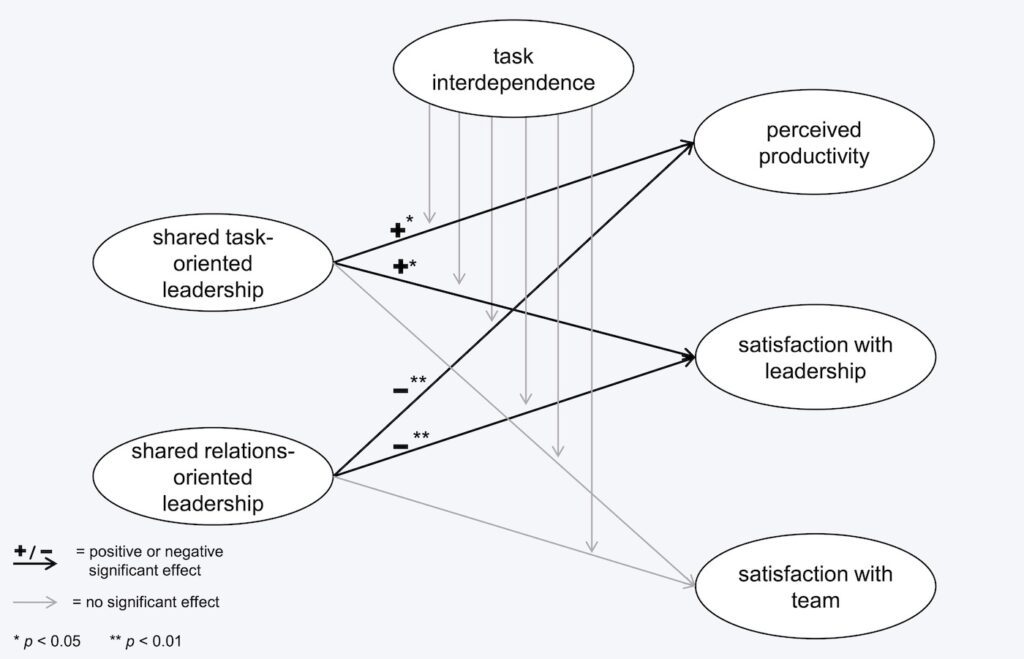
In a previously published questionnaire study, team members of virtual teams with primary formal leadership structures (n=411) were asked to what extent task- and relations-oriented leadership behaviors are taken on by team members and how this affects the subjectively perceived productivity and satisfaction of team members [17]. Since earlier research indicated that task interdependency could have an influence on this relationship, this variable was taken into account as a moderator in the analysis [16, 11, 12]. The results show that sharing task-oriented leadership has a significantly positive effect on perceived productivity of team members and their satisfaction with leadership, while sharing relations-oriented leadership has a significantly negative effect [17].
A moderating effect of task interdependency couldn’t be confirmed [17]. Therefore, the results of the structural model presented in Figure 1 imply that team members in virtual teams tend to take on task-oriented leadership behaviors. However, relations-oriented leadership behaviors should remain the responsibility of leaders in the interest of team members’ productivity and satisfaction with leadership. The question remains as to why team members like it when task-oriented leadership behavior is shared, but not when relations-oriented leadership behavior is shared.
Implications for leadership in virtual teams
One way to successfully manage virtual teamwork may be to reduce the centralization of decision-making responsibility by empowering employees to take responsibility for leadership behaviors. As the empirical results show, teams work productively and are satisfied with leadership when team members take on responsibility for task-oriented leadership behaviors. Figure 2 visualizes a suggestion for sharing leadership in virtual teams based on the empirical results. Accordingly, different team members take the responsibility for various task-oriented leadership behaviors like task planning, task clarification, problem-solving or controlling.
In this case, the formal leader with a transformational leadership style only supports on a task level and primarily focuses on relations-oriented leadership topics such as supporting, empowering and giving feedback. Based on the findings of an interview study [16], Figure 2 also illustrates an example in which one team member works at another office site and a person from the organization, who works at the same site, is assigned as a buddy to support the team member. This is an example of ensuring that every team member receives as much relational support as they individually need, even if the leader cannot be on site.
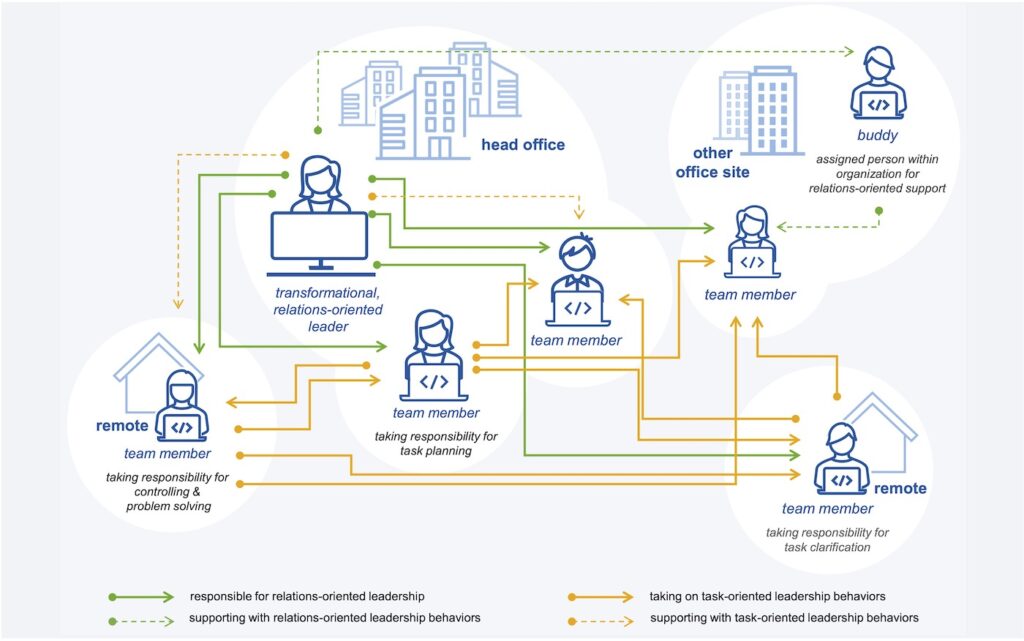
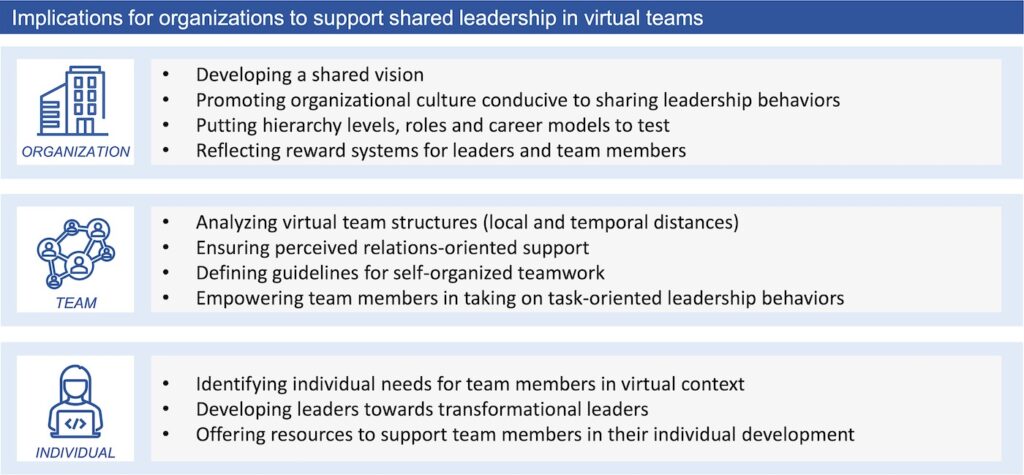
For a leadership concept such as the one presented in Figure 2 to work successfully in practice, an organization must create conducive framework conditions. These must be negotiated internally by the organization, particularly with regard to the extent that they want to promote emergent leadership concepts such as shared leadership. In the following, design implications on organizational, team and individual level are introduced which should be considered to create a framework to best support transformational and shared leadership in virtual teams (Fig. 3).
Implications on organizational level
The main implication for leadership in virtual teams on organizational level that influences all the other implications is the development of a clear vision. In particular, it forms the basis for the successful promotion of a transformational leadership style within an organization, which is based on providing employees with a vision to guide their actions. Promoting an organizational culture to conduce shared leadership secures the relations-oriented support in transforming settings. Empirical findings demonstrate benefits of a transformational leadership style for shared leadership as it has a positive influence on encouraging employees [18].
While empirical results indicate the advantages of shared leadership in virtual teams, the promotion of this concept in organizations leads to some challenges due to its emergent nature. One main challenge is the determination of who’s authorized to make certain decisions. In this context, the role of leaders should be clarified, especially with respect to relations-oriented leadership behaviors. This also leads to the discussion on whether transferring decision-making power to team members leads to a flattening of hierarchy levels. When leading virtual teams where relations-oriented leadership work is associated with more effort, it’s also necessary to question how large the leadership span can be for a leader to successfully support their team members at the relationship level.
Along with the evaluation of hierarchy levels and the task profiles of leadership positions, organizations should reflect the design of different career models. For instance, although subject matter expertise is not the only predictor of good leadership, in many (especially technology-oriented) companies it’s still common practice to promote employees into leadership positions based on that expertise [19].
With shared leadership, however, task responsibility that requires subject matter expertise are taken on by team members, while leaders have primarily relations-oriented leadership responsibility, thus requiring a different skill set for people in leadership positions. For the experts, on the other hand, specialist careers may become more attractive to than the traditional leadership career. This, however, also requires a reevaluation of remuneration and reward systems for both leaders and team members.
Implications on team level
The implications for leadership in a virtual context at organizational level directly affect the team. Further implications relevant to successful virtual teamwork should be considered. For instance, to ensure that team members are satisfied with working in virtual team settings, organizations should carefully analyze the team structures and ensure that all team members receive relations-oriented support.
As the results of the previously referred to questionnaire-based study show, this should be provided by the leader of the team and not be haphazardly taken on by team members [17]. If a leader can’t fulfill the individual needs due to local or temporal distribution, solutions like buddy-concepts or even distributed leadership concepts should be discussed [16].
In order to support shared task-oriented leadership behaviors within virtual teams, organizations should develop guidelines for self-organized teamwork e. g. for the process of decision-making and documentation and the use of ICT and meeting formats. At the same time, it is important to create an environment in which team members feel empowered to take on task-oriented leadership behaviors.
Implications on individual level
As mentioned earlier, successful leadership in virtual contexts should ensure that the individual feels well-supported despite the local and/or temporal distance to the leader and colleagues. For this reason, leaders should identify the individual needs of team members which may differ particularly in terms of their personality and individual maturity.
Furthermore, on an individual level, it’s important to support individual leaders in developing their transformational leadership style by offering development, coaching or mentoring programs. Guidelines for transformational leaders would be to act confidently, to express their trust in the employees, to use symbolic actions and to lead by example [12]. It’s equally important to offer resources for the development of team members so they can develop individually and feel empowered and encouraged to take on task-oriented leadership behaviors.
Summary
The current changes in technological, ecological and demographic conditions present companies with major challenges that must be driven forward by the people in the company. Therefore, leadership plays a central role in the continuous digitally-, economically- and ecologically-driven transformation of organizations. Firstly, it requires a vision and goals that are communicated by leaders and motivate employees to act in the interests of common goals, even under uncertain conditions.
Further, an organizational framework that offers employees scope for decision-making so that they can develop their skills and support each other on the task level in line with the shared leadership approach is required. Using the example of increasing virtual collaboration in organizations, this article examined how leadership may be (re-)organized to meet the requirements on the organizational, team and individual level during this transformation. Future studies should address further questions in this regard, in particular on influencing factors and leadership concepts that should be taken into account when (re-)organizing leadership.
The studies were conducted in the context of the LUTZ research and development project, which was funded by the Federal Ministry of Education and Research (BMBF) and the European Social Fund (ESF) as part of the “Future of Work” program (funding reference: 02L18B535).
Bibliography
[1] Foster, M. K. et al.: Rethinking Virtuality and Its Impacts on Teams. In: Small Group Research 46 (2015) 3, pp. 267–299.[2] Ferreira, R. et al.: Decision Factors for Remote Work Adoption: Advantages, Disadvantages, Driving Forces and Challenges. In: Journal of Open Innovation: Technology, Market and Complexity 7 (2021) 1, p. 70.
[3] Morrison-Smith, S.; Ruiz, J.: Challenges and Barriers in Virtual Teams: A Literature Review. In: SN Applied Sciences 2 (2020) 6, p. 179.
[4] Wald, P. M.: Virtuelle Führung: Mit neuen Medien führen. In: Aktuelle Führungstheorien und -konzepte. Wiesbaden 2021.
[5] Yukl, G.: Leadership in Organizations. Harlow 2013.
[6] Purvanova, R. K.; Bono, J. E.: Transformational Leadership in Context: Face-to-face and Virtual Teams. In: The Leadership Quarterly 20 (2009) 3, pp. 343–357.
[7] Schwarzmüller, T. et al.: How Does the Digital Transformation Affect Organizations? Key Themes of Change in Work Design and Leadership. In: Management Revue 29 (2018) 2, pp. 114–138.
[8] Pearce, C. L.; Conger, J. A.: Shared Leadership: Reframing the Hows and Whys of Leadership. Thousand Oaks 2003.
[9] Zhu, J. et al.: Shared Leadership: A State-of-the-Art Review and Future Research Agenda. In: Journal of Organizational Behavior 39 (2018) 7, pp. 834–852.
[10] Gronn, P.: Distributed Leadership as a Unit of Analysis. In: The Leadership Quarterly 13 (2002) 4, pp. 423–451.
[11] Stewart, G. L.; Courtright, S. H.; Manz, C. C.: Self-Leadership: A Multilevel Review. In: Journal of Management 37 (2011) 1, pp. 185–222.
[12] Kozlowski, S. W. J.; Chao, G. T.; van Fossen, J.: Leading Virtual Teams. In: Organizational Dynamics 50 (2021) 1, p. 100842.
[13] Wu, Q.; Cormican, K.; Chen, G.: A Meta-Analysis of Shared Leadership: Antecedents, Consequences, and Moderators. In: Journal of Leadership & Organizational Studies 27 (2020) 1, pp. 49–64.
[14] Hoch, J. E.; Kozlowski, S. W. J.: Leading Virtual Teams: Hierarchical Leadership, Structural Supports, and Shared Team Leadership. In: The Journal of Applied Psychology 99 (2014) 3, pp. 390–403.
[15] Yukl, G.; Gordon, A.; Taber, T.: A Hierarchical Taxonomy of Leadership Behavior: Integrating a Half Century of Behavior Research. In: Journal of Leadership & Organizational Studies 9 (2002) 3, pp. 15–32.
[16] Mayer, C. et al.: Herausforderungen virtueller Führung in Unternehmen: Ableitung von Anforderungen an aufgaben- und beziehungsorientierte Führungsverhaltensweisen. In: 67. Frühjahrskongress der Gesellschaft für Arbeitswissenschaft, Arbeit HUMAINE gestalten. Dortmund 2020.
[17] Mayer, C. et al.: Sharing Leadership Behaviors in Virtual Teams: Effects of Shared Leadership Behaviors on Team Member Satisfaction and Productivity. In: Team Performance Management: An International Journal 49 (2023) ½, pp. 90–112.
[18] Coun, M. J.; Peters, P.; Blomme, R. J.: ‘Let’s share!’ The Mediating Role of Employees’ Self-Determination in the Relationship Between Transformational and Shared Leadership and Perceived Knowledge Sharing Among Peers. In: European Management Journal 37 (2019) 4, pp. 481–491.
[19] Litzcke, S.: Fachlaufbahn oder Führungslaufbahn: Einflussfaktor Karriereanker. In: Führungskompetenzen lernen: Eignung, Entwicklung, Aufstieg. Stuttgart 2013.
Your downloads
Potentials: Leadership Management
You might also be interested in