Adaptability

Management of Changeability from an Actor-oriented Perspective

Management of Changeability from an Actor-oriented Perspective

Thorsten Blecker, Günter Graf
Changeability has become a buzzword for operations management, especially in German literature. Management of changeability, in contrast, has not yet been considered in practice or in literature sufficiently. The article presents an actors oriented approach for the management of changeability that enables a better composition and maintenance of change potentials in operation sys-tems. Change potentials are the unused abilities and relationships of actors and build up the changeability of an operation system. The management of changeability has to take care of these potentials for using i hemin the change process.
Industrie Management | Volume 20 | 2004 | Edition 2 | Pages 70-73
Development and Application of Adaptive Enterprise Resource Planning Systems

Development and Application of Adaptive Enterprise Resource Planning Systems

Norbert Gronau ORCID Icon, Horst Wildemann, Michael F. Zäh
Medium-sized industrial enterprises apply resource planning systems for their business processes. Changing markets require permanent adaptation of these enterprises’ organisational structures and processes to ensure their efficiency and their competitiveness. However, currently applied standard software systems have proven to be insufficiently adaptable. They allow multiple configuration options during implementation and setup, but it is hardly possible to perform configuration changes during the application phase. Therefore software developers will have to focus on adaptable enterprise resource planning systems in future. Beyond the development phase (build time) technological progress caused by changing requirements also has to be synchronised simultaneously by current software releases during the application phase (run time).
Industrie Management | Volume 20 | 2004 | Edition 2 | Pages 25-30
Virtual Supply Chains, an Approach for Market Based Coordination

Virtual Supply Chains, an Approach for Market Based Coordination

Ein Ansatz zur marktlichen Koordinierung industrieller Wertschöpfungsnetze
Axel Braßler
In order to put virtual supply chains into practice a suitable option for coordination is necessary. This contribution presents which actors and which processes are required, if the problem will be solved by electronic marketplaces. Finally it will be shown which chances and opportunities are associated with the suggested approach.
Industrie Management | Volume 20 | 2004 | Edition 2 | Pages 47-50
Changeable, Variable Targeted Manufacturing Systems

Changeable, Variable Targeted Manufacturing Systems

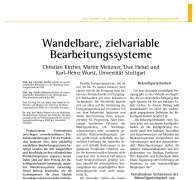
Christian Kircher, Martin Meitzner, Uwe Heisel, Karl-Heinz Wurst
The demands on production companies increasingly vary due to unpre-dictable changes. This results in batch production of varying products and shorter life cycles of products and leads to difficulties in controlling the production sequences. In order to maintain optimal production processes the machining systems, including the controllers, must be adapted, when changes get too drastic. Thus autarkic modules with standardised interfaces for mechanical connection, energy, and information are required. As the adaptation process must be manageable und executable in a short time, self-adapting control systems, which adapt themselves depending on the changed machine structure, are needed.
Industrie Management | Volume 20 | 2004 | Edition 2 | Pages 17-20
Changeability by Holistic Competence Management

Changeability by Holistic Competence Management

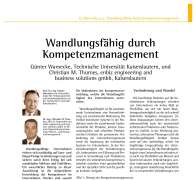
Günter Warnecke, Christian M. Thurnes
Changeable enterprises are sustainably focussing market and technology changes ranging from a short term up to long term view to maintain market success under changing market and environment conditions. The specific addressing of competence development can provide a significant contribution to changeable conditions. For these both, adaptive reactions to present changes as well as preventative planning addressing future changes are needed. To support the changeability of an enterprise holistic competence management approaches can be used. They allow to match supply and demand of competence and to design corresponding concepts for competence development.
Industrie Management | Volume 20 | 2004 | Edition 2 | Pages 9-11
Changeability by Flexibility Optimisation in Production Projects

Changeability by Flexibility Optimisation in Production Projects

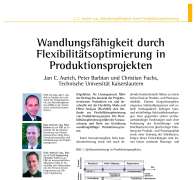
Jan C. Aurich, Peter Barbian, Christian Fuchs
Due to the dynamic production environment with its multiple fast changing influences, planning and reconfiguration cycles in production have become shorter. In this context, changeability and flexibility of production systems are major factors for success. The paper defines changeability and describes flexibility as major base for changeability. With the concept of Production Projects an innovative and promising concept is introduced that supports the systematic optimization of flexibility and that links the lifecycles of products and production. Furthermore, the Flexibility Mode and Effect Analysis (FlexMEA), on which the systematic analysis and optimisation of flexibility is based, is presented.
Industrie Management | Volume 20 | 2004 | Edition 2 | Pages 21-24
Transformability by Technology Planning

Transformability by Technology Planning

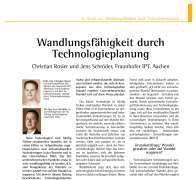
Christian Rosier, Jens Schröder
New technologies are often drivers of structural change, which in many cases leads to profound organizational and infrastructural changes in industry and within the enterprises. The aim of business action is to be versatile. That means that enterprises should play the role of the main actor of change instead of reacting only. The technology calendar described in this article is a strategic planning instrument. With this instrument it is possible to gain an overview about technologies available now and in future. From the confrontation of the product spectrum that can be manufactured in future and the technologies available in future, the necessary organizational and infrastructural measures, which result as consequence from the technological change, can be initiated. This way the planning of business change becomes possible.
Industrie Management | Volume 20 | 2004 | Edition 2 | Pages 55-57
How to Change Cost-Effectively

How to Change Cost-Effectively

A method for the appropriate design of transformability
Christoph Heger, Hermann Holzer
In today’s changing market forecasts have become much less certain, thus seriously affecting in-house planning. The need to be able to adapt, on the other hand, is increasing. Transformability has therefore become a decisive key factor in the competitiveness of manufacturing companies in addition to the classical target factors of costs, time and quality. Nevertheless, transformability is seldom taken into sufficient consideration or implemented in practice, for it requires additional investments and the returns are not always clear. This paper describes a method that makes it possible for companies to calculate the relevant costs of changeability using the technique of scenario planning.
Industrie Management | Volume 20 | 2004 | Edition 2 | Pages 12-16
Autonomous Cooperating Logistic Processes: A Paradigm Shift and its Limitations

Autonomous Cooperating Logistic Processes: A Paradigm Shift and its Limitations

Ein Paradigmenwechsel und seine Grenzen Ein neuer Sonderforschungsbereich an der Universität Bremen
Michael Freitag ORCID Icon, Otthein Herzog, Bernd Scholz-Reiter ORCID Icon
The new Collaborative Research Centre “Autonomous Cooperating Logistic Processes: A Paradigm Shift and its Limitations”, funded by the German Research Foundation, started on January 1st, 2004 at the University of Bremen. The objective of the new Collaborative Research Centre is systematic and broad investigation and application of “autonomy” as a new paradigm for logistic processes. For this, appropriate concepts and models as well as methods and tools are being researched and developed in twelve scientific sub-projects. In a later phase of the Collaborative Research Centre, the results of this research will be transferred into real logistic applications.
Industrie Management | Volume 20 | 2004 | Edition 1 | Pages 23-27
1 20 21