
Robustness-enabling Properties in Business Processes |
Identification and evaluation of characteristics related to robustness

| Journal | Industry 4.0 Science |
| Issue | Volume 40, 2024, Edition 3, Pages 27-32 |
| Bibliography | Share | Cite | Download |
Abstract
Article
The consideration of critical resources and infrastructure is not solely expedient for manufacturing companies [1]. In [2], the authors show that the criticality of resources and infrastructure can also change due to changing boundary conditions. The aim of robustness as a property is to maintain sufficient business process performance in the face of changing conditions. To achieve this, processes must be designed with robustness in mind.
In the context of robustness as a property, related terms repeatedly appear both in scientific literature and in business practice. Interviews were conducted with company representatives to understand the robustness of business processes. Representatives of manufacturing companies from different sectors and of different sizes were interviewed. Within these interviews, open questions were asked. The interviews were then transcribed, coded and finally subjected to qualitative analysis with certain hypotheses. The characteristics of stability and flexibility were mentioned several times. Further findings from the interviews are described in [2].
The following hypothesis is drawn from the qualitative content analysis of the interviews: Related properties can enable business process robustness. The following research questions can be derived from this hypothesis: What are the similarities and differences between robustness and its related properties? Can the related properties strengthen the robustness of business processes?
Aspects of the robustness of business processes
It has already been shown that the robustness of business processes is becoming increasingly relevant for companies. In order to manage robustness, it is necessary to design processes and assess their robustness. For evaluation to take place, robustness must be quantified and a robustness corridor must be defined [3]. In addition to the robustness corridor, a warning corridor is also defined. If this is breached, the robustness of the business processes is considered to be under threat.
In order to increase the robustness of business processes, it is necessary for manufacturing companies to be aware of their risks and stress factors. Risks are events that have not yet occurred but could potentially occur [4]. As soon as a risk is identified, the potential impact of the damage must be assessed [5] and a decision made as to whether measures are required to increase robustness.
In line with research done in the field of police work [6], the early identification of risks is referred to as the time-based situation (Fig. 1a). This is characterized by the fact that the robustness indicator is within the robustness corridor and has not yet reached the warning range. Processes are designed proactively with regard to time-based situations so that the robustness property has a protective effect when the stress factor occurs. To this end, the current robustness level and forecasts of potential changes are included in the design process.
In addition to time-based situations, there are also immediate situations (Figure 1b) [6]. These occur as soon as the robustness level reaches the warning corridor. This is the case if measures were not effective enough or a risk or stress factor was not identified at an earlier stage. Immediate situations are characterized by reactive action.

So-called robustness objects and enablers are required to increase the robustness of business processes [3]. Robustness enablers operate on robustness principles, which support their implementation. Methods and tools help with the implementation of robustness principles.
Study design and related features
The authors of [7] and [8] have already examined robustness-related properties. Nevertheless, the related properties mentioned in these works differ. In order to ensure completeness, related properties are identified based on a systematic literature search (an approach designed according to [9]) for the robustness property of business processes, which was then extended by a snowball search [10]. First, the search algorithm Title = Robust* AND “Business Process” was used. Only three hits were obtained, two of which did not contain a definition of robustness. Therefore, the search algorithm was generalized to Title = Robust* AND Process. After filtering based on practical criteria in the systematic literature search, 170 articles relating to the robustness of business processes were identified.
The abstracts of these articles were examined for discussion of related properties. For the articles retrieved via the snowball search, the full texts were examined for mention of related properties. Descriptively named properties were not taken into account. The related properties which were identified are described below in terms of their similarities and differences to the robustness of business processes.
Agility is understood as the rapid adaptation of a system in response to a change [11]. This is made possible by proactive preparation. From the definitions of agility, it can be concluded that risks and disruptions of internal and external origin are included. The agile manifesto describes the principles of agility.
Transformability of factories enables reactive or proactive adaptation of change objects. The design guidelines are described by change enablers and objects [12]. However, there is no concrete implementation through principles and methods. The need for change is triggered by changes in the business environment [13]. These are to be understood as equivalent to risks and stress factors. Nevertheless, robustness also includes risks and stress factors of internal origin. In contrast to robustness, transformability is not assessed using a corridor.
Corporate resilience is the ability of a company to withstand external and internal changes in the business environment [14, 15]. Depending on the approach taken, a new state of equilibrium can be achieved, or a return to the old state is possible [1]. Corporate resilience takes both risks and disruptions of an external origin into account. In particular, [1] describes the design principles, methods and tools necessary for a resilient production system. However, enablers and objects are not available. Resilience is measured based on performance. The minimum performance indicates how long a production system is considered resilient. This means that there is no corridor for resilience, only a lower limit. The framework for resilient value creation [1] shows that measures can be both proactive and reactive.
Stability describes small deviations from the target state. A corridor range is defined for this purpose. In contrast to robustness, however, this corridor is smaller [16]. Only stress factors with negative target-actual discrepancies are considered in the deviations. No explicit design guidelines for a stable production system were found.
Flexible production systems describe the system’s ability to adapt to changes in the environment [16]. Whether the changes relate to both negative and positive target-actual discrepancies remains to be seen. One resource [17] describes various forms of flexibility, such as machine and process flexibility. This is equivalent to the robustness objects and principles. Flexible production systems are designed proactively. Indications of reactive design were not found.
Regenerative ability refers to the rapid transformation that takes place following the occurrence of a stress factor with a negative target-actual discrepancy. The level of effort required to overcome stress factors should be minimized in order to enable rapid switching between normal and crisis modes [1]. Furthermore, this ability should help to ensure that the original level of performance is quickly regained. The prerequisites for the ability to regenerate are created proactively. Concrete design guidelines are not available.
A resistant production system is understood to mean one that is resistant to stress factors without violating its state of equilibrium. The central goal is therefore to ward off stress factors [18]. Resistant production systems only focus on stress factors with a negative target-actual discrepancy. There are no explicit design guidelines.

Figure 2 summarizes the degree of correspondence between the related properties and the aspects of business process robustness. The Harvey balls represent the degree of agreement between the related properties and the individual aspects of the robustness of business processes.
Robustness-enhancing effect of related properties
In the previous section, the related properties were considered in relation to the property of robustness. The focus was on the similarities between robustness and the related properties. This section considers whether the related properties have a robustness-enabling effect in time-based or immediate situations. According to [1], robustness is a capability of a resilient production system, thus robustness enables the resilience of production systems. Consequently, corporate resilience is not taken into further consideration in this section.
Time-based situations in particular are characterized by a proactive design. The related properties, which also facilitate proactive design, are particularly helpful here. These are transformability, flexibility and agility. These values in particular enable robustness when the stress factor occurs, so that the effects of the stress factor are cushioned by the capacity to withstand change that transformability, flexibility and agility bring. If the effects of the stress factor nevertheless occur, the regenerative ability is engaged to maintain the robustness corridor and thus enabled the continued robustness of the process.
Resistance and stability have a robustness-enhancing effect, especially when the stress factors occur. This prevents the warning corridor from ever being reached and the robustness of the process from being jeopardized.
Application example: flexibility to increase robustness
In this serious game, drilling machines are produced in seven different variants according to the pull principle. Various process steps, divided into different workstations, are required to produce the drills, each of which is carried out manually by an employee as standard protocol. After each station, there is an intermediate storage area that serves as a buffer and can hold a maximum of five products in progress per variant [19].
First, production is simulated with eight employees and the throughput times for various orders are determined. In the stress scenario, the absence of three employees represents the stress factor. As a result of these absences, three of the stations would no longer be manned. Due to the buffers, the first three orders could still be serviced, after which there would be an interruption. The robustness of the process would therefore no longer be guaranteed. It is therefore necessary to take action to counteract this.
The robustness-enabling characteristic of flexibility is employed towards this end. Concretely, the principle of job rotation, in which employees can be flexibly assigned, is used for this purpose [20]. The previous qualification levels of the employees is negligible here due to the simplicity of the production process. In other use cases, however, a preparation phase must be taken into account for preliminary qualification. This action ensures that, although the throughput time increases, production does not come to a standstill.
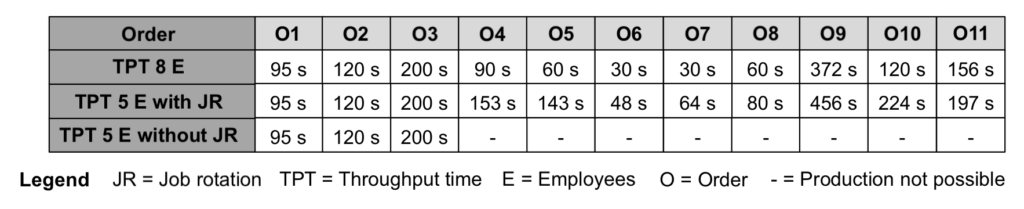
Figure 3 compares the throughput times of the individual orders with eight and with five employees. Initially, there are no deviations within the throughput time. This is due to the buffer stocks, which cover production requirements for a certain period of time. Deviations can be seen from job four onwards. However, thanks to the job rotation principle, there is no point at which complete interruption of the process occurs.
How can the robustness of a process be evaluated?
This article looks at the differences and similarities between robustness and its related properties. These can be categorized into two groups: related properties that relate to resilience and those that relate to the ability to change. Both resilience and changeability address objectives of robustness. Thus, robustness-related properties can increase the robustness of business processes. However, in order to fully assess the extent to which robustness is increased, it is necessary to quantify robustness.
Existing methods, including qualitative and quantitative approaches, can serve as a basis here. In order to be able to fully evaluate the robustness in the application example, the available approaches for evaluating the robustness of business processes must first be evaluated and, if necessary, expanded.
Bibliography
[1] Kohl, H. et al: Resiliente Wertschöpfung in der produzierenden Industrie – innovativ, erfolgreich, krisenfest. “RESYST” White Paper, Munich, (2021).[2] Lange, A.; Knothe, T.: Robuste Unternehmensprozesse: Unternehmen brauchen nicht nur robuste Ressourcen. In: Industrie 4.0 Management 39 (4) 4, p. 36-39 (2023).
[3] Lange, A.; Knothe, T.: Modellierung robuster Prozesse: Anforderungen an die Prozessmodellierungsmethoden. In: Industrie 4.0 Management 39 (5), pp. 62-65 (2023).
[4] Ivanov, D.: Structural Dynamics and Resilience in Supply Chain Risk Management. International Series in Operations Research & Management Science 265. Cham (2018).
[5] Romeike, F.: Risikomanagement. Studienwissen kompakt. Wiesbaden (2018).
[6] Kahl, S.: Einsatzlehre: Polizeiliches Risikomanagement für den Einsatz. Munich (2021).
[7] Stockmann, C.: Untersuchung der Robustheit in Produktionssystemen. Konzeptionelles Verständnis, Bewertungsmethode und Managementansatz. Berlin: Logos Verlag (2021).
[8] Stricker, N.: Robustheit verketteter Produktionssysteme. Dissertation, Shaker Verlag, (2016).
[9] Fink, A.: Conducting Research Literature Reviews: From the Internet to Paper. Los Angeles, London, New Delhi, Singapore, Washington DC (2014).
[10] Duff, A.: The Literature Search: A Library Based Model for Information Skills Instruction. In: Library Review 45 (4), pp. 14-18 (1996).
[11] Ramsauer, C.; Rabitsch, C.: Agile Production: Ein Produktionskonzept für gesteigerten Unternehmenserfolg in volatilen Zeiten. In: Industrial Engineering and Management: Articles from the Techno-Economics Forum held by the TU Austria consortium. Wiesbaden, pp. 63-81 (2016).
[12] Morales, R. H.: Systematik der Wandlungsfähigkeit in der Fabrikplanung. Düsseldorf (2002).
[13] Westkämper, E.; Zahn, E.: Wandlungsfähige Produktionsunternehmen. Berlin, Heidelberg (2009).
[14] Günther, E.: Definition Resilienz. URL: wirtschaftslexikon.gabler.de/definition/resilienz-52429/version-275567, Accessed 14.11.2023.
[15] Soucek, R. et al.: Resilienz als individuelle und organisationale Kompetenz: Inhaltliche Erschließung und Förderung der Resilienz von Beschäftigten, Teams und Organisationen. In: Gestaltungskompetenzen für gesundes Arbeiten: Arbeitsgestaltung im Zeitalter der Digitalisierung, pp. 27-38 (2017).
[16] Hingst, L.; Park, Y.-B.; Nyhuis, P.: Life Cycle Oriented Planning of Changeability in Factory Planning Under Uncertainty. In: Proceedings of the Conference on Production Systems and Logistics: CPSL 2021, pp. 11-22 (2021).
[17] Sethi, A.; Sethi, S.: Flexibility in Manufacturing: A Survey. In: The International Journal of Flexible Manufacturing Systems. Boston (1990).
[18] Fiskel, J.: Designing Resilient, Sustainable Systems. In: Environmental Science & Technology 37 (239), pp. 5330-5339 (2003).
[19] Rieckmann, J. M.; Torka, J.; Gering, P.: Weg zur intelligenten Fabrik. In: Zeitschrift für wirtschaftlichen Fabrikbetrieb 117 (1-2), pp. 14-19 (2022).
[20] Garell, J.; Schenk, M.; Seidel, H.: Flexibilisierung der Produktion: Maßnahmen und Status Quo. In: Flexible Produktionskapazität innovativ managen: Handlungsempfehlungen für die flexible Gestaltung von Produktionssystemen in kleinen und mittleren Unternehmen, pp. 81-12 6 (2014).
You might also be interested in