Autor: Bernd Kuhlenkötter

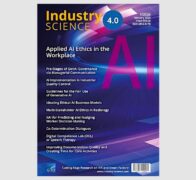
I4S 1/2026: Applied AI Ethics in the Workplace

I4S 1/2026: Applied AI Ethics in the Workplace

A shared responsibility — from radiology and speech therapy to assembly
AI ethics in the workplace is everyone’s responsibility. It requires accountability from companies as a whole and conscious action from individuals—whether developers or users, managers or employees. Key issues revolve around ethical AI skills and questions of governance and employee representation. How will the world of work change, from radiology and speech therapy to assembly and quality control?
Pre-Stages of GenAI Governance via Managerial Communication

Pre-Stages of GenAI Governance via Managerial Communication

Exploratory findings from SMEs in the Ruhr area
Niklas Obermann ORCID Icon, Uta Wilkens ORCID Icon, Antonia Weirich ORCID Icon, Matthias E. Cichon ORCID Icon, Jürgen Mazarov, Bernd Kuhlenkötter ORCID Icon
The governance of generative artificial intelligence (GenAI) usage is often described as a formalized reporting system. This neglects the early-stage mechanisms of coping with ethical challenges during the GenAI implementation period. Exploratory empirical findings from the Ruhr area reveal that managerial communicative practices serve as a substitute for missing institutional structures, particularly at an early stage of GenAI implementation in SMEs.
Industry 4.0 Science | Volume 42 | Edition 1 | Pages 6-13 | DOI 10.30844/I4SE.26.1.6
Adapting AI Work Systems for Human-Centeredness

Adapting AI Work Systems for Human-Centeredness

A methodical approach for exploring the design space in transdisciplinary teams
Florian Bülow ORCID Icon, Michael Herzog ORCID Icon, Sophie Berretta ORCID Icon, Dominik Arnold ORCID Icon, Christian Els, Bernd Kuhlenkötter ORCID Icon
Designing adaptations in AI-based work systems poses a central challenge for achieving human-centered AI (HCAI). This paper presents a methodical approach that enables transdisciplinary teams to systematically explore and structure the design space of adaptable work systems. Building on an extended work system model and operationalized through a matrix-based framework, the method supports the identification of interdependencies, stakeholder perspectives, and context-specific goals. Its practical applicability is demonstrated through a real-world case study in radiographic non-destructive testing.
Industry 4.0 Science | Volume 42 | Edition 1 | Pages 44-53 | DOI 10.30844/I4SE.26.1.136
Towards Human-Centered Industrial AI Adoption

Towards Human-Centered Industrial AI Adoption

A reference architecture for machine vision demonstrators
Dominik Arnold ORCID Icon, Florian Bülow ORCID Icon, Bernd Kuhlenkötter ORCID Icon
Despite its potential, the introduction of artificial intelligence (AI) in industry is often delayed, primarily due to perceived complexity, high costs, and a lack of expertise. This article presents a modular demonstrator reference architecture that provides practical, low-cost access to industrial AI applications. Developed within a design science research approach, it specifically supports experimentation, learning, and gradual integration into existing production processes. The focus is on machine vision, implemented using cost-effective hardware and open-source software. Its applicability is demonstrated in three scenarios: quality control, chip classification, and in-company training. Initial evaluations confirm the technical feasibility, didactic relevance, and transferability to a variety of industrial contexts.
Industry 4.0 Science | Volume 41 | 2025 | Edition 5 | Pages 152-160 | DOI 10.30844/I4SE.25.5.146
Error Management in Production

Error Management in Production

Current situation and challenges in the industry
Johannes Prior ORCID Icon, Milan Brisse ORCID Icon, Nikita Govorov, Robert Egel ORCID Icon, Bernd Kuhlenkötter ORCID Icon
This study explores experience-based error management on the basis of 23 participating companies. This study aims to identify essential criteria for effective error management in production. For this purpose, a comprehensive questionnaire was created, featuring 77 questions across eight key topics, including error culture, documentation, root cause analysis and software-supported knowledge management. The following analysis highlights both positive and negative measures, providing specific recommendations to optimize experience-based error management.
Industry 4.0 Science | Volume 41 | Edition 2 | Pages 38-45
Digital and Ecological Transformation in Companies

Digital and Ecological Transformation in Companies

Challenges and potential in interaction
Manfred Wannöfel, Bernd Kuhlenkötter ORCID Icon, Christopher Prinz ORCID Icon, Fabian Hoose ORCID Icon, Manfred Wannöffel ORCID Icon
Although the concept of double transformation is being intensely discussed in companies, the practical implementation in operational structures often remains unclear. This article sheds light on how digital technologies and environmental sustainability strategies can be developed either synergistically, antagonistically or independently of each other. In addition, it discusses the different experiences of employees in different industries and the varying progress in the introduction of digital and ecological measures. To this end, it will discuss existing research findings and practical examples that pave the way for the successful integration of both transformation processes in companies.
Industry 4.0 Science | Volume 40 | 2024 | Edition 5 | Pages 34-42 | DOI 10.30844/I4SE.24.5.34
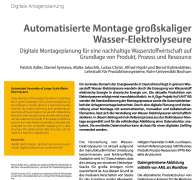
Automated Assembly of Large-Scale Water Electrolyzers

Automated Assembly of Large-Scale Water Electrolyzers

Digitale Montageplanung für eine nachhaltige Wasserstoffwirtschaft auf Grundlage von Produkt, Prozess und Ressource
Patrick Adler, Daniel Syniawa, Malte Jakschik, Lukas Christ, Alfred Hypki, Bernd Kuhlenkötter ORCID Icon
A key element of the energy transition in Germany lies in green hydrogen. The current production of electrolyzers is mostly done in a manufactory-like manner. By digital planning and preparing an assembly with automated, manual and collaborative elements, the manufacturing of water electrolyzers can be scaled economically. In this paper, a reference process from electrolyzer assembly is selected and analyzed for the complete mapping of a data structure. The determined data structure can be used as a basis for a digital twin.
Industrie 4.0 Management | Volume 38 | 2022 | Edition 5 | Pages 12-16 | DOI 10.30844/IM_22-5_12-16
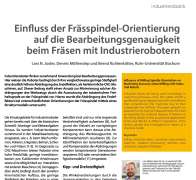
Influence of Milling Spindle Orientation on Machining Accuracy

Influence of Milling Spindle Orientation on Machining Accuracy

A case study on milling with industrial robots
Bernd Kuhlenkötter ORCID Icon, Dennis Möllensiep, Lars N. Josler
Industrial robots are being used increasingly in machining processes. Here, the robots exhibit a significantly higher displacement of the end effector than conventional CNC machines due to their comparable low stiffness. This paper presents an approach to minimize such displacements of the tool by exploiting the rotational degrees of freedom at the milling spindle. For this purpose, the displacement of the end effector at different orientations of the milling spindle was investigated by means of a structural model.
Industrie 4.0 Management | Volume 38 | 2022 | Edition 5 | Pages 53-56 | DOI 10.30844/IM_22-5_53-56
Learning and Competence Development in AI-based Adaptive Systems

Learning and Competence Development in AI-based Adaptive Systems

Uta Wilkens ORCID Icon, Dominik Lins, Christopher Prinz ORCID Icon, Bernd Kuhlenkötter ORCID Icon
The paper reflects the potential and remaining shortcomings of AI-based work systems for exploiting and enhancing individual and organizational learning processes. It especially refers to the use adaptive systems in production and gives examples of good practice for the design of AI-based work systems which promote the interplay between individual and artificial intelligence. The conceptual framework refers to different methods in machine learning which are complemented by insights from individual and organizational learning theory.
Industrie 4.0 Management | Volume 36 | 2020 | Edition 6 | Pages 30-34
Economic Effectiveness Assessment in Context of CPPS

Economic Effectiveness Assessment in Context of CPPS

Entwicklung eines ganzheitlichen Ansatzes zur Wirtschaftlichkeitsbewertung mittels Betrachtung von Interdependenzen
Thom Wienbruch, Stefan Leineweber, Simon Fahle, Bernd Kuhlenkötter ORCID Icon
The article presents an approach which supports the assessment of the economic effectiveness of measures during the development towards CPPS through a holistic simulation approach. This is based on the mapping of the various interdependencies between the dimensions technology, organisation and personnel according to the socio-technical approach. From the validation of the approach conclusions for the further development of the concept are drawn.
Industrie 4.0 Management | Volume 35 | 2019 | Edition 4 | Pages 17-20
1 2