Internet of Things Calls for a New Way of Working |
Ways to Digitally Transform Qualification, Organization, and Leadership

| Journal | Industrie 4.0 Management |
| Issue | Volume 34, 2018, Edition 3, Pages 8-12 |
| Open Access | https://doi.org/10.30844/I40M_18-3_S8-12 |
| Bibliography | Share | Cite | Download |
Abstract
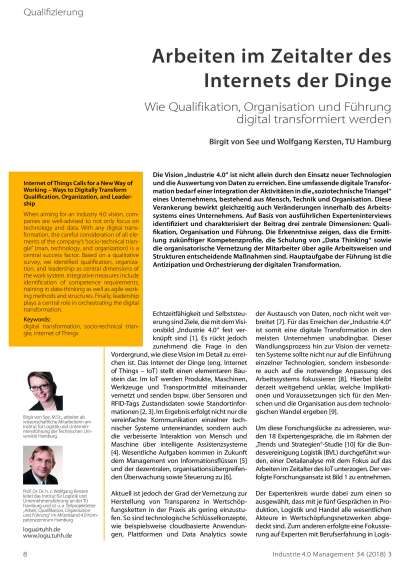
When aiming for an Industry 4.0 vision, companies are well-advised to not only focus on technology and data. With any digital transformation, the careful consideration of all elements of the company’s “socio-technical triangle” (man, technology, and organization) is a central success factor. Based on a qualitative survey, we identified qualification, organization, and leadership as central dimensions of the work system. Integrative measures include identification of competence requirements, training in data-thinking as well as agile working methods and structures. Finally, leadership plays a central role in orchestrating the digital transformation.
Keywords
Bibliography
[1] Spath, D. (Hrsg): Produktionsarbeit der Zukunft – Industrie 4.0, Studie. Stuttgart 2013.[2] Andelfinger, V. P.; Hänisch, T.: Internet der Dinge. Technik, Trends, Geschäftsmodelle. Wiesbaden 2015.
[3] Bullinger, H.-J.; ten Hompel, M.: Internet der Dinge. Berlin Heidelberg 2007.
[4] Windelband, L.; Spöttl, G.: Diffusion von Technologien in die Facharbeit und deren Konsequenzen für die Qualifizierung am Beispiel des „Internet der Dinge“. In: Faßhauer, U.; Fürstenau, B.; Wuttke, E. (Hrsg): Berufs- und wirtschaftspädagogische Analysen. Aktuelle Forschungen zur beruflichen Bildung. Opladen u. a. 2012.
[5] Ullrich, A.; Vladova, G.; Thim, C.; Gronau, N.: Akzeptanz und Wandlungsfähigkeit im Zeichen der Industrie 4.0. In: HMD Praxis der Wirtschaftsinformatik 52 (2015) 5, S. 769-89.
[6] Franken, S.: Führen in der Arbeitswelt der Zukunft: Instrumente, Techniken und Best-Practice-Beispiele. Wiesbaden 2016.
[7] Dougados, M.; Felgendreher, B.: Digitale Transformation der Supply Chain – Stand heute und in 5 Jahren. Eine branchenübergreifende Studie mit 337 Führungskräften aus 20 Ländern offenbart die Erwartungen an die Digitale Transformation. Hamburg 2016.
[8] Deuse, J.; Weisner, K.; Hengstebeck, A.; Busch, F.: Gestaltung von Produktionssystemen im Kontext von Industrie 4.0. In: Botthof, A.; Hartmann, E. A. (Hrsg): Zukunft der Arbeit in Industrie 4.0. Berlin Heidelberg 2015.
[9] Becker, K.-D.: Arbeit in der Industrie 4.0 – Erwartungen des Instituts für angewandte Arbeitswissenschaft e.V. In: Botthof, A.; Hartmann, E. A. (Hrsg): Zukunft der Arbeit in Industrie 4.0. Berlin Heidelberg 2015.
[10] Kersten, W.; Seiter, M.; See, B. von; Hackius, N.; Maurer, T.: Chancen der digitalen Transformation. Trends und Strategien in Logistik und Supply Chain Management. Hamburg 2017.
[11] Hoberg, K.; Alicke, K.; Flöthmann, C.; Lundin; J.: The DNA of Supply Chain Executives. Supply Chain Management Review 18 (2014) 6, S. 36-43.
[12] Dregger, J.; Niehaus, J.; Itter- mann, P.; Hirsch-Kreinsen, H.; ten Hompel, M.: The digitization of manufacturing and its societal challenges: a framework for the future of industrial labor: 2016 IEEE International Symposium on Ethics in Engineering, Science and Technology (ETHICS). Vancouver 2016.
[13] Kersten, W.; Schröder, M.; Indorf, M.: Industrie 4.0: Auswirkungen auf das Supply Chain Risikomanagement. In: Lödding, H.; Kersten, W.; Koller, H. (Hrsg): Industrie 4.0 – Wie intelligente Vernetzung und kognitive Systeme unsere Arbeit verändern. Berlin 2014.
[14] Hirsch-Kreinsen, H.; ten Hompel, M.: Digitalisierung industrieller Arbeit. Entwicklungsperspektiven und Gestaltungsansätze. In: Vogel-Heuser, B., Bauernhansl, T.; ten Hompel, M. (Hrsg): Handbuch Industrie 4.0 Bd. 3: Logistik. Berlin Heidelberg 2017, S. 357-376.
[15] Ulich, E.: Arbeitssysteme als soziotechnische Systeme – eine Erinnerung. In: iafob/Ulich, E. (Hrsg): Unternehmensgestaltung im Spannungsfeld von Stabilität und Wandel. Neue Erfahrungen und Erkenntnisse. Band 2. Zürich 2016, S. 81-96.
[16] Ulich, E.: Arbeitspsychologie. Stuttgart 2011.
[17] Faller, M.; Otto, C.: Industrie 4.0 gelingt nur mit aktivem Personalmanagement. MaschinenMarkt 45 (2014), S. 22-23.
[18] von Ameln, F.; Wimmer, R.: Neue Arbeitswelt, Führung und organisationaler Wandel. Gruppe. Interaktion. Organisation. In: Zeitschrift für Angewandte Organisationspsychologie (GIO) 47 (2016) 1, S. 11-21.
[19] Dombrowski, U.; Riechel, C.; Evers, M.: Industrie 4.0 – Die Rolle des Menschen in der vierten industriellen Revolu- tion. In: Kersten, W.; Koller, H.; Lödding, H. (Hrsg): Industrie 4.0. Wie intelligente Vernetzung und kognitive Systeme unsere Arbeit verändern, Berlin 2014, S. 129-153.
[20] Ludwig, T.; Kotthaus, C.; Stein, M.; Durt, H.; Kurz, C.; Wenz, J.; Doublet, T.; Becker, M.; Pipek, V.; Wulf, V.: Arbeiten im Mittelstand 4.0 – KMU im Spannungsfeld des digitalen Wandels. HMD Praxis der Wirtschaftsinformatik 53 (2016) 1, S. 71-86.
[21] Gehrckens, H. M.: Agilität im Kontext der digitalen Transformation – Kernanfor- derung an die Organisation von morgen. In: Heinemann, G.; Gehrckens, H. M.; Wolters, U. J.; dgroup GmbH (Hrsg): Digitale Transformation oder digitale Disruption im Handel. Vom Point-of-Sale zum Point-of-Decision im Digital Commerce. Wiesbaden 2016, S. 79-108.
[22] Huber, T.: Führungspersönlichkeit 4.0. So gelingt der Weg zum Digital Leader. Arbeit und Arbeitsrecht 1 (2016), S. 34-35.
[23] McAfee, A.; Brynjolfsson, E.: Big data: the management revolution. Harvard Business Review 90 (2012) 10, S. 60-68.
[24] Staufen AG (Hrsg): Deutscher Industrie 4.0 Index 2015. Industrie 4.0 und Lean. Eine Studie der Staufen AG, Köngen 2015. URL: http://www.staufen.ag/fileadmin/hq/survey/studie_deutscher_industrie_4_0_ index_2015_150907.pdf, Abrufdatum: 30.06.2017.
[25] Weiß, Y. M.-Y.; Wagner, D. J. Die Zukunft der Arbeitswelt: Arbeiten 4.0. In: Jochmann, W.; Böckenholt, I.; Diestel, S. (Hrsg): HR-Exzellenz. Wiesbaden 2017, S. 203-217.
[26] von See, B.; Kersten, W.: Digitale Transformation des Arbeitsumfelds. Identifikation und Analyse von Handlungsfeldern in Unternehmen am Beispiel der Logistik. In: Gronau, N. (Hrsg): Industrial Internet of Things in der Arbeits- und Betriebsorganisation. Berlin 2017.
Your downloads
You might also be interested in