Autor: Wolfgang Kersten

Digitization of German SMEs across Industries

Digitization of German SMEs across Industries

Why Companies Should Look Closely at Competencies
Henning Schöpper ORCID Icon, Sebastian Lodemann, Florian Dörries, Wolfgang Kersten ORCID Icon
Digitization has a considerable impact on companies and their business environment. With extensive digital pilot projects and digitization programs, large corporations show that they are increasingly internalizing the digital transformation. Small and medium-sized enterprises (SMEs), on the other hand, often have a need to catch up. In addition to the technical aspects of digital transformation, the human factor is playing an increasingly important role. With the help of a cross-sectional analysis of German SMEs, findings on digitization competence were derived and analyzed across industries. The term work 4.0 was divided into the dimensions of qualification, organization and leadership and these were considered as influencing factors. In individual industries, there are clear deficits in the area of digitization competence. It shows that these competences depend to a large extent on the dimensions of the work 4.0.
Industrie 4.0 Management | Volume 34 | 2018 | Edition 2 | Pages 38-42 | DOI 10.30844/I40M18-2_38-42
Open Innovation in Logistics

Open Innovation in Logistics

Successful integration of customers into service development
Katharina Kalogerakis, Birgit von See, Wolfgang Kersten ORCID Icon, Cornelius Herstatt
Compared to other industries the innovative output in logistics is rather low, although innovations provide a promising way to survive in harsh competition. According to the open innovation paradigm, the integration of external resources can improve the innovativeness of a company. This paper analyses requirements logistics services providers as wells as their customers have on joint open innovation initiatives in logistics and shows how open innovation with customers can lead to success.
Industrie 4.0 Management | Volume 32 | 2016 | Edition 1 | Pages 30-33
Between Corporate Claims and Operational Reality

Between Corporate Claims and Operational Reality

The development of more sustainable products
Moritz Petersen, Sebastian Brockhaus, Wolfgang Kersten ORCID Icon
This article demonstrates results of a qualitative study in the consumer goods industry. The study shows that translating sustainability into measurable and actionable requirements is a crucial prerequisite for developing products that are more sustainable and successful in the marketplace. However, most companies still struggle with this translation due to a lack of codification of sustainability in their development process.
Industrie 4.0 Management | Volume 32 | 2016 | Edition 1 | Pages 7-10
Supply Chain Risk Management for the Industry 4.0

Supply Chain Risk Management for the Industry 4.0

Anforderungen einer neuartigen Arbeits- und Betriebsorganisation
Wolfgang Kersten ORCID Icon, Meike Schröder, Marius Indorf
The integration of information technologies in the production environment proceeds and is summarized under the term ’Industry 4.0’. As a consequence, new challenges and opportunities transform the risk landscape of supply chains substantially. Acknowledging this, our article outlines the impact of Industry 4.0 and formulates first recommendations for practitioners especially in the field of supply chain risk management.
Industrie Management | Volume 31 | 2015 | Edition 3 | Pages 36-40
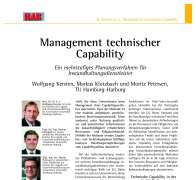
Management of Technological Capability

Management of Technological Capability

A Decision Support System for Multivendor Capable Service Companies
Wolfgang Kersten ORCID Icon, Markus Klotzbach, Moritz Petersen
Multivendor capable service companies are facing growing challenges concerning the alignment of their technological capability portfolio to dynamic market requirements. This paper presents a method that enables practitioners from technical service companies to systematically manage their capability portfolio using both qualitative and quantitative data. Thereby decision makers are provided with a tool to help them shaping the company’s service portfolio.
Industrie Management | Volume 30 | 2014 | Edition 3 | Pages 11-14
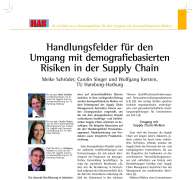
Approaches for Dealing with the Demographic Change in Supply Chains

Approaches for Dealing with the Demographic Change in Supply Chains

Meike Schröder, Carolin Singer, Wolfgang Kersten ORCID Icon
In the context of risk management the demographic change is reflected in demand and environmental risks. On the one hand, the requirements of products’ target groups are changing. On the other hand, the labour bottleneck is increasing due to the shift in population and age structure. When choosing strategies and measures for dealing with the demographic change in supply chains, companies should consider organizational as well as technological and personnel management-related aspects. In this connection, the integral examination of the complete product line as well as the company’s and the supply chain partners’ development of capabilities are essential.
Industrie Management | Volume 29 | 2013 | Edition 3 | Pages 69-72
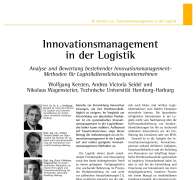
Innovation Management in Logistics

Innovation Management in Logistics

Analysis and Validation of Innovation Management Methods for Logistic Service Providers
Wolfgang Kersten ORCID Icon, Andrea Victoria Seidel, Nikolaus Wagenstetter
Technological progress, stringent competitive conditions and continually changing customer behaviour force the logistics industry to develop innovative solutions to generate long-term competitive advantage. Compared to the development of physical products, a systematic innovations management has not been established in logistics yet. Grounded in the analysis of interviews with experts from industry, this article puts forward requirements with respect to innovation management implementation and suggests the use of specific methods.
Industrie Management | Volume 28 | 2012 | Edition 6 | Pages 31-34
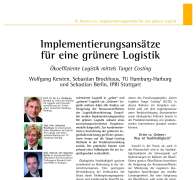
Implementing Greener Logistics

Implementing Greener Logistics

Ökoeffiziente Logistik mittels Target Costing
Wolfgang Kersten ORCID Icon, Sebastian Brockhaus, Sebastian
Following increasing public demand, sustainability is currently on the agenda of every company. In particular for logistics, environmental considerations play an important role today. This manuscript will put forward the concepts of “green” and “greener” logistics and highlight the differences between the two. “Greener logistics” encompasses all approaches dedicated to increasing the resource efficiency of logistics processes. In this article a practical guide to implementing greener logistics will be outlined. In order to ensure customer focus, a target costing approach is suggested. Practical relevance is demonstrated with a case study.
Industrie Management | Volume 27 | 2011 | Edition 6 | Pages 57-60
Implementing Flexibility to Manage Supply Chain Risks

Implementing Flexibility to Manage Supply Chain Risks

Wolfgang Kersten ORCID Icon, Carolin Singer
Nowadays, the economic determining factors are volatile and change dynamically leading to high uncertainty and risk for supply chain partners. Increased supply chain flexibility is not only considered as a success factor but is also essential for companies to remain competitive. The present article is based on selected results from expert interviews, a focus group as well as a survey analysing the status quo concerning supply chain risk management and the importance of flexibility. Afterwards, a process model is presented which consists of an approach to deduct strategies and measures in order to adjust supply chain flexibility in a structured way. The approach can be implemented for risk mitigation in practice.
Industrie Management | Volume 27 | 2011 | Edition 3 | Pages 61-64
Effects on Employment in the Logistics Field

Effects on Employment in the Logistics Field

Wolfgang Kersten ORCID Icon, Mareike Böger, Meike Schröder
Globalisation, shorter product life cycles and mass customization are only some keywords which describe the logistics branch. They lead to modified general conditions in the industry and to effects on the employment. Fields of activities and responsibilities are changed as well as demands on further education. Although logistics companies have realized theses changes, they still do not take them into account in their personnel planning. The article shows the interdependencies between general trends in logistics and organisation science and their effects on quantitative and qualitative effects on employment.
Industrie Management | Volume 23 | 2007 | Edition 2 | Pages 29-32
1 2 3