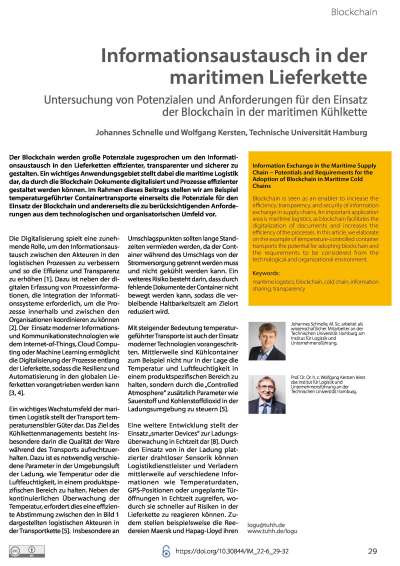
Information Exchange in the Maritime Supply Chain

JournalIndustrie 4.0 Management
Issue Volume 38, 2022, Edition 6, Pages 29-32
Open Accesshttps://doi.org/10.30844/IM_22-6_29-32
Bibliography Share Cite Download

Abstract

Blockchain is seen as an enabler to increase the efficiency, transparency, and security of information exchange in supply chains. An important application area is maritime logistics, as blockchain facilitates the digitalization of documents and increases the efficiency of the processes. In this article, we elaborate on the example of temperature-controlled container transports the potential for adopting blockchain and the requirements to be considered from the technological and organizational environment.

Keywords


Bibliography

[1] Fruth, M.; Teuteberg, F.: Digitization in Maritime Logistics: What Is There and What Is Missing? In: Cogent Business & Management 4 (1), S. 1411066 (2017).
[2] Heilig, L.; Lalla-Ruiz, E.; Voß, S.: Digital Transformation in Maritime Ports: Analysis and a Game Theoretic Framework. In: Netnomics 18 (2-3), S. 227-254 (2017).
[3] World Economic Form und World Trade Organization: Policy Approaches to Harness Trade Digitalization. URL: www3.weforum.org/docs/WEF_The_promise_of_TradeTech_Policy_approaches_to_harness_trade_digitalization_2022.pdf, Abrufdatum 13.04.2022.
[4] Scholten, K.; Schilder, S.: The Role of Collaboration in Supply Chain Resilience. In: Supply Chain Management: An International Journal 20 (4), S. 471-484 (2015).
[5] Behdani, B.; Fan, Y.; Bloemhof, J. M.: Cool Chain and Temperature-Controlled Transport: An Overview of Concepts, Challenges, and Technologies. In: Sustainable Food Supply Chains, S. 167-183 (2019).
[6] van Baalen, P.; Zuidwijk, R.; van Nunen, J.: Port Inter-Organizational Information Systems: Capabilities to Service Global Supply Chains. In: FNT in Technology, Information and Operations Management 2 (2-3), S. 81-241 (2008).
[7] Fan, Y.; Behdani, B.; Bloemhof-Ruwaard, J. M.: Reefer Logistics and Cool Chain Transport, In: European Journal of Transport and Infrastructure Research 20 (2), S. 1-35 (2020).
[8] Jedermann, R. u. a.: Reducing Food Losses by Intelligent Food Logistics. In: Philosophical Transactions. Series A 372, S. 20130302 (2017).
[9] A. P. Møller-Mærsk: Captain Peter™: Get Relevant Notifications About the Condition of Your Reefer Goods. URL: www.maersk.com/digital-solutions/captain-peter/services, Abrufdatum 05.07.2022.
[10] Hapag-Lloyd: Hapag-Lloyd LIVE: Smart Monitoring for Your Cargo. URL: www.hapag-lloyd.com/content/dam/website/downloads/pdf/supplier-extranet/HLFlyerLIVENEW.pdf, Abrufdatum 05.07.2022.
[11] Galvez, J. F.; Mejuto, J. C.; Simal-Gandara, J.: Future Challenges on the Use of Blockchain for Food Traceability Analysis. In: TrAC Trends in Analytical Chemistry 107, S. 222-232 (2018).
[12] Czachorowski, K.; Solesvik, M.; Kondratenko, Y.: The Application of Blockchain Technology in the Maritime Industry, In: Studies in Systems, Decision and Control, Green IT Engineering: Social, Business and Industrial Applications 171, S. 561-577 (2019).
[13] Mayring, P.: Qualitative Inhaltsanalyse: Grundlagen und Techniken. Weinheim, Basel (2010).
[14] Hackius, N.; Petersen, M.: Blockchain in Logistics and Supply Chain: Trick or Treat? In: Proceedings of the Hamburg International Conference of Logistics (HICL), Digitalization in Supply Chain Management and Logistics: Smart and Digital Solutions for an Industry 4.0 Environment 23, S. 3-18 (2017).
[15] Dujak, D.; Sajter, D.: Blockchain Applications in Supply Chain, In: EcoProduction, SMART Supply Network. Cham (2019).
[16] Hackius, N.; Reimers, S.; Kersten, W.: The Privacy Barrier for Blockchain in Logistics: First Lessons from the Port of Hamburg, In: Logistics Management: Lecture Notes in Logistics, S. 45-61 (2019).
[17] Wragg, E.: Bolero Links Up with TradeLens on Electronic Bill of Lading. URL: www.gtreview.com/news/fintech/bolero-links-upwith-tradelens-on-electronic-billof-lading, Abrufdatum 13.04.2022.
[18] Munim, Z. H.; Duru, O.; Hirata, E.: Rise, Fall, and Recovery of Blockchains in the Maritime Technology Space. In: Journal of Marine Science and Engineering 9 (3), S. 1-19 (2021).
[19] van der Horst, M. R.; Langen, P. W. de: Coordination in Hinterland Transport Chains: A Major Challenge for the Seaport Community, In: Marit Econ Logist 10 (1-2), S. 108–129 (2008).

Your downloads


You might also be interested in

Serious Gaming and the Energy Transition

Serious Gaming and the Energy Transition

Collaborative knowledge generation and interactive understanding of complex interrelationships
Janine Gondolf ORCID Icon, Gert Mehlmann, Jörn Hartung, Bernd Schweinshaut, Anne Bauer
Conveying the complexity and multifaceted nature of the energy transition to a broad audience is a challenge. This article demonstrates how interactive serious games on a multitouch table can help make connections tangible and comprehensible. The games and the table were used in various conversational contexts. These are presented here in three case vignettes based on participant observation of the different applications, as well as situated and shared reflection. The vignettes demonstrate how interaction can trigger epistemic processes, enable shifts in perspective, and foster collective thinking, all of which are necessary for shaping the future of society as a whole.
Industry 4.0 Science | Volume 42 | 2026 | Edition 2 | Pages 62-69
Industrial Transformation via a Machining Learning Factory

Industrial Transformation via a Machining Learning Factory

A learning module to foster competencies for a sustainability-driven transformation
Oskay Ozen ORCID Icon, Victoria Breidling ORCID Icon, Stefan Seyfried ORCID Icon, Matthias Weigold
Sustainability-enhancing transformation processes are necessary in all sectors if we are to remain within planetary boundaries. This also applies to the industrial sector as a significant emitter of greenhouse gases. Employees need new competencies to master this complex task of industrial transformation. These range from CO2 equivalents accounting to the development and evaluation of transformation scenarios, including technical measures. The learning module developed here addresses these competency requirements and uses the example of the ETA factory to show how a competency-oriented learning module for industrial transformation can be structured. It essentially comprises four phases: data collection and CO2 equivalents accounting, cause analysis, development of measures and evaluation of measures.
Industry 4.0 Science | Volume 42 | Edition 2 | Pages 38-47 | DOI 10.30844/I4SE.26.2.38
Building the Future Workforce Today

Building the Future Workforce Today

Trendiation as a strategic framework for employee qualification and training
Jürgen Fritz, Sebastian Busse, Ingo Dieckmann, Torsten Laub
As Industry 4.0 and artificial intelligence reshape organizational capabilities, traditional training systems struggle to keep pace with evolving skill requirements. This paper introduces Trendiation—a structured methodology for translating emerging trends into actionable strategies—as a systematic approach to this challenge. Through a workshop-based application examining Edutainment, Human-Centered Design, and Workforce Transformation, we demonstrate how organizations can move from abstract trend identification to concrete qualification requirements and prioritized training initiatives. The method produces a traceable artifact chain spanning trend framing, capability-gap assessment, and implementation roadmaps. Participant evaluations indicate high perceived clarity and practical utility. By bridging foresight analysis with participatory design, Trendiation enables organizations to proactively cultivate adaptive capabilities and build learning cultures aligned with future work ...
Industry 4.0 Science | Volume 42 | 2026 | Edition 2 | Pages 22-29 | DOI 10.30844/I4SE.26.2.22
Operationalizing Ethical AI with tachAId

Operationalizing Ethical AI with tachAId

Validating an interactive advisory tool in two manufacturing use cases
Pavlos Rath-Manakidis, Henry Huick, Björn Krämer ORCID Icon, Laurenz Wiskott ORCID Icon
Integrating artificial intelligence (AI) into workplace processes promises significant efficiency gains, yet organizations face numerous ethical challenges that stakeholders are often initially unaware of—from opacity in decision-making to algorithmic bias and premature automation risks. This paper presents the design and validation of tachAId, an interactive advisory tool aimed at embedding human-centered ethical considerations into the development of AI solutions. It reports on a validation study conducted across two distinct industrial AI applications with varying AI maturity. tachAId successfully directs attention to critical ethical considerations across the AI solution lifecycle that might be overlooked in technically-focused development. However, the findings also reveal a central tension: while effective in raising awareness, the tool’s non-linear design creates significant usability challenges, indicating a user preference for more structured, linear guidance, especially ...
Industry 4.0 Science | Volume 42 | 2026 | Edition 1 | Pages 50-59 | DOI 10.30844/I4SE.26.1.48
AI Implementation in Industrial Quality Control

AI Implementation in Industrial Quality Control

A design science approach bridging technical and human factors
Erdi Ünal ORCID Icon, Kathrin Nauth ORCID Icon, Pavlos Rath-Manakidis, Jens Pöppelbuß ORCID Icon, Felix Hoenig, Christian Meske ORCID Icon
Artificial intelligence (AI) offers significant potential to enhance industrial quality control, yet successful implementation requires careful consideration of ethical and human factors. This article examines how automated surface inspection systems can be deployed to augment human capabilities while ensuring ethical integration into workflows. Through design science research, twelve stakeholders from six organizations across three continents are interviewed and twelve sociotechnical design requirements are derived. These are organized into pre-implementation and implementation/operation phases, addressing human agency, employee participation, and responsible knowledge management. Key findings include the critical importance of meaningful employee participation during pre-implementation, and maintaining human agency through experiential learning, building on existing expertise. This research contributes to ethical AI workplace implementation by providing guidelines that preserve human ...
Industry 4.0 Science | Volume 42 | 2026 | Edition 1 | Pages 120-127 | DOI 10.30844/I4SE.26.1.112
Guidelines for the Fair Use of Generative AI

Guidelines for the Fair Use of Generative AI

Practical examples from production management and social welfare
Anja Gerlmaier, Paul-Fiete Kramer ORCID Icon, Dirk Marrenbach ORCID Icon, René Wenzel ORCID Icon
With the rapid spread of assistive AI tools such as ChatGPT, Gemini, and Copilot, companies are being challenged to address the opportunities and challenges of artificial intelligence. Based on two practical examples, this article provides insight into how companies can use company-specific risk and potential analyses to develop guidelines for the fair and responsible use of AI.
Industry 4.0 Science | Volume 42 | 2026 | Edition 1 | Pages 22-28 | DOI 10.30844/I4SE.26.1.22