COVID-19: A Catalyst for Digitalization and Transparency? |
A study on the effects of the pandemic

| Journal | Industrie 4.0 Management |
| Issue | Volume 37, 2023, Edition 1, Pages 27-31 |
| Open Access | https://doi.org/10.30844/I4SE.23.1.72 |
| Bibliography | Share | Cite | Download |
Abstract
Keywords
Article
In addition to a variety of social and ecological issues, the COVID-19 crisis has had an economic impact, especially in the context of global supply chains. At the beginning of the crisis in January 2020, procurement activities and the material flow of numerous companies were significantly disrupted by the closure of many factories in China. This was followed by negative economic effects on Europe and the rest of the world from mid-March, further weakening the demand side. As a result, supply chains worldwide have come under considerable pressure. Even before the pandemic, the trade dispute between the USA and China and the UK’s impending exit from the European Union had led to uncertainty [1, 2, 3].
The crisis has affected the various industries in Germany to varying degrees. For example, at the beginning of the crisis, the automotive industry struggled primarily with procurement problems, followed by a 61% decline in sales in April 2020 [4]. Although sales recovered slightly, they remained 21% below the pre-crisis level in August 2020.
In addition to the manufacturing industry, the effects have also inevitably led to restrictions in the logistics sector. Initially, this was particularly noticeable given the partially closed borders within Europe or the interrupted flow of goods from Asia [5]. As a result, the logistics industry had to adapt to the changed circumstances. On the one hand, there has been a shift or reduction in the flow of goods. A current study by PWC assumes that logistics services will decline by 8.6% in 2020 [6]. On the other hand, the demand for B2C shipments in the CEP (courier, express, parcel) sector have increased due to a higher volume of online trading, while shipments to business customers have decreased [7].
The crisis has revealed the vulnerability of global supply chains. Therefore, the short and long-term effects of the crisis were discussed in the media and academic circles. The term ‘Resilience’ is often used to describe the ability of supply chains to be resilient to potential threats [8, 9]. Resilience describes the ability of a system to withstand disruptions through proactive measures that lead to the restoration of its original state or even the improvement of its position [10].
Various factors influence the resilience of supply chains, such as knowledge of the structure of the supply chain or accurate information on inventory levels [11]. In addition, resilience requires a resilient supplier structure. In this regard, companies need to consider which regions they source their goods from and the extent to which they diversify their supplier base [12]. Incorporating digitalization into the supply chain is seen as another factor of increasing relevance for the future, as it enables the necessary transparency to improve the response to disruptions in the supply chain [10].
In addition to the technical infrastructure, a sufficient level of transparency requires the willingness of various actors to exchange data and thus trust one another. In total, five core topics can be identified that are affected as a result of the COVID-19 crisis [cf. 13, 14]:
- Increasing importance of flexibility to ensure competitiveness
- Identification of resilience as a success factor for value chains
- Acceleration of digitalization and development of digital business models
- Regionalization of manufacturing
- Change in work organization through flexibilization
This study aims to provide an overview of the current situation in the supply chains, particularly regarding the aspects of transparency and digitalization, and to provide an outlook for future developments.
Research approach
To examine the effects of the COVID-19 crisis on supply chains, a cross-sectional study was carried out in Hamburg in collaboration with the Logistics Initiative Hamburg (LIHH). Developments in global supply chains are particularly important for the logistically well-located Hamburg, as changes in supply chains quickly impact the local economy, which is largely characterized by logistics and trading companies. The survey was carried out using an online questionnaire that was sent to the members of the Logistics Initiative Hamburg.
In the period from August 5th to August 28th, 2020, we received 150 completed questionnaires. Some of the respondents hailed from sectors such as Software and IT, Consulting, and Education. Since it is difficult to assess the impact on the supply chains for companies in these industries, the initial step was to remove them from the analysis. The result was a sample of 108 respondents, which was then subjected to a comparative statistical analysis using Tableau®.
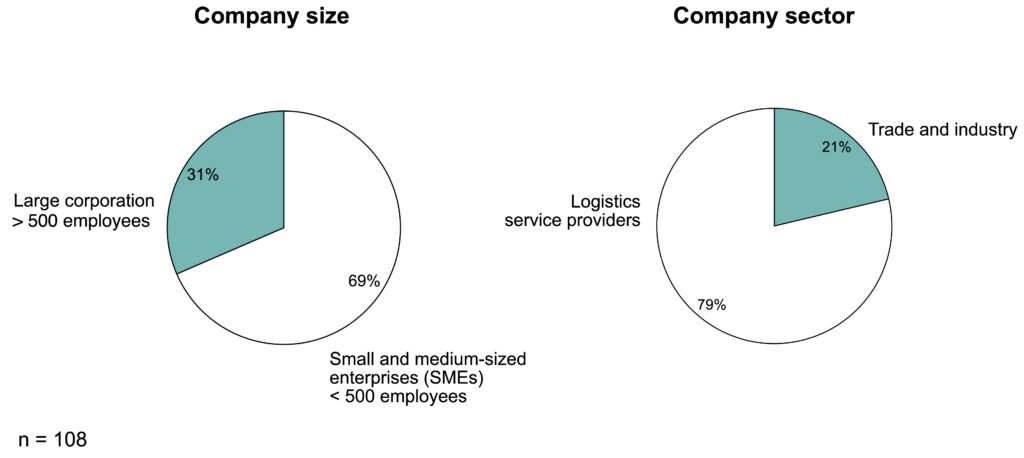
The sample (see Fig. 1) consists predominantly of logistics service providers (79%) and, to a lesser extent, manufacturing and trading companies (21%). Among the respondents, 69% worked in small and medium-sized enterprises (SMEs) (fewer than 500 employees) and 31% in large companies.
Transparency in supply chains
Globalization caused significant changes to supply chains in recent decades. Driven by cost pressure [15] and the concentration on core competencies in combination with reduced trade restrictions, many companies have in the past relocated production capacities to low-wage countries (“offshoring”) [16, 17].
While offshoring manufacturing has reduced costs and opened up new sales potential, it also led to new challenges. As a result, many companies face the challenge of maintaining product quality and ensuring sufficient responsiveness in the supply chain [18]. In addition, offshoring entails additional risks due to political uncertainties or natural disasters. As a result, the real cost savings are often significantly lower than expected. To be able to deal with the resulting complexity and the resulting risks in the supply chain, sufficient knowledge about the supplier structure appears to be necessary [11]. This knowledge enables organizations to identify impending risks in good time and take appropriate measures proactively.
However, studies show that many companies generally have a low level of knowledge about their supply chains. Currently, only 8% of the companies in the clothing industry can trace their products back to their origin [19] and 81% of consumer goods manufacturers have no or only limited transparency about the sustainability activities of their suppliers [20]. These examples show that companies across many industries often have limited visibility into upstream supply chain activities.
However, further studies have shown that enhanced transparency can increase efficiency in supply chains and reduce both costs and risks [21, 22]. In addition, other negative effects of a lack of transparency were identified, such as lower cost control, lack of insight into important technological developments, and difficulties in ensuring sustainable and socially responsible manufacturing conditions among suppliers [23].
Results of the survey
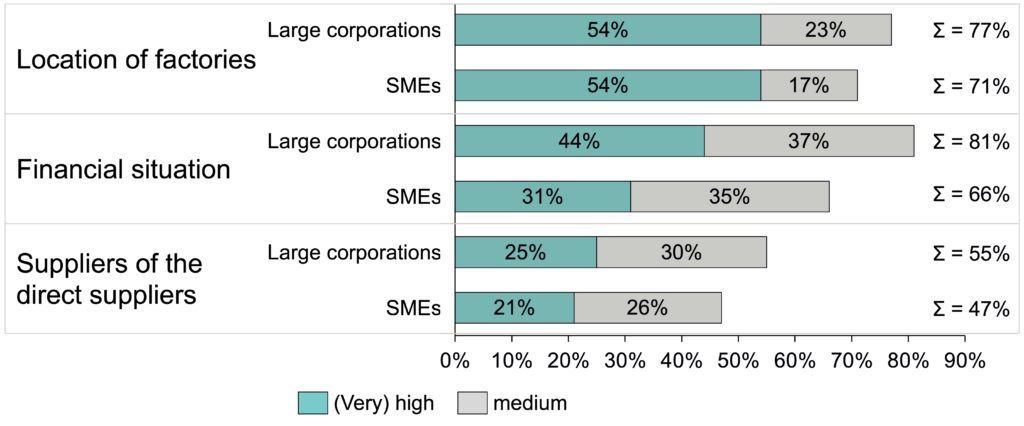
The results of the survey largely confirm the observations described above, as shown in Figure 2. 54% of the companies surveyed stated to have a high level of knowledge about the locations of their direct suppliers. However, companies are less well informed about the financial situation of their direct suppliers: 44% of the respondents from large companies stated that they had a high to very high level of knowledge. It is noticeable that, at 31%, significantly fewer SMEs can demonstrate a similarly high level of knowledge. However, across the two company categories, at least two-thirds have a medium to high level of knowledge.
A different picture emerges regarding the level of knowledge of the supply chain beyond the immediate direct suppliers. Results show that only 25% of large corporations and 21% of SMEs have high or very high levels of knowledge in this area. Even including companies with a medium level of knowledge, it can be assumed that only around half of the companies have knowledge that goes beyond their direct suppliers.
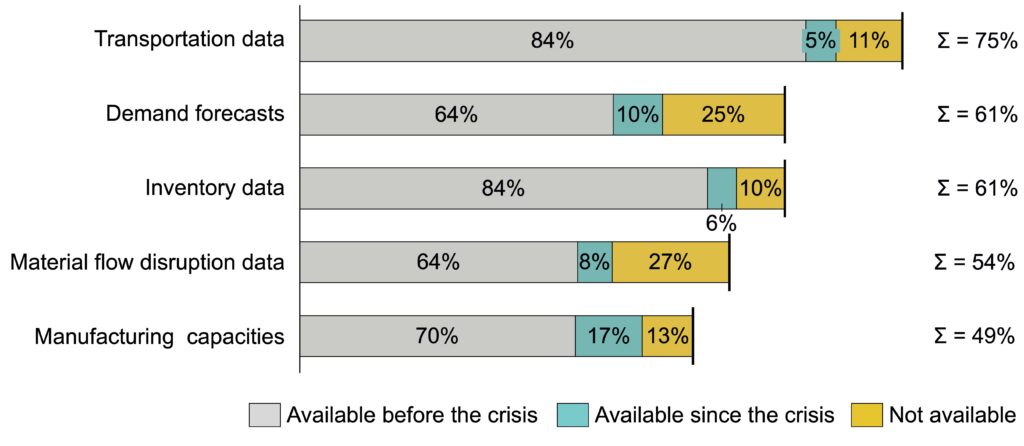
In addition to the level of information about suppliers, the results of the survey reveal potential for the intensified exchange of operational data (see Fig. 3). For example, 61% of respondents stated the need for demand forecasts from their supply chains, but 25% of these respondents did not receive this data. A similar picture emerges from the data on material flow disruptions. In this respect, 27% of those surveyed stated that they did not have the necessary data. Across all types of information, the results also show that data exchange has increased since the COVID-19 crisis. However, there remains a significant proportion of companies whose information requirements have not yet been adequately met.
It is often argued that COVID-19 is promoting digitalization. German companies, especially SMEs, have long been facing significant challenges in digital transformation [24]. In terms of the extent to which the COVID-19 crisis is driving this development, a distinction is rarely made between the digitalization of business processes and far-reaching digitalization measures that include the development of new business models. The survey provides some information on this (see Fig. 4). Most companies are planning to expand their investments in digitalization based on the findings of the crisis.
The focus is particularly on the digitalization of business processes, in which almost 77% of both SMEs and large companies want to invest more. In terms of the implementation of artificial intelligence, the proportion of large companies that see a need for investment is significantly larger. Almost 51% of respondents from large companies want to increase their investments in artificial intelligence, while the proportion rests at a significantly lower 35% for SMEs. On the other hand, 63% of SMEs see investment potential in the development of new business models, compared to 49% of large corporations.
This development shows that companies are not only interested in making their existing processes more crisis-proof and future-oriented but also in strategically adapting to new circumstances.

Conclusion
Overall, the results of the study show that the COVID-19 crisis is changing companies’ awareness of their supply chain. The study shows that the level of knowledge about the supply chain – especially as to how it extends beyond direct suppliers – has generally been low and that more transparency in the supply chain is needed. An important element to achieve transparency in the supply chain is the willingness to share data. This study indicates that Hamburg-based companies are receiving more data from their supply chain partners as a result of the crisis.
However, there remains a significant proportion of respondents whose data requirements cannot be fully satisfied so far. Above all, companies lack sensitive information about partners’ demand forecasts and material flow disruptions, which are highly relevant for the short and medium-term adjustment of resources. The results of the survey do not answer whether this is due to a lack of information among the partners themselves, or rather to an unwillingness to share it.
However, the effects of the COVID-19 crisis made clear that a high level of responsiveness requires a sufficient availability of data about the companies’ supply chains. From this, it can be deduced that further action is needed to ensure the trustworthy exchange of data. Findings on the question of how data will be shared in the future can be drawn from the results on investments in digitalization. The results show a growing awareness of digitalization in the companies. In particular, increasing investments in the digitalization of business processes, products, and services suggest that companies see a need for further action here.
However, it remains partly unclear how companies will manage to use the resulting volumes of data profitably for decision-making. Around 59% of both large companies and SMEs say they want to increasingly invest in web-based platforms that make data accessible to internal stakeholders as well as external partners. However, among SMEs, companies that want to increase their investments in business analytics follow at a considerable distance (50%) and, at an even greater distance, those who want to invest in artificial intelligence (35%).
On the other hand, the difference between investments in the use of data and the provision of data is smaller for large companies. This suggests that large corporations have already made further progress in digitizing their processes. As a result, investments in the use of data may become more important for large companies. However, SMEs should also be aware that they can only fully exploit the advantages of digitalization if they leverage the potential of their data for decision-making.
The results of the study show that the COVID-19 crisis can be seen as a catalyst for the implementation of existing trends such as digitalization, transparency, and cross-company data exchange [14, 15]. This development not only appears to be suitable for ensuring more efficient processes in supply chains but also contributes significantly to the establishment of flexible and resilient supply chain structures.
However, companies should avoid finding themselves in a similar situation to the one after the financial crisis of 2008/2009. It could be observed that as a result of that crisis, companies focused on analyzing the supplier structure and expanding their risk management, but over time they returned their focus to increasing efficiency and creating innovations [25]. For long-term resilient and flexible supply chains, however, these developments must be anchored in both continuous change management and supply chain risk management.
Bibliography
[1] Handfield, R. B.; Graham, G.; Burns, L.: Corona virus, tariffs, trade wars and supply chain evolutionary design, IJOPM, ahead-of-print, 2020.[2] Klös, H.-P.: Nach dem Corona-Schock: Digitalisierungspotenziale für Deutschland, 2020, IW-Policy Paper 14/2020.
[3] Raehlmann, I.: Corona! Die Krise der Verschlankung und ihre Folgen (ger). In: Zeitschrift fur Arbeitswissenschaft, 2020, pp. 1-6.
[4] Kraftfahrtbundesamt: Fahrzeugzulassungen im September 2020: Pressemitteilung No. 23/2020. URL: www.kba.de/SharedDocs/Pressemitteilungen/DE/2020/pm_23_2020_fahrzeugzulassungen_09_2020_pdf.pdf?__blob=publicationFile&v=4, accessed Nov 24, 2020.
[5] Ankel, S.: Trucks are forming 37-mile-long queues at European borders after authorities started closing them to stop the coronavirus spread. URL: www.businessinsider.com/coronavirus-europe-borders-shut-trucks-traffic-jam-2020-3?r=DE&IR=T, accessed Nov 24, 2020.
[6] Bauer, I. et al.: Transport and logistics barometer: 2020 mid-year analysis of M&A deals, joint ventures and strategic alliances in the transport and logistics industry. URL: www.pwc.de/de/transport-und-logistik/transport-and-logistics-barometer-h1-2020.pdf.
[7] BIEK: Rekord-Weihnachten: 420 Millionen Sendungen an Privatpersonen erwartet. URL: www.biek.de/presse/meldung/rekord-weihnachten-420-millionen-sendungen-an-privatpersonen-erwartet.html, accessed Nov 24, 2020.
[8] Ponomarov, S. Y.; Holcomb, M. C.: Understanding the concept of supply chain resilience, International Journal of Logistics Management, Vol. 20, No. 1, 2009, pp. 124-143.
[9] van Hoek, R.: Research opportunities for a more resilient post-COVID-19 supply chain – closing the gap between research findings and industry practice, IJOPM, Vol. 40, No. 4, 2020, pp. 341-355.
[10] Scholten, K.; Schilder, S.: The role of collaboration in supply chain resilience, Supply Chain Management, Vol. 20, No. 4, 2015, pp. 471-484.
[11] Wilding, R.; Dohrmann, K.; Wheatly, M.: Post-Coronavirus Supply Chain Recovery: The Journey Towards the New Normal. URL: www.dhl.com/content/dam/dhl/global/core/documents/pdf/glo-core-post-covid-eme-white-paper.pdf, accessed Nov 24, 2020.
[12] Roscoe, S.; Skipworth, H.; Aktas, E.; Habib, F.: Managing supply chain uncertainty arising from geopolitical disruptions: evidence from the pharmaceutical industry and brexit, IJOPM, ahead-of-print, 2020.
[13] Hippold, S.: 6 Strategies for a More Resilient Supply Chain. URL: www.gartner.com/smarterwithgartner/6-strategies-for-a-more-resilient-supply-chain/, accessed Sept 3, 2020.
[14] Falk, S. et al.: Corona und die Folgen: Zehn Thesen zur Zukunft digitaler Geschäftsmo-delle für Industrie 4.0 in der Post-Corona-Ökonomie. URL: www.plattform-i40.de/PI40/Redaktion/DE/Downloads/Publikation/Corona_Thesen.pdf?__blob=publicationFile&v=5 , accessed Sept 21, 2020
[15] Kersten, W.; von See, B.; Lodemann S.; Grotemeier, C.: Trends und Strategien in Logistik und Supply Chain Management – Entwicklungen und Perspektiven einer nachhaltigen und digitalen Transformation, BVL.digital GmbH, 2020.
[16] Farrell, D.: Offshoring: Value Creation through Economic Change, Journal of Management Studies, Vol. 42, No. 3, 2005, pp. 675-683.
[17] OECD: Offshoring and Employment: Trends and Impacts, 2007.
[18] Heim, E.; Matiz, D.; Ehrat, M.: Offshoring oder Reshoring?, ZWF, Vol. 109, No. 12, 2014, pp. 920-922.
[19] Tatzenko, J. et al.: The 2019 Ethical Fashion Report: The Truth Behind the Barcode. URL: https://apo.org.au/sites/default/files/resource-files/2019-04/apo-nid229606.pdf, accessed April 24, 2020.
[20] The Sustainability Consortium: Greening Global Supply Chains: From Blind Spots To Hotspots To Action. Impact Report. URL: www.sustainabilityconsortium.org/tsc-downloads/greening-global-supply-chains-from-blindspots-to-hotspots-to-action/?wpdmdl=19769&ind=1501155000091, accessed April 24, 2020.
[21] Nooraie, S. V.; Mellat Parast, M.: A Multi-Objective Approach to Supply Chain risk Management: Integrating Visibility with Supply and Demand Risk, Int J Prod Econ, Vol. 161, 2015, pp. 192-200.
[22] Yu, M.-C.; Goh, M.: A Multi-Objective Approach to Supply Chain Visibility and Risk, European Journal of Operational Research, Vol. 233, No. 1, 2014, S. 125-130.
[23] Choi, T. Y.; Linton, T.: Don’t let your Supply Chain Control your Business, Harvard Business Review, Vol. 12, No. 89, 2011, pp. 112-117.
[24] Schöpper, H.; Lodemann, S.; Dörries, F.; Kersten, W.: Digitalisierung deutscher KMU im Branchenvergleich, I40M, Vol. 2018, No. 2, 2018, pp. 38-42.
[25] DVZ Redaktion: „Der ökonomische Antrieb der Globalisierung bleibt sehr stark“. URL: www.dvz.de/rubriken/land/detail/news/der-oekonomische-antrieb-der-globalisierung-bleibt-sehr-stark.html, accessed May 5, 2020.
Your downloads
Potentials: Globalization Profitability
You might also be interested in