Branche: Manufacturing

Human-Centered AI in Companies with Employee Representation

Human-Centered AI in Companies with Employee Representation

Using the HUMAINE model for a company-specific works agreement
Alexander Ranft, Fabian Hoose ORCID Icon, Claudia Niewerth ORCID Icon, Mathias Preuß, Manfred Wannöffel ORCID Icon
The introduction of artificial intelligence (AI) in companies poses new challenges for regulation and co-determination. Binding requirements have been in force since the 2025 EU AI Act, which must be linked nationally with the Works Constitution Act (BetrVG). The regional competence center humAine has developed a model works agreement on AI (MBV KI) in accordance with Section 77 BetrVG, which strengthens co-determination rights in companies and implements European regulations in a practical way. Flanked by co-determination dialogues, the MBV KI enables company-specific adaptation for responsible and human-centered AI use. Using selected parts of the MBV KI as examples, this article shows how a framework works agreement on AI can be designed and discusses its transferability to companies without a works council. The MBV KI presented here contributes to the sustainable, socially secure design of the digital transformation.
Industry 4.0 Science | Volume 42 | Edition 1 | Pages 14-21 | DOI 10.30844/I4SE.26.1.14
Production Control in Space

Production Control in Space

An AI-supported approach for industry in orbit
Dominik Augenstein, Lara Jovic
Production in space, of semiconductors for example, offers many advantages for companies. At the same time, high transport costs mean that careful consideration must be given to the production materials being transported. The use of Kalman filters enables (real-time) control from Earth, making space production a cost-efficient option. Machine learning could make it a viable approach even for highly complex production systems.
Industry 4.0 Science | Volume 41 | 2025 | Edition 6 | Pages 22-29
Customized Organs from Space

Customized Organs from Space

How weightlessness could change human lives
Due to its weightlessness, space offers enormous opportunities for production. The unique conditions of microgravity, for example, can simplify the development of organs and tissues from the body's own stem cells, allowing therapies to be developed in a more targeted manner. Even though many independent initiatives are currently emerging to explore this and other potential applications, their success is not a foregone conclusion.
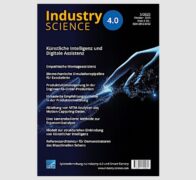
I4S 5/2025: Artificial Intelligence and Digital Assistance

I4S 5/2025: Artificial Intelligence and Digital Assistance

How we can better support work
Demographic change, skills shortages, and stagnating productivity are threatening the competitiveness of German industry. At the same time, AI and digital assistance systems are opening up new opportunities: they make work more efficient and support skilled workers. But while they have long been part of everyday life, their potential in industry remains largely untapped—this is where this issue comes in with innovative concepts.
Applied Knowledge and Augmented Reality

Applied Knowledge and Augmented Reality

Bridging the gap between learning and application
Jana Gonnermann-Müller ORCID Icon, Philip Wotschack, Martin Krzywdzinski ORCID Icon, Norbert Gronau ORCID Icon
The increasing complexity of industrial environments demands new competencies from workers, particularly the ability to interact with advanced digital systems. Traditional training methods often fall short in supporting the effective transfer of applied knowledge to such contexts, and the effectiveness of this transfer, as measured by performance-based outcomes, remains to be investigated. To address this gap, the present study employed a between-subjects experimental design comparing augmented reality- and paper-based instructions within a realistic production training scenario. The results show that participants who learned with augmented reality completed the production process significantly faster and with fewer errors than those using paper instructions. In addition, learners using augmented reality reported higher usability and experienced lower cognitive load during training. These findings suggest that augmented reality can enhance the transfer of practical skills in industrial ...
Industry 4.0 Science | Volume 41 | 2025 | Edition 5 | Pages 22-29 | DOI 10.30844/I4SE.25.5.22
AI Smart Workstation for Industrial Quality Control

AI Smart Workstation for Industrial Quality Control

Enhancing productivity through vision systems, real-time assistance, and Axiomatic Design
Leonardo Venturoso ORCID Icon, Simone Garbin ORCID Icon, Dieter Steiner, Dominik T. Matt
Traditional quality control often falls short in high-mix, low-volume production environments due to variability and complexity. This project introduces an advanced workstation to boost industrial productivity and quality, developed with Axiomatic Design to ensure a clear link between customer needs, functional requirements, and design solutions. Combining polarization cameras, high-resolution imaging, adaptive lighting, and deep learning-based computer vision, the system performs high-accuracy inspection on quantity, quality, and compliance. A digital assistance system offers real-time feedback via an intuitive interface. Validation in a controlled environment confirmed both the system’s practical benefits and its scalability.
Industry 4.0 Science | Volume 41 | 2025 | Edition 5 | Pages 128-134 | DOI 10.30844/I4SE.25.5.124
Mechanisms of GenAI Governance

Mechanisms of GenAI Governance

A case study on the responsible use of GenAI in organizations
Niklas Obermann ORCID Icon, Daniel Lupp ORCID Icon, Uta Wilkens ORCID Icon
Compared to traditional AI systems, generative artificial intelligence (GenAI) introduces user-dependent characteristics that create unique challenges for AI governance in organizations. These challenges are particularly tied to human factors, such as employee attitude, awareness, and skills, which are often neglected by existing governance frameworks. This qualitative case study examines how a manufacturing organization implemented GenAI governance mechanisms to foster the responsible use of this technology. The findings reveal that organizations should adopt a holistic approach, combining structural, procedural, and relational mechanisms to address employee-related aspects of GenAI governance. As a result, this study contributes to the growing field of GenAI governance and provides practical insights for its responsible use in organizations.
Industry 4.0 Science | Volume 41 | 2025 | Edition 5 | Pages 58-64 | DOI 10.30844/I4SE.25.5.58
Data-Driven Assistance Systems in the Working Environment

Data-Driven Assistance Systems in the Working Environment

Efficient development of target group-specific BI dashboards in companies
Martin Schmauder ORCID Icon, Gritt Ott ORCID Icon, Martin Hahmann
Dashboards play a key role in informed business decisions. Based on findings from an action research process, this article shows how company-specific solutions can be systematically developed and bad investments avoided. The provision of IT capacities, securing data access, formulating requirements, and developing the data model prove to be particularly critical.
Industry 4.0 Science | Volume 41 | 2025 | Edition 5 | Pages 136-143 | DOI 10.30844/I4SE.25.5.130
Developing Data Standards in Battery Cell Manufacturing

Developing Data Standards in Battery Cell Manufacturing

From requirements analysis to standard development procedure
David Roth, Tom Hülsmann, Felix Tidde
The growing demand for battery cells offers significant potential for the use of digital solutions in their manufacture, which in turn creates opportunities for added value through adaptive and flexible production systems. A key enabler is interoperable data exchange based on formalized data descriptions. Existing ontologies and information models remain too abstract for direct implementation. This paper presents a requirements analysis of data standards in battery cell manufacturing. A procedure for developing domain-specific standards based on OPC UA (Open Platform Communications Unified Architecture) is derived from the results.
Industry 4.0 Science | Volume 41 | Edition 4 | Pages 96-103
Proactive Skill Development in Logistics Management

Proactive Skill Development in Logistics Management

The future of dynamic work contexts
Michael Heins
Smooth logistics management is fundamental for companies to function effectively. This is challenged by actor- and organization-related barriers in production planning and management. The Berufliche Hochschule Hamburg fosters the skills that individuals need to overcome obstacles in digitalized working environments. This concept is presented in the following article.
Industry 4.0 Science | Volume 41 | 2025 | Edition 4 | Pages 22-28
1 2 3 5