Autor: Dominik T. Matt

AI Smart Workstation for Industrial Quality Control

AI Smart Workstation for Industrial Quality Control

Enhancing productivity through vision systems, real-time assistance, and Axiomatic Design
Leonardo Venturoso ORCID Icon, Simone Garbin ORCID Icon, Dieter Steiner, Dominik T. Matt
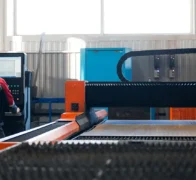
Traditional quality control often falls short in high-mix, low-volume production environments due to variability and complexity. This project introduces an advanced workstation to boost industrial productivity and quality, developed with Axiomatic Design to ensure a clear link between customer needs, functional requirements, and design solutions. Combining polarization cameras, high-resolution imaging, adaptive lighting, and deep learning-based computer vision, the system performs high-accuracy inspection on quantity, quality, and compliance. A digital assistance system offers real-time feedback via an intuitive interface. Validation in a controlled environment confirmed both the system’s practical benefits and its scalability.
Industry 4.0 Science | Volume 41 | 2025 | Edition 5 | Pages 128-134 | DOI 10.30844/I4SE.25.5.124
Man and Digital Technology

Man and Digital Technology

A roadmap for the digital transformation of an Alpine region
Dominik T. Matt, Guido Orzes, Giulio Pedrini, Mirjam Beltrami, Erwin Rauch
We are currently experiencing rapid transformation in technologies and society. Due to the convergence of various megatrends, these changes have considerable impacts on everyday life. Our study aims to identify relevant strategies for the digital future of a macro-region (Tyrol, South Tyrol and Veneto). The study conducts semi-structured interviews with representatives of companies, universities and local governments, using the approach of a triple helix model. Based on the empirical analysis, we develop an action plan for the digital transformation of the macro-region.
Industrie 4.0 Management | Volume 36 | 2020 | Edition 3 | Pages 11-15
Industry 4.0 Assessment – A Guide for SMEs

Industry 4.0 Assessment - A Guide for SMEs

Bewertungsmodell zur Festlegung und Priorisierung von Industrie 4.0-Umsetzungsmaßnahmen in KMUs
Dominik T. Matt, Erwin Rauch, Marco Unterhofer, Bozen, Michael Riedl, Riccardo Brozzi
The Fourth Industrial Revolution has changed profoundly the entrepreneurial environment. In particular, smaller companies have difficulties putting 4.0 paradigms into practice. If one considers that small and medium-sized enterprises form the backbone of the European economy, then it becomes all the more obvious which leverage effect suitable implementation concepts for SMEs can have. The following article therefore presents an evaluation model for the definition and prioritization of Industry 4.0 implementation measures, which is based on the requirements for SMEs.
Industrie 4.0 Management | Volume 35 | 2019 | Edition 3 | Pages 7-10
Collaborative Robotics-Machine Learning by Imitation

Collaborative Robotics-Machine Learning by Imitation

Flexible Automation for SMEs Through Intelligent and Collaborative Robotic Assistants
Andrea Giusti, Dieter Steiner, Walter Gasparetto, Sebastian Bertoli, Michael Terzer, Michael Riedl, Dominik T. Matt
The trend towards customer-specific mass production poses great challenges for the classic production methods of small and medium-sized companies. The combination of flexible robotic solutions and artificial intelligence approaches is promising to enable production efficiency and fast adaptability in modern production systems. This paper presents such a solution in the form of a realized demonstrator setup composed of a collaborative robot assistant. The robotic system independently interprets the activities of a human employee and supports the employee in his or her activities by imitation.
Industrie 4.0 Management | Volume 35 | 2019 | Edition 3 | Pages 43-46 | DOI 10.30844/I40M_19-3_S46-46
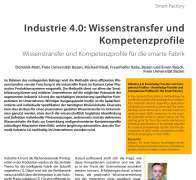
Industry 4.0: Knowledge Transfer and Competence Profiles

Industry 4.0: Knowledge Transfer and Competence Profiles

Knowledge Transfer and Competence Profiles for the Smart Factory
Dominik T. Matt, Michael Riedl, Erwin Rauch
In the context of this article, a methodology for an efficient transfer of knowledge from research into industrial practice regarding cyber-physical production systems is presented. The methodology serves above all to sensitize small and medium-sized (SME) enterprises to the possible potentials of the so-called Industry 4.0. The starting point for this is the need-oriented and individual specification of knowledge required for a practical knowledge transfer and the development of tailor-made competence profiles of future employees in smart SMEs
Industrie 4.0 Management | Volume 33 | 2017 | Edition 3 | Pages 11-15
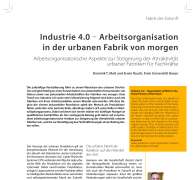
Industry 4.0 – Organization of Work in the Urban Factory of the Future

Industry 4.0 - Organization of Work in the Urban Factory of the Future

Arbeitsorganisatorische Aspekte zur Steigerung der Attraktivität urbaner Fabriken für Fachkräfte
Dominik T. Matt, Erwin Rauch
Die zukünftige Verstädterung führt zu einem Wachstum der urbanen Strukturen und gleichzeitig zu einer Konzentration von potenziellen Konsumenten von Gütern sowie von potenziellen Arbeitskräften der Fabriken von morgen. Dem Trend von Industrie 4.0 sowie einer Urbanisierung folgend sind daher auch die Fabriken mit ihren Arbeitsmodellen einem Wandel unterworfen. Mit dem Beginn der vierten industriellen Revolution spielt der Mensch als Produktionsfaktor weiterhin eine zentrale Rolle, allerdings ändert sich seine Rolle im Wertschöpfungsprozess. Dabei zeichnet sich immer stärker ein künftiger Mangel an qualifizierten Fachkräften ab. Der vorliegende Beitrag geht daher auf verschiedene arbeitsorganisatorische Ansätze zur Steigerung der Attraktivität urbaner Fabriken ein, welche zur Bewältigung des Fachkräftemangels einen Beitrag leisten sollen.
Industrie Management | Volume 31 | 2015 | Edition 3 | Pages 31-35
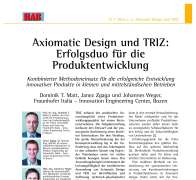
Axiomatic Design and TRIZ

Axiomatic Design and TRIZ

A winning duo for product engineering
Dominik T. Matt, Janez Zgaga, Johannes Weger
This paper describes the successful combination of the two methods Axiomatic Design and TRIZ based on the practical use case in a product development project at a small enterprise. The task included the design and prototypical implementation of a small tractor for viticulture. The major challenge in developing the concept was the requirement that the tractor must move in the narrow streets between closely lying pergolas as well as in steep terrain. The application example underpins the performance of the combined application of Axiomatic Design and TRIZ for the identification and resolution of technical and physical contradictions and shows how even small businesses can bring innovative and sophisticated product ideas targeted for implementation in close cooperation with research institutions.
Industrie Management | Volume 30 | 2014 | Edition 3 | Pages 57-61
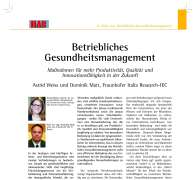
Workplace Health Promotion – A Challenge for Labour and Company Organisation

Workplace Health Promotion - A Challenge for Labour and Company Organisation

Astrid Weiss, Dominik T. Matt
According to current social and economic trends, businesses underlie considerable organizational challenges which imply a long term strategy development in order to maintain productivity and competitiveness. Development processes such as the globalization and internationalization, the demographic change, the increasing importance of knowledge, the technological change as well as the trend of individualization and flexibilization are significant. Businesses are challenged with its implications on the labour conditions and therefore on their productivity, quality and innovativeness. This article discusses the concept of Workplace Health Promotion as an efficient tool to support companies at mastering these essential challenges.
Industrie Management | Volume 29 | 2013 | Edition 3 | Pages 77-81
Knowledge Work in Small Enter-prises of the Building Sector

Knowledge Work in Small Enter-prises of the Building Sector

Dominik T. Matt, Erwin Rauch, Vittorio Franzellin
The rising demand and availability of knowledge contributes to the change away from an industrial society towards a more knowledge oriented society. This article focuses on knowledge work in small enterprises. The article describes the importance and the potential of know-ledge work in small enterprises and demonstrates the difficulties in the implementation. The small structured building industry with its change towards a more and more knowledge intensive branch of business over the last years was chosen as an example to explain this approach. In a systems-theoretical model the authors describe an approach to make the application of knowledge work in small enterprises of the building sector possible.
Industrie Management | Volume 28 | 2012 | Edition 3 | Pages 21-24
Fit for Change: Manage the Dynamics of Complexity in Production Systems

Fit for Change: Manage the Dynamics of Complexity in Production Systems

Dominik T. Matt
Against the background of today’s highly competitive and dynamic market environment, the concept of changeability of producing gets increasingly important for producing companies in order to maintain or even enhance their survivability. The necessity for change in a production system is determined by the time-dependent complexity of the production tasks which change dynamically with the system’s environment. Most research in this area focuses on the approach to achieve a better changeability by the production system’s design. This paper puts another viewpoint on changeability: best way to achieve an enhanced and sustainable survivability of a production system can be achieved by an early and focused determination of the right time and amplitude of change.
Industrie Management | Volume 27 | 2011 | Edition 3 | Pages 29-32
1 2