Proactive Skill Development in Logistics Management |
The future of dynamic work contexts
| Journal | Industry 4.0 Science |
| Issue | Volume 41, 2025, Edition 4, Pages 22-28 |
| Bibliography | Share | Cite | Download |
Abstract
Article
Today’s world is characterized by geopolitical uncertainties, global warming and social tensions. These dynamic conditions are presenting ongoing challenges to companies. Humans are the leading actors, or “agents of change” [1] in this transitional phase.
Logistics requirements are constantly changing [2]. Prior to the coronavirus pandemic, delivery speed was the primary focus [3]. However, since then, delivery reliability has emerged as the predominant concern [4]. Requirements for production planning and control (PPC) are changing accordingly [1].
Obstacles in production planning and control
Wiendahl, whose work looks at socio-technical influences, identified a variety of obstacles in PPC [2]. He distinguishes between obstacles that are primarily actor- and organization-related and such that are primarily software- and function-related (Fig. 1). It is the actor- and organization-related obstacles (for example diverging actor interests) that lead to unsubstantiated decisions in the design of PPC.
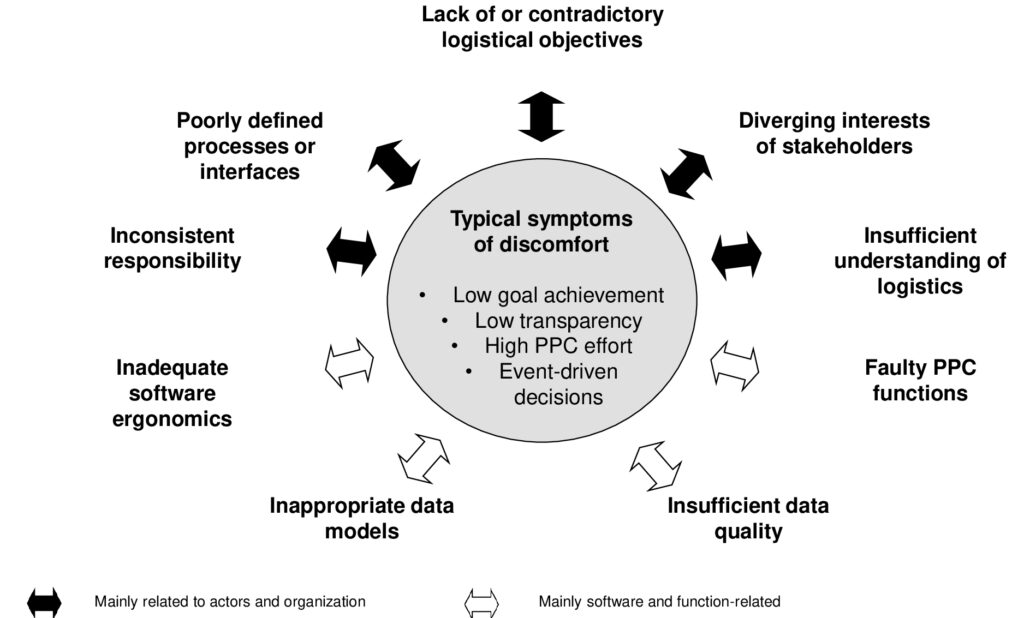
To overcome these obstacles, Wiendahl recommends both logistics training and consistent change management [2]. Similar to other research on socio-technical adaptability (see [5]), Wiendahl only considers a company’s situation from the date employees join the respective organization. Proactive steps—such as employee training measures—are not considered. In this article, the focus is placed on skills development in training.
Overcoming these obstacles requires, among other things, the realization that some are inherent to the system and therefore cannot be actively avoided. As a result, it is becoming increasingly important to strengthen employees’ ability to deal with occuring obstacles, tolerate contradictions and maintain their ability to act. Remaining obstacles can be addressed through adequate reflective competence. Given the proactive approach to the obstacles outlined above, it is crucial to foster a broad socio-technical skill profile in the training of future PPC professionals, equipping them to navigate and drive transformation within complex digitalized settings.
Future skills as a foundation for transformation
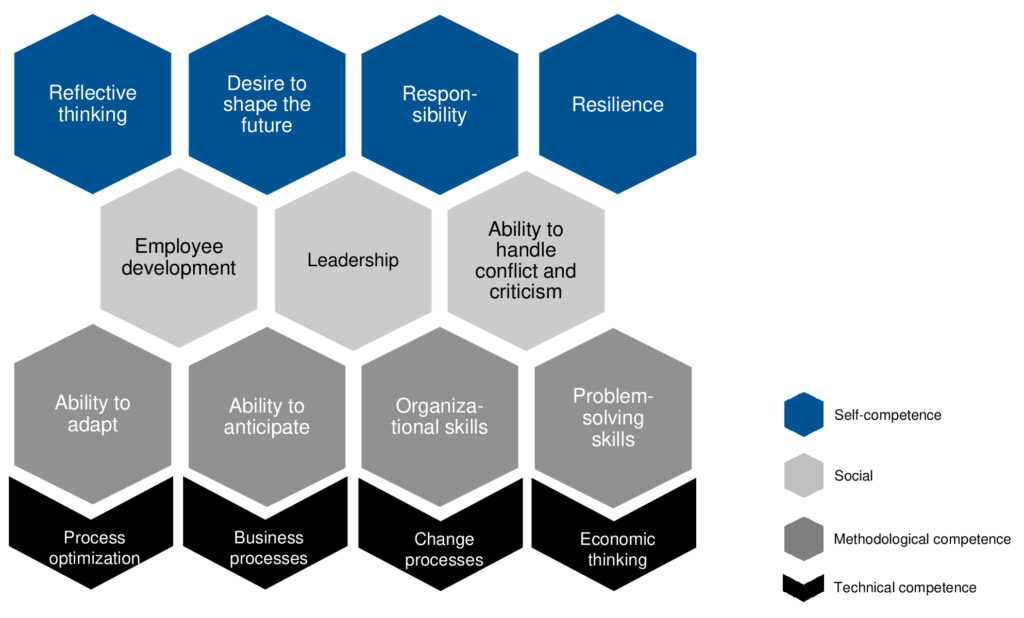
In addition to the necessary technical and methodological skills, transformation is rooted in soft skills such as the ability to reflect, to create and to work under pressure. Social skills, such as the ability to deal with conflict and criticism, are also crucial (Fig. 2). In education, this is referred to as future skills. According to Ehlers [6], future skills represent a competence framework with a specific content focus. At their core, these skills aim to ensure that people remain capable of acting in dynamic and urgent contexts. Future skills are value-based and can be acquired through learning processes.
In companies, appropriately trained professionals can act as essential elements of progress. However, the bustling day-to-day life of an organization often leaves little time for (further) training of employees regarding their skills profile. Therefore, when joining their respective organization, future employees should ideally come equipped with interdisciplinary skills that will remain relevant in the years ahead.
The Berufliche Hochschule Hamburg (BHH) meets the demands of this graduate profile by integrating future skills into its curriculum and providing coaching support for learners. BHH’s four-year study-integrated apprenticeship (siA) [7] combines traditional vocational training with academic courses. This form of training, which is now being tested and practiced in Hamburg, offers the advantage that participants in siA courses can gain practical work experience as well as an academic degree.
They study at three locations: company, vocational school and university. Both in modules designed for this purpose and during coaching, siA participants reflect on their ambivalent experiences at the three learning locations in a resource- and strength-oriented manner. Future graduates are supported in developing a skills profile that enables them to remain capable of acting in dynamic change processes. The following section looks at the Industrial Management course, which focuses on industrial value-adding processes and on production planning and control.
Description model
An initial description model is being developed to assess the influence of future skills teaching on the skills profile of graduates of the Industrial Management course and their ability to deal with the obstacles of PPC shown in Figure 1.
Description models represent empirical phenomena without directly analyzing and explaining them. However, they can provide valuable indications of potential process anomalies [8]. The description model developed in the present case is based on empirical studies on “agents of change” [1] and on the obstacles of PPC [2], which were deductively combined with insights drawn from the authors’ own practical experience in the field. Figure 3 reflects on the individual transformation skills from Figure 2 and uses them as the foundation for an exemplary network of relationships with the actor- and organization-related PPC obstacles.
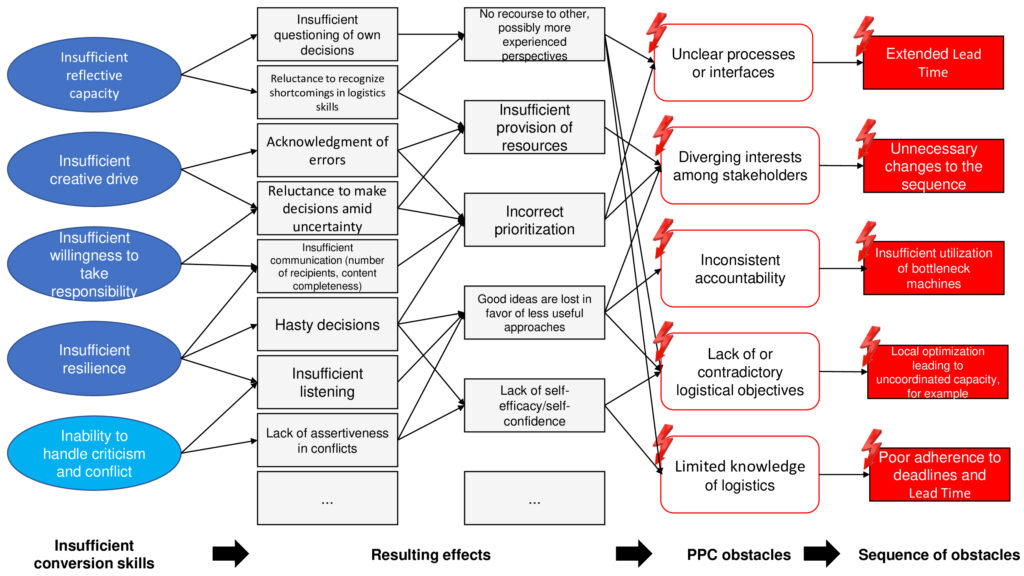
A key strength of this competence-oriented, deductive approach is its strategic and preventative nature. By defining the skills required for successful logistics management in an increasingly changing environment, requirements for future employees can be identified. Simultaneously, it allows for the creation of targeted development initiatives to effectively mitigate challenges caused by skill shortages.
Exchange with experts—a long-standing PPC consultant from a service company for the technical maintenance of complex capital goods and a manager of a PPC software company—clearly demonstrates the validity of the derived network of relationships. If, for example, employees struggle with criticism and conflict, they may refrain from asserting their own—possibly correct—perspective in such situations. This can result in reduced self-efficacy, reinforcing a self-image of possessing poor conflict-handling skills. Even if the person is highly skilled in logistics, this may prevent them from devising effective solutions in production, ultimately jeopardizing order deadlines.
This relationship (and, by extension, other relationship chains from Figure 3) potentially impacts logistics performance directly while also indirectly influencing the necessary digitalization processes. A lack of understanding of logistics, for instance, may also lead to a lack of basic data and therefore unsuitable IT systems for PPC support, ultimately resulting in limited logistics performance.
The description model emphasizes the crucial role of a skills profile that supports the ability to operate effectively in complex situations. Regarding the curriculum, there is no universally valid set of future skills that can be defined for every academic or vocational course. Rather, it is necessary to detect which social or sector-specific developments require which skills profile. The aim should be to take a closer look at a few key skills, firmly integrate them and offer learners a framework within which they can be practiced [9].
This article therefore focuses on the following aspects:
1) Critical reflection skills
2) Decision-making skills, which includes transformation skills such as willingness to shape change, readiness to take on responsibility, and the ability to handle criticism and conflict (Figure 3)
3) Tolerance of ambiguity, which serves as a more comprehensive term for the resilience competence (Figure 3)
All three points prove to be essential in the context of decisions in PPC.
Overcoming actor- and organization-related obstacles in PPC
The following section explains how appropriate skills can support employees in maintaining their ability to act despite the complex and dynamic framework conditions in PPC.
- Decision-making competence means that a person can recognize situations that require decisions and act accordingly [6]. When dealing with PPC obstacles, decision-making skills enhance the ability to listen and observe effectively, even under high stress. It prevents hasty decisions and leads to sensible prioritization, resulting in clearer processes and interfaces and reducing the risk of prolonged throughput times.
- Reflective competence means that a person can critically question themselves, others, situations and facts. In doing so, they recognize and analyze their own behaviors, thoughts and values while adopting different perspectives. This ability allows them to consciously distance themselves from their own experiences, actions, thoughts and feelings, enabling obstructive patterns of thinking and behavior to give way to alternative perspectives and solutions [6, 11]. In a professional context, reflective competence is rightly considered a key aspect of professionalism [12]. When encountering PPC obstacles, strong reflective competence increases the likelihood that individuals will critically evaluate their own skills and decisions, while acknowledging and disclosing uncertainties. This openness enables them to seek and integrate other, possibly more experienced perspectives, thereby continuously expanding their understanding of logistics and helping to prevent scheduling difficulties.
- Ambiguity tolerance refers to how a person recognizes, understands and categorizes ambiguity and diversity in situations. This also refers to how a person manages contradictory information and conflicting role expectations [6]. Individuals with high ambiguity tolerance can withstand tensions and contradictions and maintain their ability to act, which is particularly beneficial in complex decision-making situations [13]. When dealing with PPC obstacles, ambiguity tolerance helps sustain creativity and willingness to take responsibility, even amid uncontrollable system challenges. It fosters confident handling of uncertainties and prevents overwhelming demands and reactive, event-driven decisions.
These three outlined future skills are promoted in different ways in the Industrial Management course of study-integrated training. Using the example of ambiguity tolerance, we will outline below what this can look like in concrete terms.
Ideally, ambiguity tolerance is promoted in a learning environment that is very close to the complex and dynamic world of actual work [13]. For example, the integration of academic and vocational education proves beneficial. Accompanying coaching within the siA creates space for learners to perceive and reflect on their experiences across the three learning locations—company, vocational school and university—in all their complexity and contradictions. This allows learners to recognize early on that ambiguity is a natural part of working life. Coaching supports them in exploring strategies and resources to maintain their ability to act despite these challenges. This is achieved through a didactic interplay of theory and practical exercises, such as self-positioning within the Riemann-Thomann model, where personal practical experiences are critically reflected upon.
Why further study is essential
The approach presented here reflects the great potential of preparing future potential PPC employees for overcoming PPC obstacles during their training so that they can also find their way around the context of digitalized PPC working environments with confidence.
As the chosen methodological approach is a deductive one, it is necessary to further verify the conclusions presented in this article by means of in-depth empirical studies. For example, the reasons for the explained obstacles of the PPC should be further confirmed based on additional interviews. This provides a basis for further substantiating or, if necessary, refining the identified relationships and addressing these gaps through proactive skills training.
Bibliography
[1] Nyhuis, P.; Deuse, J.; Rehwald, J. [eds.]: Wandlungsfähige Produktion – Heute für Morgen gestalten. Garbsen, 2013.[2] Wiendahl, H.H.: Auftragsmanagement der industriellen Produktion. Heidelberg, 2011.
[3] Heins, M.; Nyhuis, P.: Changeable Production Ramp-Up of Assembly Systems. In: Proceedings of CATS 08 – 2nd CIRP Conference on Assembly Technologies and Systems, Toronto, Canada, September 21 – 23, 2008.
[4] Kolf, F.: Investitionen in die Lieferketten – Amazon will wieder zuverlässiger liefern. URL: https://www.handelsblatt.com/unternehmen/handel-konsumgueter/e-commerce-investitionen-in-die-lieferketten-amazon-will-wieder-zuverlaessiger-liefern/28262308.html; 21.04.2022, accessed 28.04.2025.
[5] Goßmann, D.: Durch passende Mitarbeitereinbindung zum wandlungsfähigen Produktionssystem. Garbsen, 2016.
[6] Ehlers, U.: Future Skills. Lernen der Zukunft. Hochschule der Zukunft. Wiesbaden, 2020.
[7] Euler, D.; Severing, E.: Von der Durchlässigkeit zur Verzahnung. In: Euler, D., Meyer-Guckel, V. & Severing, E. (eds.): Neue Wege für Studium und Berufsausbildung. Studienintegrierende Ausbildung. Essen, 2019.
[8] Nyhuis, P.; Schmidt, M.: Logistische Modelle der innerbetrieblichen Lieferkette. Berlin, 2025.
[9] Demele, U.; Schmitz, M.: Systematische Verankerung von Future Skills in curricularen Strukturebenen. Zeitschrift für Hochschulentwicklung18 (2023) 3, pp. 157-173.
[10] Yu, V.; Mielke, L.: Entscheiden. Ein Workbook zur Entscheidungskompetenz. URL: https://www.uni-potsdam.de/fileadmin/projects/studium/docs/04_beratung_service/01_zsb/Entscheidung_Workbook_ZSB_Uni_Potsdam.pdf; 2023, accessed 05.05.2025.
[11] Landesinstitut für Lehrerbildung und Schulentwicklung Hamburg, Abteilung Ausbildung (ed.): Reflexionskompetenz fördern. Reflexion und Reflexionskompetenz in der Lehrerbildung. Hamburg, 2018.
[12] Combe, A.; Kolbe, F.-U.: Lehrerprofessionalität: Wissen, Können, Handeln. In: W. Helsper; J. Böhme (eds.): Handbuch der Schulforschung. Wiesbaden, 2004.
Your downloads
You might also be interested in