Autor: Paul Motzki

Immersive Human Digital Twins for Industry 4.0

Immersive Human Digital Twins for Industry 4.0

Supporting adaptive human-centric production by integrating cognitive and physical states
Tajbeed A. Chowdhury ORCID Icon, Martina Lehser ORCID Icon, Eric Wagner ORCID Icon, Paul Motzki ORCID Icon
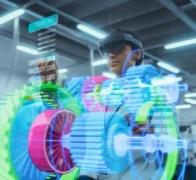
The rapid advancement of immersive technologies has created new opportunities to transform human-machine collaboration in industry. This paper presents an immersive platform with a digital twin that combines both physical and cognitive characteristics of human dynamics. By integrating multimodal sensing, human biomechanics, and cognitive state into digital twin technology, the proposed system enhances operational safety and ensures better ergonomics. The main argument is that human digital twins are not only desirable but essential for next-generation industrial systems. We discuss the limitations of existing human modeling approaches, outline the conceptual foundations of human digital twins, and demonstrate their industrial relevance across safety, productivity, ergonomics and sustainability.
Industry 4.0 Science | Volume 42 | 2026 | Edition 3 | Pages 6-13 | DOI 10.30844/I4SE.26.3.1
Artificial Muscles and Nerves in Industry 4.0

Artificial Muscles and Nerves in Industry 4.0

Multifunctional actuator-sensor systems with shape memory alloys (SMAs) and dielectric elastomers (DEs)
Paul Motzki ORCID Icon, Steffen Hau ORCID Icon, Marvin Schmidt, Stefan Seelecke ORCID Icon
Within the concepts of Industry 4.0, the term “Smart Factory” stands for the creation of effective production environments through digitalization and cyber-physical systems. Most manufacturers plan to make their manufacturing systems more automated, flexible and adaptive. In the course of these efforts, intelligent materials are increasingly brought into focus. Combined actuator and sensory properties enable the construction of lightweight and compact multifunctional actuator-sensor systems that are operated in an energy-efficient, noise-free and emission-free manner. This makes them appropriate for building networked systems. Shape memory alloys (SMAs) and dielectric elastomers (DEs) are particularly suitable for building intelligent actuators, and are presented in this article alongside several use cases.
Industry 4.0 Science | Volume 39 | 2023 | Edition 1 | Pages 8-15 | DOI 10.30844/I4SE.23.1.8