Experiencing Digital Twins in Production and Logistics |
The fischertechnik® Learning Factory 4.0 as a development platform for possible expansion stages

| Journal | Industry 4.0 Science |
| Issue | Volume 42, Edition 2, Pages 30-37 |
| Open Access | https://doi.org/10.30844/I4SE.26.2.30 |
| Bibliography | Share | Cite | Download |
Abstract
Keywords
Article
Learning factories have established themselves as important platforms in research and education [1], for example, to realistically represent production and logistics systems and to investigate current Industry 4.0 developments in a controlled environment. Due to their scalability, modularity, and the ability to replicate real production and material flow processes in a reduced but transferable level of complexity [2], learning factories offer a systematic and risk-free experimental space for digital twins.
According to ISO/IEC 30173:2023-11, digital twins are digital representations of real-world objects (e.g., resources, products, or processes) that by using simulation and appropriate data interfaces, enable the best convergence between the real and the digital state at an appropriate rate of synchronization [3].
With increasing maturity, their functions range from state description to analysis and prediction, and even to control interventions in production and logistics processes [4-5]. With a maturity model, digital twins of production and logistics systems can be systematically classified according to their expansion stage (maturity) using indicators by evaluating the degree to which previously defined requirements are fulfilled [6].
Maturity model for digital twins
The maturity model developed, specifically designed for small and medium-sized enterprises (SMEs), is the result of a systematic literature review and analysis, in which 31 maturity models for digital twins from the Web of Science database were identified and analyzed using the search string “digital twin* AND (level OR maturity)” (see e. g. [5, 7-8]). A detailed documentation is available in the research data repository of the University of Kassel [9].
The new maturity model is based on four dimensions, each comprising four indicators:
The first dimension, “convergence,” assesses the degree of synchronicity between the real and digital systems using the indicators connection mode (1.1), update frequency (1.2), level of detail (1.3), and data interpretation (1.4).
The second dimension, “capability,” describes the functional performance of digital twins using the indicators cognition level (2.1), degree of autonomy (2.2), simulation capability (2.3), and learning capability (2.4).
The third dimension,“integration,” assesses the depth and breadth to which digital twins are embedded in existing systems, processes, and life cycle phases using the indicators integration breadth (3.1), integration depth (3.2), life cycle integration (3.3), and trustworthiness (3.4).
In addition to the three technical core dimensions, the fourth dimension, “strategy and organization,” evaluates the prerequisites for the successful use of digital twins using the indicators strategic anchoring (4.1), personnel competence (4.2), collaborative network (4.3), and process governance (4.4). Further details can be found in [9].
The three technical core dimensions span a three-dimensional assessment space in which the expansion stage of a digital twin can be located for each dimension (Fig. 1). The fourth dimension acts as a normative guiding framework for the sustainable implementation of digital twins along the three core dimensions (sphere radius = maturity stage).
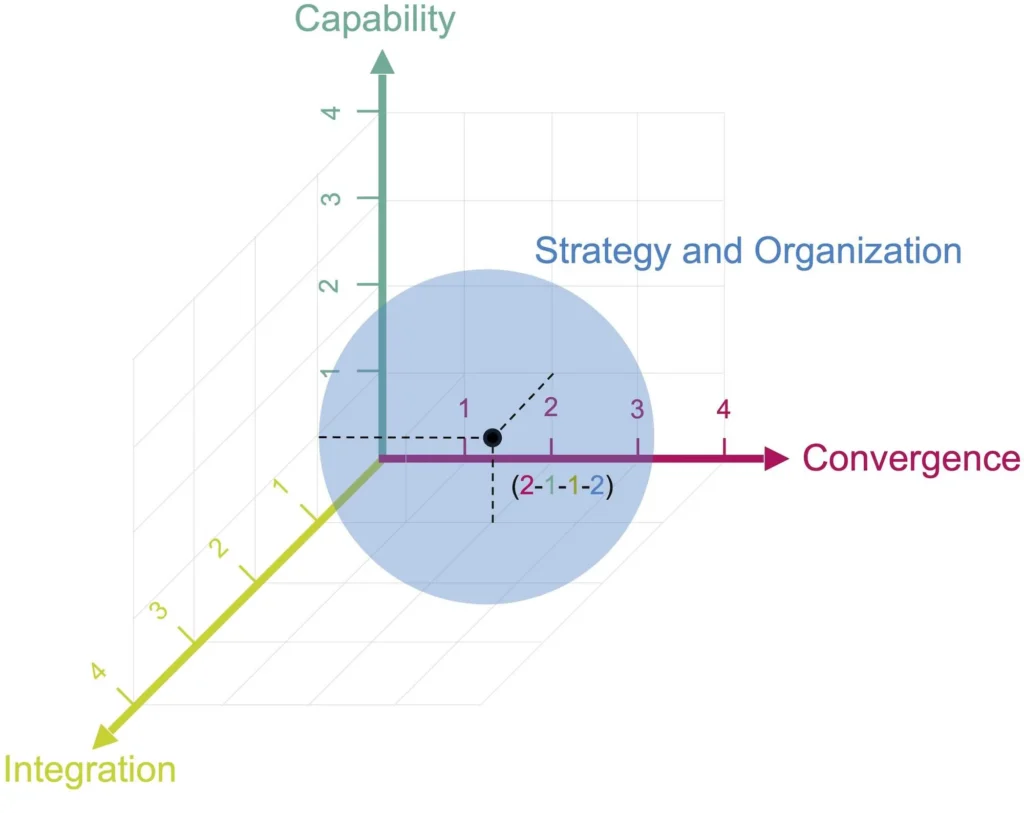
The expansion stage of a dimension is determined by the rounded average of its associated indicators. Stages 1 to 4 can be assigned for each dimension (example: convergence = 2, capability = 1, integration = 1, radius (strategy and organization) = 2). The technical maturity of the digital twin should not exceed the organizational prerequisites at the dimension stage, but individual indicators may have a higher maturity stage depending on the specific application purpose.
Test and development environment for digital twins
In order to iteratively test different expansion stages for digital twins, the fischertechnik® Learning Factory 4.0 [10] is available at the Department of Production Organization and Factory Planning at the University of Kassel. The decision to implement a fischertechnik® Learning Factory 4.0 is based on a systematic literature review and analysis [9]; in particular, the modular structure, the consistent use of standardized data interfaces, the detailed documentation for rapid expandability, and the transferability of knowledge to real production and logistics systems were decisive selection criteria.
Profiles are available for 17 different learning factories related to digital twins, which include a general description of the learning factory, its scope and system boundaries, and the components used. An analysis of the identified learning factories shows that the fischertechnik® Learning Factory 4.0 forms a suitable basis for a physical test environment for digital twins without significant initial hurdles.
The fischertechnik® Learning Factory 4.0 comprises the modules “Delivery and Pickup Station” (DPS), “Vacuum Gripper Robot” (VGR), “High-Bay Warehouse” (HBW), “Multi-Processing Station with Oven” (MPO), and “Sorting Line with Color Detection” (SLD). These modules represent a realistic production and logistics flow, enabling experimental testing of digital twins along real event and state sequences.
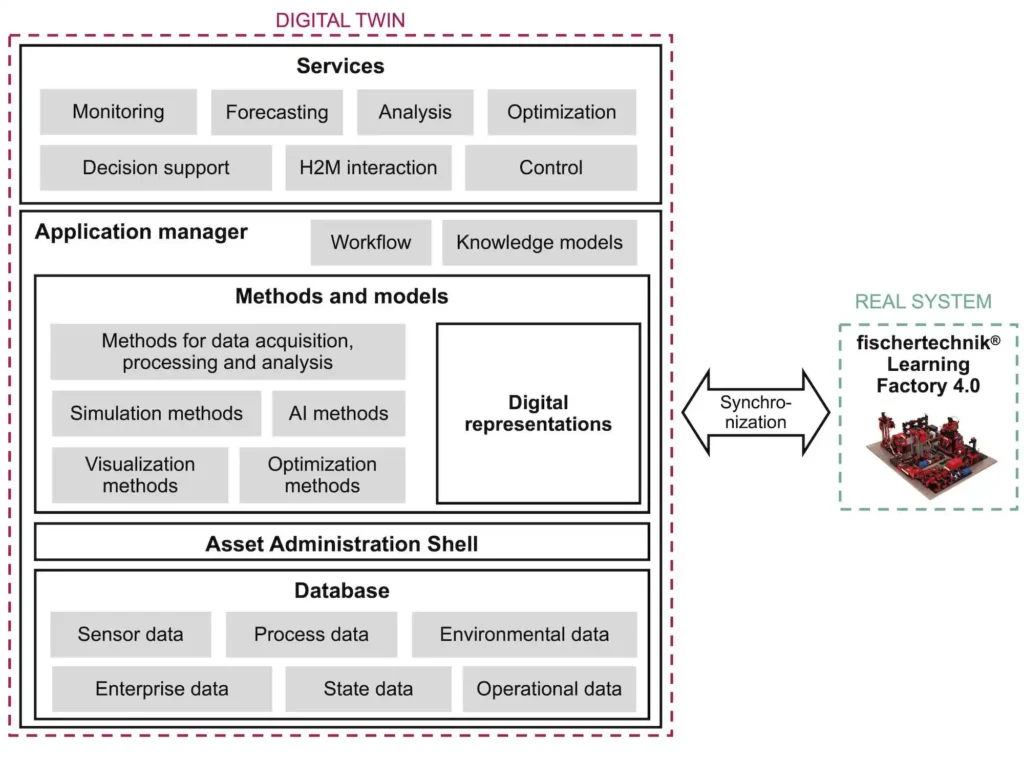
The further development of the standard kit into a test and development environment for digital twins is based on a system architecture with a multi-layered logic structure (Fig. 2). At the lowest layer, “database,” data models are used for the structured acquisition of sensor, state, or operating data, for example. The data is stored persistently and therefore available in a consistent form for further processing steps. The Asset Administration Shell [11] serves as an information model and forms the semantic basis for describing plant resources, products, and processes.
The “methods and models” layer provides digital representations that map system behavior synchronously with the real system. Methods for data acquisition, preprocessing and analysis, visualization, simulation, and optimization access the available data, information, and digital representations as required and include both classical approaches and AI-based methods.
At higher expansion stages, these methods and models can be used to generate recommendations for operational control. An application manager orchestrates data and process flows based on defined workflows and uses knowledge models to map domain-specific relationships. The top layer comprises “services” such as monitoring, forecasting, or optimization, which are provided by digital twins using the application manager.
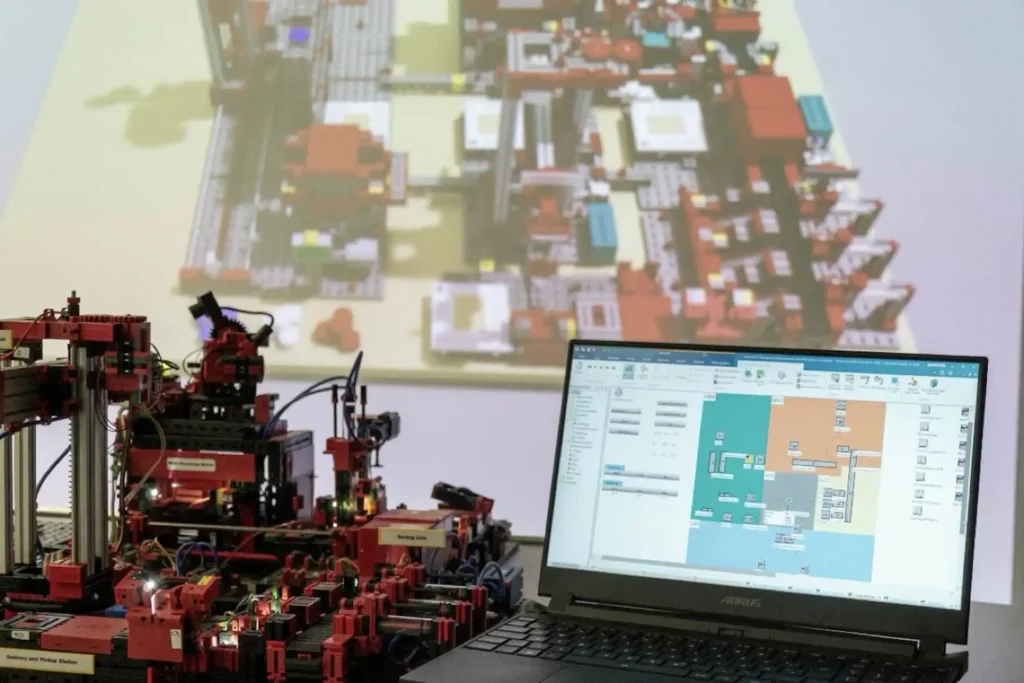
To represent the system behavior of the fischertechnik® Learning Factory 4.0, a simulation model implemented in Tecnomatix Plant Simulation by Siemens is available. This model serves as an integral component of a digital twin and can be used for forecasts and improvements based on real-time data. The simulation model is also connected to NVIDIA Omniverse, enabling 3D visualization and, in the future, the coupling of additional digital twins (Fig. 3). The combination of real system operation, semantic structuring, and simulation models enables both the use of the digital twin at lower maturity stages and the expansion, e.g., of predictive and AI-based functionalities.
In the following, three selected use cases serve to illustrate the possibilities for experimental testing digital twins in a learning factory. Dimension 4 is not considered due to the laboratory environment.
Discussion of selected use cases
1. Real-time monitoring of the learning factory
In the first use case (Fig. 4: Use Case 1 – Real-time monitoring of the learning factory), the digital twin is used exclusively for recording real-time state and for providing transparency regarding material flow, plant utilization, and throughput times. Communication is unidirectional (Indicator (I) 1.1, Stage (S) 2) via the network protocol Message Queuing Telemetry Transport (MQTT), whereby sensor states, material flow events, and machine statuses are transmitted in standardized topics (e.g., ft/<station>/<state>) and persistently stored in a SQL database. The update frequency is near real time (I 1.2, S 4). The Asset Administration Shell describes, e.g., basic system and product information, but without semantic interpretation logic (I 1.4, S 2).
The simulation model is merely synchronized, without forecasting and without intervention in the real process (I 2.3, S 1). In the fischertechnik® Learning Factory 4.0, the events relate to real process chains via DPS, VGR, HBW, MPO, and SLD. The Digital twin has neither cognitive abilities (I 2.1, S 1) nor autonomy (I 2.2, S 1), but it provides the necessary basis for all subsequent expansion stages. The integration comprises the relevant system modules in production and logistics (I 3.1, S 2).
The first use case with the expansion stages (2-1-1-2) addresses key challenges that also limit the initial implementation of digital twins in real factories (see also [12]). In industrial environments, many implementation projects fail due to insufficient data quality, undocumented interfaces, lack of semantic structuring, and heterogeneous data formats from sensors and control technology.
Seemingly simple requirements (e.g., stable data flow, harmonized topics, unique identification of resources, unambiguous timestamps, and consistent data persistence) often represent the largest cost and effort factor in practice. In addition, the introduction of a standardized information model such as the Asset Administration Shell requires significant competence building. Limitations arise where existing systems do not offer retrofit solutions or where proprietary protocols make interoperability difficult.
At the same time, there are also significant opportunities; transparency, data validation, and traceable real-time visualization facilitate earlier detection of process errors, fact-based decision-making, and trust in data-driven methods. Thus, the first use case provides the technical and organizational prerequisites for ensuring that higher maturity stages, such as forecasting and AI-based optimization, are robust and low-risk.
![Figure 4: Maturity classification of selected use cases (for the maturity model, see [9]).](https://industry-science.com/wp-content/uploads/2026/04/Gliem_I4S-26-2_Figure-4-1024x671.webp)
2. Forecasting
The second use case (Fig. 4: Use Case 2 – Forecasting) encompasses predictive capabilities. The forecasting functions are performed on the basis on real measured process data from all fischertechnik® modules. Communication between the real system and the simulation model is bidirectional (I 1.1, S 3) with continuous updates (I 1.2, S 3). Data is interpreted context-sensitively, as the ontology-based knowledge model (for ontologies, see [13]) links system entities with process chains (I 1.4, S 3).
The simulation performs predictive calculations and makes them available in the order manager to support decision-making (I 2.3, S 2). Thus, the digital twin gains predictive cognitive capabilities (I 2.1, S 3) while still remaining an assistant without operational autonomy (I 2.2, S 2). Integration takes place at the system stage (I 3.1, S 2).
From the perspective of real factory environments, this use case addresses key challenges in predictive production control with the expansion stages (3-2-2-3). Forecasts of arrival times, bottleneck probabilities, and expected throughput rates create reliable decision spaces in which scheduling variants and alternative sequences can be evaluated using simulations before operational interventions are made. This corresponds to the implementation of a production or logistics control center, where decisions are prepared on the basis of data and finalized with human assistance.
The benefits result from improved human decision-making capabilities, reduced throughput times, and enhanced usability of simulation results for operational planning. At the same time, methodological limitations arise in the synchronization of simulation and real-world behavior, continuous model calibration, interoperability between the Asset Administration Shell, MQTT, and simulation environment, and in relation to robust validation schemes for forecasts. Consequently, the implementation also requires active change management. This use case bridges the gap between monitoring and autonomous decision-making.
3. AI-based optimization
In the third use case (Fig. 4: Use Case 3 – AI-based optimization), AI agents are trained in the simulation environment using reinforcement learning [14] (not yet technically implemented). The training environment is based on the real process chains of the fischertechnik® modules and is additionally connected to NVIDIA Omniverse. Communication is context-dependent and bidirectional (I 1.1, S 4) with near real-time data updates (I 1.2, S 4).
Digital information is interpreted cognitively (I 1.4, S 4) and the digital twin has prescriptive cognitive abilities (I 2.1, S 4). The simulation is used both for decision-making and serves as a training basis (I 2.3, S 4). The integration encompasses several domains within a factory (I 3.1, S 3). This results in learning, prescriptive digital twins that generate optimized proposals for action.
For technical implementation, simulation and AI agents are integrated to develop learning-based control strategies. First, the “state space” of the learning factory is modeled, which includes buffer levels, machine availability, and process states, among other things. On this basis, the agent selects suitable action from the “action space”, e.g., the prioritization of orders or the selection of routing options. The “reward function” is formulated as a weighted objective function consisting of throughput maximization and energy efficiency.
The learned strategies are initially trained in the simulation environment and subsequently transferred to the real system for validation and later application. In real industrial applications, this expansion stage with the expansion stages (4-3-3-4) corresponds to highly digitized production systems with integrated models, standardized interface architectures, and established data quality processes. Through the connection with NVIDIA Omniverse, there is also the prospective possibility of coordinating multiple digital twins of different assets within a shared environment, enabling cross-system evaluation of strategies.
The benefits of this stage lie primarily in data-driven process innovation, continuous improvement, and increased efficiency in ongoing operations. At the same time, technical complexity and requirements for data management, validation, IT security, governance, and ethics increase significantly. Acceptance becomes a critical success factor, as AI decisions must remain traceable and controllable before trust in autonomous control decisions can be established. Thus, the third use case marks the transition from data-driven decision-making to data-driven action, initiating the transformative phase of digital twins.
Added value of learning factories
The fischertechnik® Learning Factory 4.0 offers clear added value in the context described above because production and logistics systems can be replicated under realistic conditions and current developments related to digital twins can be tested in a controlled environment. Data models, interfaces, digital models, and methods can be gradually developed, tested, and improved before transferring the findings to industrial systems. The controllable complexity of the learning factory makes it possible to better understand interrelationships and systematically validate operating principles. Learning factories therefore support the transfer of research results into industrial practice.
Future work should examine how digital twins can be used beyond individual machines and systems within networked production and supply chains. In addition, research should be conducted into how AI-based decision strategies can be reliably and transparently validated during ongoing operations. Consideration should also be given to how the benefits of different digital twin expansion stages can be economically evaluated and incorporated into investment decisions.
The original German version of this article can be accessed via DOI: 10.30844/I4SD.26.2.30
Bibliography
[1] IALF: International Association of Learning Factories. URL: https://www.ialf-online.net/, accessed 07.03.2026.[2] Abele, E.; Metternich, J.; Tisch, M.; Chryssolouris, G.; Sihn, W. et al.: Learning Factories for Research, Education, and Training. In: Procedia CIRP 32 (2015), pp. 1–6. DOI: https://doi.org/10.1016/j.procir.2015.02.187.
[3] ISO/IEC 30173:2023-11: Digital twin – Concepts and terminology.
[4] Newrzella, S. R.; Franklin, D. W.; Haider, S.: 5-Dimension Cross-Industry Digital Twin Applications Model and Analysis of Digital Twin Classification Terms and Models. In: IEEE Access 9 (2021), pp. 131306-131321. DOI: https://doi.org/10.1109/ACCESS.2021.3115055.
[5] ISO/IEC 30186:2025-07: Digital twin – Maturity model and guidance for a maturity assessment.
[6] Akkasoglu, G.: Methodik zur Konzeption und Applikation anwendungsspezifischer Reifegradmodelle unter Berücksichtigung der Informationsunsicherheit. Dissertation 2014, Friedrich-Alexander University Erlangen-Nuremberg.
[7] Stark, R; Damerau, T.: Digital Twin. In: CIRP Encyclopedia of Production Engineering (2019), pp. 1-8. DOI: https://doi.org/10.1007/978-3-642-35950-7_16870-1.
[8] Uhlenkamp, J.-F.; Hauge, J. B.; Broda, E.; Lutjen, M.; Freitag, M. et al.: Digital Twins: A Maturity Model for Their Classification and Evaluation. In: IEEE Access 10 (2022). DOI: https://doi.org/10.1109/ACCESS.2022.3186353.
[9] Gliem, D.; Wenzel, S.: Forschungsdatenpublikation. Digitale Zwillinge in Produktion und Logistik – Modellfabriken und Reifegradmodelle. Kassel 2025. DOI: https://doi.org/10.48662/daks-488.2.
[10] fischertechnik: GitHub fischertechnik GmbH. URL: https://github.com/fischertechnik, accessed 07.03.2026.
[11] IEC 63278-1:2023-12: Asset Administration Shell for industrial applications – Part 1: Asset Administration Shell structure.
[12] Gliem, D.; Wittine, N.; Wenzel, S.: Digital Twins for Production and Logistics Systems. Challenges and focus areas in implementation and use . In: Industry 4.0 Science 41 (2025) 3, pp. 44–49. DOI: https://doi.org/10.30844/I4SE.25.3.42.
[13] Hesse, W.: Ontologie(n). In: Informatik Spektrum 25 (2002), pp. 477-480. DOI: https://doi.org/10.1007/s002870200265.
[14] Sutton, R. S.; Barto, A. G.: Reinforcement Learning: An Introduction. 2nd ed. Cambridge, MA 2018.
Your downloads
Solutions: Logistics Production Control Production Planning
You might also be interested in