Digital Transformation in International Conglomerates

Identification of Best Practice Solutions Using the Example of MANN+HUMMEL

JournalIndustrie 4.0 Management
Issue Volume 38, 2022, Edition 1, Pages 53-56
Bibliography Share Cite Download

Abstract

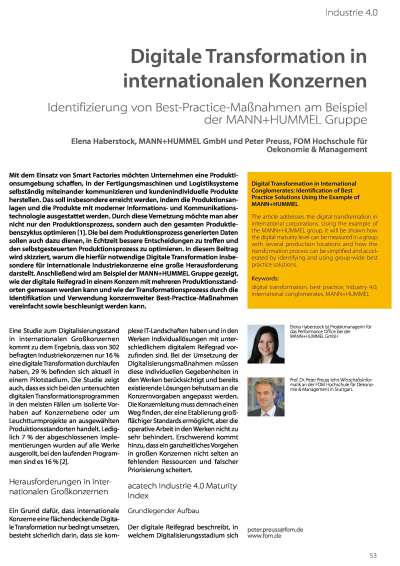
The article addresses the digital transformation in international corporations. Using the example of the MANN+HUMMEL group, it will be shown how the digital maturity level can be measured in a group with several production locations and how the transformation process can be simplified and accelerated by identifying and using group-wide best practice solutions.

Keywords

Access limited

You are currently not logged in / not yet registered.

In order to download the desired file(s), you must be logged in and have an appropriate inclusive subscription. Alternatively, you can also obtain access by paying a one-off fee.

Subscription included Purchase
without 29,00 €
Digital 27,55 €
Expert 26,10 €
Professional 0,00 €

Download for one time 29,00 €

All prices include 7% VAT

After purchasing access rights, you will automatically be redirected back to this page.


You might also be interested in

Tacit Talk

Tacit Talk

A speech-based hybrid AI system for capturing tacit maintenance knowledge
Vincent Philipp Brandhoff ORCID Icon, Philipp Besinger, Joscha Zaremba ORCID Icon, Daniel Valtiner ORCID Icon, Michael Necemer ORCID Icon, Safa Omri ORCID Icon, Jens Neuhüttler ORCID Icon, Fazel Ansari, Katharina Hölzle ORCID Icon
The tacit expertise required for industrial maintenance is increasingly at risk due to demographic change and system complexity. This article presents Tacit-TALK, a speech-based system that externalizes tacit knowledge through AI-guided conversation. Spoken input is transcribed, analyzed by large language models (LLMs), and persisted in a knowledge graph, linking new insights to existing organizational data. Using a design science research process grounded in sociotechnical theory and instantiated for semiconductor maintenance, the article contributes design principles for AI-supported tacit knowledge capture derived from value-based stakeholder engagement, a reference architecture combining LLMs with knowledge graphs, and preliminary prototyping insights into user acceptance and organizational implications.
Industry 4.0 Science | Volume 42 | 2026 | Edition 5 | Pages 82-90 | DOI 10.30844/I4SE.26.5.16
Audio-Immersive Learning in Continuing Vocational Education

Audio-Immersive Learning in Continuing Vocational Education

From linear audio playback to AI-supported conversational learning companions
Tim Beichter, Vanessa Hartmann, Katharina Hölzle ORCID Icon, Manuel Kaiser
Artificial intelligence is increasingly shaping continuing vocational education and training by enabling the personalization of individual learning experiences. At the same time, audio-based learning formats are attracting growing interest among learners because of their flexibility and suitability for workplace learning. However, a conceptual framework for AI-supported audio learning, as well as the potential of combining artificial intelligence with audio-based learning, has received little attention to date. This paper therefore presents a conceptual perspective on the design possibilities and educational potential of AI-supported audio learning formats.
Industry 4.0 Science | Volume 42 | 2026 | Edition 5 | Pages 102-108 | DOI 10.30844/I4SE.26.5.12
Generative AI in Organizational Knowledge Management

Generative AI in Organizational Knowledge Management

AI literacy as a prerequisite for augmentation
Uta Wilkens ORCID Icon, Valentin Langholf ORCID Icon, Niklas Obermann ORCID Icon
Generative Artificial Intelligence (GenAI) offers new opportunities for organizational knowledge management, particularly when it comes to learning processes at the interface between explicit, firm-specific, and tacit knowledge. Its use is therefore of particular interest for application areas such as industrial maintenance. Based on a mechanical engineering case study, this article demonstrates that augmenting both processes and employees with GenAI requires AI literacy combined with professional skills.
Industry 4.0 Science | Volume 42 | 2026 | Edition 5 | Pages 118-126 | DOI 10.30844/I4SE.26.5.14
AI-Based Identification of Knowledge Transfer Situations

AI-Based Identification of Knowledge Transfer Situations

An adaptive multi-agent system for agile product development in engineering
Georg David Ritterbusch ORCID Icon, Ravil Goetzke, Norbert Gronau ORCID Icon
Although it has been demonstrated that organizational knowledge transfer can be improved in principle, there is still no automated approach for identifying patterns in complex, context-dependent, and domain-specific knowledge transfer situations. This conceptual article therefore examines and characterizes knowledge transfer situations using the real-world example of product development in engineering. Furthermore, a concept for an adaptive, AI-based, real-time multi-agent system uses data to recognize recurring patterns in knowledge transfer situations and enables context-sensitive interventions. Finally, an outlook is provided on AI-based learning mechanisms (reinforcement learning) that can be used to adapt interventions for higher effectiveness in the long term.
Industry 4.0 Science | Volume 42 | 2026 | Edition 5 | Pages 110-116 | DOI 10.30844/I4SE.26.5.13
Explaining AI in Industrial Production in an Accessible Way

Explaining AI in Industrial Production in an Accessible Way

Requirements for AI demonstrators to promote acceptance
Jennifer Link ORCID Icon, Markus Harlacher ORCID Icon, Colin Srebny, Sascha Stowasser ORCID Icon
Artificial intelligence (AI) offers a wide range of possibilities in industrial production, but it also presents challenges regarding employee acceptance. AI demonstrators are therefore of central importance, as they enable hands-on experience with AI. However, there has been a lack of systematically identified requirements for demonstrators that specifically promote acceptance and address negative emotions. Using a multi-stage research design, 69 requirements were identified, structured into functional requirements, quality requirements, and boundary conditions.
Industry 4.0 Science | Volume 42 | 2026 | Edition 5 | Pages 6-14 | DOI 10.30844/I4SE.26.5.1
Inclusive Work System Design

Inclusive Work System Design

Automation, standardization, and adaptability
Sebastian Schlund ORCID Icon
The design of inclusive work systems is gaining importance due to demographic change and the increasing digital penetration of value creation processes. While traditional ergonomic approaches are based primarily on percentile logic and thus address only a portion of the user population, the integration of digital technologies opens up new possibilities for the dynamic and individualized adaptation of work systems. This article presents a conceptual framework for inclusive work system design that integrates standardization, automation, and adaptability. Methodologically, the article is based on a conceptual analysis of existing approaches from ergonomics and human-centered design. The article makes a theoretical contribution to the systematization of inclusive work system design and identifies areas of focus for further research and industrial practice.
Industry 4.0 Science | Volume 42 | 2026 | Edition 5 | Pages 70-76 | DOI 10.30844/I4SE.26.5.8