Inclusive Work System Design |
Automation, standardization, and adaptability

| Journal | Industry 4.0 Science |
| Issue | Volume 42, 2026, Edition 5, Pages 70-76 |
| Open Access | https://doi.org/10.30844/I4SE.26.5.8 |
| Bibliography | Share | Cite | Download |
Abstract
Keywords
Article
A central goal of work system design is to consistently take into account future users and their individual characteristics, abilities, and needs. This is essential for developing human-centered and high-performance work systems that contribute not only to increased productivity and quality but also to well-being and user acceptance [1]. Nevertheless, current work design practice is constrained by a fundamental paradigm: work systems are not tailored to the individual requirements of specific people but are designed around aggregated user groups.
This approach is evident in so-called “percentile logic,” which seeks to cover the largest possible proportion of potential users by taking into account statistical distributions of human characteristics [2]. As a result, however, individuals whose characteristics fall outside defined percentile ranges are systematically overlooked. Inclusive design concepts challenge this paradigm by orienting the design of technical systems so that, in principle, they can be used by all people [3].
The aim of this article is therefore to present a conceptual framework for inclusive work system design. This framework should react to current challenges and encompass the essential strategies for inclusive work system design. The short-term goal is to stimulate discussion within the industrial and organizational engineering community, while the medium-term goal is to specify design patterns, examples, and evaluations of inclusive work systems.
This article is structured as a conceptual paper based on the current state of research and implementation in ergonomics, human-centered design, adaptive systems, and industrial production. The author’s experiences in analyzing existing work systems form the basis for the discussion.
Dynamic adaptation through artificial intelligence is already possible
The term “inclusive design” was originally coined in the context of design and later applied to ergonomics [3]. Inclusive work system design aims to systematically integrate the full range of human variability into the design process. Products, systems, and work environments designed in this way should be accessible to as broad a user group as possible without additional adaptation.
In practice, this means explicitly taking into account various dimensions of human diversity – such as age, gender, cultural background, and physical or cognitive limitations. Related concepts include Design for All [4], Human-Centered Design [5], and Universal Design [6]. Although they differ in their focus, these concepts all share the goal of comprehensively addressing human differences, ensuring that no potential user group is excluded.
The term has been in use in the fields of industrial and organizational engineering since 1995 [7]. Although its conceptual roots lie in a different disciplinary domain, inclusive design aligns with industrial engineering’s traditional core principle: adapting work systems to people.
The goal of inclusive work system design is to design and implement work systems in such a way that they can be used productively by everyone. For a long time, this could only be achieved by adapting workplaces to specific groups of people with reduced ability. For example, “Silver Lines”—workstations separated from the production cycle for employees with altered abilities—were implemented under the banner of “age-appropriate” work design. The goal was to separate productive, cycle-based work systems from non-cycle-based pre-assembly tasks. Today, this approach holds negative connotations: Exclusion from the production cycle often meant exclusion from the larger organization and an implicit devaluation of the work itself. The concept of age-appropriate work design has also evolved from a focus on the differences between older and younger employees to a consideration of the increasing variance in abilities that comes with age. Today, the more popular term is aging-adaptive work design.
New, increasingly cost-effective sensor and actuator technologies now make it possible to dynamically adapt work systems using artificial intelligence. This allows the variability of human ability to be continuously taken into account within a practical context. Such developments not only mitigate performance deficits, for example through the individual adjustment of grip ranges and ability enhancers. The accompanying digitalization also enables optimizations in production control.
Current challenges and prospects
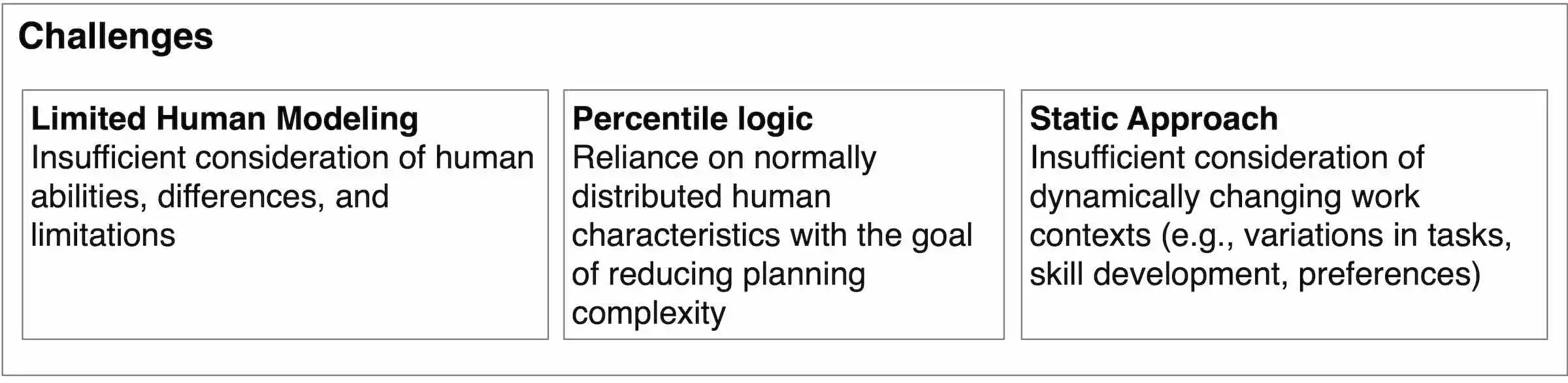
Despite the growing importance of human-centered approaches, significant challenges remain when implementing inclusive work system design (Fig. 1). A central problem lies in the highly simplified modeling of humans in technical systems. In much current research, the variability of human abilities, differences, and limitations is not adequately taken into account.
In production engineering, an increasing number of studies have appeared in recent years that use terms such as “human-centric” [8] or “symbiotic” [9]. These approaches often focus either on the automation of so-called DDD tasks (dirty, dull, dangerous) or on supporting human work through sensory, digital, or physical systems.
However, the evaluation of such approaches is usually limited to productivity metrics and simple indicators of user workload (e.g., NASA-TLX or SUS). A nuanced modeling of human diversity generally does not take place and differences between potential user groups are rarely taken into account systematically.
Since its inception, ergonomics has applied human parameters to the design of work systems. Over time, the percentile approach has established itself as the dominant method. This method aims to cover as wide a range as possible of normally distributed human characteristics, for example in anthropometry.
Though widespread, this approach, by definition, excludes individuals outside the selected percentile ranges. Although variance is acknowledged, it is rarely accounted for in practice due to largely static implementations. A clear example is height-adjustable work tables. Although they allow for individual adaptation, they are often not used in practice because they require active adjustment.
Another problem lies in the predominantly static view on work systems. In reality, work contexts are dynamic: tasks vary, requirements change, and human ability is subject to continuous development in line with the stress-strain model. These changes can be both negative (e.g., overload) and positive (e.g., training effects).
Framework for inclusive work system design
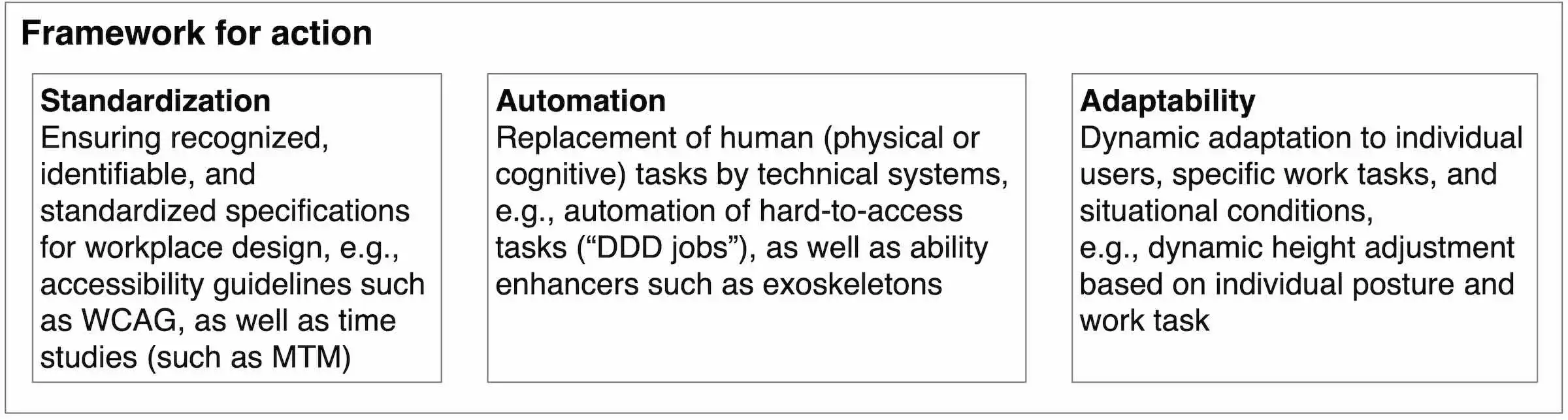
The following section presents fundamental strategies for designing inclusive work systems. Three central design dimensions come together to form a framework for action: standardization, automation, and adaptability.
Standardization
An established approach to promoting inclusion is the development and application of standards, particularly with regard to accessibility. EU Directive 2019/882 (the European Accessibility Act) and its national implementations dictate accessible design for a range of products and services [10].
One key example is the Web content accessibility guidelines (WCAG) [11], which are based on the principles of recognizability, operability, intelligibility, and robustness. These guidelines provide empirically grounded design recommendations and contribute to the standardization of information provision. Standardization thus creates an important foundation for inclusion by defining minimum requirements and systematically improving accessibility.
Automation
A second key approach is the automation of work tasks. In addition to productivity and quality benefits, automation can help make tasks accessible to broader user groups.
A distinction must be made between substitution and augmentation: While traditional automation replaces human labor, modern technologies increasingly serve to expand human capabilities. Examples include active assistance systems and exoskeletons.
At the same time, potential negative effects such as a loss of skills, monotony, or reduced learning opportunities do arise. Inclusive design must therefore draw a deliberate balance between technological support and the preservation of human agency.
Adaptability
The third central dimension is adaptability, which describes the ability of work systems to dynamically adapt to individual users, work tasks, and conditions. Unlike static adjustment, adaptability allows for the continuous consideration of individual differences. This includes, in particular:
- Adapting to different physical and cognitive abilities
- Accounting for experience and skill development
- Responding to changing tasks and conditions
In a technical sense, adaptability relies on the integration of sensor technology, data analysis, and adaptive control mechanisms. Both the perception of the context and the processing of time series, images, and text, as well as the adaptation itself, are handled by machine learning algorithms. It is only through developments in the field of artificial intelligence that high-resolution tracking of human poses and movements [12] and accurate assessments of cognitive load are possible [13]. Equally, artificial intelligence allows for better analysis of adaptations and thus continuous dynamic adaptation during operation (Fig. 2).
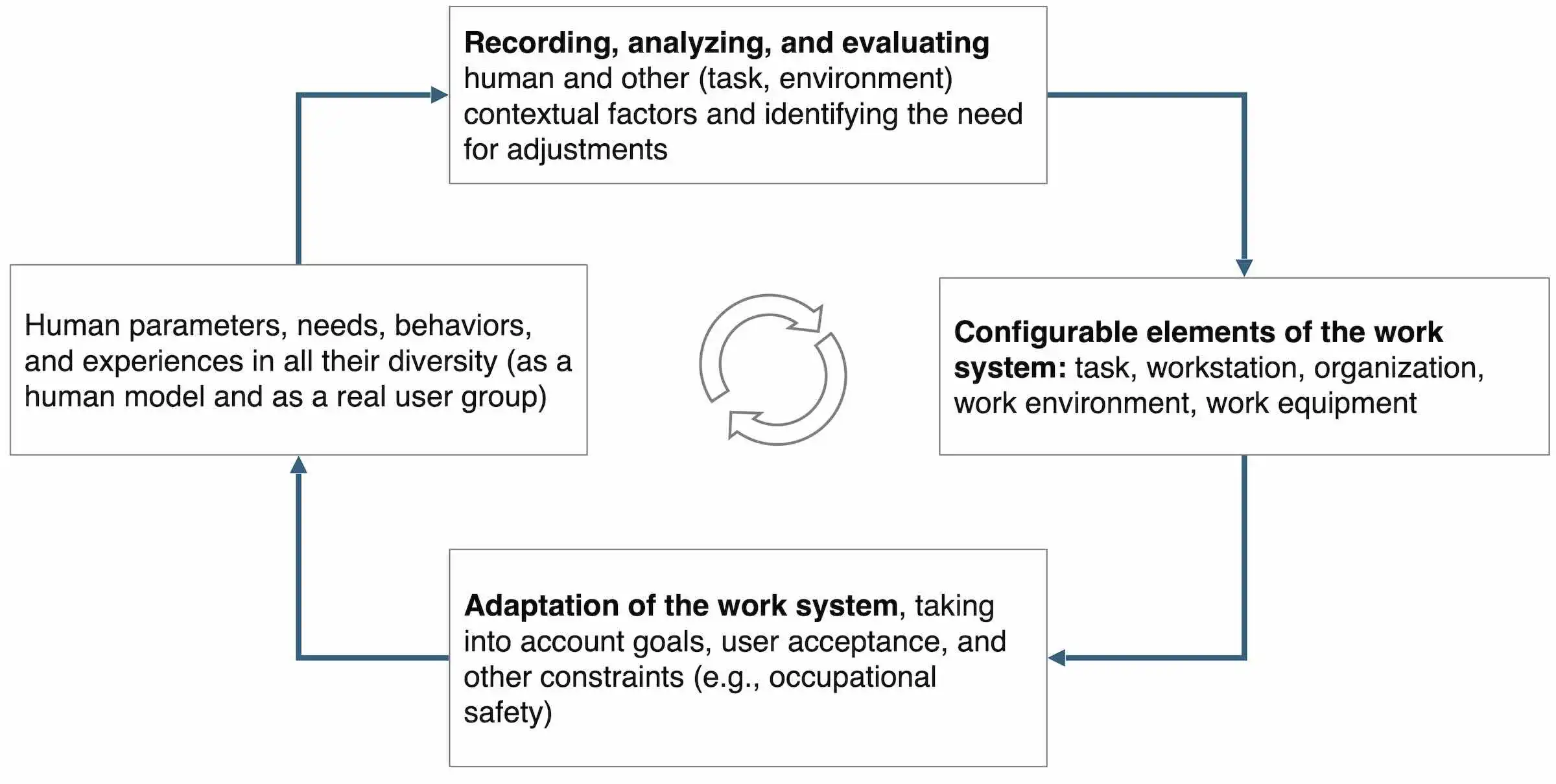
The overarching goal is to design work systems that can flexibly adapt to different usage situations without active user intervention. Only via the interplay of standardization, automation, and adaptability does a coherent design framework for inclusive work systems emerge (Fig. 3).
The effects of individual and dynamic adaptations remain largely unexplored
This article serves as a catalyst for the further development of inclusive work system design. It focuses on the systematic integration of standardization, automation, and adaptability as complementary design dimensions.
For the first time, thanks to artificial intelligence, it is possible to adapt work systems individually and dynamically rather than relying on systems designed with average user groups in mind. This can significantly improve accessibility for people with varying abilities.
At the same time, however, the complexity and potential cost of design are increasing. The effects on productivity have not yet been conclusively clarified. The potential benefits of better utilizing individual abilities could be offset by the effects of increased performance variability.
Since existing implementations are limited and the evaluation of adaptive systems presents methodological challenges, there remains a significant need for further research. However, against the backdrop of demographic change, there is growing pressure to make industrial work systems accessible to new user groups. It is important, therefore, for future research to systematically analyze and empirically evaluate the potential and risks of inclusive work system design.
Bibliography
[1] DIN EN ISO 6385:2016-12: Ergonomics principles in the design of work systems (ISO 6385:2016).[2] Schlund, S.; Kostolani, D.: Towards Designing Adaptive and Personalized Work Systems in Manufacturing. In: Plapper, P. (ed.): Digitization of the work environment for sustainable production. Berlin 2022, pp. 81–96. DOI: https://doi.org/10.30844/WGAB_2022_5
[3] Clarkson, P. J.; Coleman, R.; Keates, S.; Lebbon, C.: Inclusive design: Design for the whole population. Springer 2013.
[4] Harper, S.: Is there design-for-all? In: Universal Access in the Information Society 6 (2007) 1, pp. 111–113.
[5] ISO 9241-210:2019: Ergonomics of human-system interaction. Part 210: Human-centred design for interactive systems. 2nd edition, 2019. URL: https://www.iso.org/standard/77520.html#lifecycle, accessed 21.05.2026.
[6] Goldsmith, S.: Universal design: a manual of practical guidance for architects. Routledge 2007.
[7] Coleman, R.: The case for inclusive design—an overview. In: Proceedings of the 12th Triennial Congress, International Ergonomics Association and the Human Factors Association, Canada. 1994.
[8] Wang, L.; Gao, R. X.; Krüger, J.; Váncza, J.: Human-centric assembly in smart factories. In: CIRP Annals 74 (2025) 2, pp. 789–815.
[9] Wang, L.; Gao, R.; Váncza, J.; Krüger, J.; Wang, X. V. et al.: Symbiotic human-robot collaborative assembly. In: CIRP Annals 68 (2019) 2, pp. 701–726.
[10] German Federal Ministry of Labor, Social Affairs, Health, Long-Term Care, and Consumer Protection: Barrierefreiheitsgesetz. URL: https://www.sozialministerium.gv.at/Themen/Soziales/Menschen-mit-Behinderungen/Barrierefreiheitsgesetz.html, accessed 18.04.2026.
[11] World Wide Web Consortium: Web content accessibility guidelines (WCAG) 2.0. 2008.
[12] Kostolani, D.; Brenter, B.; Schlund, S.: Fluency in Failure: The Impact of Interaction Modalities on Human-Robot Collaboration in Error Recovery. In: 34th IEEE International Conference on Robot and Human Interactive Communication (RO-MAN), pp. 2529–2534. IEEE 2025.
[13] Kostolani, D.; Pülke, D.; Schlund, S.: Detecting Industrial Boredom: An In-the-Wild Study of Monotonous Manufacturing Work Using Physiological Signals. In: Proceedings of the 18th ACM International Conference on Pervasive Technologies Related to Assistive Environments 2025, pp. 64–73.
Your downloads
Potentials: Training
You might also be interested in