AI-Based Identification of Knowledge Transfer Situations |
An adaptive multi-agent system for agile product development in engineering

| Journal | Industry 4.0 Science |
| Issue | Volume 42, 2026, Edition 5, Pages 110-116 |
| Open Access | https://doi.org/10.30844/I4SE.26.5.13 |
| Bibliography | Share | Cite | Download |
Abstract
Article
Agile product development in engineering is characterized by a high rate of change, cross-disciplinary collaboration, and continuous alignment between product, process, and organization. Particularly in the development of mechatronic systems, it is therefore not sufficient to view product development as a linear sequence of technical steps. Rather, short cycles give rise to knowledge transfer situations in which, for example, task and artifact status, uncertainties, or even courses of action are exchanged [1, 2].
The daily scrum is particularly well-suited for this purpose because, according to the scrum methodology, it reviews daily progress toward the sprint goal and adjusts the plan accordingly. Furthermore, the daily scrum is limited to 15 minutes, making it a formally recurring and comparable process [3]. In mechatronics, however, this coordination becomes more complex, as knowledge transfer involves not only language but also CAD models, prototypes, drawings, test reports, photos, or experiential knowledge. As a result, the daily scrum evolves from a purely status-based meeting into a condensed knowledge transfer situation [3, 4].
To analyze such situations, it is essential to differentiate between various forms of knowledge [5, 6]. In Figure 1, building on the SECI model developed by Nonaka and Takeuchi, Grum and Gronau distinguish between tacit, explicit, and embedded knowledge.
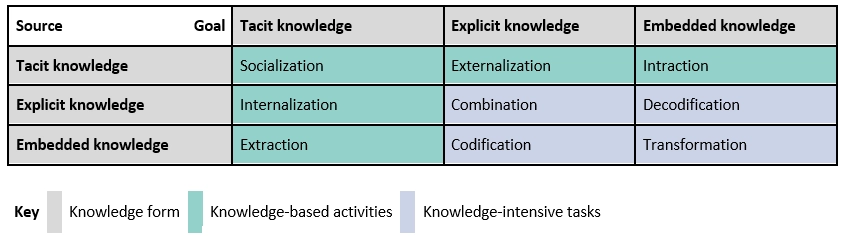
In product development, tacit knowledge manifests in routine problem-solving behaviors, judgments based on experience, or intuitive anomaly identification based on motor or sensory skills. Explicit knowledge, on the other hand, can be described and conveyed using a wide variety of communication tools including graphics, images, text, or speech. Embedded knowledge is embodied in artifacts such as models, components, or experimental setups.
The intertwining of these forms of knowledge is a defining characteristic of knowledge transfer within product development teams. This knowledge transfer occurs in a multimodal and situation-dependent manner, which often makes it difficult to reconstruct from individual documents or transcripts alone [4, 7].
Extending the SECI model is important for classifying knowledge transfer situations in engineering, as it accounts not only for knowledge conversions like socialization, externalization, combination, and internalization, but also extraction, codification, decodification, intraction, and transformation. It highlights that knowledge transfer occurs not only in conversation but also in the interpretation of documents, the derivation of insights from artifacts, or the creation of new designs.
In addition, there are influencing factors that significantly shape the quality and speed of knowledge transfer. Preliminary studies show that the competence of team members, the complexity or novelty of the knowledge, time pressure, and team composition are particularly relevant. Furthermore, “stickiness”—that is, the difficulty of the transfer in terms of duration or the need for follow-up questions—is a decisive influencing factor [8–10]. In more advanced conceptualizations, distinctions can also be made between sender-receiver relationships, confidentiality, organizational culture, communication culture, language proficiency, the richness of media content, the degree of media synchrony, and error-prone process dynamics [9, 11, 12].
In a real-world product development situation, however, these factors cannot be observed as isolated variables. They manifest in patterns such as follow-up questions, stalling conversation, repeated externalization, a lack of connection to prior knowledge, frequent references to documents, or shifts between conversation and collaborative work on artifacts. It has been empirically demonstrated that targeted intervention can improve knowledge transfer. However, no approach has yet recognized such patterns in on-site situations in a domain-specific and automated manner for real-time intervention [1, 13, 14].
Daily scrums in product development are particularly suitable as a use case, as they occur regularly but differ in terms of their tasks, artifacts, team configurations, and problem statuses. They can thus be understood as microprocessual knowledge transfer situations in which purpose, content, actors, media, timing, artifact references, and progression shape the situational context. For AI-supported identification, therefore, pure semantic analysis of spoken language is no longer sufficient. Rather, conversion patterns, artifact references, and other forms of interaction must be captured in a multimodal and process-sensitive manner.
While generic meeting summarization systems can extract decisions, consensus, or action items from conversation, they often treat meetings as linear transcripts and capture negotiation processes, temporal structures, and nonverbal signals only to a limited extent [15, 16]. For knowledge transfer in product development, an architecture is required that combines linguistic, audiovisual, and contextual information with an intervention-based situation assessment.
Adaptive AI-based real-time multi-agent system
This problem highlights the need for a distributed, context-sensitive system architecture. A monolithic approach would be unsuitable for this use case for two reasons. Firstly, data sources such as audio, video, documents, role information, or prototype images are heterogeneous. Secondly, partial decisions must be made across different time horizons. Real-time analysis during a meeting requires different methods than those used for downstream verification, labeling, or the adjustment of interventions. Therefore, an adaptive multi-agent system is proposed that builds on existing process and activity layers [7, 17–19]. In Figure 2, the architecture of the adaptive AI-based real-time multi-agent system is divided into five functional levels.
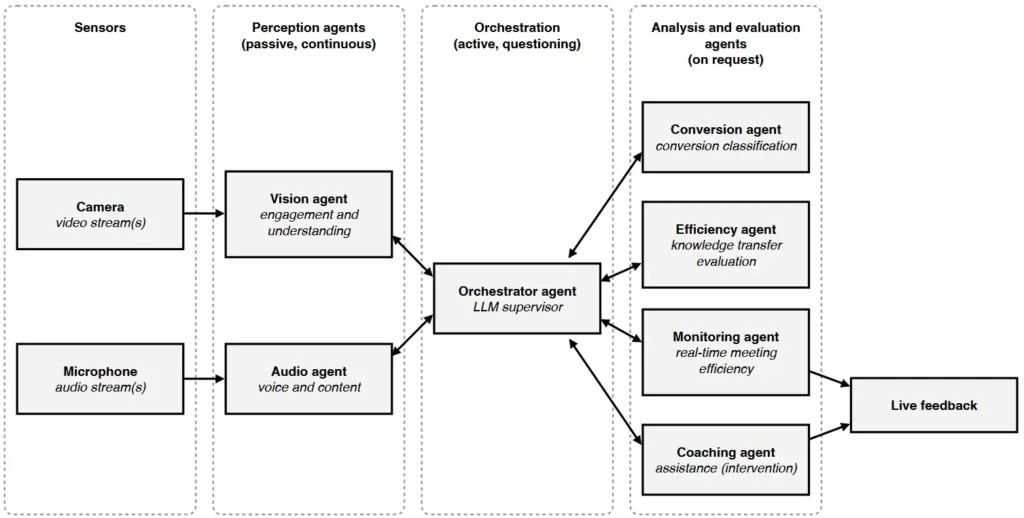
In this architecture, the course of the meeting is primarily captured via camera and microphone. The first layer consists of the sensor system. This is followed by two perception agents that operate passively and continuously. The vision agent processes the video stream into observable features such as attention, agreement, irritation, and understanding, conveyed through facial expressions or gestures [20, 21].
In the future, the goal is to visually capture not only the participants but also the artifacts used in the meeting. The audio agent processes the audio stream into transcripts, detects speaker changes (diarization), and extracts prosodic features such as stress, uncertainty, or questioning intonation [22]. It is crucial that these agents initially only collect evidence and do not yet trigger any interventions. This separation is important because nonverbal and paralinguistic signals can only be reliably interpreted in conjunction with the situational context.
The orchestrator agent forms the operational core of the architecture. It assumes the role of a context-aware decision-making module that places observations from the perception agents into a situational context. Unlike a purely data-driven processing chain, the orchestrator agent does not operate continuously at the same level of abstraction. Rather, it invokes specialized analysis and evaluation agents only when the perception data indicate a need for clarification. This may be the case when an explanatory pattern repeats itself, follow-up questions increase, agreement is lacking, or an agenda item takes up a disproportionate amount of time. The orchestrator agent thus assumes the role of context control and task distribution [18, 23].
The four analysis and evaluation agents become active upon request. The conversion agent assigns a sequence of interactions to a presumed knowledge conversion, asking which form of knowledge is being converted into another form in a specific situation. The efficiency agent synthesizes linguistic, temporal, and interactive features to assess the quality of the knowledge transfer. The monitoring agent continuously synthesizes these evaluations into a concise overview of the meeting’s current status, in the form of a traffic light system that updates in real time. Only when a reliable potential for improvement becomes apparent (the light turns red or yellow) is the coaching agent called upon to generate a specific intervention or recommendation for action.
In this way, the continuously recorded analysis and evaluation results are transformed into situation-specific live feedback. The architecture does not focus on communication in general but asks whether an intervention is necessary in each specific knowledge transfer situation to improve the knowledge transfer.
Reinforcement learning for the adaptive control of interventions
The architecture is only fully adaptive if it can also continuously adjust the selection of interventions based on their observed effects. Reinforcement learning is particularly well-suited for this task, since recurring knowledge transfer situations can be described as sequences of states, decisions, and feedback. In reinforcement learning, an AI system gradually learns an appropriate action strategy based on feedback regarding the effects of its decisions. For example, the system not only recognizes a communication difficulty but also learns which intervention is more likely to lead to an improvement in knowledge transfer in that context. In human-AI interaction, reinforcement learning is particularly useful for adapting to human behavior or new interaction partners, and for coordinating highly dynamic environments [24].
For the use case considered here, the state is derived from the situation description aggregated by the orchestrator agent. This includes the presumed knowledge conversion, follow-up questions, indications of understanding or lack thereof, speaking shares, duration, and intervention history to date. The agent-based AI system has only a few predefined intervention options, such as a clarification request, a suggestion for visualization, a recommendation to delegate, or deliberate non-intervention.
The learning signal (reward function) for reinforcement learning should not be based solely on a shortened meeting duration. Qualitative aspects of collaboration can also be decisive, such as perceived fairness, transparency, or the opportunity for personal participation [25]. For this reason, both objective effects—such as faster clarification or fewer follow-up questions—and subjective assessments of usefulness should be incorporated [24, 25].
Methodologically, this calls for a phased approach in which the agent-based AI system is first trained offline using annotated meeting data and then adapted online within a limited decision space. Adaptive query processing methods enable the timing and form of feedback to be specifically controlled [26]. For example, approving, rejecting, ignoring, or correcting an intervention can also be used as learning signals for reinforcement learning.
Such a learning mechanism requires clear boundaries, as feedback on interventions is not neutral but shaped by roles, expectations, and values. The system should therefore not decide independently on the appropriateness of an intervention but rather gradually adapt its suggestions based on observed effects. The human remains part of the decision-making loop and the system learns from recurring knowledge transfer situations which interventions are appropriate under which conditions [24, 27].
From pattern recognition to effective intervention
It is difficult to capture knowledge transfer situations based solely on transcribed speech. In agile product development, knowledge transfer arises in the interplay of verbal interaction, technical artifacts, nonverbal cues, and situational process dynamics. The example of the daily scrum illustrates that, while these knowledge transfer situations recur in form, their content is shaped by changing tasks, team configurations, and problem statuses. A multimodal and context-sensitive architecture is therefore required for situational classification. The proposed real-time multi-agent system functionally separates recording, evaluation, and coaching, and focuses analysis on patterns in knowledge transfer that are relevant for intervention.
The conceptual framework of this article forms the basis for further empirical investigations. The proposed architecture is to be implemented as a prototype and adapted using appropriate data collection and evaluation routines. Recurring knowledge transfer situations in daily scrums will be recorded, processed, and annotated (data labeling) to create training data for the detection of knowledge conversions and intervention needs.
Building on this, the system will be tested in live-lab studies and, in the future, in field studies. In addition to data quality, real-time capability, and context-sensitive interpretation of multimodal signals, quantitative potential should also be considered. This can be measured based on transfer duration, follow-up questions, subsequent coordination needs, the quality of work outcomes, and the AI system’s performance. In addition, feedback from participants regarding usefulness and acceptance should be incorporated to evaluate the impact of AI-generated interventions on knowledge transfer.
This article is part of the project “Analysis of recurring knowledge transfer situations to derive methodological interventions to improve agile product development using AI-based approaches”, which is funded by the German Research Foundation (DFG) under grant number 559141885.
Bibliography
[1] Albers, A.; Gronau, N.; Rapp, S. et al.: Influencing factors and methods for knowledge transfer situations in Product Generation Engineering based on the SECI model. In: DS 91: Proceedings of NordDesign 2018. August 14–17, 2018, Linköping, Sweden.[2] Stray, V.; Moe, N.; Aurum, A.: Investigating Daily Team Meetings in Agile Software Projects. In: 38th Euromicro Conference on Software Engineering and Advanced Applications. 2012, Cesme, Izmir, Turkey, pp. 274–281.
[3] Žužek, T.; Kušar, J.; Rihar, L. et al.: Agile-Concurrent hybrid: A framework for concurrent product development using Scrum. In: Concurrent Engineering 28 (2020) 4, pp. 255–264.
[4] Albers, A.; Rapp, S.; Spadinger, M. et al.: The Reference System in the Model of PGE: Proposing a Generalized Description of Reference Products and their Interrelations. In: Proceedings of the Design Society: International Conference on Engineering Design 1 (2019) 1, pp. 1693–1702.
[5] Grum, M.; Gronau, N.: Quantification of Knowledge Transfers: The Design of an Experiment Setting for the Examination of Knowledge Transfers. In: Shishkov, B. (ed.): Business Modeling and Software Design, Lecture Notes in Business Information Processing. 422. Cham: Springer International Publishing, 2021. ISBN 978-3-030-79975-5, pp. 224–242.
[6] Nonaka, I.; Takeuchi, H.: The Knowledge-Creating Company: How Japanese Companies Create the Dynamics of Innovation, 1st edition. Oxford 1995.
[7] Gronau, N.: Knowledge Modeling and Description Language (KMDL) 3.0: an introduction into the creation of knowledge-intensive business processes. Berlin 2024.
[8] Albers, A.; Rapp, S.; Grum, M. et al.: Knowledge Transfer Velocity Model Implementation–An Empirical Study In Product Development Contexts. In: Knowledge Transfer Speed Optimizations in Product Development Contexts: Results of a Research Project. Berlin 2019.
[9] Grum, M.; Rapp, S.; Gronau, N. et al.: Accelerating Knowledge: The Speed Optimization of Knowledge Transfers. In: Shishkov, B. (ed.): Business Modeling and Software Design, Lecture Notes in Business Information Processing. 356. Cham 2019.
[10] Szulanski, G.: Exploring internal stickiness: Impediments to the transfer of best practice within the firm. In: Strategic Management Journal 17 (1996) S2, pp. 27–43.
[11] Argote, L.; Guo, J.; Park, S. et al.: The Mechanisms and Components of Knowledge Transfer: The Virtual Special Issue on Knowledge Transfer Within Organizations. In: Organization Science 33 (2022) 3, pp. 1232–1249.
[12] Dennis, A.; Fuller, R.; Valacich, J.: Media, Tasks, and Communication Processes: A Theory of Media Synchronicity. In: MIS Quarterly 32 (2008) 3, p. 575.
[13] Grum, M.; Gronau, N.: The impact of knowledge characteristics on process performance: experimenting with the conversion perspective on knowledge transfer velocity. In: Business Process Management Journal 30 (2024) 4, pp. 1088–1110.
[14] Klippert, M.; Stolpmann, R.; Grum, M. et al.: Knowledge Transfer Quality Improvement – The Quality Enhancement of Knowledge Transfers in Product Engineering. In: Procedia CIRP 119 (2023), pp. 919–925.
[15] Jin, Y.; Shi, Q.; Liu, Q.: CFAS: consensus-focused abstractive meeting summarization through multi-party discourse modeling. In: Journal of King Saud University Computer and Information Sciences 37 (2025) 7, p. 187.
[16] Retkowski, F.; Züfle, M.; Sudmann, A. et al.: Summarizing Speech: A Comprehensive Survey. In: Proceedings of the 2025 Conference on Empirical Methods in Natural Language Processing. Suzhou, China: Association for Computational Linguistics, 2025, pp. 27263–27294.
[17] Gronau, N.; Grum, M.: Towards a prediction of time consumption during knowledge transfer. In: Knowledge Transfer Speed Optimizations in Product Development Contexts: Results of a Research Project. Berlin 2019.
[18] Li, X.; Wang, S.; Zeng, S. et al.: A survey on LLM-based multi-agent systems: workflow, infrastructure, and challenges. In: Vicinagearth 1 (2024) 1, p. 9.
[19] Xie, J.; Chen, Z.; Zhang, R. et al.: Large multimodal agents: a survey. In: Visual Intelligence 3 (2025) 1, p. 24.
[20] Das, R.; Dev, S.: Optimizing student engagement detection using facial and behavioral features. In: Neural Computing and Applications 37 (2025) 23, pp. 19063–19085.
[21] Hashi, A.; Hashim, S.; Asamah, A.: A Systematic Review of Hand Gesture Recognition: An Update From 2018 to 2024. In: IEEE Access 12 (2024), pp. 143599–143626.
[22] Loakes, D.: Automatic speech recognition and the transcription of indistinct forensic audio: how do the new generation of systems fare? In: Frontiers in Communication 9 (2024), p. 1281407.
[23] Abou Ali, M.; Dornaika, F.; Charafeddine, J.: Agentic AI: a comprehensive survey of architectures, applications, and future directions. In: Artificial Intelligence Review 59 (2025) 1, p. 11.
[24] Li, W.; Liu, H.; Huang, K. et al.: Reinforcement Learning for Human-AI Collaboration: Challenges, Mechanisms, and Methods. In: Cognitive Computation 17 (2025) 5, p. 146.
[25] Mayer, L.; Karny, S.; Ayoub, J. et al.: Human–AI collaboration: trade-offs between performance and preferences. In: Cognitive Research: Principles and Implications 11 (2026) 1, p. 18.
[26] Anand, Y.; Nwagwu, N.; Sabbe, K. et al.: Adaptive querying for reward learning from human feedback. In: Frontiers in Robotics and AI 12 (2026), p. 1734564.
[27] González Barman, K.; Lohse, S.; De Regt, H.: Reinforcement Learning from Human Feedback in LLMs: Whose Culture, Whose Values, Whose Perspectives? In: Philosophy & Technology 38 (2025) 2, p. 35.
Your downloads
Potentials: Leadership
Solutions: Product Development
You might also be interested in