Explaining AI in Industrial Production in an Accessible Way |
Requirements for AI demonstrators to promote acceptance

| Journal | Industry 4.0 Science |
| Issue | Volume 42, 2026, Edition 5, Pages 6-14 |
| Open Access | https://doi.org/10.30844/I4SE.26.5.1 |
| Bibliography | Share | Cite | Download |
Abstract
Keywords
Article
The increasing use of artificial intelligence (AI) in manufacturing can trigger negative emotions among employees—such as uncertainty, fear, overwhelm, and skepticism—and thus hinder the acceptance of AI in industrial transformation processes [1]. Against this backdrop, competencies in working with AI are becoming increasingly important. An ability to understand, interpret, and critically evaluate AI system is essential for their competent use. A recent study also shows that acceptance of AI increases when individuals have prior experience [2].
AI demonstrators represent a suitable means of imparting these competencies. They serve as interactive artifacts that facilitate practical experience, didactic understanding, and reflective engagement with AI. As boundary objects, they also support communication and exchange among scientific, technical, and application-oriented stakeholders. [3]
Despite their practical relevance, there is currently a lack of systematically derived requirements for AI demonstrators that explicitly aim to reduce negative emotions and promote acceptance. This leads to the following research question: What requirements must AI demonstrators meet to promote acceptance of AI in industrial production and reduce negative emotions?
Method for deriving requirements for AI demonstrators
To answer the research question, a multistage, qualitative research design was chosen that combines empirical data collection with a market and literature analysis (Fig. 1).
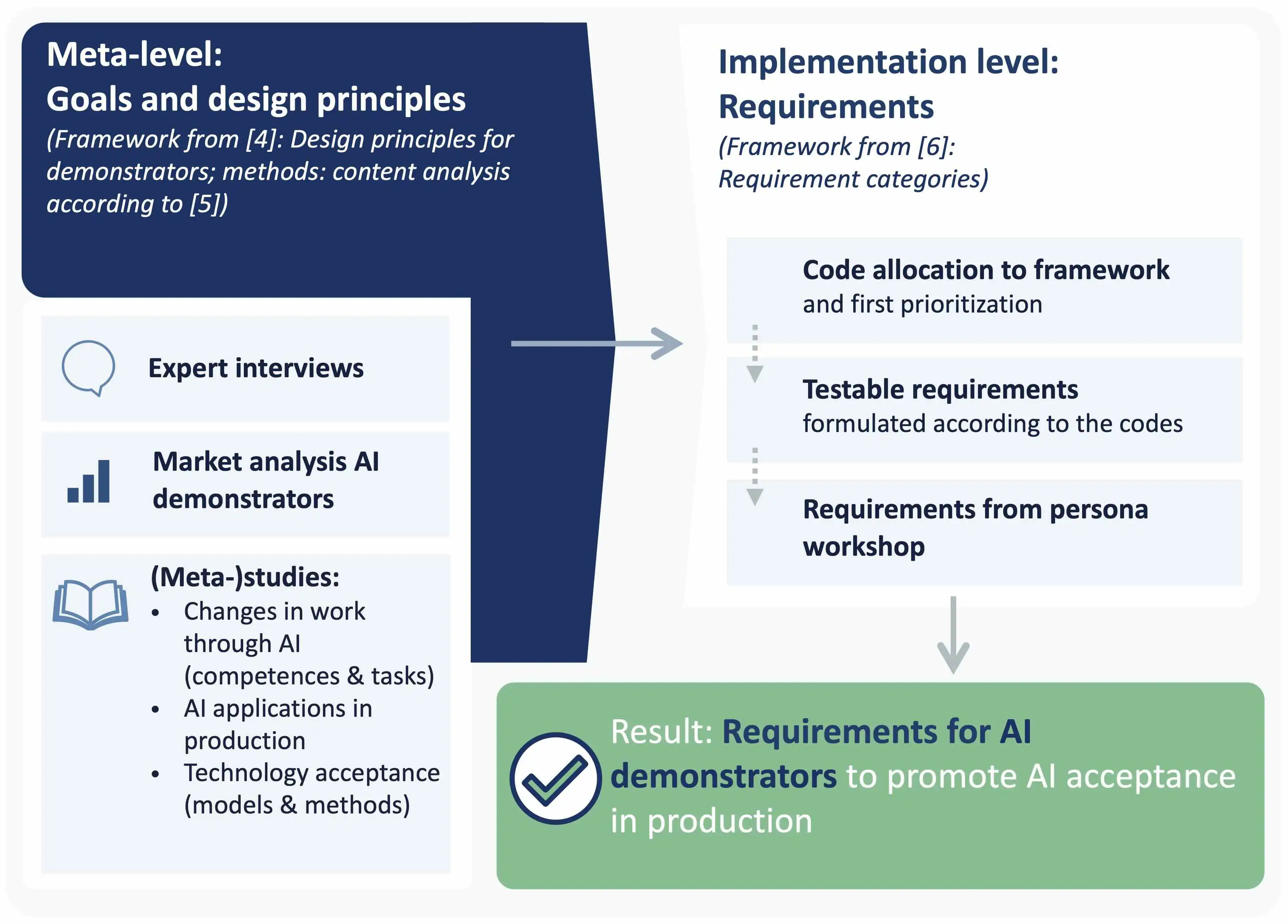
The analysis is based on guided interviews with experts, supplemented by market research on existing AI demonstrators as well as (meta)studies. A total of 15 interviews were conducted with experts from academia, industry, and associations (for details, see [7]). The goal of the interviews was to identify relevant design aspects and requirements for AI demonstrators from different perspectives.
In addition to the interviews, an exploratory market and literature analysis was conducted to gain a systematic overview of existing AI demonstrators. Publicly available AI demonstrators were identified, systematically documented, and evaluated both quantitatively and qualitatively. The analysis shows that demonstrators focus on industrial applications such as quality management and process optimization, and that physical and interactive formats are frequently used. Shortcomings in the didactic design are evident, particularly with regard to the transparent presentation of limitations and the tailoring of content to the target audience (for details, see [3]).
(Meta-)studies on changes in work due to AI—with a focus on shifts in job tasks and competence requirements—, areas of industrial AI application and AI acceptance were also taken into account. The findings from these studies served to supplement the empirical results from interviews and market research.
A qualitative content analysis was initially conducted on the interviews and the market and literature analysis at the meta-level using a based on Mayring’s method with MAXQDA. The framework from [4], which describes design principles for demonstrators, was used as the analytical framework. Aspects of technology acceptance were incorporated into the analysis using established acceptance models such as the AI-TAM [8] and empirical findings from a meta-analysis [9]. Furthermore, studies investigating changes in work tasks and competency requirements [10-13], as well as meta-analyses on fields of application for AI in industrial practice [14, 15], were considered.
To translate the identified aspects from the meta- to the implementation level, the framework described in [6] was applied, which distinguishes between functional requirements, quality requirements, and constraints. The codes and categories formed as part of the content analysis were assigned to the respective requirement types and then selected. The selection criterion was that a code had to be mentioned by at least one-third of the interviewed experts and/or identified in the other analyzed sources (market research and studies). In this way, the number of codes was reduced, and the focus was narrowed to central, repeatedly documented content. Based on the prioritized codes, requirements were finally formulated according to [6].
In a subsequent step, the derived requirements were extended with additional requirements from a user-centered perspective. A persona-based workshop was conducted, building on a prior study investigating the causes of negative emotions toward AI [1]. The underlying personas made it possible to systematically incorporate emotional patterns into the requirements.
In an interdisciplinary workshop, user requirements for AI demonstrators were jointly developed, structured, and prioritized (for details, see [16]). Existing requirements from the preliminary analysis were consolidated where content overlapped and newly identified aspects were added to the requirements catalog. While not claiming to be statistically representative, the goal is to develop a structured, practical framework for the design and evaluation of AI demonstrators.
Results: Requirements for AI demonstrators
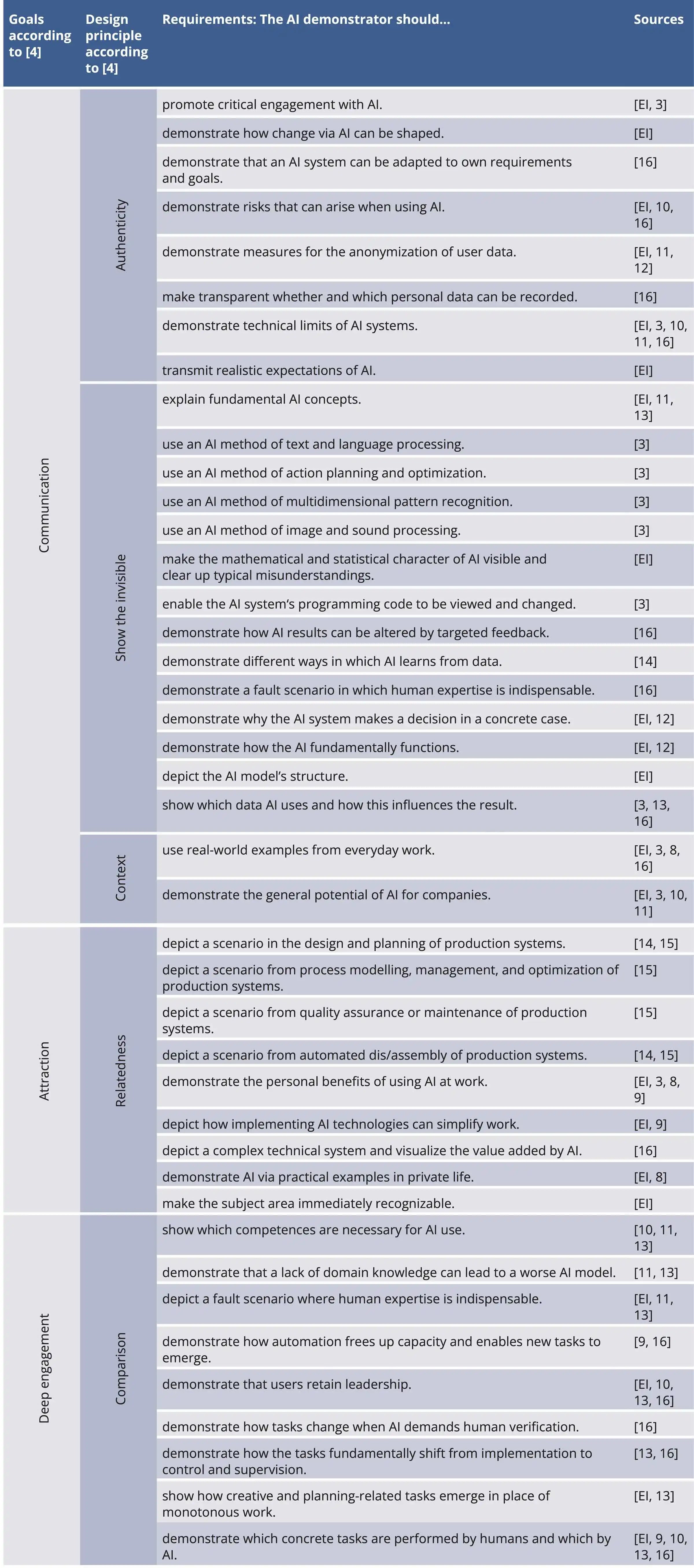
Based on the analysis, a total of 69 requirements for AI demonstrators were identified, including 42 functional requirements, 22 quality requirements, and five overarching constraints. The functional requirements address content-related and didactic characteristics, while the quality requirements focus on user experience, design, and operation. The constraints describe fundamental prerequisites for the development of AI demonstrators.
The functional requirements were structured according to the goals and design principles outlined in [4] (Fig. 2). These include requirements aimed at transparency, expectation management, and the contextualization of AI systems. Several experts emphasize that demonstrators should also specifically highlight the limitations and errors of AI in order to counteract inflated expectations. A technical expert illustrates this with an example: [One should] make the limitations visible in the demonstrator by showing what was necessary to achieve the result and everything that was done to make it work […] Then one could take a small and seemingly obvious next step, one that a human would still be able to understand […] whereas the AI system […] would fail completely.”
This perspective is supported by both the market and the literature analysis. It underscores the importance of realistic expectation management as a central function of AI demonstrators.
In addition to highlighting technical limitations, illustrating concrete potential benefits is essential. As one company representative explains: “For production workers, the demonstrator needs to highlight the personal benefits much more clearly and at an earlier stage […].“
Accordingly, functional requirements include practical scenarios, everyday examples, and the visualization of concrete ways in which work is made easier.
The quality requirements were structured according to the categories in [6] as well as supplementary categories derived from the analysis (Fig. 3). In addition to traditional aspects such as reliability and usability, requirements related to design, visual impact, and user experience stand out. As one AI developer puts it: “Something where you can try things out for yourself […] and not only see the AI’s decisions on the screen, but actually experience them physically […], that’s naturally always a crowd-pleaser.”
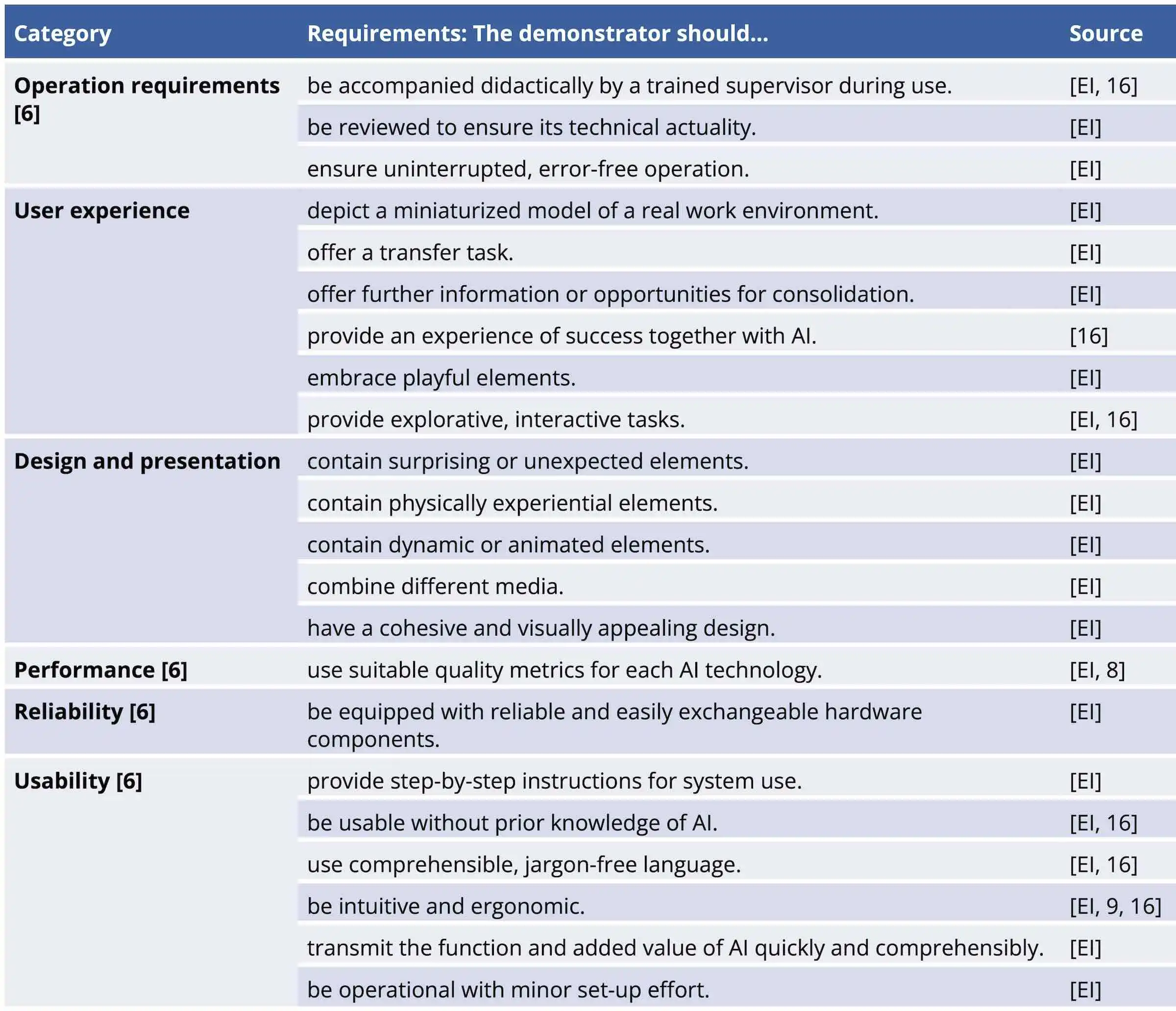
In addition, the following five constraints were identified that pertain to the development and design process of AI demonstrators [EI]:
- The demonstrator’s objective must be defined before system development begins.
- The target audience must be clearly defined before system development begins.
- Before implementation, a storyboard must be created that fully describes the application workflow, interactions, and inputs and outputs.
- Development proceeds iteratively, with progress regularly verified with appropriate tests.
- During development, various usage scenarios—including relevant disruptive factors—are taken into account and used in tests to evaluate robustness.
Promoting acceptance is not based on individual design features
The derived requirements make it clear that using demonstrators to promote AI acceptance in production is not based solely on individual design features. Rather, success arises in the interplay of technical implementation, user experience, and didactic integration.
Individual requirements cannot be considered in isolation. There are areas of tension between, e.g., accessibility and technical depth, expectation management and positive portrayal of benefits, and explainability and model complexity. These conflicting goals illustrate that not all requirements can be fulfilled simultaneously; they must be prioritized depending on the context. The diversity of requirements is also one argument against a singular demonstrator. A multi-demonstrator approach is called for to address different technologies, usage contexts, and emotional reactions in a nuanced way. Specific demonstrators could be provided for specific technologies or applications, for example, allowing users to quickly grasp the benefits before developing a deeper understanding.
The results must be interpreted in light of several limitations. The requirements can only be verified to a limited extent, as they were primarily derived from qualitative analyses and no quantitative thresholds are available. While general formulations facilitate broad application, they make verification more difficult. Furthermore, the requirements were not prioritized, so no conclusions can be drawn regarding the particular importance of certain requirements in practice. Potential end users—that is, production staff—were not directly involved in the empirical study. The requirements are based primarily on expert knowledge, supplemented by by a user-centered extension using personas. While this addresses emotional patterns, it does not capture the direct experience of future users.
These limitations highlight the need for further research, particularly regarding the empirical prioritization of the requirements. A study involving industrial employees and managers is planned to further prioritize the requirements. In addition, the design and development of a multi-demonstrator concept is planned to evaluate the impact of demonstrators on acceptance and emotional perception in real-world applications.
The authors would like to thank the Federal Ministry of Research, Technology, and Space (BMFTR) for funding the WIRKsam project (02L19C600ff), within the framework of which this article was written. The authors are solely responsible for the content of this publication.
Bibliography
[1] Link, J.; Stowasser, S.: Negative Emotions Towards Artificial Intelligence in the Workplace – Motivation and Method for Designing Demonstrators. In: Degen, H.; Ntoa, S. (eds.): Artificial Intelligence in HCI. Cham 2024.[2] Feggeler, N.; Harlacher, M.; Link, J.; Jeske, T.: ifaa-Trendstudie: Zukunftstechnologien. URL: www.arbeitswissenschaft.net/fileadmin/user_upload/ifaa_Trendstudie_Auswertung_Zukunftstechnologien_3.pdf, accessed 14.04.2026
[3] Link, J.; Feggeler, N.; Harlacher, M.; Stowasser, S.: Making AI understandable: Systematisation of AI demonstrators in the production context. In: Procedia Computer Science 277 (2026), pp. 1941–1952.
[4] Bobbe, T.; Opeskin, L.; Lüneburg, L.-M.; Wanta, H.; Pohlmann, J.; Krzywinski, J.: Design for communication: how do demonstrators demonstrate technology? In: Design Science 9 (2023).
[5] Mayring, P.; Fenzl, T.: Qualitative Inhaltsanalyse. In: Baur, N.; Blasius, J. (eds.): Handbuch Methoden der empirischen Sozialforschung. Wiesbaden 2022.
[6] Pohl, K.; Rupp, C.: Basiswissen Requirements Engineering. Aus- und Weiterbildung nach IREB-Standard zum Certified Professional for Requirements Engineering Foundation Level. Heidelberg 2021.
[7] Link, J.; Stowasser, S.: Design principles for AI Demonstrators: Insights from Expert Interviews. In: Artificial Intelligence in HCI – Lecture Notes in Computer Science. In print.
[8] Baroni, I.; Calegari, G.; Scandolari, D.; Celino, I.: AI-TAM: a model to investigate user acceptance and collaborative intention inhuman-in-the-loop AI applications. In: Human Computation 9 (2022).
[9] Link, J.; Stowasser, S.: Acceptance of AI in the workplace: Literature analysis and process-oriented methods to foster organizational acceptance and trust of AI. In: Ahram, T.; Karwowski, W.; Kalra, J. (eds.): Human Factors in Design, Engineering, and Computing. USA 2025.
[10] Franken, S.; Mauritz, N.; Prädikow, L.: Kompetenzen für KI-Anwendungen: Theoretisches Modell und partizipative Erfassung und Vermittlung in Unternehmen. In: GfA (ed.): Technologie und Bildung in hybriden Arbeitswelten. Magdeburg 2022.
[11] Baumgartner, M.; Horvat, D.; Kinkel, S.: Künstliche Intelligenz in der Arbeitswelt – Eine Analyse der Kompetenzbedarfe auf Unternehmensebene. In: GfA (ed.): Nachhaltig Arbeiten und Lernen. Analyse und Gestaltung lernförderlicher und nachhaltiger Arbeitssysteme und Arbeits- und Lernprozesse. Hannover 2023.
[12] Hein, P.; Simon, K.; Kögel, A.; Löffler, T.; Bullinger-Hoffmann, A.: Menschzentrierte Einführung von Künstlicher Intelligenz in Produktion und Engineering. In: Zeitschrift für wirtschaftlichen Fabrikbetrieb 120 (s1) (2025), pp. 12–16.
[13] Pokorni, B.; Braun, M.; Knecht, C.: Menschzentrierte KI-Anwendungen in der Produktion – Praxiserfahrungen und Leitfaden zu betrieblichen Einführungsstrategien. DOI: https://doi.org/10.24406/publica-fhg-300817.
[14] Presciuttini, A.; Cantini, A.; Costa, F.; Portioli-Staudacher, A.: Machine learning applications on IoT data in manufacturing operations and their interpretability implications: A systematic literature review. In: Journal of Manufacturing Systems 74 (2024), pp. 477–486.
[15] Gao, R. X.; Krüger, J.; Merklein, M.; Möhring, H.-C.; Váncza, J.: Artificial Intelligence in manufacturing: State of the art, perspectives, and future directions. In: CIRP Annals 73 (2024), pp. 723–749.
[16] Link, J.; Harlacher, M.; Stowasser, S.: Demonstratoren zur Verringerung negativer Emotionen gegenüber Künstlicher Intelligenz in der Produktion: Eigenschaften und Anforderungen auf Basis von Personas. In: GfA (ed.): Menschengerechte Arbeitsgestaltung. Kassel 2026.
Your downloads
Potentials: Leadership Management
You might also be interested in