Generative AI in Organizational Knowledge Management |
AI literacy as a prerequisite for augmentation

| Journal | Industry 4.0 Science |
| Issue | Volume 42, 2026, Edition 5, Pages 118-126 |
| Open Access | https://doi.org/10.30844/I4SE.26.5.14 |
| Bibliography | Share | Cite | Download |
Abstract
Article
The use of generative artificial intelligence (GenAI) ideally leads to augmentation—both of the workforce and of the organizational processes in which it is deployed [1]. In general terms, augmentation means that something grows in size or develops positively. According to a meta-analysis by Bear et al. [1, p. 760], this applies to four distinct areas: “body, cognition, work, and performance.”
In industrial applications—such as customer service or maintenance work—these four areas should not be considered in isolation. The augmentation of the individual, work output, and organizational performance are interrelated. From a sociotechnical perspective, the use of AI serves the joint optimization of both people and the organization [2].
However, areas of tension may arise. For example, an increase in organizational output can come at the expense of employee skills because AI-based automation means that they no longer apply their expertise in task completion. A user study by Lee et al. [3] suggests that individuals tend to limit their critical thinking when collaborating with GenAI.
With regard to organizational performance, Pereira et al. [4] show that the productivity potential of AI in operational applications often remains unrealized at U.S. companies. They note that this is not due to the technology itself but rather a failure to align the technology with the organizational context.
Organizational knowledge management is one fruitful area for GenAI optimization [5]. The primary aims are:
- to ensure that the knowledge critical to organizational performance and problem-solving is available at all times and
- to continuously develop the relevant knowledge base.
This includes knowledge about (technological) artifacts, organizational routines, and processes, as well as the individual, person-specific knowledge of employees (Fig. 1). The goal is to make this knowledge available independently of the individual knowledge holders and to ensure it is accessible at all times to employees involved in the organizational performance process [6].
When GenAI is deployed, it provides codified knowledge but also facilitates internal knowledge exchange—from problem identification to problem-solving—for the mutual benefit of both the organization and the individual. GenAI-based knowledge management systems can strengthen an organization’s resilience against critical influences, protect against the loss of knowledge holders, and at least partially compensate for the shortage of skilled workers [7, 8]. It can also enhance the capacity of available employees to act by reducing their dependence on other individual knowledge holders and, ideally, enabling them to gain new knowledge and experience.
This is where our article can contribute. We aim to specify the conditions under which GenAI contributes to an augmentation that strengthens system resilience while simultaneously developing the capabilities of human experts [1]. To this end, we focus on organizational knowledge management and specify the challenges for typical application areas such as industrial maintenance. We also identify the necessary prerequisites with regard to employees’ AI literacy. A qualitative empirical study carried out at a medium-sized pump manufacturer illustrates approaches to the joint optimization of GenAI, revealing that the use of GenAI leads to the augmentation both of processes and members of the workforce. Whether this succeeds depends on whether professional skills and AI literacy are developed interdependently.
Augmentation of processes through GenAI: Knowledge management in industrial maintenance
Industrial maintenance can be corrective—that is, focused on repairing machines when malfunctions occur—or preventive, preventing malfunctions in the sense of predictive maintenance [9]. The unique potential of GenAI for optimizing industrial maintenance is seen in the predictive function [10, 11]. Using large language models (LLMs), AI agents can be generated to take on prospective maintenance roles [12] requiring access to libraries of codified maintenance-related knowledge. Key performance indicators for AI-based augmentation range from reduced downtime to increased resilience [13]. First of all, a knowledge management system must be established.
With regard to establishing a knowledge management system for the field of industrial maintenance, it should be noted that operational work processes require both explicit and tacit knowledge [14]. Explicit knowledge refers to original blueprints, subsequent modifications, limit values, functionalities, or other characteristics of machines and systems—that is, artifacts in the broadest sense. This knowledge is usually documented, although the quality of the documentation varies.
Tacit knowledge is associated with human expertise and experience. It is rarely codified, more ephemeral and has a procedural or episodic character as it is developed informally in the course of work. Experienced employees recall critical incidents and the ways in which these were resolved, including using unconventional methods.
Explicit and tacit knowledge are not distinct but interconnected to varying degrees [15], both in the case of organizational and individual knowledge. The latter comprises both explicit components—i.e., those reflected in qualifications—and tacit components—i.e., those built on experience. In industrial maintenance, all components of knowledge are required. Procedural knowledge about system environments goes hand in hand with knowledge about the technical artifact. Due to the lack of documentation, tacit knowledge appears to be a greater bottleneck than explicit knowledge and is particularly critical to success: “Tacit knowledge is fundamental in maintenance due to the diverse and often non-routine nature of tasks, the involvement of multiple disciplines, and the constant evolution of technology” [7, p. 1].
If a GenAI-supported knowledge management system is to be established, it must include all knowledge components (Fig. 1):
- Bibliographic knowledge about the machines and systems (artifacts) already mapped in GenAI and
- supplementary firm-specific knowledge about artifacts and organizational routines and processes. This is documented in some places but is mostly unstructured.
- Person-specific knowledge, which includes the skills and knowledge acquired by employees in training, as well as
- their tacit knowledge built up through experience, which is often difficult to make explicit.
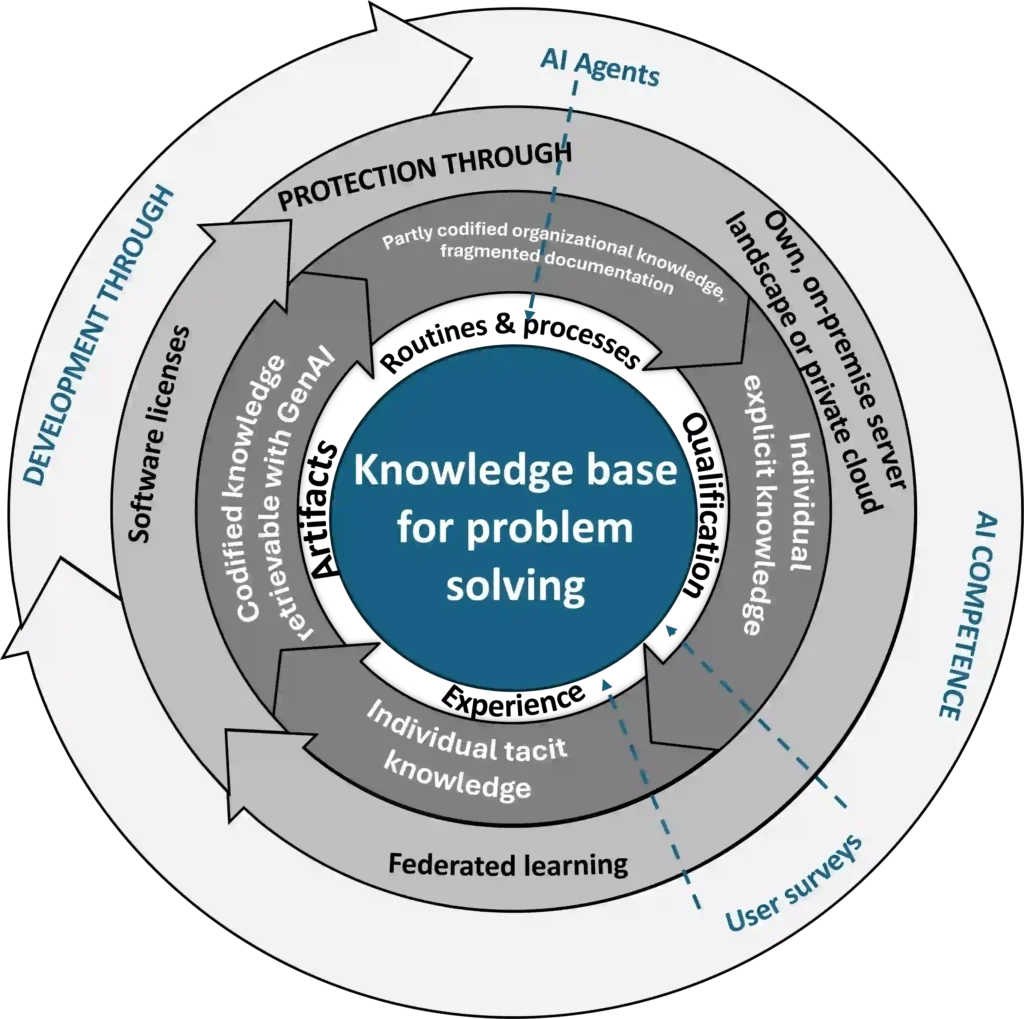
The GenAI system provides the first knowledge component and prioritizes it over other types of knowledge when it comes to problem-solving. The second component requires operational data preparation, a process in which GenAI can also provide support. To do this, LLMs must be able to access knowledge codified within the organization. This can be achieved by defining distinct roles for AI agents to handle this task [16].
Qualifications, as the third component, come into play through personnel deployment, whereby staff members are assigned tasks that match their skills and apply these skills beyond their own workstations to broader organizational operations. Dealing with AI can present an additional challenge here. For tacit knowledge—the fourth component—ways are being sought to make it available independently of individual experts [7, 17]. This can occur through the use of and interaction with AI [5].
Even in his early writings, Nonaka [14, 18] addresses how to make tacit knowledge accessible and identifies various learning processes. A key focus is the specific contribution of tacit knowledge for gaining and sustaining competitive advantages. To make tacit knowledge accessible independently of specific individuals, it must either be externalized through documentation or learned from one tacit source to another through socialization, whereby a task domain is intuitively understood within a shared experiential space and internalized by other experienced individuals [18]. Externalization increases reach while potentially diminishing the specific advantages that tacit knowledge offers. Socialization better preserves the knowledge but is limited in its scope.
GenAI-based organizational knowledge management can support both learning approaches [5]. GenAI makes it possible to extract previously inadequately documented organizational and individual knowledge from a wide variety of available sources (email threads, voice messages, brief minutes, digital notes, etc.) and keep it readily accessible for critical problem-solving situations. User queries reveal the task areas in which additional knowledge is needed, so that the social system becomes recognizable and visible through the digital system [19]. This interaction also leads to system development that, in the future, will enable LLM-based preventive condition monitoring using operational documents.
When it comes to learning from tacit to tacit, federated learning [20] provides a useful security measure, as it allows for the structured use of data without prior externalization. Questions related to what, where and how knowledge is required is specified from the user logic. This is a considerable advancement compared to early knowledge management systems, which were heavily oriented toward the perspective of the knowledge holder [5]. GenAI instead mediates from the perspective of users. It should be noted that an LLM continuously modifies the knowledge base in this process, which poses challenges for reliability. For this reason, augmentation through GenAI always requires a high level of user competence.
Augmentation of individuals through GenAI: AI literacy and user behavior
Augmentation aims to enable employees to expand their capability in performing tasks and solving problems, rather than gradually losing expertise or ceding it to technology [21]. The set of skills required to effectively utilize AI for problem-solving while simultaneously developing one’s own skill set is referred to as AI literacy. This encompasses not only the competent use of GenAI tools but also the background knowledge of large language models (LLMs) necessary to anticipate how the technology operates. Another dimension is the critical reflection on AI-generated suggestions, supplemented by an ethical assessment of the impacts of AI use. Promma et al. [22] were able to identify four AI literacy dimensions of working with GenAI through factor analysis:
- User competence to consistently leverage GenAI for problem-solving processes (also described, in simplified terms, as prompt engineering);
- basic knowledge of how GenAI works [23];
- analytical skills for critically reflecting on AI-generated propositions and the underlying data. This capacity for reflection requires the domain expertise to make judgments independently [24];
- ethical responsibility regarding both the origin of the data and the overall consequences of AI use [3, 25].
GenAI user studies show that individuals’ critical reflection is changing. The critical evaluation of a proposition is no longer primarily driven by domain knowledge but has shifted to the question of AI trustworthiness [3]. This could imply that augmentation on the system level goes along with a negative impact on employees in the long run, as their contribution is successively based less on their own expertise but increasingly on their situated trust in the AI.
In the context of industrial maintenance, this would mean that employees who draw on AI support and expand their GenAI-specific competence would less frequently activate their professional maintenance skills. As a result, their individual explicit and tacit knowledge would gradually decline.
User behavior is therefore decisive in determining how AI literacy is developed in combination with professional, domain-specific expertise. The conditions under which simultaneous augmentation at both the organizational and individual levels—or joint optimization—is achieved, and the conditions under which it fails, require empirical validation.
Case study on AI interaction at a pump manufacturer
Between February and October 2025, Langholf et al. [26] conducted a case study at a medium-sized pump manufacturer that is part of a larger American corporation. There, GenAI (Copilot) was introduced for all employees with desktop workstations, following instructions from the American parent company. This applies to all positions in technical service and maintenance, though it is not limited to these departments. Overall, the goal was to optimize work processes while establishing a knowledge management system.
The case study involves monitoring the implementation phase to observe changes in processes, including the augmentation of both processes and individuals. Qualitative user interviews were conducted at two points of measurement, each with twelve employees, first during the implementation period and then six months later. Information about the user interaction with GenAI was captured from self-reports. The collected data was then analyzed using longitudinal thematic analysis [27, 28].
Overall, it can be observed that employees develop AI agents to optimize operational processes and mutually train each other in prompt engineering with the help of a so-called champion program.
Process optimization, process innovation and organizational learning
On the organizational level, two issues of augmentation could be observed: the enhancement of efficiency in existing processes and the advancement of organizational learning processes for innovation. For optimization, AI agents are used to translate recurring prompts and workflows into automated processes that can be systematically reproduced. Entire process chains can be automated in this way, with AI agents reducing multi-step workflows (e.g., data search, enrichment, and verification) by eliminating manual intermediate steps (e.g., searching for specific pieces of information). AI agents lead to significant time savings, particularly for repetitive tasks, both in terms of individual task completion and overall process times.
For process innovation, an internal database of frequently used documents is further developed towards an organizational knowledge management system, systematically utilized by AI agents to extract support for individual requests. This facilitates the onboarding and training of employees regardless of the availability of individual experts, while avoiding delays in the work process caused by searches for knowledge. Based on the positive experiences in individual use cases and as an expression of internal organizational learning, each department develops AI agents for specific problems. This fosters organization-wide, experimental process innovation.
Workforce augmentation
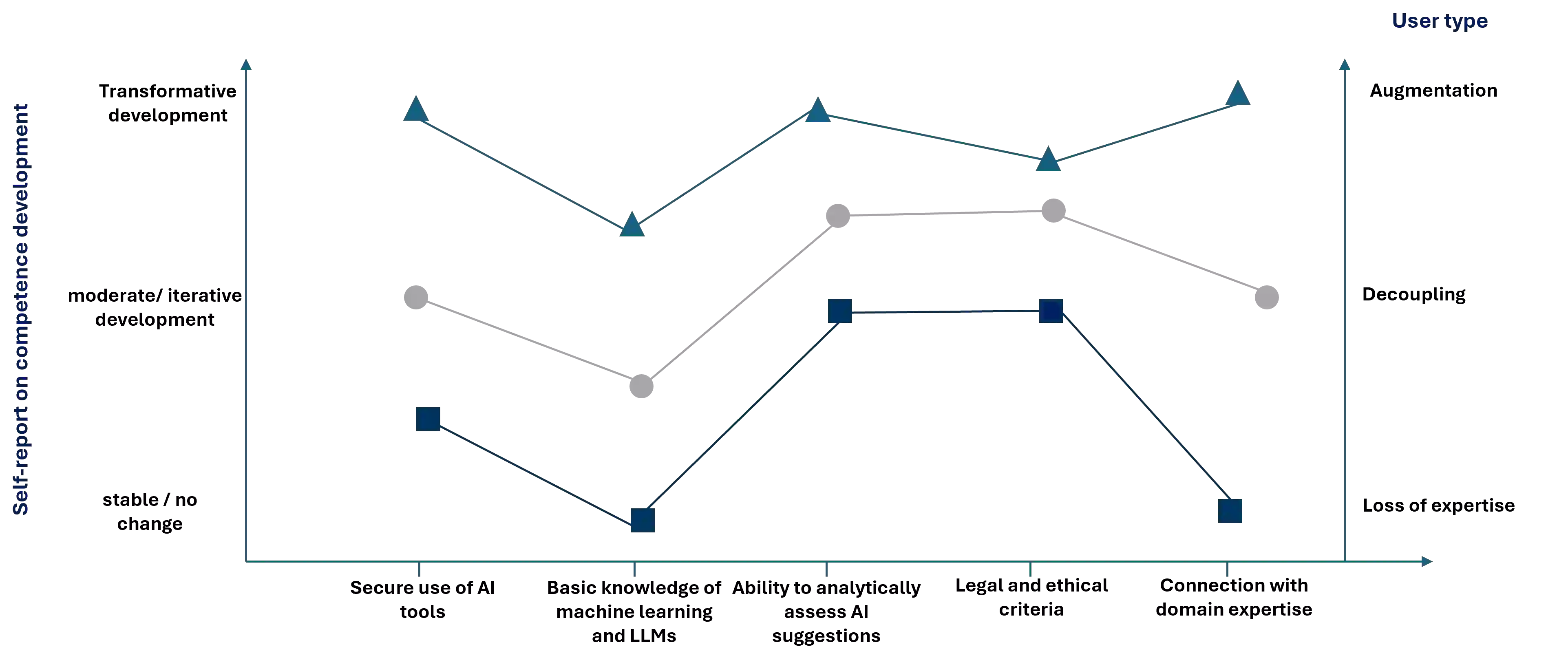
Ideally, process augmentation goes hand in hand with workforce augmentation. The qualitative interviews reveal that this requires a specific type of user, which can currently only be observed among a sub-group of employees. Workforce augmentation occurs when the affected workers combine their AI literacy with domain expertise across the four aforementioned AI literacy dimensions (Fig. 2). Three distinct user types were identified. They differ in how AI literacy is developed according to Promma et al.’s dimensions [22] and how it is linked to—or decoupled from—professional expertise, i.e. in customer service or maintenance.
The “augmented type” experiences competence development while enhancing cognitive skills beyond GenAI usage by also including creative outcomes and extended contextual domain knowledge. This goes along with process optimization activities in terms of improved depth of solutions, uninterrupted workflow, etc.
The “decoupled type” uses AI only for peripheral tasks that do not—or hardly—touch upon their own core professional qualifications (domain expertise). This decoupling is a strategy consciously pursued by the individual to protect their expertise. The user’s knowledge of prompt engineering and their background knowledge of LLMs is less extensively developed compared to the first type. While protecting their expertise the employees do not experience additional development or expansion, meaning that the protected aspect may gradually become outdated.
The “loss of expertise type” comes about as a result of fear that human competence may decline due to AI usage. Here, the ethical and reflective dimensions of AI literacy are developed slightly but remain separated from other dimensions of AI literacy or professional domain-specific skills.
The results of the case study show that the joint optimization of processes and employees is ensured when AI users undergo a transformative development across all dimensions of AI literacy—user competence, foundational knowledge, analytical and critical-reflective skills, and ethical judgment—and combine them with their domain expertise when performing tasks. Only with these prerequisites does individual explicit and tacit knowledge expand. In this scenario, prompting skills continuously grow, routines for comprehensive critical review are established, and new workflows emerge based on increasing individual competences. In this case, individual and organizational knowledge provided by the organization’s process landscape continuously co-evolve (Fig. 1).
Summary of GenAI-based knowledge management in industrial maintenance
The aim of our study was to better understand the conditions under which the use of GenAI can support operational knowledge management in industrial maintenance by simultaneously augmenting both processes and human expertise [1]. A necessary condition is the ability to handle the diverse and interlinked knowledge components required for operational maintenance. Accordingly, the approach encompassed explicit knowledge about artifacts, firm-specific knowledge about routines and processes, as well as the explicit and tacit knowledge of the maintenance employees.
If GenAI-based augmentation is to join company-specific and individual knowledge as a critical source of competitive advantage, a commercially available GenAI solution must be combined with an on-premises approach or a private cloud solution hosted in Europe. This means that the technology is either hosted and operated on the organization’s own, secure server infrastructure [29] or that a high level of security is ensured in a cloud environment. Under these safety conditions, an organizational knowledge base can be developed and accessed by AI agents.
Moreover, the users’ interaction with the GenAI fosters the sharing of personal explicit and tacit knowledge within an organization while protecting it from access through potential external users. To enable this process, AI agents must be programmed with different roles for knowledge processing and structuring (Fig. 1).
According to the case study results, achieving an augmentative effect—in which employees expand their expertise and tasks while contributing to workflow optimization—requires a high level of AI literacy combined with domain expertise [24]. Comprehensive AI literacy training tailored to specific operational application areas is therefore a key practice for organizations. Core outcomes include efficiency gains and enhanced resilience [13] on both the process and individual levels.
The case study analysis is an example of an in-depth exploration of organizational knowledge management for a specific GenAI application area, which takes into account both the process and individual levels. Statements regarding the frequency of augmentation and GenAI user types require a quantitative research approach, which may be the subject of future studies.
This article was written as part of the BMFTR-funded project (HUMAINE Competence Center: Ruhr Metropolis Transfer Hub for human-centered work with AI, grant number: 02L19C200).
Bibliography
[1] Baer, I.; Waardenburg, L. et al.: What Is Augmented? A Metanarrative Review of AI-Based Augmentation. In: Journal of the Association for Information Systems 26 (2025) 3, pp. 760–798.[2] Parker, S. K.; Grote, G.: Automation, Algorithms, and Beyond: Why Work Design Matters More Than Ever in a Digital World. In: Applied Psychology 71 (2022) 4, pp. 1171–1204.
[3] Lee, H.; Sarkar, A. et al.: The Impact of Generative AI on Critical Thinking: Self-Reported Reductions in Cognitive Effort and Confidence Effects From a Survey of Knowledge Workers. In: Proceedings of the 2025 CHI Conference on Human Factors in Computing Systems. New York 2025.
[4] Pereira, E.; Graylin, A., et al.: The Enterprise AI Playbook: Lessons from 51 Successful Deployments. Stanford 2026.
[5] Böhm, D.; Durst, S.: Knowledge Management in the Age of Generative Artificial Intelligence—From SECI to GRAI. In: VINE Journal of Information and Knowledge Management Systems (2026) 56, pp. 106–121.
[6] Alavi, M.; Leidner, D., et al.: A knowledge management perspective of generative artificial intelligence. In: Journal of the Association for Information Systems (2024) 25, pp. 1–12.
[7] Aedo, I.; Onorati, T., et al.: Bridging the Gap between Knowledge and Human Expertise: Integrating Explicit and Tacit Knowledge in Maintenance Operations. In: CEUR Workshop Proceedings 3978. Munich 2025.
[8] Wilkens, U.; Polte, J., et al.: Bridging Knowledge Gaps with GenAI in Industrial Maintenance: Specific Needs and Contextualized Solutions. In: Industrie 4.0 Science 41 (2025) 5, pp. 52–57.
[9] Otto, F.: Assistenzsysteme für kontextsensitive Informationsbereitstellung in der operativen Instandhaltung von Werkzeugmaschinen. Doctoral dissertation, TU Berlin, 2026.
[10] Li, X.; Wang, P. et al.: Generative AI for Predictive Maintenance in Manufacturing: A Survey. In: Procedia CIRP 139 (2026), pp. 35–40.
[11] Mikołajewska, E.; Mikołajewski, D., et al.: Generative AI in AI-Based Digital Twins for Fault Diagnosis for Predictive Maintenance in Industry 4.0/5.0. In: Applied Sciences 15 (2025) 6, p. 3166.
[12] Jiang, W.; Hu, F.: Artificial Intelligence Agent-Enabled Predictive Maintenance: Conceptual Proposal and Basic Framework. In: Computers 14 (2025) 8, p. 329.
[13] Bukowski, L.; Werbinska-Wojciechowska, S.: “Toward Maintenance 5.0: Resilience-Based Maintenance in AI-Driven Sustainable and Human-Centric Industrial Systems.” In: Sensors 25 (2025) 16, p. 5100.
[14] Nonaka, I.: The Knowledge-Creating Company. In: Harvard Business Review on Knowledge Management (1998), pp. 21–45.
[15] Dienes, Z.; Perner, J.: A theory of implicit and explicit knowledge. In: Behavioral and Brain Sciences 22 (1999), pp. 735–808.
[16] Gao, S.; Fang, A. et al.: Empowering biomedical discovery with AI agents. In: Cell (2024) 187, pp. 6125–6151.
[17] Ottersböck, N.; Dander, H., et al. (Eds.): Wissensmanagement mit Künstlicher Intelligenz: Erfahrungswissen effizient sichern und transferieren. Berlin 2026.
[18] Nonaka, I.; Takeuchi, H.: The Knowledge-Creating Company: How Japanese Companies Create the Dynamics of Innovation. New York/Oxford 1995.
[19] Leonardi, P.; Treem, J.: Behavioral Visibility: A New Paradigm for Organization Studies in the Age of Digitization, Digitalization, and Datafication. In: Organization Studies 41 (2020) 12, pp. 1601–1625.
[20] Koppelmann, T.; Becker, L. et al.: Clustering-Based Wake Word Detection in Privacy-Aware Acoustic Sensor Networks. In: Interspeech. Incheon 2022.
[21] Wilkens, U.; Lutzeyer, I., et al.: Augmenting Diversity in Hiring Decisions with Artificial Intelligence Tools (Special Issue on Interdisciplinary Narratives on Artificial Intelligence and Personnel Selection Systems). In: The International Journal of Human Resource Management 36 (2025) 14, pp. 2585–2622.
[22] Promma, W.; Imjai, N., et al.: The influence of AI literacy on complex problem-solving skills through systematic thinking skills and intuitive thinking skills: An empirical study among Thai Gen Z accounting students. In: Computers and Education: Artificial Intelligence 8 (2025), p. 100382.
[23] Hönigsberg, S.; Mallek, S. et al.: Measuring AI Literacy of Future Knowledge Workers: A Mediated Model of AI Experience and AI Knowledge. In: 20th International Conference on Business Informatics. Münster 2025.
[24] Tambe, P.: Reskilling the Workforce for AI: Domain Expertise and Algorithmic Literacy. In: Management Science 72 (2025), no. 1.
[25] Bankins, S.; Formosa, P.: The Ethical Implications of Artificial Intelligence (AI) for Meaningful Work. In: Journal of Business Ethics 185 (2023) 4, pp. 725–740.
[26] Langholf, V.; Wilkens, U. et al.: User Behavior and the Evolution of GenAI Literacy – A Qualitative Trajectory Analysis. In: Paper for the EURAM 2026 conference proceedings. Kristiansand 2026.
[27] Braun, V.; Clarke, V.: Using thematic analysis in psychology. In: Qualitative Research in Psychology 3 (2006) 2, pp. 77–101.
[28] Spencer, L.; Radcliffe, L. et al.: Thematic Trajectory Analysis: A Temporal Method for Analyzing Dynamic Qualitative Data. In: Journal of Occupational and Organizational Psychology 94 (2021) 3, pp. 531–567.
[29] Pahl, C.; Xiong, H., et al.: A Comparison of On-Premise and Cloud Migration Approaches. In: Lau, KK.; Lamersdorf, W.; Pimentel, E. (Eds.): Service-Oriented and Cloud Computing. ESOCC 2013. Lecture Notes in Computer Science, 8135. Berlin, Heidelberg 2013.
Your downloads
Potentials: Innovation Strategy
Solutions: Process Management
You might also be interested in