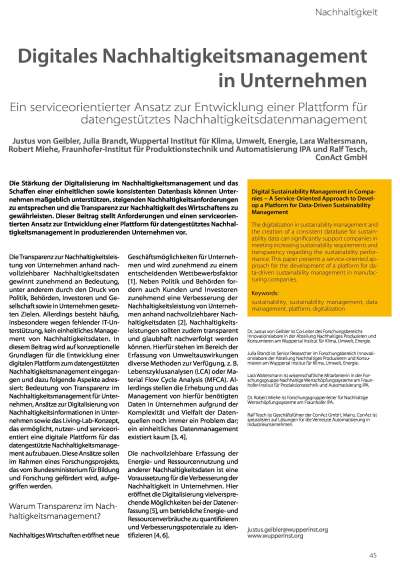
Digital Sustainability Management in Companies

A Service-Oriented Approach to Develop a Platform for Data-Driven Sustainability Management

JournalIndustrie 4.0 Management
Issue Volume 38, 2022, Edition 1, Pages 45-47
Open Accesshttps://doi.org/10.30844/I40M_22-1_45-47
Bibliography Share Cite Download

Abstract

The digitalization in sustainability management and the creation of a consistent database for sustainability data can significantly support companies in meeting increasing sustainability requirements and transparency regarding the sustainability performance. This paper presents a service-oriented approach for the development of a platform for data-driven sustainability management in manufacturing companies.

Keywords


Bibliography

[1] Löser, F.: Strategic Information Systems Management for Environmental Sustainability: Enhancing Firm Competitiveness with Green IS. Berlin 2015.
[2] Seidel, S.; Recker, J.; Vom Brocke, J.: Sensemaking and Sustainable Practicing: Functional Affordances of Information Systems in Green Transformations. In: MIS Quarterly 37 (2013) 4, S. 1275-1299.
[3] Schaltegger, S.; Burritt, R.: Contemporary environmental accounting. Issues, concepts and practice. Sheffield 2017.
[4] Burritt, R.; Christ, K.: Industry 4.0 and environmental accounting: a new revolution? In: AJSSR 1 (2016) 1, S. 23-38. DOI: 10.1186/s41180-016-0007-y.
[5] Geibler, J. v.; Wiesen, K.; Mostyn, R.; Werner, M.; Riera, N. u. a.: Forming the Nucleus of a Novel Ecological Accounting System. The myEcoCost Approach. In: Key Engineering Materials, Vol. 572 (2014), S. 78-83.
[6] VDI Zentrum Ressourceneffizienz GmbH (VDI ZRE): Ressourceneffizienz durch Industrie 4.0 – Potenziale für KMU des verarbeitenden Gewerbes. VDI ZRE 2017. ULR: www.ressource-deutschland.de/fileadmin/user_upload/downloads/studien/VDI-ZRE_Studie_KI-betriebliche-Ressourceneffizienz_Web_bf.pdf, Abrufdatum 15.09.2021.
[7] Schaltegger, S.; Herzig, C.; Kleiber, O.; Klinke, T.; Müller, J.: Nachhaltigkeitsmanagement in Unternehmen. Von der Idee zur Praxis: Managementansätze zur Umsetzung von Corporate Social Responsibility und Corporate Sustainability. Lüneburg 2007.
[8] WBGU: Unsere gemeinsame digitale Zukunft. Zusammenfassung. 1. Auflage. Berlin 2019.
[9] Miehe, R.; Waltersmann, L.; Sauer, A.; Bauernhansl, T. Sustainable production and the role of digital twins—Basic reflections and perspectives. J. Adv. Manuf. Process. 2021, 3.
[10] Barni, A.; Fontana, A.; Menato, S.; Sorlini, M.; Canetta, L.: Exploiting the Digital Twin in the Assessment and Optimization of Sustainability Performances. In: International Conference on Intelligent Systems. 2018.
[11] Waltersmann, L.; Kiemel, S.; Stuhlsatz, J.; Sauer, A.; Miehe, R. Artificial Intelligence Applications for Increasing Resource Efficiency in Manufacturing Companies—A Comprehensive Review. Sustainability 2021, 13, 6689.
[12] Conrad C.: ERP for ESG: Nachhaltigkeitsmanagement mit Software-Systemen. In: CSR und Finance 2014. DOI: 10.1007/978-3-642-54882-6_13.
[13] Bischof, C.; Winkler, H.: Zeitgemäßes Umweltcontrolling mit SAP. In: Tschandl, M.; Posch, A. (eds): Integriertes Umweltcontrolling. Wiesbaden 2012.
[14] Al Assadi, A.; Waltersmann, L.; Miehe, R.; Fechter, M.; Sauer, A.: Automated Environmental Impact Assessment (EIA) via Asset Administration Shell. In: Weißgraeber, P.; Heieck, F.; Ackermann, C. (eds): Advances in Automotive Production Technology – Theory and Application. ARENA2036. Berlin Heidelberg 2021. https://doi.org/10.1007/978-3-662-62962-8_6.
[15] DIN und DKE: Deutsche Normungsroadmap Industrie 4.0 Version 3. 2018.
[16] Warnke, P.; Koschatzky, K.; Dönitz, E.; Zenker, A. u. a.: Opening up the innovation system framework towards new actors and institutions. Discussion Papers Innovation Systems and Policy Analysis, No. 49. Karlsruhe 2016.
[17] Bartle, M.: Open Innovation. Der offene Umgang mit Wissen verändert das Innovationsmanagement. In: pen Journal of Knowledge Management 1 (2010).
[18] Schneidewind, U.; Singer-Brodowski, M.: Vom experimentellen Lernen zum transformativen Experimentieren. Zeitschrift für Wirtschafts- und Unternehmensethik, 16 (2015) 1, S. 10-23.
[19] Schäpke, N.; Stelzer, F.; Caniglia, G.; Bergmann, M.; Wanner, M. u. a.: Jointly experimenting for transformation? Shaping real-world laboratories by comparing them. GAIA-Ecological Perspectives for Science and Society 27 (2018) 1, S. 85-96.
[20] Ley, B.; Ogonowski, C.; Mu, M.; Hess, J.; Race, N. u. a.: At home with users: a comparative view of Living Labs. Interacting with Computers, 27 (2015) 1, S. 21-35.
[21] Geibler, J. v.; Erdmann, L.; Liedtke, C.; Rohn, H.; Stabe, M. u. a.: Living Labs für nachhaltige Entwicklung. Wuppertal Spezial Nr. 47. Wuppertal 2013.
[22] Baedeker, C.; Piwowar, J.; Themann, P.; Grinewitschus, V.; Krisemendt, B. u. a.: Interactive Design to Encourage Energy Efficiency in Offices: Developing and testing a User-Centred Building Management System based on a Living Lab Approach. In: Sustainability, Volume 12 (2020) 17, 6956.
[23] Geibler, J. v.; Echternacht, L.; Stadler, K.; Liedtke, C.; Hasselkuß, M. u. a.: Nachhaltigkeitsanforderungen und -bewertung in Living Labs: Konzeption eines Bewertungsmodells. Wuppertal 2016.
[24] Schuurman, D.; Herregodts, A.-L.; Georges, A.; Rits, O.: Innovation Management in Living Lab Projects: The Innovatrix Framework. Technology Innovation Management Review 9 (2019) 3, S. 63-73.
[25] Liedtke, C., Baedecker, C., Hasselkuß, M., Rohn, H., Grinewitschus, V.: User-Integrated Innovation in Sustainable LivingLabs: An Experimental Infrastructure for Researching and Developing Sustainable Product Service Systems. Journal of Cleaner Production, 97. (2015), 106–116.
[26] Geibler, J. v.; Piwowar, J.; Greven, A.: The SDG-Check: Guiding Open Innovation towards Sustainable Development Goals. Technology Innovation Management Review, 9 (2019) 3, S. 20-37.

Your downloads


Potentials: Business Models

You might also be interested in

Serious Games as a Training Tool

Serious Games as a Training Tool

Game mechanics design to promote resilience
Annika Lange ORCID Icon, Thomas Knothe ORCID Icon
Unforeseen events are increasingly challenging manufacturing companies. Being resilient during crises is becoming a key competence. Serious games (SG) can help make resilience-building processes more transparent. This article derives specific requirements for SG from different phases of resilience and shows how these can be implemented in game mechanics in order to effectively support the training of resilience.
Industry 4.0 Science | Volume 42 | 2026 | Edition 2 | Pages 98-104
Serious Gaming and the Energy Transition

Serious Gaming and the Energy Transition

Collaborative knowledge generation and interactive understanding of complex interrelationships
Janine Gondolf ORCID Icon, Gert Mehlmann, Jörn Hartung, Bernd Schweinshaut, Anne Bauer
Conveying the complexity and multifaceted nature of the energy transition to a broad audience is a challenge. This article demonstrates how interactive serious games on a multitouch table can help make connections tangible and comprehensible. The games and the table were used in various conversational contexts. These are presented here in three case vignettes based on participant observation of the different applications, as well as situated and shared reflection. The vignettes demonstrate how interaction can trigger epistemic processes, enable shifts in perspective, and foster collective thinking, all of which are necessary for shaping the future of society as a whole.
Industry 4.0 Science | Volume 42 | 2026 | Edition 2 | Pages 62-69
Industrial Transformation via a Machining Learning Factory

Industrial Transformation via a Machining Learning Factory

A learning module to foster competencies for a sustainability-driven transformation
Oskay Ozen ORCID Icon, Victoria Breidling ORCID Icon, Stefan Seyfried ORCID Icon, Matthias Weigold
Sustainability-enhancing transformation processes are necessary in all sectors if we are to remain within planetary boundaries. This also applies to the industrial sector as a significant emitter of greenhouse gases. Employees need new competencies to master this complex task of industrial transformation. These range from CO2 equivalents accounting to the development and evaluation of transformation scenarios, including technical measures. The learning module developed here addresses these competency requirements and uses the example of the ETA factory to show how a competency-oriented learning module for industrial transformation can be structured. It essentially comprises four phases: data collection and CO2 equivalents accounting, cause analysis, development of measures and evaluation of measures.
Industry 4.0 Science | Volume 42 | Edition 2 | Pages 38-47 | DOI 10.30844/I4SE.26.2.38
From Brownfield to Industry 4.0

From Brownfield to Industry 4.0

Learning factories as training and testing environment for digital transformation
Jakob Weber, Sven Völker ORCID Icon
To succeed in their digital transformation, manufacturing companies need engineers with in-depth knowledge of key technologies and concepts, and a profound understanding of the transition from Industry 3.0 to Industry 4.0. This article describes the concept of a learning factory that is continuously subjected to a digital transformation, thereby creating an environment for the development of transformation competencies. The concept of digital transformation is based on digital worker assistance systems and multi-agent systems for production control. These enable the incremental integration of existing resources into the digitalized factory. The learning factory is not presented to students as a completed solution. Instead, it is continuously developed further as part of student projects. This way, it contributes directly to the qualification of personnel for the implementation of Industry 4.0.
Industry 4.0 Science | Volume 42 | 2026 | Edition 2 | Pages 88-96
AI Colleagues?

AI Colleagues?

Competence requirements and training for AI use in industry
Swetlana Franken ORCID Icon
Artificial intelligence is fundamentally changing tasks, roles, and skills in (industrial) companies. Increasingly, it acts as a colleague, preparing decisions, supporting processes, and interacting with people. This article highlights key competence requirements for AI use in industry, presents an integrated competence model, and outlines practical strategies for the transfer of skills. The aim is to prepare companies and employees for humane, competence-oriented AI implementation that combines technological efficiency with human creativity and judgment.
Industry 4.0 Science | Volume 42 | 2026 | Edition 2 | Pages 78-86
Operationalizing Ethical AI with tachAId

Operationalizing Ethical AI with tachAId

Validating an interactive advisory tool in two manufacturing use cases
Pavlos Rath-Manakidis, Henry Huick, Björn Krämer ORCID Icon, Laurenz Wiskott ORCID Icon
Integrating artificial intelligence (AI) into workplace processes promises significant efficiency gains, yet organizations face numerous ethical challenges that stakeholders are often initially unaware of—from opacity in decision-making to algorithmic bias and premature automation risks. This paper presents the design and validation of tachAId, an interactive advisory tool aimed at embedding human-centered ethical considerations into the development of AI solutions. It reports on a validation study conducted across two distinct industrial AI applications with varying AI maturity. tachAId successfully directs attention to critical ethical considerations across the AI solution lifecycle that might be overlooked in technically-focused development. However, the findings also reveal a central tension: while effective in raising awareness, the tool’s non-linear design creates significant usability challenges, indicating a user preference for more structured, linear guidance, especially ...
Industry 4.0 Science | Volume 42 | 2026 | Edition 1 | Pages 50-59 | DOI 10.30844/I4SE.26.1.48