Autor: Peter Preuss

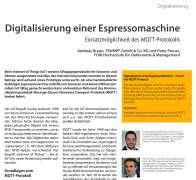
Digitalisation of an Espresso Machine

Digitalisation of an Espresso Machine

Use of the MQTT protocol
Andreas Braun, Peter Preuss
The article investigates whether a standard portafilter espresso machine can be made IoT-capable with the help of sensors and small microcontrollers and what added value the communication protocol Message Queue Telemetry Transport Protocol (MQTT) provides.
Industrie 4.0 Management | Volume 38 | 2022 | Edition 3 | Pages 53-56
Digital Transformation in International Conglomerates

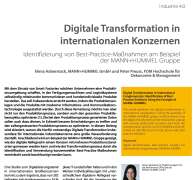
Digital Transformation in International Conglomerates

Identification of Best Practice Solutions Using the Example of MANN+HUMMEL
Elena Haberstock, Peter Preuss
The article addresses the digital transformation in international corporations. Using the example of the MANN+HUMMEL group, it will be shown how the digital maturity level can be measured in a group with several production locations and how the transformation process can be simplified and accelerated by identifying and using group-wide best practice solutions.
Industrie 4.0 Management | Volume 38 | 2022 | Edition 1 | Pages 53-56
Global IoT Platform with AWS – Prototype of a Serverless Architecture

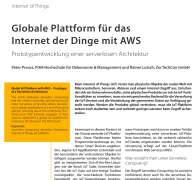
Global IoT Platform with AWS - Prototype of a Serverless Architecture

Prototypentwicklung einer serverlosen Architektur
Peter Preuss, Rainer Lutsch
The article addresses serverless computing and the criteria a serverless architecture must meet. Serverless computing allows developers to deploy applications as a set of functions without worrying about the underlying IT-infrastructure. This software paradigm is then used to implement a global IoT platform for numerous IoT devices in the AWS cloud.
Industrie 4.0 Management | Volume 36 | 2020 | Edition 5 | Pages 48-52
Agile Project Management with Scrum

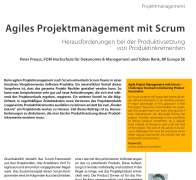
Agile Project Management with Scrum

Challenges Involved in Delivering Product Increments
Peter Preuss, Tobias Renk
In Scrum projects self-organized teams develop software products in an iterative process. A major advantage of this approach is that the project becomes more flexible. For example, the project team can react very quickly if new requirements are discussed during the project. Another advantage is the possibility to deliver product increments on a regular base instead of having to wait until the end of the project. The aim of this article is to discuss challenges that must be overcome when these regular increments are moved into the production environment.
Industrie 4.0 Management | Volume 36 | 2020 | Edition 3 | Pages 29-32