Automated Assembly of Large-Scale Water Electrolyzers

Digitale Montageplanung für eine nachhaltige Wasserstoffwirtschaft auf Grundlage von Produkt, Prozess und Ressource

JournalIndustrie 4.0 Management
Issue Volume 38, 2022, Edition 5, Pages 12-16
Open Accesshttps://doi.org/10.30844/IM_22-5_12-16
Bibliography Share Cite Download

Abstract

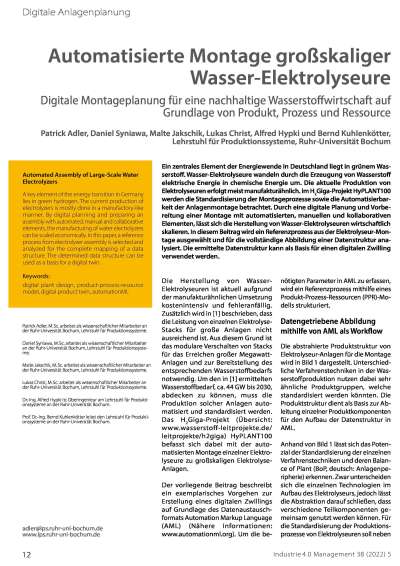
A key element of the energy transition in Germany lies in green hydrogen. The current production of electrolyzers is mostly done in a manufactory-like manner. By digital planning and preparing an assembly with automated, manual and collaborative elements, the manufacturing of water electrolyzers can be scaled economically. In this paper, a reference process from electrolyzer assembly is selected and analyzed for the complete mapping of a data structure. The determined data structure can be used as a basis for a digital twin.

Keywords


Bibliography

[1] Smolinka, T. u. a.: Studie IndWEDe Industrialisierung der Wasserelektrolyse in Deutschland: Chancen und Herausforderungen für nachhaltigen Wasserstoff für Verkehr, Strom und Wärme. URL: www.now-gmbh.de/wp-content/uploads/2020/09/indwede-studie_v04.1.pdf, Abrufdatum 02.05.2022.
[2] Schmidt, N. u. a.: AutomationML for User Requirements Fulfilment Related to Engineering Process Efficiency. In: Proceedings of the 40th Annual Conference of the IEEE Industrial Electronics Society (IECON 2014).
[3] Ruschuck, M.: Darstellung von Aufgaben der Prozessleittechnik: Fließbilder und Datenaustausch zwischen EDV-Werkzeugen zur Fließbilderstellung und CAE-Systemen. URL: www.dke.de/de/arbeitsfelder/industry/news/aufgaben-prozessleittechnik-caex, Abrufdatum 24.03.2022.
[4] Grieves, M.: Digital Twin: Manufacturing Excellence Through Virtual Factory Replication. URL: www.researchgate.net/publication/275211047_Digital_Twin_Manufacturing_Excellence_through_Virtual_Factory_Replication, Abrufdatum 29.03.2022.
[5] Jones, D. u. a.: Characterising the Digital Twin: A Systematic Literature Review, In: CIRP Journal of Manufacturing Science and Technology (29), S. 36–52 (2020). DOI: 10.1016/j.cirpj.2020.02.002
[6] Qi, Q.; Tao, F.: Digital Twin and Big Data Towards Smart Manufacturing and Industry 4.0: 360 Degree Comparison, In: IEEE Access (6), S. 3585–3593 (2018). DOI: 10.1109/ACCESS.2018.2793265
[7] Kuhlenkötter, B. u. a.: Robot Workcell Simulation with AutomationML Support: An Element of the CAx-Tool Chain in Industrial Automation. In: Conference: Robotics (ISR), 2010 41st International Symposium on and 2010 6th German Conference on Robotics (ROBOTIK).
[8] Schroeder, G. N. u. a.: A Methodology for Digital Twin Modeling and Deployment for Industry 4.0. In: Proceedings of the IEEE (109), S. 556–567 (2021). DOI: 10.1109/JPROC.2020.3032444
[9] Schyja, A.; Bartelt, M.; Kuhlenkötter, B.: From Conception Phase up to Virtual Verification Using AutomationML. In: Procedia CIRP (23), S. 171–177 (2014). DOI: 10.1016/j.procir.2014.10.067
[10] Zhang, H.; Yan, Q.; Wen, Z.: Information Modeling for Cyber-Physical Production System Based on Digital Twin and AutomationML. In: The International Journal of Advanced Manufacturing Technology (107), S. 1927–1945 (2020). DOI: 10.1007/s00170-020-05056-9
[11] Fechter, M.; Seeber, C.; Chen, S.: Integrated Process Planning and Resource Allocation for Collaborative Robot Workplace Design. In: Procedia CIRP (72), S. 39–44 (2018). DOI: 10.1016/j.procir.2018.03.179
[12] Cutting-Decelle, A. F. u. a.: ISO 15531 MANDATE: A Product-Process-Resource Based Approach for Managing Modularity in Production Management. In: Concurrent Engineering. S. 217–235 (2007).
[13] Pfrommer, J.; Schleipen, M.; Beyerer, J.: PPRS: Production Skills and Their Relation to Product, Process, and Resource. In: 2013 IEEE 18th Conference on Emerging Technologies & Factory Automation (2013).
[14] Drath, R.: AutomationML: The Industrial Cookbook. Boston (2021).

Your downloads


You might also be interested in

Generative AI in Organizational Knowledge Management

Generative AI in Organizational Knowledge Management

AI literacy as a prerequisite for augmentation
Uta Wilkens ORCID Icon, Valentin Langholf ORCID Icon, Niklas Obermann ORCID Icon
Generative Artificial Intelligence (GenAI) offers new opportunities for organizational knowledge management, particularly when it comes to learning processes at the interface between explicit, firm-specific, and tacit knowledge. Its use is therefore of particular interest for application areas such as industrial maintenance. Based on a mechanical engineering case study, this article demonstrates that augmenting both processes and employees with GenAI requires AI literacy combined with professional skills.
Industry 4.0 Science | Volume 42 | 2026 | Edition 5 | Pages 118-126 | DOI 10.30844/I4SE.26.5.14
Work Design in the Use of Autonomous Systems

Work Design in the Use of Autonomous Systems

Addressing the shortage of skilled workers
Tim Jeske ORCID Icon, Sascha Stowasser ORCID Icon, Nicole Ottersböck, Sebastian Terstegen, Rasmus Adler ORCID Icon
Companies are increasingly challenged to address shortages of skilled workers while meeting rising demands for productivity, flexibility, and innovation. Because labor supply can only be expanded to a limited extent, there is a growing focus on designing work systems with productivity in mind. Autonomous systems offer significant potential in this regard. Their implementation requires not only technical adjustments but, above all, changes in organization, skills, and work design. This article analyzes empirically grounded change requirements in existing work systems as well as associated economic potential.
Industry 4.0 Science | Volume 42 | 2026 | Edition 5 | Pages 44-50 | DOI 10.30844/I4SE.26.5.5
Optimized Manual Processes in Automotive Production

Optimized Manual Processes in Automotive Production

A module-based approach for the efficient creation of work system simulations
Barbara Brockmann, Tobias Jurk, Beate Stoffels, Jochen Deuse ORCID Icon
In the manufacturing industry, the integration of digital human models into the product development and manufacturing process is becoming increasingly important. Particularly in assembly, which is characterized by a high proportion of manual tasks, motion simulations enable a realistic representation of human work and thus make a significant contribution to the evaluation of motion economy, process validation, and efficiency improvement. However, widespread application in production planning faces various challenges, such as the high initial effort required to create human simulations as well as volatile planning conditions. This article presents a practice-oriented solution from the automotive assembly sector that enables the creation of simulations with reduced effort as well as their early and consistent use in the planning process.
Industry 4.0 Science | Volume 42 | 2026 | Edition 3 | Pages 48-55
XAI for Predicting and Nudging Worker Decision-Making

XAI for Predicting and Nudging Worker Decision-Making

Feasibility and perceived ethical issues
Jan-Phillip Herrmann ORCID Icon, Catharina Baier, Sven Tackenberg ORCID Icon, Verena Nitsch ORCID Icon
Explainable artificial intelligence (XAI)-based nudging, while ethically complex, may offer a favorable alternative to rigid, algorithmically generated schedules that simultaneously respects worker autonomy and improves overall scheduling performance on the shop floor. This paper presents a controlled laboratory study demonstrating the successful nudging of 28 industrial engineering students in a job shop simulation. The study shows that the observed concordance between students’ sequencing decisions and a predefined target sequence increases by 9% through nudging. This is done by using XAI to analyze students’ preferences and adjusting task deadlines and priorities in the simulation. The paper discusses the ethical issues of nudging, including potential manipulation, illusory autonomy, and reducing people to numbers. To mitigate these issues, it offers recommendations for implementing the XAI-based nudging approach in practice and highlights its strengths relative to rigid, ...
Industry 4.0 Science | Volume 42 | 2026 | Edition 1 | Pages 70-78
Improving Documentation Quality and Creating Time for Core Activities

Improving Documentation Quality and Creating Time for Core Activities

Success factors for implementing AI-based documentation systems in nursing care
Sophie Berretta ORCID Icon, Elisabeth Liedmann ORCID Icon, Paul-Fiete Kramer ORCID Icon, Anja Gerlmaier, Christopher Schmidt
Demographic change is accompanied by both a growing demand for care and a shortage of qualified nursing staff. Consequently, AI-based technologies are increasingly becoming a focus of care-related innovations. Their aim is to reduce workload pressure, save time, and enhance the attractiveness of the nursing profession. Using the example of AI-supported documentation systems for admission interviews, this article examines to what extent such systems can contribute to improvements in work processes and care quality, focusing on the perspectives of nursing professionals and nursing experts. The results indicate potential for workload relief, enhanced documentation quality, and the reallocation of time resources toward direct patient care. However, realizing these potentials requires a human-centered and context-sensitive implementation approach.
Industry 4.0 Science | Volume 42 | 2026 | Edition 1 | Pages 154-160 | DOI 10.30844/I4SE.26.1.146
Applied Knowledge and Augmented Reality

Applied Knowledge and Augmented Reality

Bridging the gap between learning and application
Jana Gonnermann-Müller ORCID Icon, Philip Wotschack, Martin Krzywdzinski ORCID Icon, Norbert Gronau ORCID Icon
The increasing complexity of industrial environments demands new competencies from workers, particularly the ability to interact with advanced digital systems. Traditional training methods often fall short in supporting the effective transfer of applied knowledge to such contexts, and the effectiveness of this transfer, as measured by performance-based outcomes, remains to be investigated. To address this gap, the present study employed a between-subjects experimental design comparing augmented reality- and paper-based instructions within a realistic production training scenario. The results show that participants who learned with augmented reality completed the production process significantly faster and with fewer errors than those using paper instructions. In addition, learners using augmented reality reported higher usability and experienced lower cognitive load during training. These findings suggest that augmented reality can enhance the transfer of practical skills in industrial ...
Industry 4.0 Science | Volume 41 | 2025 | Edition 5 | Pages 22-29 | DOI 10.30844/I4SE.25.5.22