Information Exchange in the Maritime Supply Chain |

| Journal | Industrie 4.0 Management |
| Issue | Volume 38, 2022, Edition 6, Pages 29-32 |
| Open Access | https://doi.org/10.30844/IM_22-6_29-32 |
| Bibliography | Share | Cite | Download |
Abstract
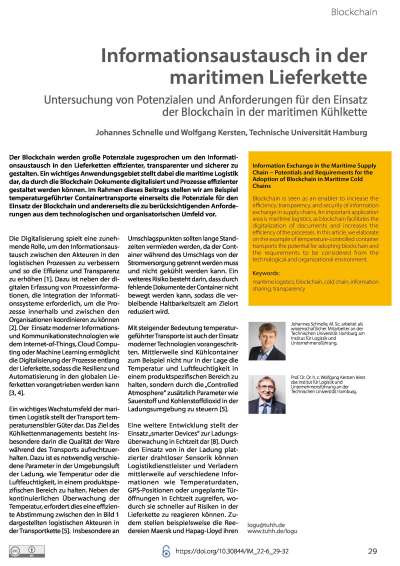
Blockchain is seen as an enabler to increase the efficiency, transparency, and security of information exchange in supply chains. An important application area is maritime logistics, as blockchain facilitates the digitalization of documents and increases the efficiency of the processes. In this article, we elaborate on the example of temperature-controlled container transports the potential for adopting blockchain and the requirements to be considered from the technological and organizational environment.
Keywords
Bibliography
[1] Fruth, M.; Teuteberg, F.: Digitization in Maritime Logistics: What Is There and What Is Missing? In: Cogent Business & Management 4 (1), S. 1411066 (2017).[2] Heilig, L.; Lalla-Ruiz, E.; Voß, S.: Digital Transformation in Maritime Ports: Analysis and a Game Theoretic Framework. In: Netnomics 18 (2-3), S. 227-254 (2017).
[3] World Economic Form und World Trade Organization: Policy Approaches to Harness Trade Digitalization. URL: www3.weforum.org/docs/WEF_The_promise_of_TradeTech_Policy_approaches_to_harness_trade_digitalization_2022.pdf, Abrufdatum 13.04.2022.
[4] Scholten, K.; Schilder, S.: The Role of Collaboration in Supply Chain Resilience. In: Supply Chain Management: An International Journal 20 (4), S. 471-484 (2015).
[5] Behdani, B.; Fan, Y.; Bloemhof, J. M.: Cool Chain and Temperature-Controlled Transport: An Overview of Concepts, Challenges, and Technologies. In: Sustainable Food Supply Chains, S. 167-183 (2019).
[6] van Baalen, P.; Zuidwijk, R.; van Nunen, J.: Port Inter-Organizational Information Systems: Capabilities to Service Global Supply Chains. In: FNT in Technology, Information and Operations Management 2 (2-3), S. 81-241 (2008).
[7] Fan, Y.; Behdani, B.; Bloemhof-Ruwaard, J. M.: Reefer Logistics and Cool Chain Transport, In: European Journal of Transport and Infrastructure Research 20 (2), S. 1-35 (2020).
[8] Jedermann, R. u. a.: Reducing Food Losses by Intelligent Food Logistics. In: Philosophical Transactions. Series A 372, S. 20130302 (2017).
[9] A. P. Møller-Mærsk: Captain Peter™: Get Relevant Notifications About the Condition of Your Reefer Goods. URL: www.maersk.com/digital-solutions/captain-peter/services, Abrufdatum 05.07.2022.
[10] Hapag-Lloyd: Hapag-Lloyd LIVE: Smart Monitoring for Your Cargo. URL: www.hapag-lloyd.com/content/dam/website/downloads/pdf/supplier-extranet/HLFlyerLIVENEW.pdf, Abrufdatum 05.07.2022.
[11] Galvez, J. F.; Mejuto, J. C.; Simal-Gandara, J.: Future Challenges on the Use of Blockchain for Food Traceability Analysis. In: TrAC Trends in Analytical Chemistry 107, S. 222-232 (2018).
[12] Czachorowski, K.; Solesvik, M.; Kondratenko, Y.: The Application of Blockchain Technology in the Maritime Industry, In: Studies in Systems, Decision and Control, Green IT Engineering: Social, Business and Industrial Applications 171, S. 561-577 (2019).
[13] Mayring, P.: Qualitative Inhaltsanalyse: Grundlagen und Techniken. Weinheim, Basel (2010).
[14] Hackius, N.; Petersen, M.: Blockchain in Logistics and Supply Chain: Trick or Treat? In: Proceedings of the Hamburg International Conference of Logistics (HICL), Digitalization in Supply Chain Management and Logistics: Smart and Digital Solutions for an Industry 4.0 Environment 23, S. 3-18 (2017).
[15] Dujak, D.; Sajter, D.: Blockchain Applications in Supply Chain, In: EcoProduction, SMART Supply Network. Cham (2019).
[16] Hackius, N.; Reimers, S.; Kersten, W.: The Privacy Barrier for Blockchain in Logistics: First Lessons from the Port of Hamburg, In: Logistics Management: Lecture Notes in Logistics, S. 45-61 (2019).
[17] Wragg, E.: Bolero Links Up with TradeLens on Electronic Bill of Lading. URL: www.gtreview.com/news/fintech/bolero-links-upwith-tradelens-on-electronic-billof-lading, Abrufdatum 13.04.2022.
[18] Munim, Z. H.; Duru, O.; Hirata, E.: Rise, Fall, and Recovery of Blockchains in the Maritime Technology Space. In: Journal of Marine Science and Engineering 9 (3), S. 1-19 (2021).
[19] van der Horst, M. R.; Langen, P. W. de: Coordination in Hinterland Transport Chains: A Major Challenge for the Seaport Community, In: Marit Econ Logist 10 (1-2), S. 108–129 (2008).
Your downloads
You might also be interested in